

We may earn a commission when you buy through links on this page, at no extra cost to you. Learn more.
The hisense 54 bottle wine fridge (model HWS54029SS) is a single-zone wine cooler designed for up to 54 standard bottles, with adjustable temperatures from 41°F to 68°F and flexible built-in or freestanding installation. Its six soft-close shelves, reversible door and UV-protective glass make it an appealing option for a household wine collection. However, it cannot maintain separate temperatures for red and white wines, and its advertised capacity assumes standard Bordeaux-shaped bottles.
The Hisense HWS54029SS combines relatively compact exterior dimensions with storage for a substantial collection. Its stainless-steel trim, glass door and front-venting design suit modern kitchens, while the electronic controls make temperature adjustments straightforward. The important purchasing questions concern installation clearance, bottle compatibility and the difference between single-zone and dual-zone cooling. Here is how the appliance’s specifications, operating characteristics and customer feedback translate into everyday ownership.
Specs and Key Features
The HWS54029SS is a 54-bottle, frost-free wine cooler with one shared temperature setting for its entire interior. Its most useful features include six soft-close shelves, anti-UV glass, electronic controls and a reversible door.
The model’s dimensions are particularly important because Hisense markets it for both built-in and freestanding applications. At 23.43 inches wide and 33.94 inches tall, it can fit into a variety of kitchen layouts, provided the cabinet opening, ventilation and electrical access are suitable. The open-door depth is considerably greater than the closed-door measurement, so a tight kitchen walkway needs attention before installation. The official Hisense HWS54029SS product specifications provide the manufacturer’s feature descriptions and installation information.
| Specification | Hisense HWS54029SS |
|---|---|
| Rated capacity | 54 standard 750 ml bottles |
| Cooling zones | 1 (single zone) |
| Cooling system | Frost-free |
| Temperature range | 41°F–68°F |
| Factory temperature preset | 53.6°F (12°C) |
| Manufacturer-listed noise level | 45 dB |
| Number of shelves | 6 |
| Shelf construction | Wood and steel |
| Total width | 23.43 inches |
| Total depth, door closed | 23.62 inches |
| Total height | 33.94 inches |
| Depth, door open | 45.80 inches |
| Door construction | Double-layer glass |
| Door protection | Low-E and anti-UV glass |
| Door configuration | Reversible |
| Interior lighting | LED |
| Installation | Built-in or freestanding |
| Electrical requirement | 115V/60Hz, grounded three-prong connection |
These specifications come from Hisense’s official product documentation and the HWS54029SS owner’s manual. The distinction between the actual model and other Hisense 54-bottle products matters because specifications can differ between product generations. In particular, the HWS54029SS should not be advertised or purchased as a dual-zone appliance.
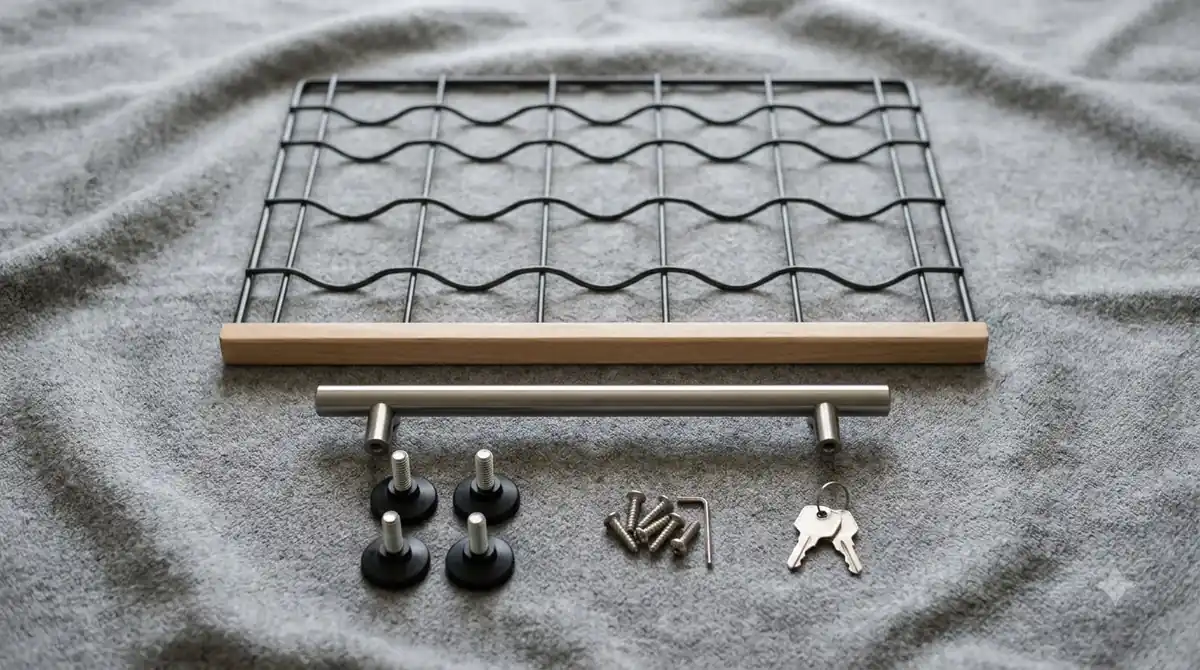
The six full-extension shelves are a practical feature. Their soft-close mechanism reduces abrupt movement when returning a shelf to its position, while the wooden fronts provide a more traditional wine-cellar appearance than an all-metal interior. Hisense also describes the shelves as designed to minimize handling noise and vibration.
The glass door combines two protective features: Low-E construction and UV filtering. These are useful in a kitchen where the cooler may receive ambient lighting throughout the day. The door-open alarm adds another layer of convenience by sounding after the door remains open for two minutes.
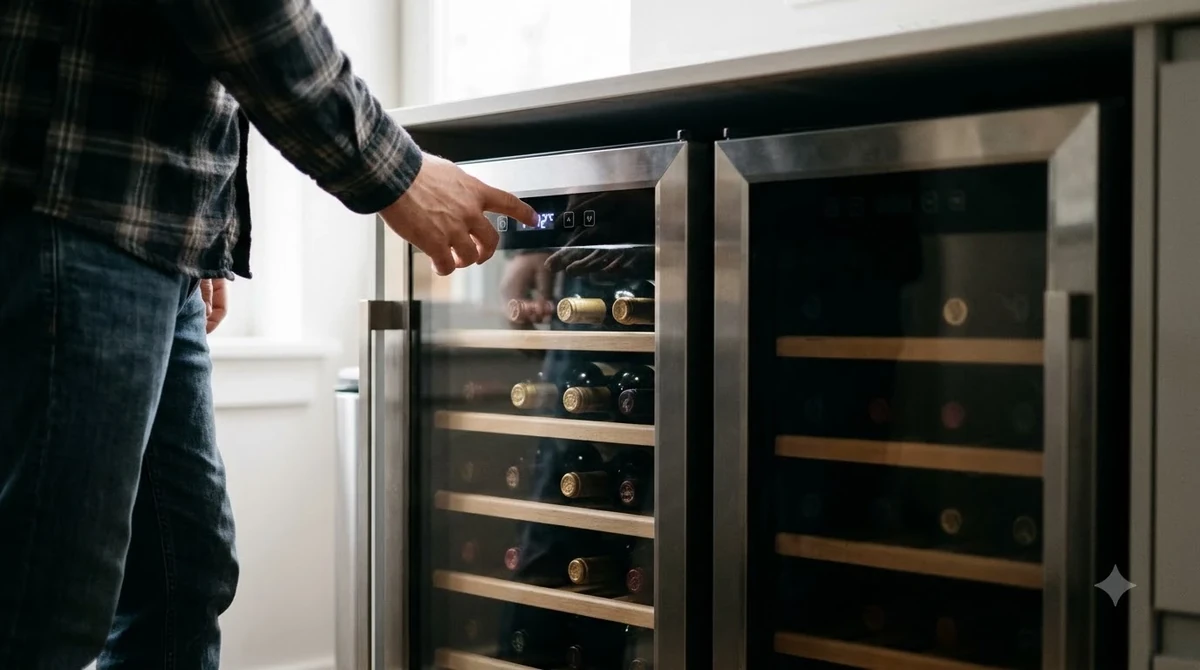
The electronic display lets owners select temperatures within the 41°F–68°F range. A separate interior LED makes bottles easier to identify, and the display supports Fahrenheit and Celsius readings. The temperature adjustment range is broad enough for common wine storage and serving preferences, although the shared setting limits how independently different wine styles can be managed.
What Owners Like
Customer feedback associated with the HWS54029SS highlights its appearance, convenient shelf movement and practical storage capacity. The most appealing ownership characteristics are the pull-out shelving, stainless-steel styling and flexibility of the installation design.
The Lowe’s review page for the HWS54029SS contains positive comments from buyers who appreciate its clean appearance and relatively straightforward installation. Some describe the cooler as quiet in everyday use, while others specifically praise the pull-out racks and the way the appliance fits into an existing kitchen space. These comments are useful indicators of the features that matter to owners, although individual experiences cannot guarantee identical results in every home.
The soft-close shelves are particularly relevant for people who access their wine collection regularly. A wine fridge is not simply a refrigerator with a glass door: bottles are often stored for extended periods, and frequent movement can disturb sediment in older wines. Shelves that extend smoothly make it easier to locate a bottle without unnecessarily moving several others.
The reversible door also receives attention as a practical design advantage. A right-hinged door may work well in one kitchen but obstruct a cabinet, wall or walkway in another. Being able to change the opening direction provides additional flexibility, especially when the appliance is being installed beneath a counter or alongside other kitchen equipment.
The appearance and visibility
The stainless-steel frame and handle give the appliance a contemporary appearance, while the glass door makes it possible to see the collection without opening the cabinet. This can be useful when organizing bottles for dinner parties, choosing a wine for a meal or keeping track of which bottles need to be replaced.
The interior lighting helps with visibility when the kitchen is dim. According to the owner’s manual, the light switches off automatically 10 seconds after the door closes. That feature limits unnecessary interior illumination rather than requiring owners to remember to switch it off manually.
Useful capacity for regular collections
For a household that buys several bottles at a time, 54 nominal positions represent meaningful storage. A collection of California Cabernet Sauvignon, Oregon Pinot Noir, Italian Chianti and French Chardonnay can occupy the same cabinet without requiring several smaller countertop coolers.
Nevertheless, the practical advantage depends on bottle dimensions. Standard Bordeaux bottles are relatively consistent in shape, but sparkling wines and some premium producers use wider glass. Buyers should therefore think of the advertised number as a standardized maximum rather than a promise that every 750 ml bottle will fit.
Another positive point is the front-venting configuration. It allows the appliance to be considered for an appropriate built-in installation instead of automatically requiring the open sides associated with many freestanding wine coolers. That makes the HWS54029SS more versatile for kitchen renovations and dedicated beverage-storage areas.
Common Complaints
The main concerns to investigate are the single-zone design, real-world bottle capacity, shelf durability and long-term cooling reliability. Customer reviews provide useful warnings, but some review-page entries are mixed with comments about another Hisense model.
The most important limitation is the lack of independent temperature zones. Although some retailer review summaries describe dual-zone functionality, Hisense’s official HWS54029SS specification identifies the appliance as single-zone. Buyers should rely on the manufacturer documentation rather than an automatically generated retailer summary when comparing technical features.
This means the cooler has one overall temperature setting. A person who regularly drinks both white wine and red wine may find the arrangement less convenient than a genuine dual-zone cabinet. The cooler can store both styles, but it cannot independently chill one group while maintaining another at a different temperature.
Another concern is actual bottle capacity. The 54-bottle rating is based on standard Bordeaux-shaped 750 ml bottles. The owner’s manual includes illustrations of different bottle profiles, including large California red, Riesling, Pinot Noir, Turley-style and Champagne bottles. These have different heights and base widths, which can change how efficiently the shelves accommodate them.
For example, a broad sparkling wine bottle may take up more horizontal space than a conventional Bordeaux bottle. A large Burgundy bottle can also interfere with the arrangement of neighboring bottles. Someone with a collection dominated by unusual glass shapes should expect the usable capacity to fall below the advertised maximum.
Shelf and durability concerns
Some Lowe’s customer entries report shelf-related problems, including one complaint about drawers coming apart during their first use. Other comments mention concerns about the appliance’s longevity. Such reports deserve attention, particularly because moving a fully loaded shelf can put significant weight on its sliding mechanism.
Hisense specifies a maximum loading weight of 33 pounds per shelf. Owners should distribute bottles evenly and avoid forcing a shelf that feels obstructed. The maximum load is a meaningful specification, not an invitation to overload the rack simply because the cabinet appears to have additional room.
Some customer comments also describe a cooler that stopped working after several years. Individual reports do not establish a predictable failure rate or prove that every unit will experience the same problem. They do, however, support checking the applicable warranty terms, service availability and replacement-part options before committing to a purchase.
Installation and temperature concerns
Installation complaints can arise when buyers measure only the cabinet width and forget about door movement, ventilation and access to the electrical connection. The HWS54029SS needs a grounded electrical outlet, and its door requires sufficient space to open without hitting adjacent cabinetry.
Temperature variation is another point worth understanding. Hisense explains in its manual that the displayed setting represents an average temperature throughout the cabinet. A difference of 2°C to 3°C may occur between the upper and lower shelves, so the temperature shown on the control panel should not be interpreted as an identical reading at every bottle position.
There is also a distinction between the HWS54029SS and the HWS054N6SS. Some Lowe’s review entries and manufacturer responses on the HWS54029SS page refer explicitly to the other model. Consequently, comments about features or problems should be checked against the model number rather than treated as definitive evidence about every 54-bottle Hisense cooler.
Who Should Buy and Who Should Skip
The Hisense HWS54029SS is most suitable for buyers who want a 54-bottle single-zone cabinet with front ventilation, soft-close shelves and a reversible door. It is less suitable for collectors who require independent temperature control or need guaranteed accommodation for unusually large bottles.
A household with a growing collection of everyday wines may appreciate the combination of capacity and relatively compact dimensions. Six shelves provide an organized arrangement for frequently purchased bottles, while the adjustable temperature range makes it possible to choose a setting appropriate for the intended storage routine.
The cooler is also worth considering during a kitchen renovation. Its 23.43-inch width and 33.94-inch height provide useful starting measurements for planning a cabinet opening. The front-venting design is particularly relevant because a properly installed built-in cooler should not depend on unrestricted airflow around its sides in the same way as an ordinary freestanding refrigerator.
Good fit for these buyers
- Everyday wine drinkers: A 54-bottle nominal capacity provides room for a rotating collection of familiar wines rather than just a few bottles for special occasions.
- Cabinet-integrated kitchens: The front-venting construction and reversible door offer useful installation flexibility.
- Collectors of standard Bordeaux bottles: The manufacturer’s capacity rating is based on this common 750 ml bottle format.
- Buyers who value accessible shelving: Six full-extension shelves with soft-close functionality simplify bottle retrieval.
- People who prefer visible storage: The glass door, LED lighting and stainless-steel trim create a practical display for a home collection.
Who should consider another cooler
- Dual-zone wine drinkers: Anyone who needs separate temperatures for red and white wines should choose a genuine dual-zone appliance.
- Champagne-focused collectors: Wider sparkling wine bottles can reduce the usable number of positions.
- Collectors of large-format bottles: Magnum bottles and unusually shaped glass may not fit the standard shelf arrangement.
- Long-term aging specialists: Buyers seeking highly precise storage conditions and independent environmental monitoring may prefer a more specialized wine cabinet.
- Buyers with restricted installation space: The 45.80-inch open-door depth may be inconvenient in a narrow walkway or tight kitchen layout.
Wine selection also affects how useful a single-zone cabinet feels. Someone who mainly drinks red wine and occasionally chills white wine can work around one shared setting by moving selected bottles to a regular refrigerator shortly before serving. For a collection that is divided evenly between ready-to-drink sparkling, white and red wines, a dual-zone design offers more convenient day-to-day control.
For instance, someone planning an Italian-themed dinner with Chianti and a chicken Marsala recipe may appreciate having bottles organized and accessible. A collection intended for spritz cocktails, such as an Aperol Spritz recipe, creates a different storage priority because sparkling wine and other cocktail ingredients may need serving preparation outside the cooler’s single temperature setting.
How It Compares to Alternatives
The most meaningful comparison for the HWS54029SS is not simply another appliance with a similar bottle count. Buyers should compare single-zone and dual-zone cooling, installation requirements, shelf design and the actual bottle dimensions supported by each cabinet.
A 54-bottle cooler can appear more capable than a smaller cabinet because of its rated capacity, but storage volume alone does not determine whether it suits a particular collection. A smaller dual-zone unit may be more practical for someone who routinely serves reds and whites at different temperatures. Conversely, a single-zone model can be perfectly adequate for a collection that is primarily intended for consistent storage.
| Comparison factor | Hisense HWS54029SS | What to look for elsewhere |
|---|---|---|
| Rated capacity | 54 bottles | Choose capacity based on actual collection size |
| Temperature zones | 1 | 2 for independently controlled red and white storage |
| Temperature range | 41°F–68°F | Compare the complete adjustable range |
| Installation | Built-in or freestanding | Verify front or rear ventilation requirements |
| Shelving | 6 soft-close shelves | Compare full-extension travel and shelf weight limits |
| Door | Reversible glass door | Check hinge options and glass protection |
| Open-door depth | 45.80 inches | Measure the actual installation location |
Single-zone versus dual-zone
A single-zone cooler maintains one average temperature throughout the interior. This arrangement works well when the collection is stored together and the owner is comfortable moving individual bottles elsewhere for serving preparation. It also keeps the temperature controls simple.
A dual-zone cooler has separate temperature controls for two compartments or sections. That arrangement is more convenient for people who want sparkling wine and Sauvignon Blanc ready at cooler serving temperatures while keeping Cabernet Sauvignon and Merlot at a different setting. It is an especially useful distinction for households that serve several wine styles during the same evening.
Built-in versus freestanding construction
The HWS54029SS is designed for both installation types, but that does not mean every wine cooler can be placed into an enclosed cabinet. Some freestanding models rely on side or rear airflow and need open space to dissipate heat. A front-venting design is generally more appropriate for an under-counter application.
Before choosing another model, compare the manufacturer’s installation diagram with the actual kitchen opening. A nominal 24-inch cabinet space does not automatically mean every appliance marketed as 24 inches wide will fit. Door trim, hinges, leveling feet and electrical access can all affect the final installation.
Capacity versus bottle flexibility
Two appliances with a 54-bottle rating may have different shelf spacing and bottle compatibility. One might accommodate standard Bordeaux bottles efficiently, while another could provide adjustable shelves for larger Burgundy or Champagne formats. Buyers with mixed collections should look for actual bottle dimensions and shelf configurations rather than relying exclusively on the headline capacity.
For a more structured comparison of other wine appliances, the wine cooler model reviews category provides a useful starting point. The important objective is to match the cabinet’s specifications to the collection rather than assume a larger advertised bottle count automatically represents a better purchase.
Installation and Ownership Checklist
Before purchasing the HWS54029SS, confirm the installation opening, electrical supply, bottle arrangement and maintenance requirements. These practical checks can prevent problems that have little to do with the appliance’s cooling performance.
The manufacturer’s installation instructions specify a grounded 115V/60Hz electrical connection with a three-prong plug. They also recommend maintaining ventilation space around the appliance. The manual suggests at least 1/2 inch behind and above the cooler and at least 1/4 inch at the sides. Follow the complete model-specific installation instructions and the cabinetry requirements rather than assuming the external dimensions alone determine a suitable opening.
Installation checklist
- Measure the opening. Confirm that the available width accommodates the 23.43-inch appliance and that the height accommodates its 33.94-inch overall measurement. Allow for the installation clearances described in the manual.
- Check the door swing. The closed unit is 23.62 inches deep, but the manufacturer’s open-door measurement is 45.80 inches. Make sure the door can open without blocking a walkway or striking nearby cabinets.
- Confirm the electrical connection. Provide the required grounded 115V/60Hz supply and ensure the plug remains accessible after installation.
- Choose the hinge direction. The door is reversible, so decide whether the standard right-hinged arrangement or the alternative left-hinged arrangement works better for the kitchen.
- Level the appliance. Follow the manufacturer’s leveling instructions to reduce vibration and help the door close properly.
- Plan the bottle arrangement. Check the dimensions of the bottles you intend to store and leave room for wider sparkling wine or Burgundy bottles.
- Allow the cooler to stabilize. Once installed, give the appliance time to reach its selected temperature before filling it with a large collection.
Tip: Measure the cabinet opening and the full door-swing area separately. A cooler can fit perfectly between two cabinets while still being impractical if the door cannot open far enough to remove its shelves comfortably.
Setting the temperature
The factory preset is 12°C, equivalent to approximately 53.6°F. The adjustable range runs from 41°F to 68°F, with one-degree increments. This makes the controls straightforward, but the selected temperature is an average for the cabinet rather than a promise of identical readings on all six shelves.
For long-term storage, a stable environment is generally more important than repeatedly adjusting the control to match the serving temperature of every individual wine. The manual identifies approximately 53.6°F to 57.2°F as a suitable constant storage range. Serving temperatures are different: sparkling wine is generally served at 40°F to 50°F, light whites and rosé at 45°F to 50°F, and full-bodied reds at 60°F to 65°F.
Because the HWS54029SS has only one zone, it is useful to establish a consistent storage routine and chill individual bottles separately when necessary. A bottle of Chardonnay intended for dinner can spend time in a kitchen refrigerator before serving, while a Cabernet Sauvignon can be allowed to warm slightly if it has been stored at a cooler setting.
Routine care
The manual recommends cleaning the interior with a mixture of approximately two tablespoons of baking soda and four cups of water. Remove the bottles, disconnect the power and clean the shelves with a mild detergent solution. The exterior can be wiped with a soft cloth and mild detergent.
Avoid abrasive powders, strong solvents and sharp cleaning tools. These can damage the cabinet finish or interior surfaces. Regularly inspect the door seal and keep the ventilation openings clear so that the cooling system can operate as intended.
Wine bottles should also be handled carefully. The manual recommends horizontal storage and advises against unnecessary movement. Keeping bottles away from direct sunlight and minimizing prolonged interior lighting are sensible practices, particularly for wines intended for longer storage.
Frequently Asked Questions
Does the Hisense HWS54029SS have Wi-Fi connectivity?
The HWS54029SS manufacturer’s product specifications and owner’s manual describe electronic temperature controls and a digital display, but do not identify Wi-Fi connectivity as a feature. Do not assume that a different Hisense 54-bottle model’s smart features are included in this model. Confirm the exact model number before relying on app-based controls.
Does the Hisense 54-bottle cooler have a lock?
No. Hisense lists the HWS54029SS as having no lock and key. Buyers who need a locking wine cabinet for a shared household, hospitality setting or controlled-access storage area should consider a different model with a documented locking mechanism.
Can the Hisense wine cooler operate in a hot garage?
The owner’s manual identifies an ambient operating range of approximately 55°F to 100°F for best performance. A garage that regularly falls below or rises above that range may affect cooling performance and energy consumption. An indoor location with a more stable ambient temperature is generally the more suitable choice.
What refrigerant does the HWS54029SS use?
Hisense specifies R600a, also known as isobutane, as the refrigerant. The owner’s manual warns that this refrigerant is flammable and that maintenance involving the refrigerant circuit must be performed by an authorized service professional. Owners should not attempt to repair or recharge the cooling system themselves.
Can the HWS54029SS be switched off without unplugging it?
Yes. The control panel includes a standby function that activates when the standby button is held for more than three seconds. The display shows an off indication and cooling stops. The manual recommends removing the wine and unplugging the appliance if it will remain unused for an extended period.
The Hisense HWS54029SS is a practical choice for households that want organized 54-bottle storage, soft-close shelves and flexible installation in one single-zone cabinet. Its biggest limitations are the lack of independent temperature controls and the fact that larger bottle shapes reduce the advertised capacity. Buyers who confirm the installation measurements and understand those limitations will have a much clearer idea of whether this wine cooler suits their collection.
More in Model Reviews
 Magic Chef 44 Bottle Wine Cooler Review for Flexible StorageUpdated Nov 21, 2026
 Whynter 164 Bottle Wine Cooler Review: Capacity, Features, and FitUpdated Nov 21, 2026
 Insignia NS WC16BK6 Review: Compact 16-Bottle Wine StorageUpdated Nov 21, 2026
 Wine Enthusiast Electric Blue Omega Review: Opening, Pouring, and Preserving Made EasierUpdated Nov 21, 2026
 Koolatron 20 Bottle Wine Cooler Review: Features, Fit, and PerformanceUpdated Nov 21, 2026
 NewAir AWC 330E Review for Home Wine StorageUpdated Nov 21, 2026