

We may earn a commission when you buy through links on this page, at no extra cost to you. Learn more.
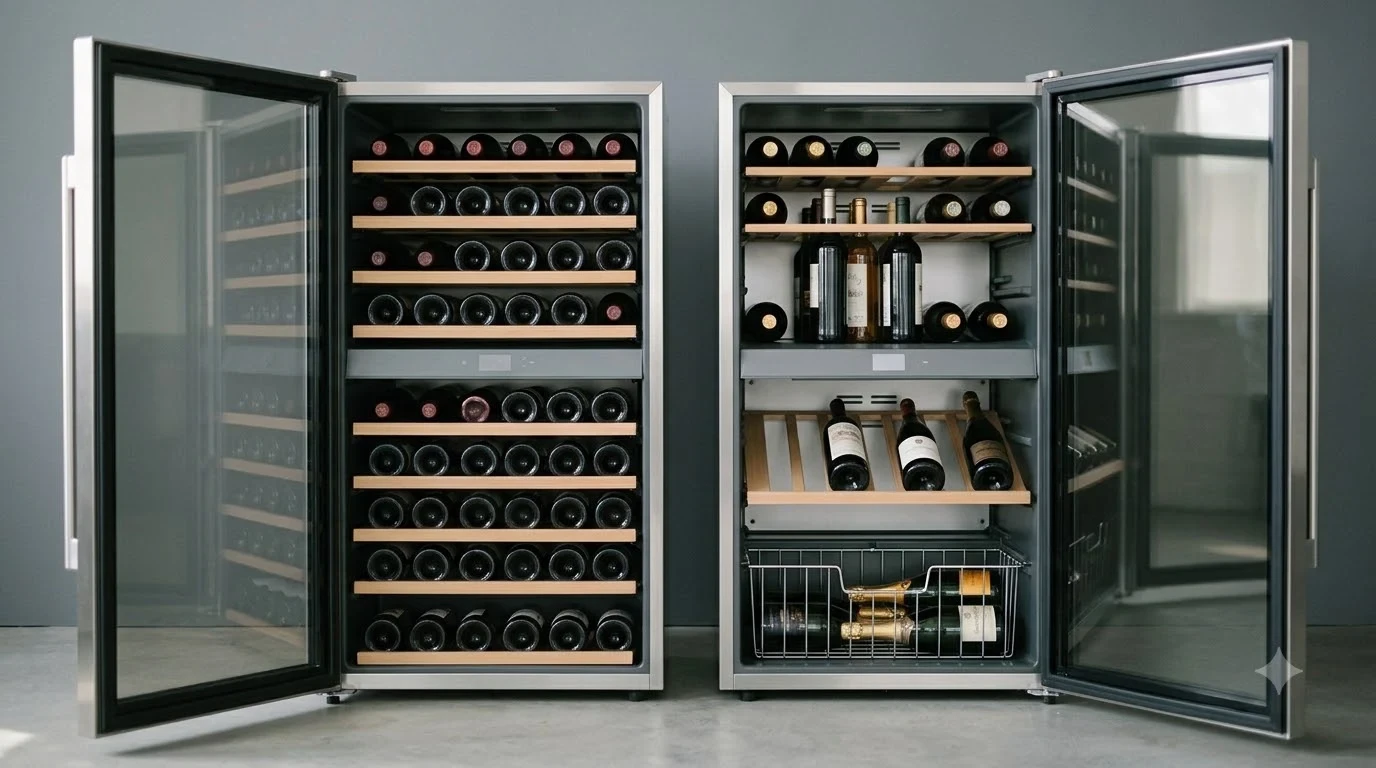
The hisense 46 bottle wine fridge, model HWD46029SS, is a dual-zone wine cooler that holds up to 46 standard bottles and offers built-in or freestanding installation. Its five soft-close shelves, reversible glass door, and separate temperature controls make it a practical option for households storing different wine styles. However, bottle dimensions, installation clearances, and some mixed owner feedback deserve attention before purchasing.
A dedicated wine refrigerator can make it easier to organize a collection than relying on a standard kitchen refrigerator. The Hisense HWD46029SS combines two temperature zones with a relatively compact, under-counter-friendly footprint, making it particularly interesting for people who regularly keep sparkling wine, white wine, and red wine available. This review examines its specifications, everyday strengths, reported drawbacks, and suitability for different collections so buyers can decide whether its design matches their storage needs.
Specs and Key Features
The Hisense HWD46029SS combines 46-bottle storage, dual-zone cooling, and a front-venting design in a cabinet approximately 23.43 inches wide. Its feature set focuses on practical home wine storage rather than advanced cellar management or connected controls.
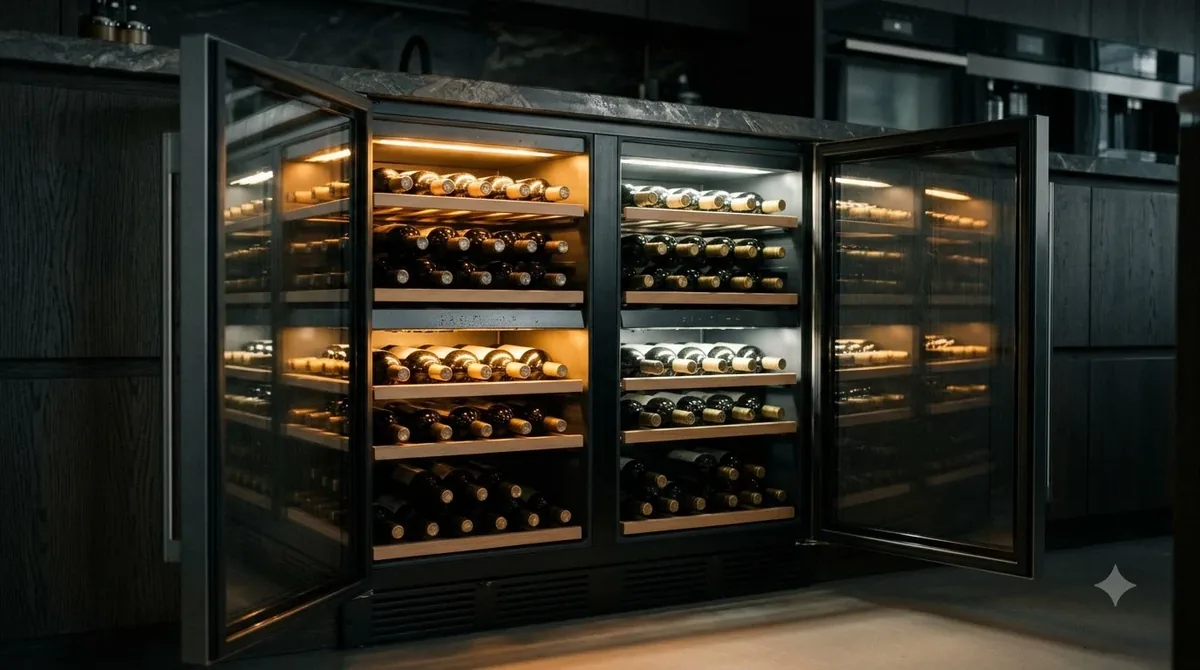
The most important feature is its independently controlled upper and lower temperature zones. This arrangement allows different wine categories to occupy separate compartments, rather than forcing every bottle into one compromise temperature. The manufacturer also specifies frost-free cooling, five wood-and-steel shelves, a reversible door, and double-layer glass.
Its exterior combines a black cabinet with a fingerprint-resistant stainless-steel door and handle. The glass is designed with UV protection and low-emissivity properties, helping limit unwanted light exposure and heat transfer. These features are useful for a refrigerator positioned in a bright kitchen or entertainment area, although the door should not be treated as a substitute for a dark, dedicated long-term wine cellar.
| Specification | Hisense HWD46029SS |
|---|---|
| Model | HWD46029SS |
| Advertised capacity | 46 standard Bordeaux bottles |
| Cabinet volume | 4.9 cubic feet |
| Temperature zones | 2 independently controlled zones |
| Published temperature range | 41°F–68°F |
| User manual temperature range | 41°F–64°F |
| Shelves | 5 |
| Shelf construction | Wood and steel |
| Cooling system | Frost-free |
| Noise specification | 45 dB |
| Width | 23.43 inches |
| Depth, door closed | 23.62 inches |
| Height to top of hinge | 33.94 inches |
| Depth, door open 90 degrees | 45.80 inches |
| Installation | Built-in or freestanding |
| Door | Reversible, double-layer glass |
| Interior lighting | LED |
| Refrigerant | R600a |
One specification deserves particular attention: Hisense’s published specification sheet lists a temperature range of 41°F to 68°F, while the HWD46029SS user manual gives 41°F to 64°F. These documents do not agree on the upper limit. Buyers should obtain confirmation for the exact unit and documentation supplied with it rather than assuming the wider range is guaranteed.
The 45 dB noise specification is another useful consideration. It provides a measurable reference when comparing wine coolers, although actual perceived noise depends on room acoustics, cabinet placement, leveling, and compressor operation. A unit installed in an open-plan kitchen may be more noticeable than one placed in a separate utility area.
Hisense provides the official HWD46029SS product specifications and support documentation, including links to the product manual, specification sheet, and warranty information. These documents are particularly useful for confirming measurements and installation requirements before buying.
For a closer look at other models and capacities, the wine cooler model reviews section provides a useful starting point for comparing dedicated storage appliances.
What Owners Like
Owner feedback for the Hisense HWD46029SS is generally positive about its capacity, appearance, temperature flexibility, and convenient shelving. The most useful advantage is the combination of two cooling zones and a 46-bottle advertised capacity in a relatively narrow cabinet.
Lowe’s customer review page reports generally favorable feedback, with reviewers frequently mentioning the spacious interior, dual-zone operation, modern appearance, and smooth shelf movement. Its published review summary also identifies quiet operation as a recurring positive. These observations provide useful information about everyday ownership, although individual experiences can differ and review summaries should not be treated as controlled performance testing.
Separate storage for different wine styles
Two temperature zones are especially useful for households that keep several wine categories ready for different occasions. For example, sparkling wine can occupy one compartment while red wine stays in the other. This reduces the need to move bottles between appliances or adjust a single temperature setting whenever dinner plans change.
Serving temperature matters because different wine styles respond differently to chilling. Sparkling wine is generally served around 40°F to 50°F, light whites and rosé around 45°F to 50°F, full-bodied whites around 50°F to 55°F, light reds around 55°F to 60°F, and fuller reds around 60°F to 65°F.
The HWD46029SS offers enough temperature flexibility for many of these everyday requirements, provided the selected setting and actual compartment temperatures are suitable. Buyers should also remember that a wine refrigerator is primarily a storage appliance. A bottle intended for immediate service may need additional time outside the cabinet to reach its preferred serving temperature.
Convenient shelf movement
Hisense highlights five soft-close shelves with wooden fronts. This arrangement provides an attractive presentation through the glass door while making it easier to access bottles without repeatedly pulling them out of a tightly packed cabinet.
Soft-close movement is particularly helpful when the refrigerator is positioned in a kitchen or dining area where repeated opening and closing is part of normal use. The shelves also make it easier to identify different bottles without removing several neighboring bottles first.
The wood-and-steel construction offers a balance between an attractive wine-storage appearance and a practical supporting structure. Nevertheless, shelf design does not eliminate the capacity limitations created by unusually shaped bottles.
Appearance and placement flexibility
The stainless-steel finish and dark glass create a restrained appearance that fits many contemporary kitchens. The reversible door provides additional placement flexibility, particularly when the appliance needs to sit next to a wall, cabinet, or another kitchen appliance.
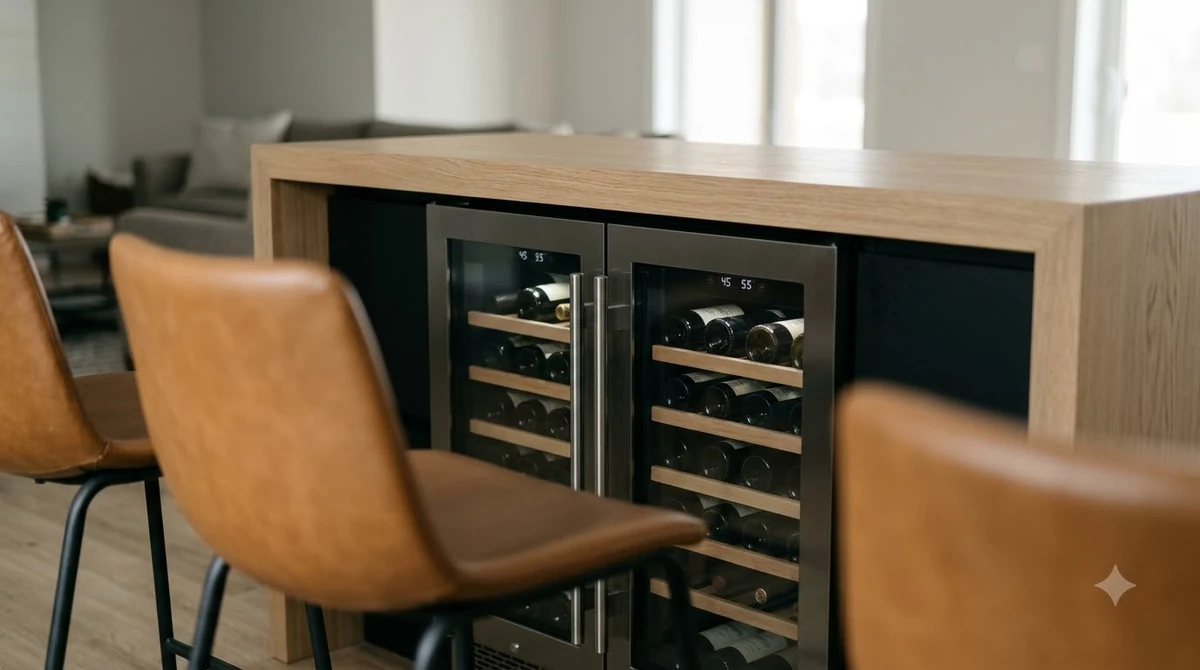
The manufacturer also describes the HWD46029SS as suitable for built-in or freestanding installation. Front ventilation is an important part of that design because it allows the cooling system to exchange heat without depending on open rear ventilation in the same way as many conventional freestanding appliances.
For homeowners who want their wine collection to remain visible without placing a large standalone refrigerator in the room, these design details are meaningful advantages.
Common Complaints
The main concerns associated with the Hisense HWD46029SS involve reliability reports, temperature-display questions, installation details, and the limitations of its advertised bottle capacity. These issues do not mean every unit will experience problems, but they deserve consideration before committing to the appliance.
Questions about long-term reliability
Some Lowe’s reviewers report cooling problems or premature failures. One reviewer describes an older unit that worked for approximately three years before its compressor reportedly ran continuously without bringing the cabinet down to its selected temperature.
Another review describes a refrigerator that stopped working after several months, although the owner also reported that the service process and retailer replacement were handled satisfactorily. These experiences illustrate two separate ownership considerations: appliance reliability and the quality of available customer support.
Online complaints cannot establish the overall failure rate of the HWD46029SS. They do, however, provide a reason to check the warranty terms, retain purchase documentation, and understand the retailer’s return and replacement procedures before installation.
Temperature readings and consistency
Some buyers mention concerns about the temperature display. The user manual provides important context because it explains that the selected temperature represents an average cabinet temperature, not an identical reading at every shelf.
The manual identifies a possible 2°C to 3°C difference between the upper and lower shelves. That difference can matter when a collection includes bottles that need relatively precise temperature management. It also means that the number shown on the display should not automatically be interpreted as the exact temperature surrounding every bottle.
Another consideration is the discrepancy between the published specification sheet and the user manual. One lists a maximum of 68°F, while the other lists 64°F. Anyone who specifically needs a storage setting above 64°F should resolve this difference with Hisense before purchasing.
Bottle capacity is not universal
The advertised 46-bottle capacity is based on standard Bordeaux bottles. The user manual includes bottle dimensions for Bordeaux, large California red, Riesling, Pinot Noir, Turley, and Champagne formats. It also explains that capacity decreases when bottles differ from the standard arrangement.
Champagne bottles, sparkling wine bottles, wider Burgundy bottles, and some premium wine formats may take up more shelf space than standard Bordeaux bottles. The same problem occurs when bottles have unusually long necks or larger shoulders.
Owners who mainly collect standard Bordeaux-shaped bottles are more likely to approach the advertised capacity. People who regularly purchase Champagne, Pinot Noir in broad Burgundy bottles, or larger-format bottles should expect to store fewer than 46.
Installation and hardware details
Although Hisense promotes built-in and freestanding installation, buyers should not assume that every opening beneath a kitchen counter will accommodate the appliance. Height, door movement, hinge clearance, electrical access, and ventilation all affect whether the installation will work.
The manufacturer lists a width of 23.43 inches and a height of 33.94 inches to the top of the hinge. The installation specification calls for 0.5 inches of clearance at each side, above, and behind the appliance. The door also requires substantial forward clearance when opened. Its published 90-degree-open depth is 45.80 inches, which can become important in narrow kitchens.
Handle installation is another point raised in owner feedback. Rather than treating the installation as an afterthought, buyers should inspect the handle, screws, door alignment, and shelf movement before placing bottles inside.
Tip: Before installation, measure the entire cabinet opening and the space required for the door to swing. Also confirm the ventilation requirements in the manual supplied with the HWD46029SS. A refrigerator that fits the opening but cannot release heat properly is not correctly installed.
Who Should Buy and Who Should Skip
The Hisense HWD46029SS is best suited to households that want organized, temperature-separated wine storage without dedicating an entire room to a collection. Its 46-bottle capacity and built-in installation option make it particularly appealing for regular wine drinkers with a moderate collection.
Who should consider buying it?
Households with mixed wine collections: The dual-zone arrangement is useful when a household regularly buys Cabernet Sauvignon, Pinot Noir, Chardonnay, Sauvignon Blanc, Riesling, and sparkling wines. Different categories can occupy separate temperature zones, reducing the need to reorganize the refrigerator for each occasion.
Homeowners planning an under-counter installation: The approximately 23.43-inch width makes this model worth considering for a kitchen renovation or dedicated beverage-storage area. Its front-venting design supports built-in placement, while the reversible door offers additional flexibility.
People who entertain regularly: A 46-bottle advertised capacity can accommodate a selection of wines for dinner parties, celebrations, and everyday meals. Keeping several styles organized also makes it easier to select a bottle for different menus.
For example, a bottle of Chardonnay can accompany chicken dishes, while Pinot Noir can work with mushroom-based meals. Someone planning a dinner featuring creamy chicken can also consult a chicken marsala recipe when deciding which wine styles to keep ready for the occasion.
Buyers who value appearance: The stainless-steel finish, dark double-layer glass, blue LED display, and wood-front shelves provide a more dedicated wine-storage appearance than a standard kitchen refrigerator.
Who should skip it?
Collectors with substantial long-term aging needs: A 46-bottle wine cooler is not automatically a dedicated wine cellar. Collectors storing expensive bottles for extended periods may prefer a purpose-built cellar or specialized wine cabinet with carefully documented temperature and humidity performance.
People with mostly oversized bottles: The advertised capacity assumes standard Bordeaux bottles. A collection dominated by Champagne, Burgundy, and other broad formats may not fit comfortably within the stated capacity.
Buyers who need extensive temperature customization: The published specifications and manual disagree about the maximum temperature. Anyone requiring a precise upper-zone or lower-zone setting beyond the manual’s stated range should confirm the appliance’s capabilities before making a purchase.
People with extremely limited installation space: The closed-door dimensions do not tell the entire story. The door needs room to open, bottles need room to slide out, and the installation must provide the ventilation specified by Hisense.
Buyers prioritizing a documented long-term reliability record: Mixed owner feedback means cautious buyers should examine warranty coverage and service arrangements rather than making a decision based on advertised features alone.
How It Compares to Alternatives
The Hisense HWD46029SS is most attractive as a mid-capacity, dual-zone wine cooler with flexible installation. Its strongest competition comes from other dedicated wine refrigerators that offer different capacities, temperature arrangements, and installation dimensions.
Hisense HWD46029SS versus a single-zone wine cooler
A single-zone refrigerator is generally simpler to operate because the entire cabinet uses one temperature setting. That arrangement works well for someone who mainly collects one category of wine or prefers to store everything at a consistent cellar temperature.
The HWD46029SS has an advantage for mixed collections because its two zones allow separate temperature settings. A household that regularly drinks both white and red wine can keep bottles in different compartments instead of choosing one setting that compromises between the two.
However, a single-zone appliance may be more suitable for buyers who want to store only red wine, only white wine, or bottles intended primarily for longer-term storage. The additional flexibility of dual-zone cooling is useful only when the owner actually needs it.
Hisense HWD46029SS versus a larger wine refrigerator
A larger wine refrigerator can make more sense for someone whose collection is growing quickly. Additional capacity provides room for different vintages, producers, and wine regions without requiring immediate reorganization.
The trade-off is that larger appliances generally require more installation space. A household with limited under-counter space may find the 46-bottle format easier to accommodate than a much taller or wider model.
Capacity should also be evaluated in terms of bottle shapes rather than advertised numbers alone. A larger refrigerator with adjustable shelving may be more useful to a Champagne collector than a nominally higher-capacity model with tightly spaced standard-bottle racks.
Hisense HWD46029SS versus a dedicated wine cellar
A dedicated wine cellar is a different category of storage equipment. It is generally intended for collectors who prioritize stable long-term conditions and may need room for a much larger collection.
The HWD46029SS is more appropriately viewed as a convenient household wine refrigerator. Its two zones are practical for maintaining ready-to-serve bottles, and its visible glass door makes everyday access straightforward.
For someone building a collection of collectible Bordeaux, Burgundy, or vintage Champagne, a dedicated cellar may offer a more suitable long-term solution. For someone who regularly buys wine to drink over the coming weeks and months, the Hisense provides a more compact approach.
Which features matter most in the comparison?
When comparing wine refrigerators, focus on the features that change actual ownership rather than simply counting marketing claims. Capacity, temperature flexibility, installation requirements, noise, shelf construction, and warranty coverage are more useful comparison points than appearance alone.
The Hisense HWD46029SS has several appealing features, including reversible door placement, frost-free cooling, and a door-open alarm. Its principal compromises are the standard-bottle capacity assumption, the published temperature-range discrepancy, and the mixed reports about reliability.
Another useful consideration is how frequently the appliance will be opened. A refrigerator used several times every day needs convenient shelf access and practical bottle organization. A cabinet used primarily for long-term storage may benefit more from stable environmental conditions and minimal disturbance.
For most households, the decision comes down to whether two temperature zones and a 46-bottle capacity justify choosing this particular format over a simpler or larger refrigerator.
Frequently Asked Questions
Does the Hisense HWD46029SS have Wi-Fi connectivity?
The published HWD46029SS specification sheet does not list Wi-Fi connectivity as a feature. Its controls are electronic and operated through the appliance’s display panel. Buyers seeking smartphone monitoring or app-based temperature adjustments should look for a model that explicitly documents those capabilities.
Does the Hisense 46-bottle wine fridge have a door lock?
The HWD46029SS specification sheet identifies the lock-and-key feature as unavailable. It does include a door-open alarm, which serves a different purpose by alerting users when the door has been left open. Households that need child-resistant or restricted access should consider this distinction before choosing the appliance.
Does the Hisense HWD46029SS require a dedicated electrical circuit?
The appliance documentation specifies a grounded 115V, 60Hz electrical supply. It does not establish that every installation requires a dedicated circuit, so the electrical requirements should be reviewed with a qualified electrician and compared with the existing kitchen circuit capacity. Hisense also warns against using extension cords or ungrounded adapters.
Can the shelves accommodate bottles stored with their corks facing outward?
The shelf arrangement is designed for horizontal bottle storage, which allows corks to remain in contact with wine. The actual fit depends on bottle length, diameter, and shelf configuration. Unusually shaped bottles may require a different position or reduce the number of bottles that fit comfortably.
Does the Hisense HWD46029SS automatically turn off its interior light?
Yes. According to the user manual, the interior light automatically switches off approximately 10 seconds after the door closes. The control panel also allows the light to be switched on or off manually, giving owners control over interior illumination.
The Hisense HWD46029SS is a practical candidate for households looking for dual-zone wine storage, a modern appearance, and a built-in installation option without moving to a large cellar system. Its five soft-close shelves and 46-bottle advertised capacity are appealing, but the temperature documentation discrepancy and mixed reliability feedback deserve careful consideration. Measure the installation area, confirm the exact specifications and warranty, and account for bottle shapes before deciding whether this Hisense wine refrigerator belongs in your kitchen.
More in Model Reviews
 Magic Chef 44 Bottle Wine Cooler Review for Flexible StorageUpdated Nov 21, 2026
 Whynter 164 Bottle Wine Cooler Review: Capacity, Features, and FitUpdated Nov 21, 2026
 Insignia NS WC16BK6 Review: Compact 16-Bottle Wine StorageUpdated Nov 21, 2026
 Wine Enthusiast Electric Blue Omega Review: Opening, Pouring, and Preserving Made EasierUpdated Nov 21, 2026
 Koolatron 20 Bottle Wine Cooler Review: Features, Fit, and PerformanceUpdated Nov 21, 2026
 NewAir AWC 330E Review for Home Wine StorageUpdated Nov 21, 2026