

We may earn a commission when you buy through links on this page, at no extra cost to you. Learn more.
The hisense 30 bottle wine fridge is a practical choice for home wine drinkers who want compact, temperature-controlled storage for up to 30 standard Bordeaux bottles. The HRWC31 offers an adjustable 5°C to 18°C temperature range, wooden shelving, anti-UV glass and electronic touch controls. Its main limitations are its single temperature zone, freestanding installation requirements and capacity restrictions when storing larger wine bottles.
Hisense offers several wine cabinets with 30-bottle capacities, so identifying the exact model matters before buying. This review focuses primarily on the HRWC31, a compact black-glass wine cabinet with features aimed at everyday home storage. It also distinguishes the older HRWC30, which has different dimensions and door specifications. Understanding those differences helps prevent confusion when comparing retailer listings, checking available space and choosing a cabinet for a particular collection.
Specs and Key Features
The Hisense HRWC31 combines a 30-bottle stated capacity with adjustable electronic temperature control and a relatively narrow freestanding cabinet. Its strongest features are the reversible door, wooden shelves and protective glass, although the single-zone configuration limits how differently wines can be stored at the same time.
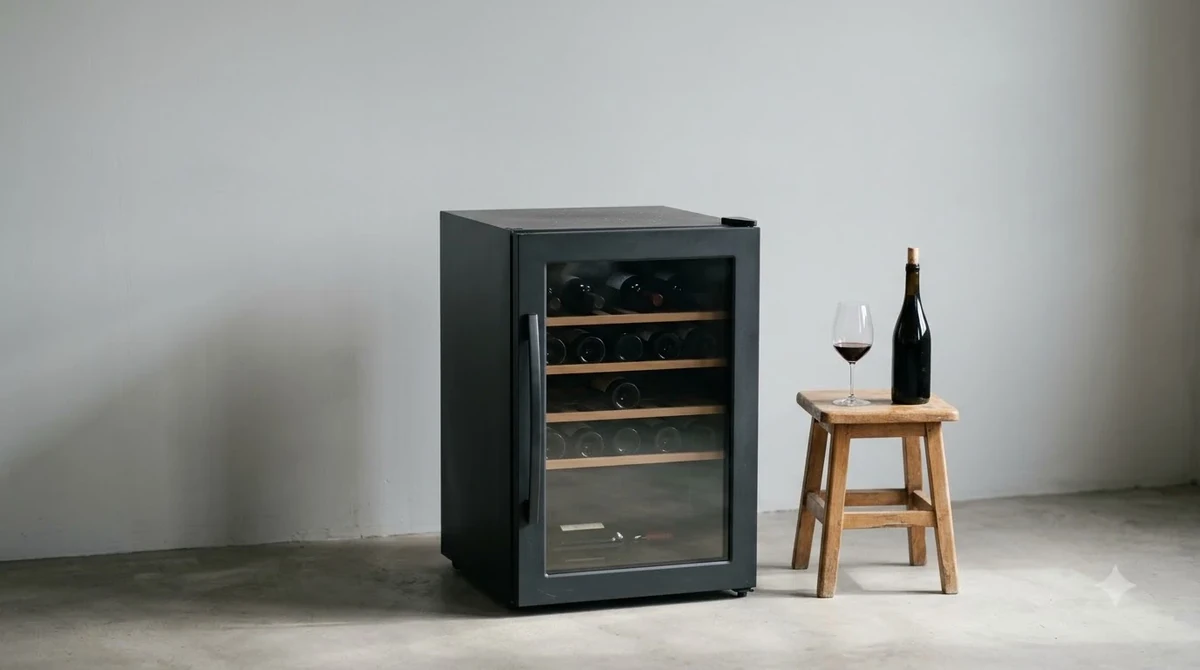
The most important specification is the temperature range of 5°C to 18°C (41°F to 64.4°F). This gives the cabinet flexibility for chilling white wines, keeping sparkling bottles cool and maintaining red wines at controlled storage temperatures. The factory setting is 12°C (54°F), according to the manufacturer’s operating manual. That is a useful starting point for mixed collections because it sits within the commonly recommended long-term storage range for many wine styles.
Hisense describes the HRWC31 as a low-noise, low-vibration wine cabinet. Wooden shelves help support bottles while making them easier to handle, and the tempered glass door has anti-UV and low-emissivity properties. These details matter because wine storage involves more than simply making bottles cold. Limiting unnecessary light exposure, vibration and temperature fluctuations helps create a more suitable environment for keeping wine between drinking occasions.
| Specification | Hisense HRWC31 |
|---|---|
| Stated capacity | 30 standard bottles |
| Temperature range | 5°C to 18°C (41°F to 64.4°F) |
| Factory temperature setting | 12°C (54°F) |
| Temperature zones | Single zone |
| Adjustable shelves | 3 |
| Door | Tempered anti-UV, low-E glass |
| Door opening | Reversible |
| Interior lighting | Soft LED |
| Width | 475 mm (18.7 inches) |
| Depth | 445 mm (17.5 inches) |
| Height | 834 mm (32.8 inches) |
| Warranty | 3 years on the Australian product listing |
One specification deserves particular attention: the cabinet’s temperature display represents an average temperature rather than an identical reading at every shelf. Hisense’s manual explains that the difference between the upper and lower shelves can reach 3°C to 4°C. This is important for anyone planning to organize bottles according to serving temperature. The upper and lower portions should not be treated as independently controlled compartments.
The dimensions also make the HRWC31 relatively easy to accommodate in a kitchen, dining area or dedicated beverage corner. However, the 834 mm height and 475 mm width are only part of the installation calculation. Buyers must also account for the ventilation space required around the appliance and sufficient room to open the door fully.
For official specifications and product features, consult the Hisense HRWC31 product page. The listed warranty and product specifications are associated with the Australian market, so American buyers should confirm local model availability and warranty coverage before purchasing.
What Owners Like About the Design
The HRWC31’s appeal comes from a combination of straightforward controls, a compact footprint and features that address everyday wine-storage concerns. Its wooden shelves, dark glass door and reversible hinge make it particularly appealing for households that want a dedicated wine cabinet without installing a large cellar appliance.
The wooden shelving is one of the more useful design features. Bottles rest horizontally, making it easier to organize a collection while keeping cork closures from drying out. The material also provides a different handling experience from bare metal shelving. Hisense specifically describes its wooden shelves as designed for smooth movement and reduced vibration, which suits a cabinet intended for regular household use.
The anti-UV glass is another practical advantage. Wine can be sensitive to prolonged exposure to strong light, so a protective door is useful when the appliance sits in a kitchen or dining room rather than a dark cellar. The glass also lets the owner see the collection without opening the cabinet repeatedly. This can make everyday bottle selection more convenient while reducing unnecessary door openings.
Electronic touch controls offer a simple way to change the temperature. The adjustable range covers a variety of wine-storage preferences, and the LED lighting makes bottle labels easier to identify. The manufacturer’s manual also describes an automatic lighting shutoff after 15 minutes, reducing the amount of time the interior light remains on if it is accidentally left activated.
The reversible door deserves consideration before installation. A wine fridge placed beside a kitchen counter, cabinet or wall needs an opening direction that does not obstruct access. The HRWC31 can be configured to open from the left or right, giving it more placement flexibility than appliances with a fixed hinge.
Its overall appearance is also relatively restrained. The black-glass finish can complement dark kitchen appliances and contemporary furniture without making the wine cabinet look like commercial refrigeration equipment. For a home bar or dining space, that combination of visible bottles and understated styling can be more attractive than an opaque storage cabinet.
These are design-based advantages rather than claims about independently verified long-term owner satisfaction. Detailed public owner feedback specifically addressing durability, temperature consistency over several years and compressor lifespan is limited. Buyers should distinguish advertised features from proven long-term reliability.
Common Complaints and Practical Limitations
The biggest compromises are the single temperature zone, the difference between advertised bottle capacity and real-world bottle fit, and the need for proper freestanding ventilation. The HRWC31 is designed for a relatively small collection, not for buyers who need separate temperature settings or highly flexible storage for unusual bottle shapes.
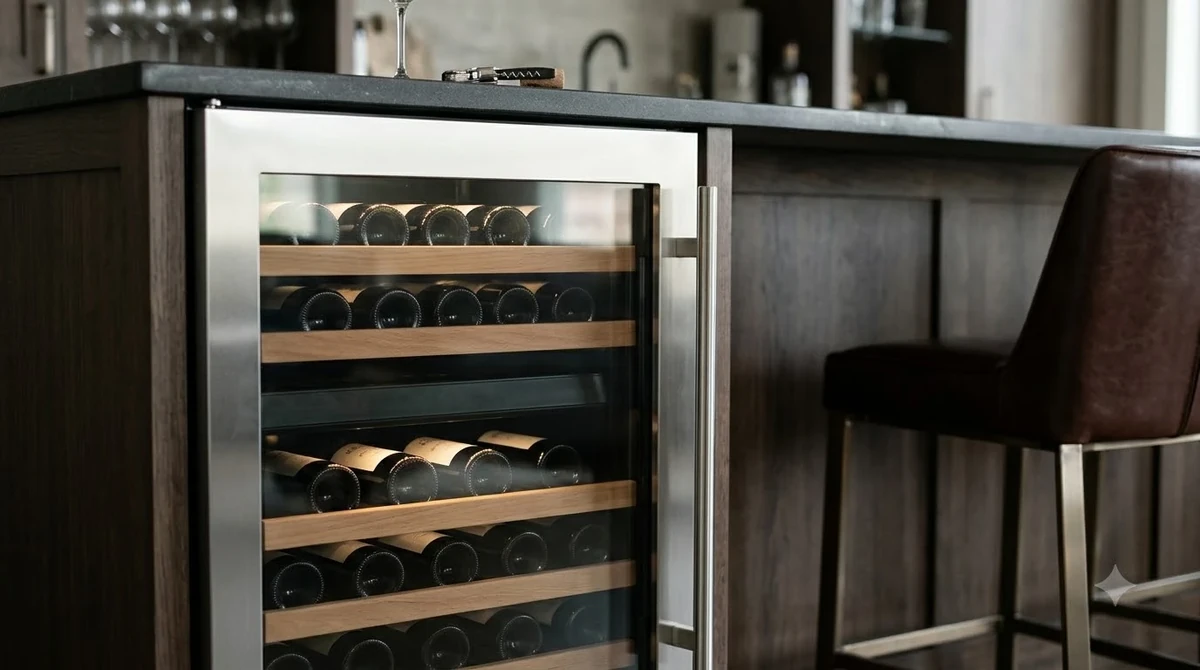
Single-zone storage is the most important limitation. The HRWC31 provides one temperature setting for the whole cabinet. Although the top and bottom shelves may differ by several degrees, those differences are not independently adjustable zones. Someone who regularly stores sparkling wine at a colder temperature while keeping red wines at a warmer temperature may find this arrangement restrictive.
Capacity is another potential source of disappointment. The manufacturer’s 30-bottle figure is based on standard Bordeaux-style 750 ml bottles and the specified shelf arrangement. That is a useful measurement for comparing wine cabinets, but it should not be interpreted as a guarantee that 30 bottles of every wine style will fit simultaneously.
Burgundy bottles, Champagne bottles and some premium sparkling wines have wider bodies than standard Bordeaux bottles. Large-format bottles such as magnums also require considerably more space. Depending on their shape and the shelf arrangement, these bottles may reduce the practical capacity. Buyers with collections dominated by wider bottles should prioritize shelf dimensions and usable spacing over the headline capacity.
Installation can also be inconvenient in a tightly fitted kitchen. Hisense identifies the HRWC31 as a freestanding appliance rather than a built-in wine refrigerator. It needs sufficient airflow, and the manual illustrates clearance requirements around the cabinet. Enclosing it inside an existing cupboard without the required ventilation can interfere with cooling performance.
The cabinet is also not intended to serve as a beverage refrigerator for every household item. Hisense describes its purpose as wine storage. Buyers who want to chill cans, food, beer and wine together should consider a beverage refrigerator designed for mixed contents instead.
Finally, temperature differences between shelves deserve attention. The HRWC31 manual identifies a possible 3°C to 4°C variation between the upper and lower portions. This is not necessarily a defect, but it means the cabinet should not be purchased with the expectation of perfectly uniform temperatures throughout. Buyers seeking highly precise storage conditions for expensive bottles may prefer a more specialized wine-storage system.
Tip: Treat 30 bottles as the maximum for standard Bordeaux-style 750 ml bottles, not as a guaranteed capacity for Champagne, Burgundy or mixed-format collections. If your collection contains many wide bottles, plan for fewer than 30.
Who Should Buy and Who Should Skip the HRWC31
The Hisense HRWC31 is best suited to casual and moderately enthusiastic wine drinkers who want organized storage for a collection of up to 30 standard bottles. It is less appropriate for serious collectors who need multiple temperature zones, substantial aging capacity or a cabinet that can be integrated into fitted cabinetry.
Who should consider buying it
First, consider the HRWC31 if most of your wine purchases are standard 750 ml Bordeaux-style bottles. Its stated capacity makes it a reasonable option for households that regularly keep a selection of everyday reds, whites, rosés and sparkling wines. The adjustable temperature range also provides flexibility for storing different styles without requiring separate appliances.
It is also worth considering for people who entertain occasionally. A dedicated cabinet makes it easier to maintain a selection of wines for dinner parties and weekend gatherings. A bottle of Sauvignon Blanc or Riesling can be stored at a cooler setting than a typical red wine serving temperature, while sparkling wines can be chilled before guests arrive.
Homeowners who value straightforward operation may also appreciate the electronic controls and interior lighting. The reversible hinge is particularly useful when the cabinet needs to fit into an existing room layout. At 475 mm wide and 834 mm high, the HRWC31 can fit into many compact spaces, provided ventilation and door clearance are properly considered.
Who should look elsewhere
Collectors with more than 30 bottles should consider a larger wine cabinet. A 30-bottle model can fill quickly once a collection includes different vintages, occasional purchases and bottles being saved for special occasions. A cabinet with a larger capacity also provides more flexibility for unusual bottle shapes.
Buyers who want independent storage temperatures for reds and whites should consider a dual-zone cabinet. The HRWC31’s single-zone arrangement means one temperature setting applies to the entire cabinet, even though different shelf positions can have slightly different actual temperatures.
It is also not the ideal choice for anyone planning to place a refrigerator directly inside a closed kitchen cabinet. The appliance is freestanding and requires ventilation. A purpose-built built-in wine refrigerator is a more suitable option for that installation style.
Finally, buyers interested in long-term aging of particularly valuable wines should evaluate the complete storage environment rather than focusing exclusively on capacity and appearance. Consistent temperature, humidity management, vibration, light protection and long-term service support all matter. The HRWC31 offers useful everyday storage features, but its published specifications do not establish that it is a specialist wine-aging cabinet.
How It Compares to the Hisense HRWC30
The HRWC31 and HRWC30 share a 30-bottle capacity, but they are not interchangeable models. The HRWC31 has a narrower, shallower cabinet and a reversible door, while the HRWC30 specification describes a different exterior size and a fixed door opening.
The HRWC31 measures 475 mm wide, 445 mm deep and 834 mm high. The HRWC30 measures 490 mm wide, 489 mm deep and 844 mm high. That makes the HRWC31 the more compact of these two models in both width and depth. For buyers working with a limited amount of floor space, this difference may be meaningful.
Door configuration is another significant distinction. The HRWC31 includes a reversible hinge, while the HRWC30 specification states that its door is not reversible. This gives the HRWC31 an advantage in rooms where the opening direction needs to match nearby furniture, walls or countertops.
The two models also have different documented temperature information. The HRWC31 product page specifies a 5°C to 18°C adjustable range. The HRWC30 technical specification lists operating conditions of 10°C to 43°C, which describes ambient operating conditions rather than its wine-storage temperature range. These figures should not be confused when comparing the appliances.
The HRWC30 specification lists a fixed-speed compressor, a 39 dB(A) noise level, 132 W rated input power and a microprocessor-controlled electronic display. The HRWC31’s official product information emphasizes low noise, low vibration and electronic touch control. Without directly comparable published measurements for both models, it would be misleading to declare one quieter or more energy-efficient solely from their feature descriptions.
For buyers choosing between the two, the HRWC31 is the more attractive option if reversible installation, smaller dimensions and the documented 5°C to 18°C range are priorities. The HRWC30 may still be relevant when its larger cabinet dimensions or particular shelf arrangement better suit an available space. Model identification is essential because retailer descriptions can sometimes use the generic phrase 30-bottle Hisense wine fridge without making the differences obvious.
Anyone comparing additional compact wine cabinets can also browse the wine fridge model reviews section to assess capacity, temperature zones and installation requirements across different products. For households building a home bar around wine and mixed drinks, the Aperol Spritz recipe provides another practical reason to keep chilled sparkling wine and ingredients available. If dinner is on the menu, a chicken Marsala recipe can also help turn a stored bottle of wine into part of a complete meal.
Frequently Asked Questions
Can the Hisense HRWC31 store opened wine bottles?
The HRWC31 is designed for wine storage, but opened bottles can also be placed inside if they are properly resealed. Use an appropriate wine stopper or sparkling-wine closure, and keep opened still wines refrigerated for approximately 3 to 5 days as a general storage guideline. Sparkling wines generally retain their best condition for a shorter period, often around 1 to 3 days.
Does the HRWC31 have a child lock?
The published HRWC31 product specifications and operating instructions describe electronic touch controls but do not establish a child-lock feature. Buyers who specifically require control-panel locking should obtain confirmation from the manufacturer or local retailer rather than assuming that the presence of electronic controls means the function is included.
Can the Hisense wine fridge be transported lying down?
The HRWC31 manual recommends waiting at least two hours before connecting the appliance if it has been transported horizontally. This allows compressor oil to return to the compressor. Transporting the cabinet upright is preferable whenever practical, and the manufacturer’s handling instructions should be followed.
Does the HRWC31 have an automatic defrost system?
The HRWC31 operating manual describes automatic defrosting and explains that defrost water drains into a collection area above the compressor, where it evaporates. It also recommends periodically cleaning the drain opening. This is useful to know because a blocked drainage opening can contribute to water collecting inside or around the appliance.
Can the Hisense HRWC31 operate in a garage?
The manual identifies a subtropical operating classification with an ambient temperature range of approximately 16°C to 43°C for the HRWC31. A garage that regularly falls outside the permitted operating conditions may not provide a suitable environment. Buyers should also account for exposure to direct sunlight, nearby heat sources and adequate ventilation before choosing a garage location.
The Hisense HRWC31 is a sensible compact wine cabinet for households that prioritize simple temperature control, protective glass, wooden shelving and a flexible door arrangement. Its 30-bottle capacity and single-zone design are best suited to everyday collections rather than extensive wine-aging programs. Confirm the exact model, local warranty and installation requirements before buying, particularly when comparing the HRWC31 with the similarly named HRWC30.
More in Model Reviews
 Magic Chef 44 Bottle Wine Cooler Review for Flexible StorageUpdated Nov 21, 2026
 Whynter 164 Bottle Wine Cooler Review: Capacity, Features, and FitUpdated Nov 21, 2026
 Insignia NS WC16BK6 Review: Compact 16-Bottle Wine StorageUpdated Nov 21, 2026
 Wine Enthusiast Electric Blue Omega Review: Opening, Pouring, and Preserving Made EasierUpdated Nov 21, 2026
 Koolatron 20 Bottle Wine Cooler Review: Features, Fit, and PerformanceUpdated Nov 21, 2026
 NewAir AWC 330E Review for Home Wine StorageUpdated Nov 21, 2026