


We may earn a commission when you buy through links on this page, at no extra cost to you. Learn more.
The Haier 20 bottle wine fridge is a compact wine storage option for small collections, with adjustable temperature controls, interior lighting, and repositionable shelves. The HVF020ABB electronic-control version and HVFM20ABB mechanical-control version offer different operating experiences. However, buyers should verify the exact model, electrical requirements, and bottle capacity before purchasing, particularly when considering an older or secondhand unit.
A small wine refrigerator can make everyday storage more convenient without requiring a dedicated wine cellar or a large appliance. Haier’s 20-bottle wine cooler family targets this type of household, providing a relatively compact cabinet for keeping a modest selection of bottles organized. Its appeal lies in straightforward storage rather than elaborate wine-preservation technology. Understanding its specifications and limitations is especially important because several Haier models share similar names, appearances, and features.
Specs and Key Features
The Haier 20-bottle wine cooler is designed around a 2.9-cubic-foot storage compartment, adjustable racks, and temperature controls. The electronic HVF020ABB and mechanical HVFM20ABB are related configurations, but their control systems are different, so identifying the exact version is essential.

According to Haier’s service documentation, the 20-bottle configuration measures approximately 19.9 inches wide, 21.7 inches deep, and 30.7 inches high. Its listed weight is 34 pounds, making it a relatively manageable appliance compared with larger wine cabinets. These measurements are useful when evaluating a kitchen corner, dining room, apartment, or home bar. Allow additional room for the door to open and for the ventilation requirements specified in the installation instructions.
| Specification | Haier 20-bottle configuration |
|---|---|
| Identified models | HVF020ABB / HVFM20ABB |
| Nominal capacity | 20 bottles |
| Cabinet volume | 2.9 cubic feet |
| Width | 506 mm / 19.9 inches |
| Depth | 550 mm / 21.7 inches |
| Height | 780 mm / 30.7 inches |
| Listed weight | 34 pounds |
| Annual energy consumption | 251.9 kWh |
| Documented electrical supply | 220–230 V, 50 Hz |
| Control type | Electronic or mechanical, depending on model |
One specification deserves particular attention for American buyers: the service manual lists a 220–230-volt, 50-Hz power supply. This is not the standard 120-volt, 60-Hz supply used by ordinary US household outlets. Consequently, the documentation for this particular configuration does not establish that it can be safely connected to a standard American outlet. Buyers should inspect the appliance’s actual rating plate and obtain confirmation of electrical compatibility before purchasing or connecting it.
The interior includes adjustable wine racks and built-in lighting. The shelves slide out and can be repositioned in the cabinet’s molded tracks, providing some flexibility for bottles that do not fit the standard arrangement. Haier also describes a staggered rack arrangement intended to improve air circulation and create more usable storage space.
Another useful detail is the bottom basket area, which can accommodate larger bottles or magnums more easily than the regular shelf positions. However, this does not mean every oversized bottle will fit. The shape, diameter, and length of a bottle can affect how much room remains for neighboring bottles.
The official service documentation is particularly useful for identifying model differences and installation limitations. Buyers can consult the Haier HVF020ABB service manual when checking the technical information for this older appliance family.
What Owners Like
The most appealing aspects of the Haier 20-bottle wine fridge are its compact footprint, adjustable storage arrangement, and relatively uncomplicated operation. These characteristics make it a practical candidate for people who want a dedicated wine compartment without allocating substantial floor space to a large cabinet.
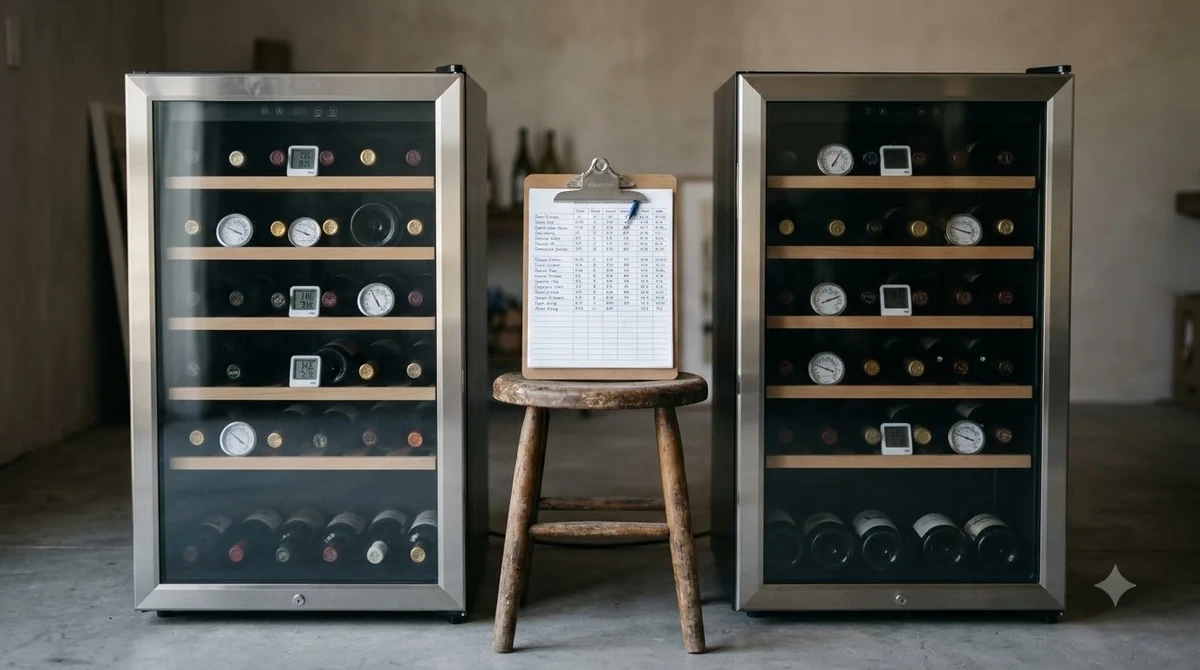
Its 20-bottle nominal capacity suits a household that keeps a rotating selection rather than purchasing wine in large quantities. For example, a collection might include several Cabernet Sauvignon bottles, a few Pinot Noir bottles, Chardonnay, Sauvignon Blanc, and sparkling wine for entertaining. Keeping these bottles together makes it easier to organize everyday selections and separate wines intended for different meals.
The adjustable shelves are another practical advantage. Standard 750 ml Bordeaux-style bottles generally make the most efficient use of a wine refrigerator’s rack space. However, many collections include Burgundy-shaped bottles, Riesling bottles, and sparkling wine bottles with wider bodies. The ability to reposition shelves provides some flexibility when the collection changes.
Haier’s documentation also describes the convenience of interior lighting. Being able to see bottle labels without repeatedly opening the door is useful in a dim kitchen or home bar. The electronic version offers a Light/Set button, while the mechanical-control configuration has a separate front light switch.
Owners considering an older HVFM20A should also distinguish documented features from individual experiences. A Homebrew Talk participant discussing the HVFM20A reported fitting a 6.5-gallon plastic fermenter with a 12-inch diameter inside the appliance. The same participant described approximately one inch of clearance above the airlock. This is an individual report, not a guaranteed fit for every 20-bottle model or fermenter.
For wine storage, the important advantage remains the dedicated compartment. A regular kitchen refrigerator is designed primarily for food rather than maintaining a convenient wine collection. A separate cabinet provides an organized location for bottles that would otherwise occupy kitchen shelves or countertops.
The Haier’s relatively simple design can also appeal to people who do not need smartphone connectivity, elaborate display settings, or multiple temperature zones. A buyer who mainly wants to keep a small selection together may find these basic functions sufficient, provided the appliance is compatible with the intended electrical supply and operates correctly.
Common Complaints and Limitations
The main limitations to consider are the modest capacity, older control technology, uncertain electrical compatibility across markets, and lack of documented dual-zone functionality. These factors make the Haier less suitable for some wine enthusiasts, particularly those seeking a modern appliance for long-term collection management.
First, 20 bottles is a nominal capacity rather than a guarantee that every combination of bottles will fit. Manufacturers typically calculate bottle capacity using standard bottle dimensions. A collection containing many Champagne bottles, Burgundy bottles, or unusually shaped bottles can reduce usable capacity substantially.
For example, a collection of 20 standard Bordeaux bottles is a more realistic target than 20 mixed-format bottles. Sparkling wine bottles often have wider bodies, while some Burgundy bottles require more horizontal room. A buyer who regularly purchases larger formats should plan for fewer bottles than the advertised maximum.
Second, the distinction between the HVF020ABB and HVFM20ABB matters. The former uses electronic controls, while the latter uses a mechanical thermostat. Buyers looking specifically for digital temperature adjustment should not assume that every Haier 20-bottle cabinet includes the same panel.
Third, the documented electrical requirements require careful attention. A manual listing 220–230 volts and 50 Hz should not be treated as proof that the appliance is suitable for a US home. A plug adapter does not change voltage or frequency. Even a transformer should not be considered an automatic solution without confirmation from a qualified appliance technician regarding the motor, compressor, electrical protection, and operating frequency.
There is also a limitation in the available temperature documentation. The service manual gives a control range using the notation A-3 to A+3, with A representing 7–15 degrees Celsius. This wording does not provide a sufficiently clear, independently verified operating range for every setting. It is therefore unwise to assume a precise temperature range from the model name alone.
Finally, buyers should not mistake a small wine refrigerator for a professional aging cabinet. Long-term storage benefits from stable temperature, appropriate humidity, limited light exposure, and minimal vibration. The available documentation establishes adjustable controls and interior lighting but does not provide enough information to establish advanced humidity management, dual-zone operation, or a specialized anti-vibration system for these 20-bottle models.
Who Should Buy and Who Should Skip
The Haier 20-bottle wine cooler makes the most sense for someone seeking a modest, dedicated wine-storage appliance with simple controls and adjustable shelves. It is less compelling for a buyer who needs a large collection cabinet, independently controlled temperature zones, or confirmed modern electrical compatibility without further investigation.
Who should consider it
Small-collection owners: People who usually keep between 8 and 15 bottles at home may find the nominal 20-bottle capacity useful. The additional room leaves space for occasional purchases and different wine styles without requiring a larger cabinet.
Apartment residents: Its documented height of 780 mm and width of 506 mm make it relatively compact compared with tall wine cabinets. It may suit a suitable freestanding location, provided there is enough ventilation and door clearance.
Buyers who prefer simple controls: The mechanical HVFM20ABB may appeal to people who prefer a straightforward thermostat. Those who want an electronic interface should seek the HVF020ABB specifically rather than relying on generic product descriptions.
People building a modest home bar: A dedicated wine cabinet can keep a few reds and whites organized alongside the equipment used for serving cocktails. It can complement a small entertaining area where wine and mixed drinks are both part of the regular selection.
For example, someone preparing an Aperol Spritz recipe for guests might also keep a selection of wines available for dinner. A compact cabinet can provide a separate storage area for those bottles, while the cocktail ingredients remain in the kitchen or bar.
Who should skip it
Serious collectors: People storing dozens of bottles or planning to expand their collections should consider a larger cabinet. A 20-bottle refrigerator offers limited room for future purchases and may require frequent rearranging.
Dual-zone shoppers: Anyone wanting independently controlled compartments for reds and whites should look for a wine cooler that explicitly specifies two temperature zones. The documentation for the identified 20-bottle models does not establish that capability.
US buyers without electrical confirmation: The listed 220–230-volt, 50-Hz specification is a significant purchasing consideration. Anyone shopping in the United States should verify the actual electrical rating before committing to this model.
Long-term wine investors: A small refrigerator with basic temperature controls is not automatically suitable for aging expensive bottles over many years. Buyers with valuable collections should prioritize verified temperature stability, suitable environmental conditions, and dependable service support.
Food pairing also matters when deciding how to organize a small collection. Cabernet Sauvignon works well with fattier cuts of beef because fat softens its tannins, while high-acidity Sauvignon Blanc can complement acidic dishes. A small refrigerator can accommodate a useful variety, but the wines should be selected according to the meals and occasions they are intended for.
How It Compares to Alternatives
The Haier 20-bottle refrigerator is best evaluated against other small wine-storage appliances by comparing capacity, electrical requirements, temperature control, and physical dimensions. The most important distinction is not simply how many bottles an appliance advertises, but whether its actual configuration suits the collection and installation location.
A compact single-zone wine cooler is generally the closest alternative. It offers a similar dedicated storage arrangement and can be a sensible option for households that primarily want to keep wine together. Depending on the model, newer alternatives may offer clearer digital temperature displays, improved lighting, and more detailed specifications.
A dual-zone wine refrigerator is a different proposition. Its two independently controlled compartments can provide greater flexibility for households that regularly keep sparkling wine, whites, and reds at different serving temperatures. For someone who frequently entertains, this arrangement can be more convenient than a basic single-compartment design.
A larger freestanding wine cabinet is another alternative. Moving from a 20-bottle unit to a 30-, 40-, or 50-bottle appliance gives a collection more room to grow. However, the larger appliance requires additional floor space, and buyers should compare its energy use and installation requirements before deciding.
| Storage option | Typical capacity | Main advantage | Main limitation |
|---|---|---|---|
| Small wine cooler | 12–20 bottles | Compact footprint | Limited collection space |
| Haier 20-bottle configuration | 20 bottles | Adjustable shelves and basic controls | Electrical compatibility requires verification |
| Medium wine cabinet | 30–50 bottles | More room for mixed collections | Requires more space |
| Dual-zone wine cooler | Varies by model | Separate temperature settings | More complicated configuration |
| Large wine cellar cabinet | 50+ bottles | Greater storage capacity | Larger installation footprint |
The table compares general appliance categories rather than claiming that all products in each category have identical features. In particular, bottle capacity does not establish temperature stability or electrical suitability.
Haier’s other wine cooler sizes are also relevant when considering the brand’s older product family. The service manual groups the 20-bottle HVF020ABB with larger 30-bottle and 46-bottle configurations. These models share aspects of the design but differ in cabinet dimensions and capacity.
Anyone comparing older Haier appliances should pay attention to the full model number. A change in the model suffix can indicate a different finish or control arrangement. A listing that simply says Haier wine cooler is not sufficiently detailed to establish which version is being offered.
For a broader look at appliance categories and model-specific reviews, the Brand x Capacity model reviews section can provide a useful starting point for comparing different storage sizes.
Buying Checks and Installation Considerations
Buying an older Haier 20-bottle wine fridge requires more careful inspection than purchasing a current appliance with a complete manufacturer product page. The model number, electrical rating, cooling performance, door condition, and availability of replacement components should all be considered before making a decision.
1. Confirm the exact model number
Start by identifying whether the appliance is an HVF020ABB or HVFM20ABB. The electronic and mechanical versions do not offer identical controls. Ask for a clear photograph of the model identification plate and the front control panel.
Do not rely exclusively on a seller’s title or a photograph of a similar-looking cabinet. Model numbers are especially important with older appliances because product listings can combine specifications from several versions.
2. Check the electrical rating
Examine the rating plate for voltage, frequency, current, and other electrical information. The service manual for the identified 20-bottle configuration lists 220–230 volts and 50 Hz. A US buyer should obtain confirmation that the individual appliance is appropriate for the local electrical supply before installation.
3. Inspect the cooling system
If the unit is used, ask the seller to demonstrate that it starts, runs, and cools. Observe whether the interior temperature changes after the appliance has operated for an appropriate period. A working display alone does not prove that the cooling system is functioning correctly.
Listen for unusual noises and inspect the cabinet for signs of physical damage. Persistent rattling, irregular operation, or a damaged door seal deserves attention. If the seller cannot demonstrate cooling performance, treat the purchase as a repair risk rather than assuming the appliance only needs cleaning.
4. Examine the shelves and door
Pull each removable shelf out carefully and inspect its support points. Look for bent components, cracks, corrosion, and missing parts. Check that the door closes evenly and that the seal makes consistent contact around its perimeter.
Also consider the bottle formats in the collection. If larger Burgundy or sparkling wine bottles are common purchases, measure their dimensions and compare them with the actual shelf spacing. The nominal capacity should not be the only deciding factor.
5. Measure the installation location
Use the documented cabinet dimensions of approximately 19.9 inches wide, 21.7 inches deep, and 30.7 inches high as a preliminary reference. Measure the available space rather than assuming that a cabinet will fit simply because its front dimensions appear suitable.
Haier’s service manual specifies freestanding installation. Avoid treating this model as a built-in appliance or placing it inside a tightly enclosed cupboard. Follow the installation instructions for clearance and ventilation.
Tip: Before buying a secondhand Haier 20-bottle wine fridge, request photographs of the model plate, power rating, control panel, shelves, and door seal. Confirm that the appliance reaches and maintains an appropriate temperature before arranging collection or installation.
6. Consider the collection’s growth
Think about how many bottles are normally kept at home and how quickly the collection grows. A household that regularly purchases wine for dinner parties may outgrow a 20-bottle cabinet faster than expected.
For example, someone who enjoys cooking might keep Chardonnay for chicken dishes, Pinot Noir for lighter meat dishes, and Cabernet Sauvignon for richer meals. A chicken Marsala recipe can also provide a reason to keep suitable wine selections on hand for cooking and serving. The appliance should accommodate the bottles the household actually purchases rather than an idealized collection of standard shapes.
How to Use and Maintain the Haier Wine Fridge
Proper installation and sensible storage practices can help a wine refrigerator perform more consistently. The most important steps are allowing adequate ventilation, positioning the cabinet securely, selecting an appropriate temperature, and avoiding unnecessary door openings.
Begin by placing the refrigerator on a stable, level surface. Haier’s service documentation includes leveling and installation guidance, and its safety instructions specify freestanding use. Avoid blocking the ventilation areas or placing the appliance in an enclosed cabinet that prevents proper heat dissipation.
After moving the unit, follow the manufacturer’s instructions regarding settling time before connecting the appliance. This is especially important for refrigerators that have been transported or tilted. Avoid assuming that an older appliance can be switched on immediately after transportation without checking its instructions.
For general wine storage, bottles are commonly kept around 55 degrees Fahrenheit, with limited exposure to light and temperature fluctuations. This is a useful reference for a collection intended for storage rather than immediate service. The Haier’s documented temperature-control notation does not establish that every setting corresponds to a precise temperature, so actual performance should be verified independently.
Serving temperatures are different from storage temperatures. Sparkling wine is generally served at 40–50 degrees Fahrenheit, light whites and rosé at 45–50 degrees, and full-bodied whites at 50–55 degrees. Light reds are generally served at 55–60 degrees, while full-bodied reds are served at 60–65 degrees.
Consequently, one storage setting should not be confused with the ideal serving temperature for every bottle. A wine stored in a dedicated refrigerator may still need a short period outside the cabinet before serving.
Keep bottles away from direct sunlight and avoid leaving the door open while searching for a particular label. The interior light is useful for viewing bottles, but Haier’s documentation recommends switching it off when it is not needed. This also avoids unnecessary lighting operation.
Cleaning should be performed with the appliance disconnected from its power supply. Follow the manufacturer’s cleaning instructions, use suitable materials for the interior surfaces, and allow cleaned components to dry before returning them to the cabinet. Avoid aggressive chemicals that could damage the interior or door seal.
Finally, maintain a simple inventory. Record the wine name, vintage, purchase date, and intended drinking period. A 20-bottle collection is small enough to manage without specialized software, and a written list helps prevent bottles from being forgotten at the back of the cabinet.
For entertaining, a small collection can cover several occasions. A chilled white can accompany seafood, Pinot Noir can complement roasted poultry, and sparkling wine can be reserved for celebrations. A separate cocktail option such as a Hugo Spritz recipe can round out the drinks selection without requiring the wine refrigerator to store every beverage.
Frequently Asked Questions
These answers address practical questions about identifying, purchasing, and using the Haier 20-bottle wine cooler. They also clarify a few details that are easy to overlook when shopping for an older appliance.
Is the Haier 20-bottle wine fridge discontinued?
The identified HVF020ABB and HVFM20ABB configurations are older model references, and the available service documentation does not establish their current retail availability. Buyers should distinguish an original Haier product listing from a secondhand listing or replacement-parts listing. Contacting Haier support with the complete model and serial numbers is the best way to investigate service information.
Can the Haier 20-bottle wine fridge store Champagne bottles?
Some larger bottles may fit in the bottom basket area, but the documented 20-bottle capacity is based on standard bottle dimensions. Champagne bottles can have wider bodies than standard Bordeaux bottles. Measure the available space and test the intended arrangement rather than assuming the cabinet can hold 20 bottles of every wine style.
Does the Haier 20-bottle wine fridge have a reversible door?
The service documentation for the identified HVF020ABB and HVFM20ABB models does not establish a reversible-door feature. Do not assume that the hinge can be changed based on specifications for a different Haier wine cabinet. Inspect the individual appliance and its installation documentation before planning a location that requires a particular door-opening direction.
Can the Haier 20-bottle wine fridge be used for beer?
Its adjustable storage compartment may physically accommodate some beverage containers, but the identified appliance is designed as a wine cooler. Beer cans and bottles can have different dimensions and cooling requirements. Anyone considering mixed beverage storage should verify the actual temperature capability and shelf configuration before using it for that purpose.
Where can buyers find the Haier 20-bottle wine fridge model number?
The service documentation identifies the model and serial-number information on the appliance identification label. The exact label position can vary by configuration, so inspect the rear cabinet and other identification areas carefully. Keep a photograph of the label because the information can help with troubleshooting, replacement parts, and support inquiries.
The Haier 20-bottle wine fridge is a straightforward compact-storage concept with useful adjustable shelving and basic controls, but its older specifications deserve careful attention. The HVF020ABB and HVFM20ABB should be evaluated separately, especially regarding their control systems and electrical requirements. For buyers who can verify the exact model, operating condition, and electrical compatibility, it may be a practical small-collection option; anyone needing modern dual-zone functionality or dependable long-term cellar conditions should compare more specialized alternatives before purchasing.
More in Model Reviews
 Magic Chef 44 Bottle Wine Cooler Review for Flexible StorageUpdated Nov 21, 2026
 Whynter 164 Bottle Wine Cooler Review: Capacity, Features, and FitUpdated Nov 21, 2026
 Insignia NS WC16BK6 Review: Compact 16-Bottle Wine StorageUpdated Nov 21, 2026
 Wine Enthusiast Electric Blue Omega Review: Opening, Pouring, and Preserving Made EasierUpdated Nov 21, 2026
 Koolatron 20 Bottle Wine Cooler Review: Features, Fit, and PerformanceUpdated Nov 21, 2026
 NewAir AWC 330E Review for Home Wine StorageUpdated Nov 21, 2026