

We may earn a commission when you buy through links on this page, at no extra cost to you. Learn more.
Gamay vs Grenache comes down to freshness versus richness: Gamay generally produces lighter-bodied, higher-acid red wines with delicate tannins, while Grenache typically delivers riper fruit, more alcohol, and a fuller texture. Gamay is an excellent choice for drinkers who enjoy bright strawberry and cherry flavors with refreshing acidity. Grenache suits those who prefer juicy red berries, warming spice, and a rounder mouthfeel. Both grapes are versatile with food, but their different structures make them better suited to different meals and drinking occasions.
These grapes come from different winemaking traditions, even though both can produce approachable, fruit-forward red wines. Gamay is most closely associated with Beaujolais in France, while Grenache has important roots in Spain and southern France and has developed a distinctive identity in Australia’s Barossa Valley and McLaren Vale. Understanding their differences in flavor, structure, growing conditions, and food compatibility makes choosing between them much easier.
Gamay vs Grenache: The Main Differences
Gamay is generally lighter, fresher, and more acidic, whereas Grenache tends to be richer, warmer, and more concentrated. The distinction becomes especially clear when comparing a traditional Beaujolais with a ripe Grenache from the southern Rhône or Barossa Valley.
Gamay is a red grape best known for its role in Beaujolais, where it produces wines ranging from uncomplicated, juicy everyday bottles to structured, age-worthy examples from the region’s top vineyards. Its naturally bright fruit, relatively low tannin, and refreshing acidity make it particularly appealing to drinkers who enjoy lighter reds.
Grenache, also called Garnacha in Spain, is a warm-climate variety capable of producing several different styles. Depending on the region, vineyard conditions, harvest decisions, and winemaking, it can be medium-bodied and elegant or powerful and full-bodied. Strawberry, raspberry, cherry, earthy notes, and white pepper are common characteristics.
The biggest practical difference is the way each wine feels in the mouth. Gamay tends to emphasize freshness and lively fruit, while Grenache often emphasizes ripe fruit, alcohol warmth, and a softer, more generous texture. However, neither grape has just one fixed style.
| Characteristic | Gamay | Grenache |
|---|---|---|
| Primary home | Beaujolais, France | Spain and southern France |
| Body | Light to medium | Medium to full |
| Acidity | Medium-high to high | Low to medium |
| Tannin | Low to medium | Low to medium |
| Typical alcohol | Approximately 11.5–13.5% ABV | Approximately 14–15.5% ABV |
| Fruit flavors | Strawberry, raspberry, cherry | Strawberry, raspberry, cherry |
| Additional aromas | Violet, pepper, floral notes | White pepper, herbs, earth, spice |
| Typical texture | Juicy, fresh, supple | Round, smooth, sometimes warm |
| Best-known region | Beaujolais, France | Southern Rhône, France |
| Serving temperature | 55–60°F | 60–65°F |
These figures are representative ranges rather than strict rules for every bottle. For example, a cool-climate Gamay can feel particularly delicate, while an old-vine Grenache made with restrained extraction can be surprisingly graceful. Oak aging, harvest ripeness, vineyard altitude, and blending also influence the finished wine.
For a quick decision, choose Gamay when you want acidity and lighter fruit-driven structure. Choose Grenache when you want more ripe-fruit concentration, spice, and a warmer finish.
Flavor and Aroma: Red Berries, Flowers, and Spice
Gamay usually emphasizes fresh red fruit and floral aromas, while Grenache offers riper berry flavors alongside spice and earthy characteristics. Both can smell like strawberries and cherries, but their secondary aromas and overall intensity help distinguish them.
Gamay commonly displays strawberry, raspberry, sour cherry, blackberry, and violet. In wines made using carbonic or semi-carbonic maceration, additional aromas can include banana, bubblegum, and other candied-fruit characteristics. These aromas are associated with fermentation techniques rather than added flavorings.
The wine’s flavor depends partly on its Beaujolais origin. A straightforward Beaujolais Nouveau typically focuses on immediate fruitiness, while wines from appellations such as Morgon and Moulin-à-Vent can develop deeper fruit, savory characteristics, and more structured finishes. The granite-influenced vineyards of Beaujolais contribute to the region’s diverse expressions of the grape.
Grenache usually has a more generous aromatic profile. Strawberry, raspberry, cherry, and dark raspberry can appear alongside white pepper, dried herbs, earth, and warm spice. In warmer regions, ripe fruit can resemble stewed berries or fruit preserves, particularly when grapes reach higher levels of ripeness.
Regional differences are important. Barossa Valley Grenache is associated with red fruit, earth, white pepper, and a richly textured palate. McLaren Vale expressions commonly show ripe, juicy fruit and spice. Meanwhile, southern Rhône Grenache may display Mediterranean herbs, red berries, and savory complexity, especially when blended with other varieties.
Grenache’s aromatic character also makes it useful in rosé production. Red Grenache can provide ripe fruit and body, while rosé versions offer a different balance of freshness and fruitiness. Gamay also produces rosé, particularly in Beaujolais and Beaujolais-Villages.
When comparing the two, pay attention to the finish. Gamay usually leaves a fresh, fruity impression, while Grenache often finishes with more noticeable warmth, spice, and ripe-fruit concentration.
Body, Acidity, Tannin, and Alcohol
Gamay generally has higher acidity and a lighter body, while Grenache typically has more alcohol and a fuller mouthfeel. Both grapes can produce relatively soft tannins, so the most noticeable structural differences are often acidity, weight, and alcohol warmth.
Gamay’s freshness makes it one of the more versatile red grapes for people who prefer wines that do not feel heavy. Its acidity provides energy, while modest tannin allows the fruit to remain prominent. This combination makes it especially appealing with dishes that benefit from a refreshing red wine rather than a strongly structured one.
Grenache is generally less acidic than Gamay, although the actual difference depends on climate, harvest date, and production methods. Grapes grown in warm conditions can accumulate substantial sugar, which can translate into higher alcohol after fermentation. This creates a fuller sensation on the palate and can make some Grenache wines feel noticeably warmer.
Tannin is more complicated. Neither variety is automatically highly tannic, but Grenache can develop greater structure through extended skin contact, whole-cluster fermentation, and blending. Gamay also varies, particularly among structured Beaujolais crus. A Moulin-à-Vent can have considerably more grip than a simple, young Beaujolais.
The following comparison provides useful general expectations when selecting a bottle.
| Structural feature | Gamay | Grenache |
|---|---|---|
| Acidity scale | 4/5 to 5/5 | 2/5 to 3/5 |
| Tannin scale | 1/5 to 2/5 | 2/5 to 3/5 |
| Body scale | 2/5 to 3/5 | 3/5 to 5/5 |
| Alcohol range | 11.5–13.5% ABV | 14–15.5% ABV |
| Perceived warmth | Generally low | Moderate to high |
The scales are editorial descriptions of typical styles, not official measurements or legal specifications. Individual bottles can fall outside these ranges, especially when Grenache is grown at higher elevations or Gamay comes from particularly ripe vineyards.
How acidity changes the experience
Acidity influences how refreshing a wine tastes and how well it works with food. Gamay’s brighter acidity makes it a natural companion for tomato-based dishes, vinaigrette, roasted vegetables, and foods with noticeable tanginess. Grenache’s softer acidity can be more comfortable alongside richer preparations, grilled meat, and dishes with sweet roasted flavors.
How alcohol affects body
Alcohol contributes to the perception of warmth and weight. A 14.5% ABV Grenache will often feel broader and warmer than a 12.5% ABV Gamay, even if both have similar fruit intensity. This is one reason serving temperature matters: overly warm red wine can make alcohol feel more prominent.
Tip: If you prefer red wine that feels refreshing rather than warming, start with a Beaujolais or another Gamay-led wine. If you enjoy ripe berries, spice, and a fuller texture, explore Grenache from the Rhône Valley or Australia.
Growing Regions and Winemaking Styles
Gamay is most closely associated with the cool-to-moderate vineyards of Beaujolais in France, while Grenache thrives in warmer regions such as Spain, the southern Rhône Valley, and South Australia’s Barossa Valley. These growing environments help explain their different levels of ripeness, acidity, and alcohol.
Beaujolais is the defining region for Gamay. According to the Beaujolais wine council, approximately 30,000 hectares of Gamay are planted worldwide, and roughly half are in Beaujolais. The grape accounts for about 98% of the vineyard area producing Beaujolais wines.
Beaujolais has 12 appellations, with important differences between its village and cru wines. Beaujolais Nouveau is designed for early drinking and emphasizes youthful fruit. Beaujolais-Villages generally provides additional regional character, while cru appellations such as Fleurie, Morgon, and Moulin-à-Vent can offer greater structure and complexity.
Granite soils are particularly important in Beaujolais, although Gamay adapts to different growing conditions. Vineyard management also matters because the grape can be naturally prolific. Growers must manage yields carefully to maintain fruit concentration and quality.
Grenache is especially suited to warm, dry conditions because it buds early and ripens relatively late. Spain is a major home of the variety, where it is known as Garnacha. In France, it is particularly important in the southern Rhône Valley, including appellations such as Châteauneuf-du-Pape and Gigondas.
Australia provides another important reference point. Wine Australia identifies Barossa Valley and McLaren Vale as major Grenache regions. Barossa is known for richly textured wines with red fruit, earth, and white pepper, while McLaren Vale produces medium-to-full-bodied expressions with ripe fruit and spice.
Winemaking can change the character of Grenache considerably. Cold soaking can help develop aromatic expression, while whole-cluster fermentation and stem inclusion can contribute structure and additional aromatic complexity. Extended post-fermentation maceration can also help integrate tannins.
Some Australian producers use larger-format barrels and older neutral oak to mature Grenache without overwhelming its fruit. Others make fresher, lighter expressions designed to emphasize the grape’s natural perfume.
For additional background, the official Beaujolais Gamay profile explains the grape’s relationship with the region, while Wine Australia’s Grenache overview describes its regional expressions and winemaking approaches.
Food Pairings: Which Wine Works Better With Dinner?
Gamay is particularly good with poultry, mushrooms, charcuterie, pork, and dishes with bright acidity, while Grenache is a strong choice for grilled meats, Mediterranean vegetables, herb-seasoned dishes, and moderately spiced food. The best pairing depends on the wine’s body, acidity, and tannin as well as the intensity of the dish.
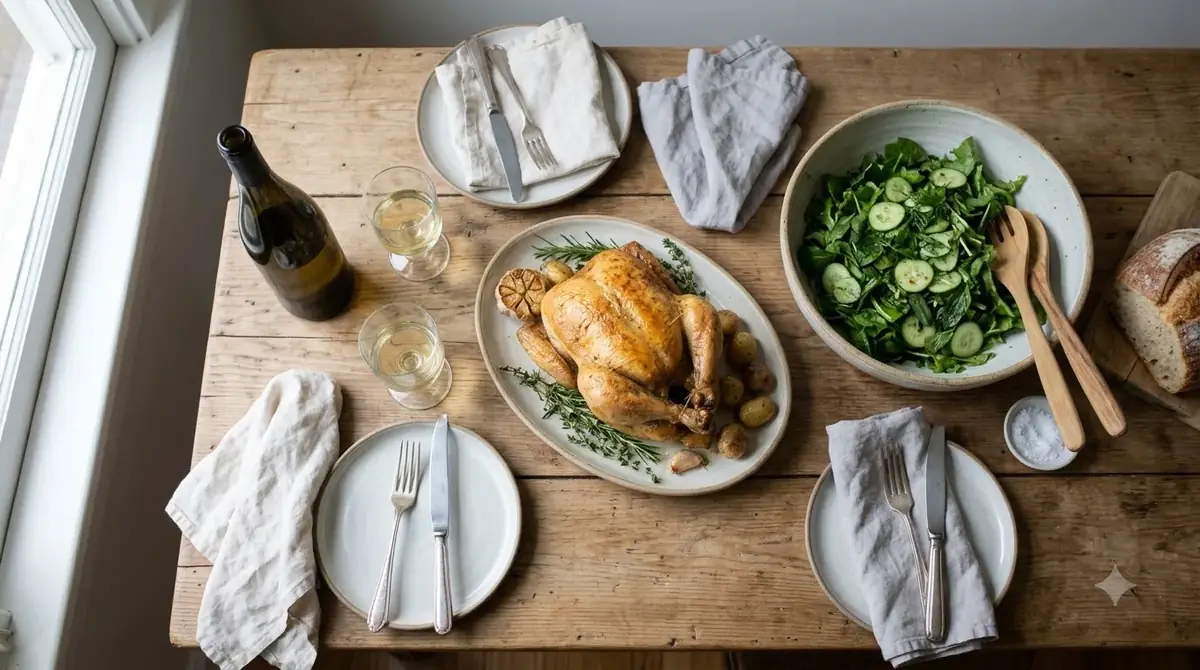
Gamay’s acidity and relatively low tannin make it an easy partner for roast chicken. The wine’s red-fruit flavors complement browned skin, savory herbs, and roasted vegetables without overpowering the meat. It also works with mushroom dishes, particularly when they include butter, garlic, thyme, or earthy sauces.
Charcuterie is another excellent match. Gamay’s freshness cuts through the richness of cured meats, while its fruit complements salty components such as prosciutto and saucisson. Mild and medium-aged cheeses also work well because the wine’s moderate structure does not overwhelm their flavors.
Grenache is particularly successful with grilled meats and Mediterranean dishes. Its ripe fruit and spice complement lamb, beef kebabs, grilled pork, and roasted vegetables seasoned with rosemary or thyme. Richer Grenache can also stand up to hearty lentil dishes and savory stews.
For tomato-based food, Gamay often has an advantage because its higher acidity can better match the dish’s tartness. Grenache can still work, especially with slow-cooked tomatoes, roasted peppers, and preparations that bring out sweeter, more concentrated flavors.
Spice requires additional attention. Grenache’s alcohol can make chili heat feel more intense, particularly in bottles above 14% ABV. Gamay is often the safer option for mildly spicy food because its lighter body and brighter acidity can feel less overwhelming, although very hot dishes can challenge both wines.
Pairing ideas for each grape
Consider these combinations when planning a meal:
- Gamay with roast chicken: Fresh raspberry and cherry flavors complement roasted poultry and herbs.
- Gamay with mushroom risotto: Earthy mushroom flavors work well with Gamay’s fruit and moderate tannin.
- Gamay with charcuterie: Acidity balances salty cured meats and rich pâtés.
- Grenache with grilled lamb: Ripe fruit, pepper, and spice complement grilled meat and rosemary.
- Grenache with roasted vegetables: The wine’s fruit intensity works with caramelized onions, peppers, and eggplant.
- Grenache with Mediterranean stew: Its fuller body complements concentrated tomato, herbs, and savory ingredients.
Oily fish is generally a better match for lighter, low-tannin wines than for strongly structured reds. Gamay is the more promising option of these two when serving salmon or tuna, especially when the fish is grilled and accompanied by mushrooms or roasted vegetables. A very tannic or powerful Grenache can make oily fish taste metallic.
Acidity also deserves attention. A dish containing lemon juice, vinegar, or a strongly acidic tomato sauce generally needs a wine with equal or higher acidity. Gamay usually has the advantage here, while a ripe Grenache may taste comparatively soft beside a highly acidic preparation.
For another useful comparison of Grenache’s food compatibility, explore Grenache vs Pinot Noir, particularly if you are deciding between two fruit-forward reds for a poultry or mushroom dish.
Serving Temperature, Storage, and Aging Potential
Gamay generally benefits from slightly cooler service than Grenache, while both wines should be stored away from heat and light. Serving temperature affects perceived acidity, fruit aromas, tannin, and alcohol, making it an important part of enjoying either grape.
Serve lighter Gamay at approximately 55–60°F. This temperature helps preserve its fresh red-fruit aromas while keeping the wine lively. A simple Beaujolais or Beaujolais-Villages can benefit from a brief period in the refrigerator before serving.
More structured cru Beaujolais can be served toward the upper end of the light-red range. A Morgon or Moulin-à-Vent with greater concentration may benefit from a little more warmth to reveal its savory and floral aromas.
Grenache generally performs well at 60–65°F. This temperature range allows its ripe berry aromas, spice, and texture to emerge without making the alcohol seem excessively warm. Particularly powerful bottles should not be served too close to room temperature in a warm dining room.
Neither grape needs extensive decanting in every situation. Young, approachable Gamay can usually be poured directly into glasses. A structured cru Beaujolais may benefit from approximately 20–30 minutes of air if it seems closed or particularly firm.
Young, full-bodied Grenache can benefit from 30–60 minutes of decanting. This is especially useful for concentrated wines from Barossa Valley, McLaren Vale, or the southern Rhône. Older bottles require more care because excessive exposure to air can diminish their aromas.
How long can each wine age?
Basic Gamay is generally intended for consumption while its fruit remains fresh and lively. Beaujolais Nouveau and many straightforward Beaujolais wines are best enjoyed relatively young. However, quality cru wines can develop additional complexity over several years, particularly those from Morgon and Moulin-à-Vent.
Grenache also has a wide aging range. Everyday bottles are usually designed for earlier drinking, but concentrated wines from old vines and established vineyard sites can develop savory, earthy, and dried-fruit characteristics with bottle age. Certain structured southern Rhône and Australian examples can reward several years of cellaring.
For storage, keep bottles on their sides when sealed with natural cork, in a dark location near 55°F with stable temperature and humidity. Avoid frequent temperature fluctuations, direct sunlight, and warm storage areas.
After opening, refrigerate both wines and use a suitable closure. Most still red wines retain good drinking quality for approximately 3–5 days, although their aromas and freshness can change during that period. Allow refrigerated wine to warm slightly before serving if it has become too cold.
Pour approximately 5 ounces per glass. A standard 750 ml bottle provides about five servings, making one bottle a practical starting point for a small dinner with several courses.
For further grape comparisons, Grenache vs Shiraz and Grenache vs Syrah explain how blending partners and regional traditions influence the character of Grenache-based wines. You can also explore the broader Wine vs Wine collection for more comparisons.
Which Wine Should You Choose?
Choose Gamay if you want a fresh, lighter red with bright acidity and delicate fruit, and choose Grenache if you prefer a rounder wine with ripe berries, spice, and more alcohol warmth. Both can be excellent choices, but the right bottle depends on the food, occasion, and style of wine you enjoy.
Gamay is a particularly useful option for people who usually drink Pinot Noir or other lighter reds. It offers a similar emphasis on fruit and freshness, although its flavor profile and winemaking traditions are different. A Fleurie or Beaujolais-Villages is a good place to begin if you want something more interesting than an uncomplicated young red.
Grenache is worth exploring if you enjoy generous fruit and a softer, fuller palate. A Spanish Garnacha can provide a useful introduction, while southern Rhône and Australian examples offer opportunities to explore more complex styles. A Grenache-based GSM blend is another option if you enjoy additional structure from Shiraz and Mourvèdre.
Think about the meal before choosing. Gamay is usually more suitable for roast chicken, mushrooms, charcuterie, and acidic dishes. Grenache is often more successful with lamb, grilled vegetables, Mediterranean herbs, and moderately spiced meat dishes.
There is also no reason to assume that one grape is inherently better. A well-made, structured Gamay can be more compelling than a simple Grenache, just as an elegant old-vine Grenache can offer greater complexity than a basic Beaujolais. Comparing bottles from different regions is one of the best ways to understand what each grape can achieve.
For a simple starting point, try one Beaujolais and one Garnacha alongside the same roast chicken dinner. Compare their acidity, fruit intensity, alcohol warmth, and finish. This side-by-side approach reveals the practical differences more clearly than relying on grape descriptions alone.
Frequently Asked Questions
Is Gamay the same grape as Pinot Noir?
No. Gamay and Pinot Noir are separate grape varieties, although Gamay is a natural cross between Pinot Noir and Gouais Blanc. Their shared genetic connection helps explain some similarities in their red-fruit and floral characteristics. Gamay is most closely associated with Beaujolais, whereas Pinot Noir is strongly associated with Burgundy.
Is Grenache called something different in Spain?
Yes. Grenache is generally called Garnacha in Spain, and the name Garnacha Tinta is commonly used for the red variety. In Catalonia, Garnatxa is another regional name. Cannonau is the name used for a closely related grape identity in Sardinia.
Is Beaujolais Nouveau always made from Gamay?
Yes. Beaujolais Nouveau is made from Gamay, the principal red grape of Beaujolais. Its release takes place on the third Thursday of November following the harvest. The style emphasizes youthful fruit and is intended to be enjoyed without extended cellar aging.
What does GSM mean on a Grenache wine label?
GSM stands for Grenache, Syrah, and Mourvèdre, with Mourvèdre also known as Mataro in Australia. Grenache commonly provides ripe fruit and body, Syrah contributes darker fruit and additional structure, and Mourvèdre can add savory complexity and tannin. The proportions vary between producers and regions.
Can Gamay and Grenache be made into rosé wine?
Yes. Both varieties can produce rosé as well as red wine. Gamay rosé is made in Beaujolais and Beaujolais-Villages, while Grenache is widely used in Mediterranean-style rosé production. The finished wines can differ considerably in color, body, acidity, and fruit intensity depending on skin contact and winemaking decisions.
Gamay and Grenache offer two different approaches to fruit-forward red wine: one emphasizes freshness and lively acidity, while the other often delivers ripe fruit, spice, and a fuller texture. Start with Gamay for lighter meals and refreshing red-wine occasions, or choose Grenache for grilled dishes and richer flavors. Exploring Beaujolais, Spanish Garnacha, southern Rhône, and Australian Grenache is an excellent way to discover the range of both grapes.
More in Wine vs Wine
 Chenin Blanc vs Pinot Gris: Acidity, Body, and Pairing DifferencesUpdated Nov 20, 2026
 Chianti vs Lambrusco: How Tuscany and Emilia-Romagna Reds CompareUpdated Nov 20, 2026
 Chianti vs Primitivo: Key Differences in Taste, Body, and PairingUpdated Nov 20, 2026
 Chianti vs Rioja: Key Differences in Taste, Aging, and PairingUpdated Nov 20, 2026
 Chianti vs Shiraz: How Acidity, Body, and Food Pairings CompareUpdated Nov 20, 2026
 Chianti vs Syrah: Key Differences in Taste, Body, and Food PairingUpdated Nov 20, 2026