
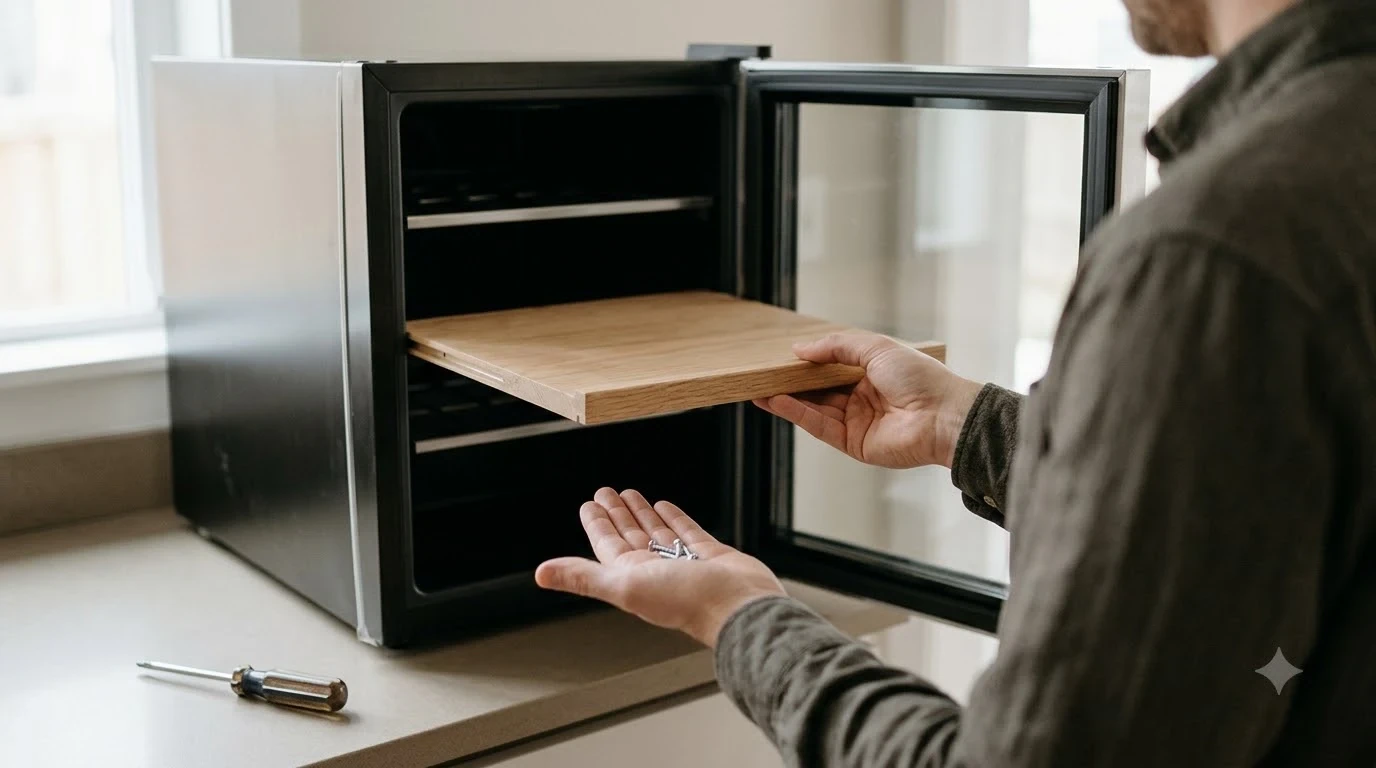

We may earn a commission when you buy through links on this page, at no extra cost to you. Learn more.
The frigidaire 18 bottle wine fridge is a compact freestanding wine cooler designed for households that want to keep up to 18 bottles organized and ready to serve. Its appeal comes from dual-zone temperature control, a glass viewing door, interior lighting, and a relatively narrow cabinet. However, model numbers matter: the FFWC18L2QB and FFWC18B2RB have different published temperature specifications, and neither should automatically be treated as the same appliance. Buyers should also consider bottle dimensions, ventilation clearance, and long-term availability before purchasing.
Frigidaire’s 18-bottle wine coolers occupy a useful middle ground between small countertop chillers and larger wine cabinets. They provide room for a modest selection of reds, whites, and sparkling wines without requiring an entire wall or dedicated wine room. The important question is whether their actual storage arrangement, cooling capabilities, and operating requirements suit your collection. This review examines the available specifications, customer feedback, practical limitations, and what to verify before buying one new or secondhand.
Specs and Key Features of the Frigidaire 18-Bottle Wine Cooler
The main attraction is a slim freestanding cabinet with 18-bottle advertised capacity, two temperature zones, eight shelves, and digital temperature controls. The FFWC18L2QB is particularly interesting for buyers who want separate cooling settings for different wine styles.
The first distinction to understand is the model number. Frigidaire’s 18-bottle category includes multiple models, and their specifications are not interchangeable. The FFWC18L2QB is listed by Lowe’s with a 41°F to 64°F temperature range, while Best Buy’s FFWC18B2RB listing gives a 46°F to 66°F range. Both listings describe dual-zone cooling, but those different published ranges matter when choosing temperatures for particular bottles. The Lowe’s Frigidaire 18-bottle cooler listing provides the product-specific specifications for the FFWC18L2QB.
| Specification | FFWC18L2QB | FFWC18B2RB |
|---|---|---|
| Advertised capacity | 18 bottles | 18 bottles |
| Cooling zones | 2 | 2 |
| Temperature range | 41°F–64°F | 46°F–66°F |
| Storage shelves | 8 | 8 |
| Temperature display | LED | Digital |
| Exterior | Black | Black |
| Installation | Freestanding | Freestanding |
| Published dimensions | Not confirmed in the cited listing | 37.25″ H × 9.88″ W |
These are useful specifications, but they do not tell the entire story. A cooler’s advertised capacity is based on particular bottle dimensions, not every wine bottle available at a retailer. Standard Bordeaux bottles are generally easier to organize than wider Champagne bottles, Burgundy bottles, and some sparkling wine formats. Eight shelves provide multiple storage positions, but the usable capacity depends on how the bottles fit together.
The dual-zone feature is the strongest practical advantage. Separate temperature controls allow a household to keep a white wine section colder than a red wine section. This can reduce the need to move bottles between a regular refrigerator and a wine cabinet before dinner. It is especially convenient for households that regularly drink both Chardonnay and Cabernet Sauvignon.
The glass door and interior light also make the cabinet easier to use. You can identify bottles without opening the door repeatedly, while the black finish gives it a straightforward appearance that suits a home bar, dining area, or kitchen. Neither feature replaces good temperature management, but both improve everyday convenience.
For shoppers comparing this model with other appliances, the broader Brand x Capacity wine cooler reviews category provides a useful starting point for understanding the differences between compact and larger-capacity designs.
What Owners Like About Its Cooling and Storage
Customer feedback highlights temperature control, compact dimensions, and appearance as important strengths of Frigidaire’s 18-bottle wine cooler. The dual-zone arrangement is particularly appealing because it allows two different wine styles to remain accessible without using separate appliances.
Best Buy’s customer review page for the FFWC18B2RB displays an average rating of 4.6 out of 5 from 278 reviews. Its review summaries identify temperature control, size, and design among the frequently mentioned positive features. These figures provide a useful indication of customer sentiment for that particular model, although they should not be assumed to represent every Frigidaire 18-bottle appliance.
Temperature flexibility is one reason owners appreciate this type of cooler. A household might reserve the upper zone for Sauvignon Blanc, Pinot Grigio, or sparkling wine and the lower zone for Merlot, Pinot Noir, or Cabernet Sauvignon. The exact temperature arrangement depends on the model’s controls and published operating limits, but the general advantage is having two separately adjustable environments in one cabinet.
Compact width is another recurring attraction. The FFWC18B2RB listing gives a width of 9.88 inches, making its footprint considerably narrower than many conventional wine refrigerators. That can be helpful in a small kitchen or home bar where a standard refrigerator-sized appliance would take up too much floor space.
The vertical arrangement also makes the cabinet practical for everyday bottle organization. Eight shelves create several storage levels, allowing users to group wines by color, grape variety, drinking occasion, or price category. For example, a household could dedicate several positions to everyday whites, reserve another section for reds, and keep a few sparkling bottles available for celebrations.
Interior lighting and the viewing door contribute to the appliance’s presentation. A collection becomes part of the room rather than disappearing inside an opaque cabinet. Customers also mention the appearance of the controls and lighting positively, which helps explain why this design appeals to people furnishing a home entertainment area.
Noise feedback is more mixed. Some Best Buy reviewers describe the appliance as quiet or unobtrusive, while noise level also appears among the frequently mentioned concerns. That difference is unsurprising because installation surfaces, room acoustics, appliance condition, and individual expectations all influence how noticeable a refrigerator sounds.
In other words, customer feedback suggests a convenient everyday appliance rather than a specialist wine-storage cabinet. Its strengths are accessibility, organization, and flexible cooling, not advanced cellar-management features.
Common Complaints and Practical Limitations
The biggest limitations are the advertised bottle count, uncertainty about long-term reliability, and differences in operating noise. The cooler also requires proper ventilation and careful placement, so its narrow appearance should not encourage buyers to squeeze it into an unsuitable enclosed space.
Capacity deserves particular attention. Eighteen bottles is the manufacturer’s advertised storage figure, not a guarantee that every combination of 18 bottles will fit. Standard 750 ml Bordeaux bottles are relatively uniform, while Champagne and some Burgundy bottles have wider bodies that can interfere with adjacent bottles or shelf spacing.
This distinction matters if sparkling wine is a regular part of your collection. A bottle of Champagne can be noticeably wider than a standard bottle of Cabernet Sauvignon. Loading several oversized bottles may reduce the number of bottles that fit comfortably. Buyers should therefore treat the advertised number as a maximum based on the intended bottle configuration rather than a universal guarantee.
Temperature capability is another consideration. The FFWC18L2QB’s published range of 41°F to 64°F gives it flexibility for serving-temperature storage, but it does not offer the same low-temperature capability as a conventional refrigerator. The FFWC18B2RB’s published 46°F minimum is higher still. That distinction is important if you want to keep sparkling wines especially cold.
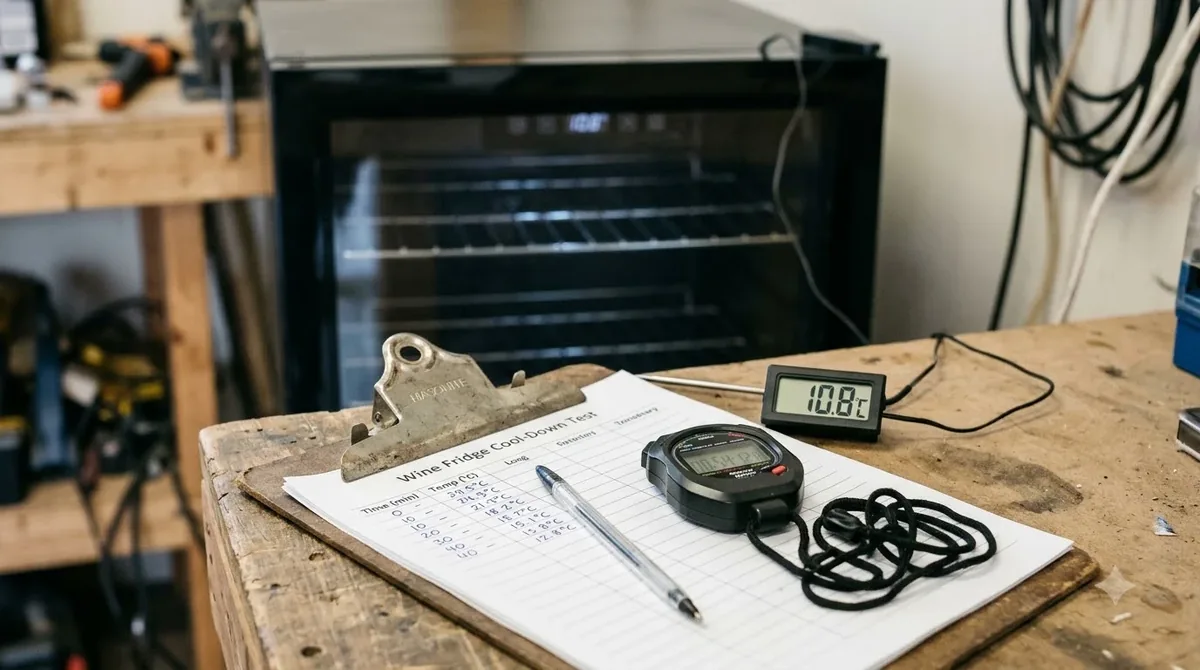
There is also a difference between a displayed set temperature and the temperature experienced by every bottle. Opening the door, loading multiple room-temperature bottles, and placing the cooler in a warm room can affect cooling performance. An independent thermometer can help buyers understand actual conditions rather than relying entirely on the control-panel number.
Durability deserves attention before purchasing an older or used appliance. Lowe’s customer feedback for the FFWC18L2QB includes reports of cooling problems developing after several years, while other customers describe satisfactory cooling and convenient operation. Such individual experiences cannot establish a universal lifespan, but they demonstrate why condition and service history matter when buying a discontinued model.
Noise is another possible drawback. Refrigeration equipment can produce compressor sounds, fan noise, and occasional operational changes. A unit placed beside a television, in a bedroom, or directly next to a dining table may be more noticeable than one installed in a separate kitchen or utility area.
Finally, availability can complicate ownership. Lowe’s identifies the FFWC18L2QB as no longer sold through its website, and Best Buy lists the FFWC18B2RB as unavailable in new condition. Buyers searching for either model may encounter used inventory, old listings, or replacement products rather than a currently stocked appliance.
Who Should Buy It and Who Should Skip It
The Frigidaire 18-bottle design makes the most sense for households with a modest collection and regular access to both red and white wine. It is less suitable for serious collectors, people who routinely buy oversized bottles, and anyone who needs a cabinet specifically designed for long-term wine aging.
It makes sense for casual wine drinkers. If you typically keep 6 to 18 bottles at home, the advertised capacity provides a reasonable organizing target. You can maintain a small selection of everyday wines, a few bottles for entertaining, and different varieties for weeknight meals.
It is also appealing for people who drink different styles throughout the week. Someone who enjoys chilled Sauvignon Blanc with seafood on Friday and Merlot with a Sunday roast can appreciate the convenience of separate temperature zones. The ability to keep both styles accessible is more useful than having one undivided storage compartment.
Home bar owners may also appreciate the narrow design. The FFWC18B2RB’s published width of 9.88 inches makes it an interesting option where floor space is limited. However, remember that the complete installation requires clearance around the cabinet, so the usable space must be greater than the appliance’s stated width.
Who should consider another wine cooler?
Collectors who regularly purchase expensive bottles for extended aging should look for a more specialized wine cabinet. Long-term storage involves more than achieving a convenient serving temperature. Temperature stability, vibration management, humidity conditions, light protection, and consistent airflow become increasingly important.
People who primarily purchase Champagne or other wide-format sparkling wines should also compare shelf dimensions before buying. An advertised 18-bottle capacity may be difficult to achieve with a collection dominated by wider bottles.
Large households and frequent entertainers may find the capacity restrictive. Eighteen bottles can disappear quickly when hosting several guests, especially if the collection includes different wines for appetizers, dinner, and dessert. A larger 24-, 38-, or 52-bottle cabinet may be more appropriate for those needs.
Finally, anyone looking for an undercounter or integrated kitchen appliance should skip this freestanding design unless the specific model’s installation documentation expressly supports the intended arrangement. A narrow cabinet is not automatically a built-in appliance.
Tip: Before purchasing a used Frigidaire wine cooler, test both temperature zones independently, inspect the door seal, listen for unusual fan or compressor noises, and measure the cabinet opening. A functioning display alone does not prove that both compartments cool correctly.
How It Compares to Alternative Wine Storage Options
The Frigidaire 18-bottle wine fridge is best understood as a compact convenience appliance rather than a universal wine-storage solution. A single-zone wine cooler, a larger dual-zone cabinet, and a standard kitchen refrigerator each serve different purposes.
A single-zone cooler generally makes more sense if you primarily drink one type of wine or prefer storing everything at a consistent cellar-style temperature. Its simpler configuration can be sufficient for a collection made up mostly of reds or mostly of whites. However, it lacks the flexibility of two separate temperature settings.
A larger dual-zone cabinet offers a more practical solution for people whose collections are expanding. More storage capacity reduces the need to rearrange bottles and provides room for wider formats, depending on the shelf configuration. It can also make organizing wines by producer, region, or drinking occasion easier.
A regular kitchen refrigerator is another alternative, especially for people who only occasionally drink wine. It can chill a bottle before serving, but its colder operating environment is not necessarily ideal for maintaining a wine collection over extended periods. It also offers no dedicated wine racks, and food odors can be a concern when bottles are stored without proper closures.
For serving, the preferred temperatures depend on the wine style rather than the cooler brand. Sparkling wine generally benefits from 40°F to 50°F, light whites and rosé from 45°F to 50°F, and fuller-bodied whites from 50°F to 55°F. Light reds are often best around 55°F to 60°F, while fuller reds are generally served around 60°F to 65°F.
These ranges help explain why dual-zone flexibility is useful. A lighter white wine and a full-bodied red do not necessarily benefit from the same serving temperature. However, the appliance’s actual temperature limits determine which combinations are practical.
The cooler also works best as part of an organized entertaining setup. You could keep a bottle of chilled sparkling wine ready for an Aperol Spritz recipe occasion while reserving the red wine section for bottles intended to accompany dinner. A separate wine-storage appliance makes this type of organization more convenient, provided the capacity matches your actual habits.
For anyone considering an upgrade, the important comparison is not simply 18 bottles versus 24 bottles. It is whether the larger cabinet provides better shelf spacing, more useful temperature flexibility, and a suitable installation design. Those factors can matter more than the advertised capacity alone.
Buying, Installation, and Ownership Considerations
Purchasing an older Frigidaire 18-bottle model requires more attention to the exact model number, physical condition, and installation requirements than buying a currently stocked appliance. Both the FFWC18L2QB and FFWC18B2RB have useful published specifications, but their availability and documentation should be checked individually.
Start by identifying the complete model number on the appliance’s rating plate. This is especially important with used inventory because listings sometimes combine specifications or photographs from different Frigidaire products. The temperature range, dimensions, warranty, and available replacement parts should all correspond to the same model.
Next, measure the installation area. For the FFWC18B2RB, Best Buy lists a height of 37.25 inches and a width of 9.88 inches. Those measurements are useful starting points, but you must also account for the door opening, electrical outlet, and ventilation requirements.
Frigidaire’s wine cooler installation guidance recommends two inches of clearance at the back and sides for airflow. It also recommends an ambient room temperature between 70°F and 78°F for optimal performance. These instructions are important because the cooler needs to release heat through its exterior cooling system. The Frigidaire wine cooler use and care guide provides additional installation, operation, and cleaning instructions.
Do not assume a tight cabinet enclosure will work simply because the appliance is narrow. Poor ventilation can interfere with cooling and make the refrigeration system work harder. A position away from direct sunlight, ovens, heating ducts, and other heat-producing appliances is preferable.
The installation surface should also be level and stable. Frigidaire’s guidance explains that an uneven cabinet can prevent the door from aligning and sealing correctly. A poorly sealed door can contribute to cooling problems, frost, and moisture accumulation.
Initial setup and temperature adjustment
Allow sufficient time for the cooler to reach its operating temperature before loading the collection. Frigidaire’s general wine cooler guidance recommends allowing four hours for a complete cooldown. Loading a full cabinet immediately after switching it on can make it harder to evaluate its cooling performance.
Once the cabinet has cooled, set the upper and lower compartments according to the wines you store. For example, a selection of light whites and rosé can benefit from a colder zone, while the red section can be set warmer. The published model-specific limits should determine the final settings.
A separate thermometer is useful during the first several days. Check both compartments after the cooler has stabilized, rather than assuming that the control-panel reading represents every shelf equally. Avoid packing bottles tightly against the rear panel because air circulation matters.
Cleaning is straightforward. Frigidaire’s guidance recommends mild detergent and warm water for removable interior components and exterior surfaces. Avoid harsh cleaners and abrasive tools that can damage the finish or glass.
Electrical installation also deserves attention. The manufacturer’s general guidance specifies a properly grounded electrical outlet and advises against using extension cords or adapter plugs. Follow the instructions for the exact model and have any electrical concerns addressed before operation.
Finally, consider the warranty and service situation. Lowe’s lists a one-year warranty for the FFWC18L2QB, but warranty coverage should be verified against the specific unit, purchase documentation, and current manufacturer support terms. A secondhand appliance may not carry the same protection as a new purchase.
Frequently Asked Questions
Does the Frigidaire 18-bottle wine fridge use a compressor or thermoelectric cooling?
The exact cooling-system specification should be verified against the complete model number and its corresponding technical documentation. Do not assume that every Frigidaire wine cooler uses the same refrigeration technology. The distinction can affect operating noise, heat management, and suitability for different room conditions.
Can the Frigidaire 18-bottle wine fridge store opened wine bottles?
It can accommodate appropriately sized, securely closed bottles, but it is not designed to preserve opened wine by itself. Reinsert the original closure or use a suitable wine stopper before returning a bottle to storage. Opened still wine generally keeps for approximately three to five days in a refrigerator, depending on the wine and closure.
Can the Frigidaire 18-bottle wine fridge be transported on its side?
Frigidaire’s installation guidance recommends keeping the wine cooler upright during transportation. Moving it upright helps avoid unnecessary complications with the refrigeration system. Allow the appliance to settle according to its model-specific instructions before reconnecting it after a move.
Does the glass door protect wine from all harmful light?
A glass door should not be assumed to provide complete protection from light exposure. Direct sunlight and prolonged exposure to strong artificial lighting can still be concerns for stored wine. Place the cooler away from sunny windows and avoid leaving its interior light on unnecessarily.
Can the Frigidaire wine cooler be used to store beer and soft drinks?
Its shelves and temperature controls are designed around wine storage, so other beverage containers may not fit the intended arrangement. Frigidaire’s general wine cooler guidance also cautions against using the appliance for food storage because its internal temperature may not be cold enough to prevent spoilage. Check the instructions for the exact model before using it for anything other than wine.
The Frigidaire 18-bottle wine fridge remains an appealing concept for households that want compact storage, dual-zone flexibility, and straightforward access to a modest wine collection. Its main strengths are convenience and organization, while bottle fit, operating noise, installation clearance, and discontinued-model availability deserve careful consideration. Verify the complete model number and test the cooling performance before purchasing, particularly when shopping for an older unit.
More in Model Reviews
 Magic Chef 44 Bottle Wine Cooler Review for Flexible StorageUpdated Nov 21, 2026
 Whynter 164 Bottle Wine Cooler Review: Capacity, Features, and FitUpdated Nov 21, 2026
 Insignia NS WC16BK6 Review: Compact 16-Bottle Wine StorageUpdated Nov 21, 2026
 Wine Enthusiast Electric Blue Omega Review: Opening, Pouring, and Preserving Made EasierUpdated Nov 21, 2026
 Koolatron 20 Bottle Wine Cooler Review: Features, Fit, and PerformanceUpdated Nov 21, 2026
 NewAir AWC 330E Review for Home Wine StorageUpdated Nov 21, 2026