

We may earn a commission when you buy through links on this page, at no extra cost to you. Learn more.
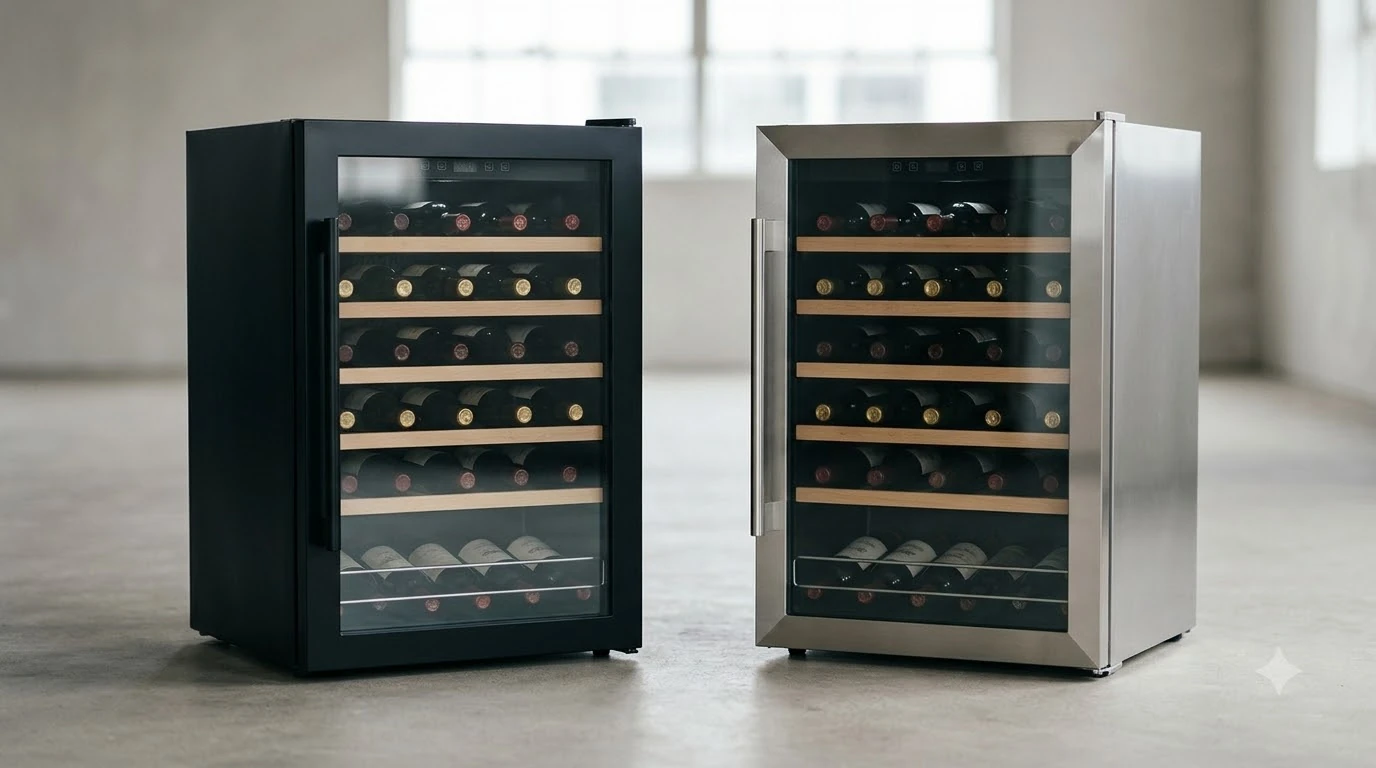
The ca lefort 24 inch wine fridge is a dual-zone, front-venting compressor cooler suited to an under-counter wine collection, but buyers should verify the exact hinge and capacity version before installation. The current Ca’Lefort page lists a 52-bottle layout, while the CLF-WD24 owner’s manual describes about 46 standard Bordeaux bottles. Its useful combination is a 40°F to 65°F setting range, separate upper and lower zones, and a cabinet under 34 inches tall; the specification inconsistencies make careful measurement essential.
This review focuses on Ca’Lefort’s 24-inch dual-zone wine fridge, commonly associated with the CLF-WD24 family. It is not a review of the brand’s single-zone or wine-and-beverage models, which share a similar width but have different interiors. The best reason to consider this unit is the combination of front ventilation and two temperature zones. The main reason to pause is that the model name, bottle count, dimensions and hinge option can vary across listings and revisions.
Specs and Key Features
The current product page describes a 23.8-inch-wide, 23.4-inch-deep cabinet with a 33.8-inch height, a 40°F to 65°F range and two zones. It lists 18 bottles in the upper zone and 34 in the lower, but the CLF-WD24 manual gives a more conservative estimate of approximately 46 Bordeaux bottles.
| Specification | Published detail | What it means |
|---|---|---|
| Installation | Built-in or freestanding; front venting | Designed for under-counter use when the front grille stays unobstructed |
| Cabinet dimensions | 23.8 in. W × 23.4 in. D × 33.8 in. H | Current product-page figures; manual lists width and depth in the opposite order |
| Depth with handle | 25.1 in. | Allow for the handle and door movement in the room layout |
| Listed capacity | 52 bottles: 18 upper, 34 lower | Current webpage count; manual says about 46 traditional 750 ml Bordeaux bottles |
| Temperature range | 40°F–65°F (5°C–18°C) | Independent set points for the two zones, with an operating relationship between them |
| Cooling and airflow | Compressor; front vent; frost-free defrost | Better suited to a fitted cabinet than a rear-venting cooler |
| Noise and electrical | 41 dB; 0.9 A | Manufacturer-published figures for the listed configuration |
| Construction | Double-pane UV-protective glass; carbonized wood shelves; stainless finish | Storage features with a display-oriented front |
| Other features | White, blue and amber lighting; charcoal filter; adjustable feet | Lighting choices and odour filtration; the filter needs periodic replacement |
| Published warranty | 1 year unit; 2 years parts; 3 years compressor | Read the current seller terms and service-labour exclusions before ordering |
The live configuration, including the available hinge selection, appears on Ca’Lefort’s 24-inch dual-zone product page. The cooling layout is designed for different serving preferences rather than a dedicated long-term cellar temperature in each zone. Ca’Lefort describes short-term red-wine settings around 54°F to 65°F and whites around 40°F to 54°F, with 54°F suggested for longer storage. The older CLF-WD24 manual says both zones can be adjusted from 40°F to 65°F, that the lower zone must be the same temperature as or warmer than the upper zone, and that the settings should differ by at least 4°C for best performance. That relationship matters: do not assume that the two compartments are completely independent of each other.
The specification sheet also lists a 106.6-pound weight, 0.9-amp draw and a 41 dB operating figure. Those numbers help with planning, but they do not answer every installation question. The current webpage gives the body as 23.8 inches wide by 23.4 inches deep; the older manual gives 23.4 inches wide by 23.8 inches deep. Since the two measurements are so close, this may be a revision or documentation issue, but a cabinet cutout should not be based on a guess. Confirm the exact model’s drawing, including the handle depth of 25.1 inches, before cabinetry is finished.
What Owners Like
Owners who choose this style of cooler are often looking for an integrated appearance without giving up separate wine temperatures. Ca’Lefort’s own customer page includes comments praising its appearance beside a matching beverage cooler, the stainless and glass presentation, and the convenience of keeping whites colder than reds. One owner describes the pair as quiet in a home bar, while another says the design suited a newly built home. These are useful indications of what buyers value, but brand-hosted comments are anecdotal rather than a controlled reliability record.
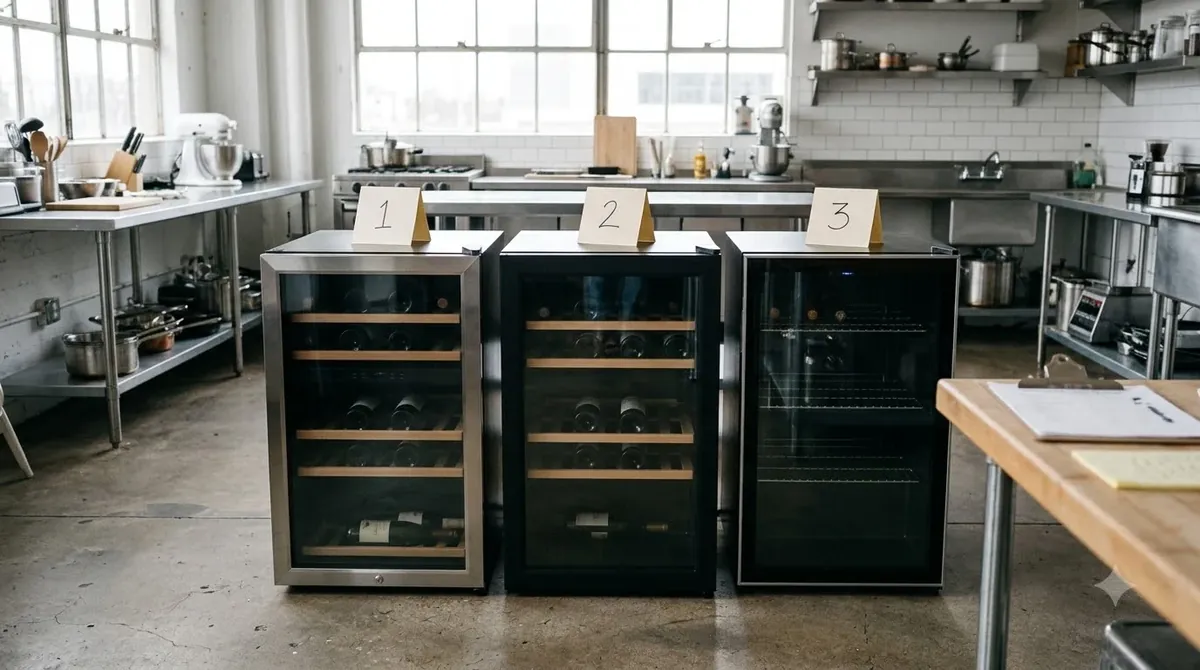
The feature mix is appealing for a kitchen or bar because the front vent allows the cabinet to be installed under a counter, while the glass door makes the bottles visible. The wood shelves soften the appearance compared with an all-wire interior, and the three lighting choices—white, blue and amber—let the owner choose a display tone or switch the light off. A compressor system also gives the unit a wider temperature range than a small wine chiller intended only for a few bottles. For someone storing Champagne, Sauvignon Blanc, Chardonnay and lighter reds at once, two compartments are more practical than one shared setting.
Independent coverage of the right-hinged CLF-WD24-A version notes the same strengths: front ventilation, two temperature zones, one-degree adjustments and a compact height below 34 inches. That review also distinguishes a right-hinged version from a left-hinged Ca’Lefort variant. This matters for a finished kitchen: a fridge that cools correctly can still be awkward if the door opens toward a wall, island, drawer bank or main walkway. Confirming the hinge before delivery is a real convenience, not a cosmetic detail.
Common Complaints
The largest purchasing concern is the mismatch in capacity claims. The current Ca’Lefort page describes 18 upper-zone and 34 lower-zone bottles, which adds to 52, even though the product title refers to a 46-bottle fridge. The CLF-WD24 manual says approximately 46 traditional Bordeaux bottles and illustrates its own loading arrangement. A third-party review of the CLF-WD24-A finds 51 bottles in its title and 52 in its bullets, and notes that some owners refer to a 46-bottle unit. The safest interpretation is that the 24-inch family has inconsistent listings or revisions, not that every example reliably stores the highest advertised count.
Nominal capacity is also not the same as everyday capacity. Bottle-count claims are typically based on a standard Bordeaux shape; Burgundy bottles have broader shoulders, Champagne bottles are wider, and some specialty bottles are unusually tall or broad. The manual itself notes that bottle dimensions vary and that bottles on the bottom shelf cannot be longer than 12 inches. If a collection contains a mix of Pinot Noir, sparkling wine and larger-format bottles, expect fewer bottles than the headline figure. A fridge filled to its theoretical maximum is also less convenient if labels are hidden or a shelf must be emptied to reach a bottle.
Shelf access and noise deserve attention too. Wine Cellar Diva summarizes owner reports that shelves do not extend fully, some slats feel narrow for particular bottles, and a minority of owners notice a persistent high-pitched whir. Other owners describe the unit as quiet, so the reports are mixed rather than proof of a universal noise fault. The same review notes that controls are inside the door and that no lock is listed. A separate Trustpilot reviewer of a Ca’Lefort 24-inch dual-zone fridge reported a strong smell from the wood racks, including replacement racks; that is one customer’s account, not evidence that every unit has the problem, but it is a sensible arrival-day inspection point.
Who Should Buy and Who Should Skip
This model makes the most sense for a household with a dedicated kitchen or bar space, a collection that has outgrown a countertop cooler, and a preference for keeping whites and reds at different serving temperatures. It is especially relevant when an opening is planned around a front-venting appliance and the cabinet height is limited to roughly 34 inches. The two zones can separate Champagne or Sauvignon Blanc from Pinot Noir or Merlot, and the adjustable temperature range gives more choice than a single-temperature beverage refrigerator.
It is less suitable for a buyer who needs a guaranteed 52-bottle usable capacity, stores many oversized Burgundy or Champagne bottles, or wants a lock and full-extension shelves. It is also not the right choice for a quiet open-plan room if even a small chance of compressor or fan noise is unacceptable. The published 41 dB figure is a useful benchmark, but the independent owner-summary reports show that perceived sound is not uniform. For a bedroom-adjacent bar or a very quiet living room, consider the location carefully and confirm the return terms before committing.
Installation is the deciding factor for many buyers. Front ventilation is the right feature for an under-counter design, but it does not remove the need to keep the grille clear, level the cabinet and allow for the door to swing. The unit weighs 106.6 pounds on the current product page, so moving it into a narrow recess is a two-person task. The manual also asks owners to keep the appliance away from direct sunlight and heat-producing equipment and to leave ventilation space around it. Do not treat “24 inch” as a finished cutout dimension: confirm width, depth, height, handle projection and hinge direction on the exact item being shipped.
Tip: Before ordering, ask the seller to confirm the model suffix, hinge side, usable bottle capacity, and a dimensioned installation drawing in writing. Compare that drawing with the cabinet opening and the fully open door path, not just the advertised 24-inch category.
How It Compares to Alternatives
The closest comparison depends on whether cabinet fit or storage flexibility matters more. The version-specific details are also covered in the independent Ca’Lefort CLF-WD24-A review. Wine Cellar Diva compares the Ca’Lefort CLF-WD24-A with the left-hinged CLF-WD24L-26US and the Kalamera KRC-150DZB-C3. In that comparison, the Ca’Lefort versions share a cabinet about 23.8 inches wide, 23.4 inches deep and 33.8 inches high, with a 40°F to 65°F range; the practical distinction between the Ca’Lefort variants is primarily hinge orientation and listing history. This illustrates why the model suffix deserves more attention than a product-page title.
The Kalamera KRC-150DZB-C3 is the alternative to investigate if a reversible door and lock are higher priorities. Wine Cellar Diva lists it as a 46-bottle dual-zone unit measuring 23.4 inches wide, 22.4 inches deep and 33 inches high, with a one-year warranty. Its listed capacity is lower than the higher Ca’Lefort webpage figure, but the reversible door and lock may solve practical requirements that matter more than a few nominal bottle spaces. These are comparison details from the independent reviewer’s model table, so check the exact Kalamera specification before buying rather than assuming every retailer listing is identical.
For a buyer who wants front ventilation, a stainless look and the option of a right- or left-hinged Ca’Lefort configuration, the Ca’Lefort remains a reasonable candidate. For someone who wants an unambiguous capacity figure, a lock or a reversible hinge, the comparison unit may deserve a closer look. Readers comparing wine storage appliances can also browse our wine fridge reviews for other formats. Keep the use case in mind: a wine-only two-zone cabinet is not interchangeable with a wine-and-beverage fridge, even when both products fit a similar opening.
Frequently Asked Questions
These answers address installation and operation details that are easy to miss when comparing the 40°F to 65°F temperature range, the 23.8-inch product-page width and the advertised bottle count. The owner’s manual contains several practical instructions that are separate from the headline specifications.
Should the wine fridge be plugged in as soon as it is delivered?
No. The CLF-WD24 manual says to keep the appliance upright and let it stand for 24 to 36 hours before connecting it to power. This is a delivery and setup instruction, so plan for that waiting period before loading bottles.
What should you do before restarting it after an outage?
After the appliance has been unplugged, lost power or been switched off, the manual instructs owners to wait 3 to 5 minutes before restarting it. Trying to restart sooner may prevent the cooler from starting immediately.
What electrical supply does the manual specify?
The manual identifies a 115-volt, 60-hertz supply and a rated current of 0.9 amp. It calls for a grounded three-prong outlet and advises against an extension cord; electrical work or outlet questions should be handled by a qualified electrician.
Can this wine fridge be used to chill groceries or prepared food?
No. The manual specifically says the appliance is designed for storing and cooling wine, not perishable foods. Treat it as a wine cabinet rather than a small general-purpose refrigerator.
What room temperature does the manual recommend?
The operating section recommends placing the cooler where the surrounding temperature is 66°F to 75°F. It warns that hotter or colder surroundings can affect performance and may prevent the cabinet from reaching its full published temperature range.
The Ca’Lefort 24-inch dual-zone fridge offers a useful built-in format and flexible wine temperatures, but its capacity and dimensional documentation deserve more scrutiny than the average appliance listing. Confirm the exact revision and installation drawing before purchase, then plan for a realistic bottle mix rather than the most optimistic count. For serving ideas once the collection is set up, pair the fridge with an Aperol Spritz recipe or a weeknight chicken Marsala recipe.
More in Model Reviews
 Magic Chef 44 Bottle Wine Cooler Review for Flexible StorageUpdated Nov 21, 2026
 Whynter 164 Bottle Wine Cooler Review: Capacity, Features, and FitUpdated Nov 21, 2026
 Insignia NS WC16BK6 Review: Compact 16-Bottle Wine StorageUpdated Nov 21, 2026
 Wine Enthusiast Electric Blue Omega Review: Opening, Pouring, and Preserving Made EasierUpdated Nov 21, 2026
 Koolatron 20 Bottle Wine Cooler Review: Features, Fit, and PerformanceUpdated Nov 21, 2026
 NewAir AWC 330E Review for Home Wine StorageUpdated Nov 21, 2026