

We may earn a commission when you buy through links on this page, at no extra cost to you. Learn more.
The brookstone wine preserver is a battery-powered vacuum sealer that removes headspace air automatically and tracks bottle age on a built-in LCD screen, making it convenient for casual midweek drinkers but battery-hungry for heavy use. Its motorized pump re-engages whenever air seeps past the rubber gasket, keeping still reds and whites drinkable for several days without manual pumping. However, rapid AAA battery drain, upright-only storage rules, and sensitivity to non-standard bottle necks keep it from matching argon systems or simple half-bottle transfers for expensive bottles.
Leftover wine begins losing fruit vibrancy within hours once oxygen hits the surface, yet most home drinkers do not want to buy pricey argon capsules for an everyday Tuesday bottle. Brookstone targets that middle ground with motorized vacuum sealers—sold both as a single-bottle unit with an integrated temperature display and as a multi-stopper countertop set—designed to take the wrist work out of resealing opened wine.
Specs and Key Features
Brookstone sells two main vacuum preservation configurations: the single-bottle Automatic Wine Preserver (model 918650 / 314687) with an onboard LCD screen, and a multi-bottle set featuring a separate motorized wand, three date-dial stoppers, and a storage stand. Both versions rely on battery-driven suction rather than inert gas cartridges to slow oxidation.
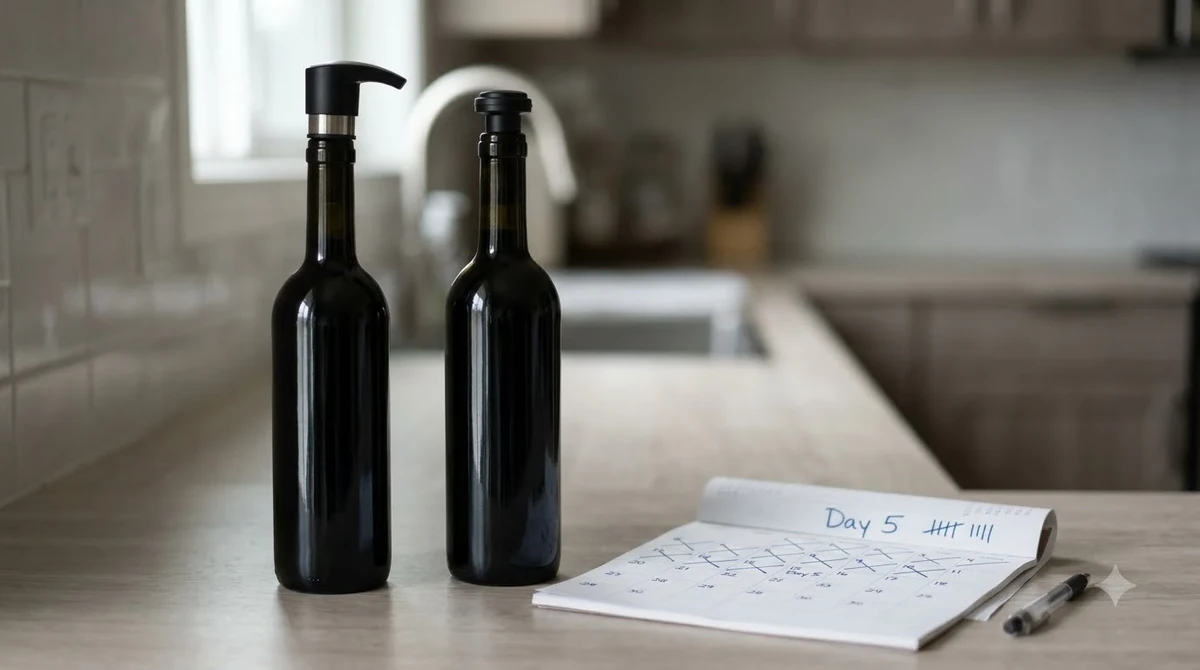
According to the Brookstone Automatic Wine Preserver instruction manual, the single-bottle unit runs on two AAA batteries housed beneath a twist-off top cap. Sliding the rubber vacuum seal stopper straight onto a standard 750 ml bottle neck and holding the TEMP/DAY button for three seconds activates the motor. During startup, the backlit LCD illuminates and cycles through a 1-2-3 countdown followed by four blinking zeros until target vacuum pressure is reached, then switches to displaying ambient temperature.
A pressure sensor inside the cap monitors the bottle interior continuously and triggers brief top-up pumping cycles whenever outside air sneaks past the seal. Pressing and releasing the TEMP/DAY button toggles the readout between ambient temperature and an automatic day counter that logs how long the stopper has remained on the bottle. A built-in tilt switch cuts power to the pump whenever the bottle leans 45 degrees or more, preventing liquid from being drawn into the motor housing.
Shoppers looking at a wine opener and preserver set or standalone kit will also encounter Brookstone’s three-stopper set. Instead of leaving electronics perched on one bottle, that version uses a handheld battery wand to evacuate air through separate rubber stoppers topped with manual date dials, storing everything on a slim countertop stand between pours.
| Feature | Brookstone Automatic Wine Preserver (Single Cap) | Brookstone Automatic Wine Preserver Set (3-Stopper) |
|---|---|---|
| Power Source | 2 AAA batteries (not included) | Battery-operated handheld vacuum wand |
| Included Stoppers | 1 integrated rubber vacuum seal stopper | 3 airtight rubber stoppers with manual date dials |
| Display & Tracking | Backlit LCD with ambient temperature and automatic day counter | Manual date indicator rings on each stopper |
| Re-Pressurization | Automatic sensor re-pumps when air leaks in | Manual re-application of handheld wand |
| Storage Orientation | Upright only (45-degree tilt shutoff) | Upright only |
| Bottle Fit | Standard 750 ml still wine necks | Standard 750 ml still wine necks |
What Owners Like
Hands-free convenience and clear visual feedback stand out as the main reasons home wine drinkers choose a Brookstone sealer over manual hand pumps. Rather than guessing whether enough strokes have been pumped, users press one button and let the motor stop automatically once resistance peaks.
In a multi-bottle evaluation published by Winery Sage Blog, tasters compared the single-bottle Brookstone cap against nitrogen gas sprays across Santa Clara Valley Cabernet Sauvignon, Santa Cruz Mountain Pinot Noir, Livermore red blend, and Santa Cruz Mountain Petite Sirah stored upright at 59 degrees F. When bottles were only one-third to one-half full, the motorized vacuum cap preserved noticeably fresher fruit character across 24 to 72 hours than nitrogen blankets, which struggled once headspace grew large.
The integrated LCD day counter and thermometer also solve two everyday kitchen habits. Drinkers who open a bottle on Wednesday and forget when it was uncorked can tap the TEMP/DAY button instead of guessing whether the wine is on day two or day five. Meanwhile, the ambient temperature readout helps verify whether a kitchen counter sits near 72 degrees F—too warm for opened reds—or closer to the 55 to 60 degrees F range recommended for short-term red wine holding.
Tip: Switch to high-capacity rechargeable NiMH AAA batteries before putting the single-bottle Brookstone cap into regular rotation, and press the stopper straight down with firm even pressure so the motor does not waste battery cycles fighting a crooked rim seal.
Common Complaints
Battery consumption and long-term motor reliability generate the sharpest criticism across owner feedback and independent gadget evaluations. Because the single-bottle cap actively monitors pressure and runs periodic top-up cycles while sitting on a bottle, a fresh pair of alkaline AAA batteries can run down in as few as three bottles.
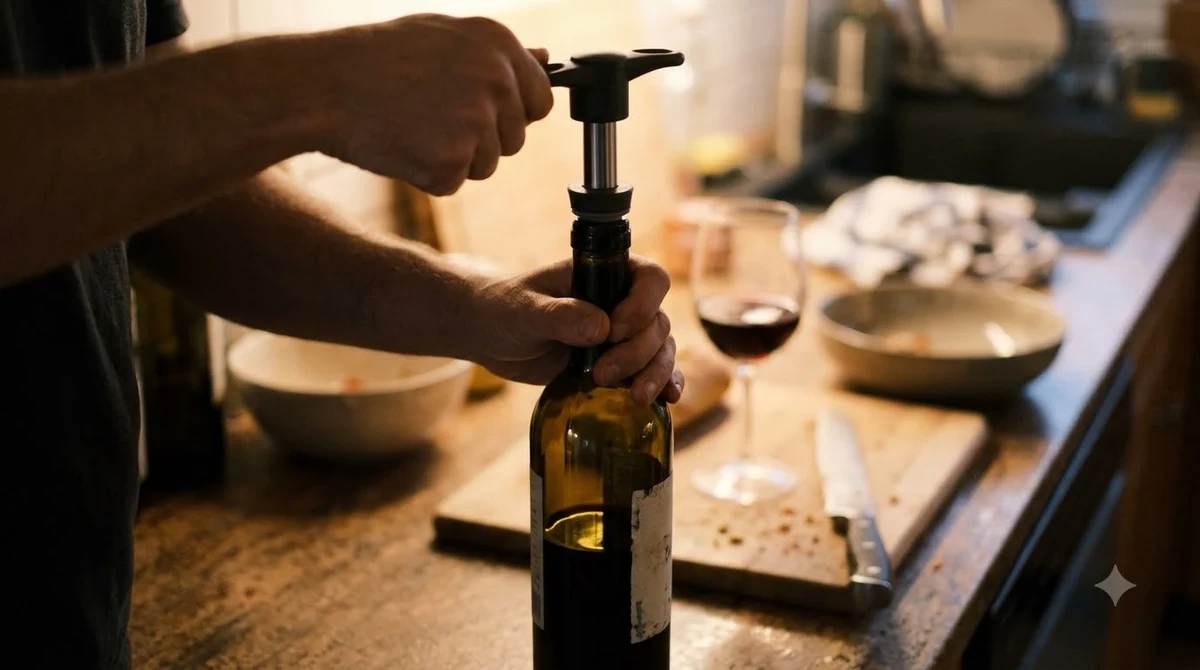
Neck geometry plays a direct role in that battery drain. Wines bottled in heavy glass with thick or irregular lip finishes—common on premium Napa Cabernet Sauvignon or wide-shouldered Syrah bottles—can prevent the rubber collar from seating flush. When microscopic gaps remain around the glass rim, air seeps back in every few hours, forcing the motor to wake up repeatedly until the cells die.
Some owners also report sudden electronic failure after several months of kitchen use, often linked to moisture or wine droplets reaching the internal valve when a bottle is tilted too far during handling. Even with the 45-degree tilt safety cutoff documented by Brookstone, setting a freshly pumped bottle inside a crowded refrigerator door shelf exposes the electronics to condensation and repeated jostling.
Finally, vacuum preservation carries an inherent sensory trade-off noted by wine publications. Pulling negative pressure inside a bottle removes volatile aromatic compounds alongside oxygen, which can leave delicate varieties such as Oregon Pinot Noir or aromatic Sauvignon Blanc smelling slightly muted on day two compared with a freshly pulled cork.
Who Should Buy and Who Should Skip
The Brookstone sealer works best for casual weekday drinkers who finish an opened 750 ml bottle within three to five days and want one-button convenience without recurring gas canister purchases. Anyone organizing a compact bar cart or kitchen counter setup who dislikes pumping a manual plunger 15 to 20 times per bottle will appreciate the automatic shutoff and day counter.
It is also a practical match for households that routinely leave half a bottle of medium- to full-bodied red wine—such as Merlot, Cabernet Sauvignon, or Zinfandel—for the next evening. Those styles hold up well under mild vacuum pressure and show clear benefit when paired with cool storage between 55 and 60 degrees F.
Skip the Brookstone preserver in three clear scenarios:
- Sparkling wine drinkers. Applying a vacuum pump to Champagne, Prosecco, or Cava strips dissolved carbon dioxide right out of the liquid, turning sparkling wine flat within minutes instead of preserving bubbles.
- Collectors saving expensive bottles for weeks. Vacuum pumps leave residual oxygen in the headspace and cannot match the multi-week protection of argon systems for special-occasion bottles.
- Horizontal wine fridge storage. Because the cap must remain upright to prevent wine from entering the pump intake, it will not work on standard horizontal wine rack shelves unless your cooler includes a dedicated upright standing compartment.
How It Compares to Alternatives
Choosing the right preservation tool comes down to how long an opened bottle sits before the last glass is poured and how much money goes into each bottle. Manual vacuum pumps, inert gas systems, single-use oxygen absorbers, and simple bottle transfers each solve oxidation differently than Brookstone’s motorized cap.
Manual vacuum pumps such as the Vacu Vin Wine Saver—featured among top preservation picks by Food & Wine—use the exact same physical mechanism as Brookstone without batteries, motors, or sensors. According to Wine Enthusiast, standard vacuum systems keep opened still wine fresh for roughly 7 to 10 days when stored in a cool place, though real-world flavor retention peaks closer to 3 to 5 days for delicate whites and light reds. A manual pump costs less upfront, does not lose battery power mid-week, and lets you seal four or five bottles at once with extra rubber stoppers, whereas Brookstone trades multi-bottle flexibility for push-button ease and automatic re-pumping.
Inert gas systems take a fundamentally different approach by displacing oxygen with heavier-than-air argon rather than creating negative pressure. Wine Enthusiast notes that argon and nitrogen systems—such as needle-based Coravin models or pressurized argon canisters—can protect wine from a week up to a month because they leave aromatics intact and avoid pulling volatile compounds out of the wine. The catch is ongoing consumable expense: every pour consumes pressurized gas, making argon overkill for a weeknight Pinot Grigio or everyday Rioja.
Single-use oxygen-absorbing stoppers like Repour eliminate both batteries and gas canisters by chemically binding oxygen inside the headspace for up to two months, though each stopper works for only one bottle before disposal. Finally, pouring leftover wine into a clean 375 ml half-bottle immediately after opening removes almost all headspace air for free, matching vacuum performance on two-day holds without any mechanical parts.
Setup and Care Tips for Longer Battery and Seal Life
Getting consistent multi-day performance out of a Brookstone wine preserver depends mostly on stopper alignment, storage temperature, and moisture control. A few habits prevent premature battery drain and protect the internal pressure valve from liquid damage.
First, wipe the inside and top lip of the glass bottle neck with a dry towel before seating the rubber gasket. Even a thin film of red wine or condensation breaks surface friction, letting air creep back into the bottle and triggering repeated pump cycles overnight. Press the unit straight down onto the neck rather than rocking it side to side so the rubber skirt seals evenly around the entire circumference.
Second, refrigerate every vacuum-sealed bottle upright—including red wines. Cooler temperatures slow chemical oxidation dramatically, stretching a vacuum seal from two days on a warm 72-degree kitchen counter to four or five days inside a 40-degree refrigerator. Pull red wines such as Cabernet Sauvignon or Syrah out 20 to 30 minutes before pouring so they warm back toward their 60 to 65 degree F serving window, while serving white wines like Sauvignon Blanc and Chardonnay directly at 45 to 55 degrees F.
Third, use the manual shutoff function when finishing a bottle soon or storing the unit between uses. As outlined in Brookstone’s operating instructions, holding the TEMP/DAY button for three seconds powers the electronics down completely so the sensor does not keep polling pressure on a nearly empty bottle. After removing the cap, wipe the rubber base with a damp cloth and let it air dry upside down—do not submerge the motorized head in water or place it in a dishwasher.
Shoppers comparing different Accessory Brands for holiday hosting or sampling mini bottles from a wine advent calendar should also note bottle neck sizing: Brookstone stoppers are engineered for standard 750 ml still wine necks and often lose suction on narrow 187 ml split bottles or wide-mouth screw-cap finishes.
Frequently Asked Questions
How do you reset the day counter on the Brookstone Automatic Wine Preserver?
Removing the preserver from the wine bottle and turning the unit off by holding the TEMP/DAY button for three seconds clears the active cycle. When placed onto a newly opened bottle and restarted, the day counter begins tracking again from zero so each bottle gets an accurate age count.
Can the Brookstone wine preserver be used on screw-cap wine bottles?
Yes, provided the glass neck has a standard 750 ml internal bore diameter and smooth rim, though threaded glass exteriors sometimes leave tiny channels if the outer rubber skirt overlaps the screw threads. Pushing the inner rubber plug firmly into the bore and checking that the pump shuts off cleanly after its four-zero countdown confirms an airtight fit.
Does vacuum sealing work on fortified wines like Port or Sherry?
Fortified wines such as Tawny Port, Madeira, and dry Sherry already resist oxidation for several weeks after opening thanks to higher alcohol levels around 17 to 20 percent ABV. Simply recorking the bottle tightly and storing it upright in a cool cabinet or refrigerator works reliably without draining batteries on a vacuum sealer.
Why does the Brookstone wine preserver turn on by itself hours after sealing a bottle?
The single-bottle Brookstone cap contains an automatic pressure sensor programmed to detect gradual vacuum loss caused by temperature shifts or minor rim seepage. When internal pressure rises past its threshold, the motor runs briefly to restore negative pressure and protect the wine without requiring user intervention.
How many glasses of wine remain if you seal a half-empty 750 ml bottle?
A standard 750 ml wine bottle holds about 25.4 fluid ounces, which equals five standard 5-ounce pours. Sealing a half-empty bottle leaves roughly two and a half glasses—enough for two generous pours the following evening before flavor begins fading.
The Brookstone wine preserver offers genuine push-button convenience and helpful day tracking for casual drinkers who finish opened bottles within a few days, provided rechargeable AAA batteries stay on hand. Drinkers who open multiple bottles per week, favor delicate aromatic whites, or store bottles on horizontal wine racks will get longer-lasting and lower-maintenance results from a manual multi-stopper vacuum pump or an inert argon gas preserver.
More in Wine Accessories
 Vinglace Wine Tumbler Review: A Glass-Lined Choice for Better SippingUpdated Nov 20, 2026
 ZWILLING Electric Wine Opener Review: Features and DrawbacksUpdated Nov 20, 2026
 Vinturi Electric Wine Opener Review for Easy UncorkingUpdated Nov 20, 2026
 Vinabon Wine Aerator Review for Easier, Cleaner Wine ServingUpdated Nov 20, 2026
 Vacu Vin Electric Wine Opener Review: Easy Cork Removal for Home Wine LoversUpdated Nov 20, 2026
 Rabbit Wine Accessories for Easier Home Wine ServiceUpdated Nov 20, 2026