

We may earn a commission when you buy through links on this page, at no extra cost to you. Learn more.
The aervana wine opener is actually an electric wine aerator and dispenser, not a traditional cork-removing opener. It uses a battery-powered pump to draw wine from the bottle, introduce air during dispensing, and deliver it directly into a glass with a push-button control. Its convenient serving design, sediment separation, and hands-free pouring make it interesting for frequent wine drinkers, although its aeration claims and long-term durability deserve careful consideration.
Aervana takes a different approach to serving wine. Instead of removing a cork and pouring through a separate aerator, the device sits on top of an opened bottle and handles dispensing and aeration together. That design can make serving guests easier, especially when several people want individual glasses without repeatedly lifting a heavy bottle. However, the distinction between opening wine and aerating wine matters before buying. This review examines the Original model’s specifications, the differences between its versions, available owner feedback, scientific considerations, and the situations in which this accessory makes practical sense.
Specs and Key Features
Aervana Original is best understood as an electric wine tap with an integrated aeration mechanism. Its main appeal is the combination of battery-powered dispensing, individual-glass serving, and a design intended to leave sediment inside the bottle.
The device operates through a telescoping tube inserted into the bottle, allowing wine to travel upward into its internal mechanism before leaving through the dispensing spout. Rather than tipping the bottle, the user positions a glass beneath the spout and activates the pump. This arrangement is particularly useful when serving from a full 750 ml bottle or a larger 1.5-liter format.
According to Aervana’s product specifications, the Original requires six AAA batteries, which are sold separately. The manufacturer claims that one battery set can dispense more than 250 bottles. That figure is a stated manufacturer performance claim rather than an independently established guarantee for every battery brand, usage pattern, or operating condition.
| Feature | Aervana Original specification |
|---|---|
| Product category | Electric wine aerator and dispenser |
| Operating method | Push-button electric pump |
| Battery requirement | 6 AAA batteries |
| Battery inclusion | Not included |
| Compatible bottle sizes | Most 750 ml and 1.5-liter bottles |
| Battery-life claim | More than 250 bottles per battery set |
| Spout clearance | More than 10 inches |
| Tube material | Stainless steel telescoping tube |
| Included accessories | Countertop stand and user manual |
| Serving method | Direct dispensing into individual glasses |
These specifications make the Original more specialized than a conventional wine pourer. A standard pourer simply controls the flow of wine, while Aervana adds an electric mechanism and an aeration process. The countertop stand also gives the device a designated storage position between uses, which is useful for households that regularly entertain.
The more than 10-inch spout clearance is another practical detail. It gives room for many standard wine glasses and taller glassware, although unusually tall vessels may still require checking the available space on the countertop.
One important distinction is that Aervana does not extract corks. A bottle must already be opened before the device can dispense its contents. Someone shopping specifically for an electric corkscrew should consider a conventional wine bottle opener keychain for a compact manual alternative, or a dedicated electric cork remover for powered opening.
For the manufacturer’s complete specifications, see the Aervana Original product information.
What Owners Like
The strongest appeal of Aervana is convenience rather than complicated wine technology. Its push-button dispensing system removes the need to lift and tilt a bottle for every glass, while its integrated aeration process eliminates the separate step of pouring through a funnel-style aerator.
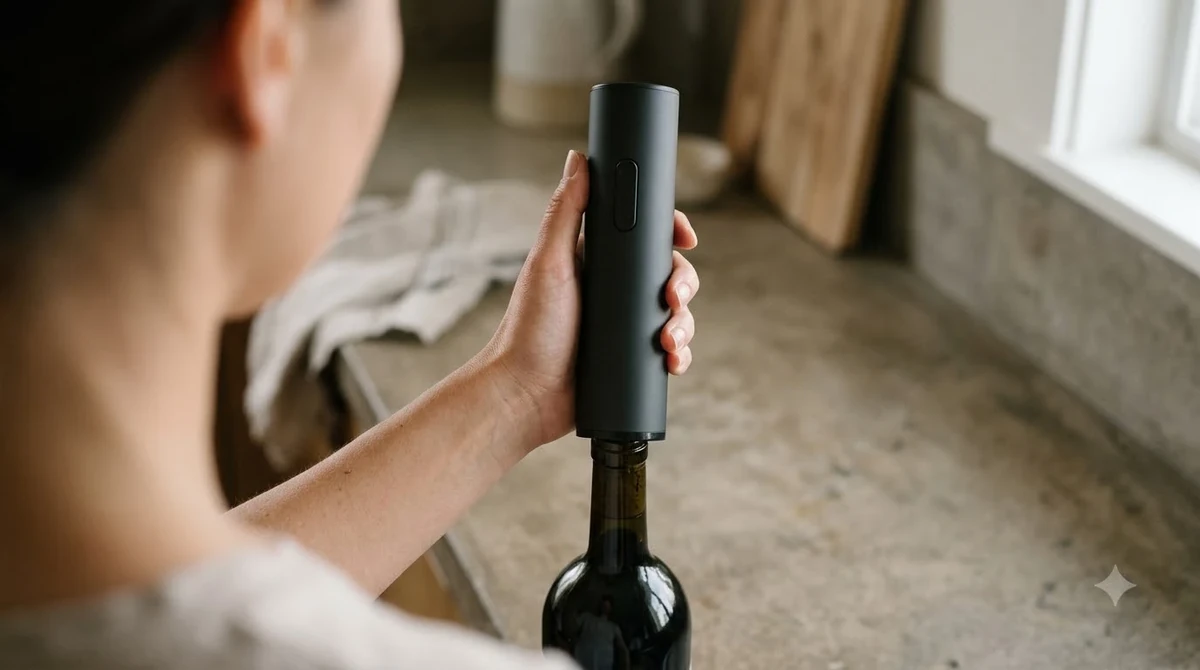
This arrangement can be especially attractive during dinner parties. Imagine serving six guests from a bottle of Cabernet Sauvignon: instead of lifting the bottle repeatedly, the host can keep it upright and dispense individual portions. The arrangement also makes it easier to maintain a consistent serving position when working around a crowded dining table.
Individual serving control
Because Aervana dispenses wine directly into the glass, it offers a different experience from traditional decanting. A decanter generally requires transferring a substantial portion, or the entire contents, of a bottle before serving. Aervana instead processes each pour separately. That can be convenient when one guest wants a glass immediately while another prefers to wait until later.
The system also offers a practical advantage for bottles that are awkward to lift. Large 1.5-liter bottles can be noticeably heavier than standard 750 ml bottles, especially when full. Keeping the bottle upright on a stable surface can make serving more manageable.
Less exposure to bottle sediment
Aervana’s design aims to keep sediment at the bottom of the bottle rather than sending it into the glass. This feature can be useful with older red wines that have developed deposits during bottle aging. It is not a replacement for careful decanting when a wine contains substantial sediment, but it provides an alternative way to serve without pouring the entire bottle in one continuous motion.
For anyone who regularly serves mature Bordeaux-style blends, aged Cabernet Sauvignon, or other bottle-aged reds, avoiding the final sediment-heavy portion can be helpful. The practical benefit depends on bottle condition and how carefully the device is positioned during use.
A more organized serving station
The countertop stand gives Aervana a dedicated place when it is not attached to a bottle. This makes it easier to incorporate into a home wine-serving setup rather than leaving a loose accessory in a kitchen drawer.
Its electric operation may also make the serving process more engaging for guests. A simple button press is intuitive, and the dispensing action can become a conversation starter at a dinner party. People who enjoy wine accessories with a distinctive presentation may appreciate that aspect more than someone who simply wants the least expensive way to pour a glass.
There is also a practical benefit in avoiding repeated bottle handling around food and glassware. Keeping the bottle upright reduces the need to maneuver it over plates, serving dishes, and other objects. This does not make spills impossible, but it changes how the wine is transferred to the glass.
Common Complaints and Performance Limitations
Aervana’s main limitations involve its dependence on batteries, its specialized dispensing mechanism, and the difference between advertised aeration benefits and independently demonstrated wine-quality improvements. Buyers should separate the convenience of electric pouring from the question of whether aeration makes every wine taste better.

The first consideration is the device’s additional mechanical complexity. A conventional wine pourer has very few components, whereas Aervana uses a pump, tubing, internal housing, and an aeration chamber. More components create additional cleaning and maintenance considerations, particularly when wine residue is allowed to remain inside the mechanism.
Battery dependence
Six AAA batteries are required for the Original, and the manufacturer does not include them. This is not a major obstacle for a household that keeps spare batteries available, but it adds another item to maintain. A dead battery can interrupt serving at an inconvenient time, especially during a gathering.
The claimed capacity of more than 250 bottles per battery set sounds generous, but actual performance can depend on battery quality, storage conditions, operating frequency, and the condition of the pump. Buyers should regard the figure as a manufacturer estimate rather than assuming that every set will deliver identical results.
Cleaning and maintenance
Any accessory that repeatedly carries wine through an internal tube requires attention to cleaning. Residual wine can dry inside narrow passages, potentially affecting flow and leaving unwanted odors or deposits. Aervana describes the Original as easy to clean, but owners should still follow the manufacturer’s cleaning instructions instead of assuming that the device can simply be rinsed casually.
Water exposure around the battery compartment and internal electrical components also deserves attention. The device should be handled according to its care instructions, and users should avoid immersing electrical sections in water unless the manufacturer explicitly permits it.
Aeration is not automatically an improvement
The most important performance question is whether instant aeration produces a better glass of wine. Aervana markets the device as a way to expose wine to air during dispensing, potentially helping certain wines reveal more expressive aromas and flavors. However, the outcome is not necessarily positive for every bottle.
A graduate research project conducted at Cornell University examined two commercial wine aerators, including Aervana and the Vintorio Omni. The study used a young California Cabernet Sauvignon and investigated chemical and sensory differences associated with aeration. It also described the Aervana mechanism as a battery-powered pump that moves wine through an internal aeration chamber.
Importantly, the research discusses how oxygen can cause both beneficial and undesirable changes. Oxygen exposure may affect aroma compounds, but excessive or unsuitable exposure can contribute to the loss of fresh fruit characteristics and the development of oxidative aromas. The paper also points out that some commercial aeration claims lacked qualitative supporting evidence from the manufacturers.
This means Aervana should not be treated as a guaranteed wine-improvement device. A wine that already smells expressive and balanced may not need additional aeration. A young, structured Cabernet Sauvignon may respond differently from a delicate Pinot Noir or an aromatic Sauvignon Blanc.
Readers interested in the scientific background can consult the Cornell University research on commercial red wine aeration devices. Its findings provide useful context, but the results should not be interpreted as a universal verdict on every wine or every Aervana model.
Durability and owner confidence
Long-term reliability is another factor to consider with an electrically operated accessory. The internal pump and connected components must operate consistently, and the device needs appropriate care after contact with wine. Unlike a simple stainless steel pourer, an electric dispenser is not something that can be treated as maintenance-free.
Customer feedback displayed by Total Wine & More includes both favorable and unfavorable experiences. Its published distribution shows that customer satisfaction is mixed rather than uniformly positive. That is a reason to investigate return policies, customer support, and replacement options before making a purchase, particularly if the device will be used frequently.
Overall, the limitations do not make Aervana impractical. They simply mean that its convenience comes with more maintenance responsibilities than a basic aerator or pourer.
Tip: Do not assume that every red wine needs aggressive aeration. Start with a small glass, evaluate the wine’s aroma and structure, and compare the result with a conventional pour. Delicate Pinot Noir and older bottles may benefit more from gentle handling than from additional oxygen exposure.
Who Should Buy Aervana and Who Should Skip It
Aervana makes the most sense for wine drinkers who regularly serve multiple guests and value convenient individual pours. It is less compelling for people who primarily want to remove corks, occasionally drink a single glass, or prefer traditional decanting techniques.
Good candidates for Aervana
Frequent entertainers are among the clearest potential buyers. Aervana can simplify serving at dinner parties, holiday gatherings, and tasting events where several people are sharing a bottle. The upright bottle position also helps reduce the need to repeatedly lift heavier bottles.
It may also appeal to people who enjoy serving wine through dedicated accessories. A well-organized wine station can benefit from an electric dispenser, particularly when the host wants guests to serve themselves without handling the bottle. Pairing the device with appropriate glassware, a stable countertop, and an organized bar cart can create a more convenient serving area.
People who frequently drink young, structured red wines may also appreciate having an aeration option available. Cabernet Sauvignon and Syrah can have substantial tannin, and exposure to air may change how their aromas and textures are perceived. Nevertheless, the ideal amount of aeration depends on the individual wine rather than the grape name alone.
Who should avoid buying it
Someone looking for an electric corkscrew should skip Aervana as a primary opener. The device cannot remove a cork, so it does not replace a waiter-style corkscrew, lever opener, or battery-powered cork remover. Its purpose begins after the bottle has already been opened.
Occasional wine drinkers may also find the mechanism unnecessarily complicated. If a bottle is opened only once or twice a month, a conventional corkscrew and a basic pourer may cover most serving needs. There is little reason to maintain a battery-powered dispenser if its main function is rarely used.
Wine collectors who regularly open delicate older bottles should also consider whether an integrated electric aerator suits their serving style. Older wines can be sensitive to oxygen exposure, and the presence of sediment may require more deliberate handling. Traditional decanting allows the user to control the transfer and observe the separation of wine from deposits.
Consider your actual serving habits
The best buying decision depends on how often the device will be used. A household that hosts several wine-focused gatherings every month may appreciate the convenience more than someone who drinks a glass occasionally after dinner.
Consider three practical questions: how often wine is served, whether several people share bottles, and whether the convenience of an electric tap matters more than the simplicity of a traditional pourer. If the answer to all three favors convenience, Aervana becomes easier to justify.
It is also important to consider available counter space. The Original includes a storage stand, and the manufacturer specifies more than 10 inches of spout clearance. A dedicated storage and serving location helps make the device easier to use without constantly moving it between cabinets and countertops.
How Aervana Compares to Alternatives
Aervana occupies a specific position between a traditional aerator and an electric wine dispenser. Its distinguishing feature is the integration of powered dispensing and aeration, rather than simply adding air as wine passes through a separate accessory.
Choosing an alternative depends on whether the priority is opening a bottle, aerating wine, controlling oxygen exposure, or preserving unfinished wine. These are different tasks, and a single accessory does not necessarily perform all of them.
Aervana versus a traditional decanter
A decanter provides a more traditional approach to exposing wine to oxygen. The entire bottle, or a selected portion, can be transferred into a larger vessel, increasing the surface area exposed to air. This is useful when serving structured red wines that may benefit from time in contact with oxygen.
Aervana takes a different approach by aerating individual servings as they are dispensed. That makes it convenient for immediate serving, but it does not provide the same visual control over sediment separation or the same opportunity to let the entire wine gradually develop in a decanter.
For a young Cabernet Sauvignon, either method may be useful depending on the wine and the desired result. For an older bottle, careful decanting may offer more control. Neither method guarantees that the wine will improve.
Aervana versus a gravity-fed aerator
A gravity-fed aerator works without batteries or an internal pump. Wine flows through the accessory as it is poured, and its design encourages contact with air during the transfer. These devices are generally simpler to maintain and easier to store.
Aervana adds the convenience of powered dispensing and an upright bottle position. However, a conventional aerator is usually more appropriate for someone who wants a lightweight, straightforward accessory without additional electronic components.
Aervana versus a wine opener and preserver set
A wine opener and preserver set serves a broader range of practical needs. Such a set may include a corkscrew and a stopper or preservation accessory, depending on its contents. This can be more useful for a household that wants to open bottles and store unfinished wine without purchasing separate accessories.
Aervana is more specialized because its primary purpose is dispensing and aeration. It does not provide the cork-removal function or automatically replace a dedicated preservation system. For buyers who want several functions in one purchase, a wine opener and preserver set may be a more practical starting point.
Aervana Original versus Aervana Select
The two Aervana models are more closely related than a traditional decanter and an electric dispenser. Both are designed around battery-powered dispensing, but Select introduces adjustable aeration settings.
The Original uses a fixed aeration process. Select allows users to choose between three aeration levels through a dial, giving them more control over how wine is treated during dispensing. Select also includes a telescoping tube with a sediment filter.
For someone who wants a straightforward push-button experience, the Original may be sufficient. Someone who enjoys comparing different aeration intensities across Cabernet Sauvignon, Merlot, and other wines may find Select’s adjustment feature more appealing.
However, adjustable settings should not be mistaken for a guarantee of better results. Wine remains sensitive to its age, grape variety, structure, and previous storage conditions. More aeration is not automatically better, even when a device offers several settings.
Frequently Asked Questions
Can Aervana be used with sparkling wine?
Aervana is designed for still wine dispensing and aeration, not for preserving carbonation in sparkling wine. Introducing air and moving carbonated wine through a dispensing mechanism can compromise its bubbles. Traditional sparkling wine service with a suitable stopper is a better choice for Champagne, Cava, and Prosecco.
Does Aervana work with screw-cap wine bottles?
A screw-cap bottle can be opened without a corkscrew, but the neck and opening dimensions still matter for fitting an electric dispenser. Aervana’s published compatibility information focuses on most standard 750 ml and 1.5-liter bottles rather than guaranteeing compatibility with every closure design. Bottle shape and neck construction should therefore be considered before use.
Can Aervana dispense white wine as well as red wine?
Yes. Aervana markets its aeration system for wine generally rather than restricting its intended use to red varieties. However, many aromatic whites are already expressive without additional aeration. Sauvignon Blanc, Riesling, and unoaked Chardonnay may be better evaluated with a conventional pour before deciding whether additional air changes their character favorably.
How much wine is in a standard American serving?
A standard wine serving is commonly 5 ounces, and a 750 ml bottle provides approximately five such glasses. Actual servings vary depending on glass size and personal pouring habits. Using a consistent serving amount makes it easier to compare different bottles during a tasting.
Can Aervana replace a wine preservation system?
No. Aervana’s primary purpose is dispensing and aerating wine, not providing a dedicated preservation process for opened bottles. Oxygen exposure can gradually change wine after opening, so an appropriate stopper or preservation system may still be useful. Sparkling wines also require a stopper specifically designed to retain carbonation.
Aervana is an interesting choice for wine drinkers who prioritize convenient, individual-glass dispensing and enjoy having a dedicated electric serving accessory. Its biggest strengths are the push-button pump, upright bottle operation, and integrated aeration, while its main compromises are battery dependence, cleaning requirements, and the uncertainty surrounding universal aeration benefits. Choose the Original for straightforward dispensing, consider Select if adjustable aeration matters, and remember that neither model replaces a proper corkscrew or a traditional wine preservation system.
More in Wine Accessories
 Coravin Vs Vacu Vin: Choose the Right Wine Saver for Your BottlesUpdated Nov 21, 2026
 Zwilling Wine Stopper Review: Preserve Open Bottles LongerUpdated Nov 21, 2026
 Wine Enthusiast Wine Preserver Review: Features, Benefits and LimitationsUpdated Nov 21, 2026
 Wine Enthusiast Wine Stopper: An Easier Way to Reseal Open BottlesUpdated Nov 21, 2026
 Vintorio Wine Opener: Two-Step Cork RemovalUpdated Nov 21, 2026
 Zwilling Wine Aerator Review: Aerate, Pour, and Seal With One ToolUpdated Nov 21, 2026