

We may earn a commission when you buy through links on this page, at no extra cost to you. Learn more.
chianti classico vineyards are the hillside plantings in Tuscany’s historic wine zone between Florence and Siena, where Sangiovese grows across a varied patchwork of elevations, exposures, and soils. Their character is shaped by more than the name of a village: a cool, high site in Radda can produce a different expression from a warmer slope near Castelnuovo Berardenga. Understanding the landscape makes it easier to read a Chianti Classico label and choose wines with the style you enjoy.
The region is not one continuous stretch of vines. Vineyards share the hills with woods, olive groves, villages, and working farms, while their soil and altitude change over relatively short distances. Here is how the geography works, which places are worth learning, and what vineyard details can tell you about the wine in your glass.
Where the Chianti Classico Vineyards Are Located
Chianti Classico occupies the historic heart of Chianti in central Tuscany, between Florence to the north and Siena to the south. Its production zone covers about 71,800 hectares, but only a portion is planted to vines, and a still smaller area is registered for Chianti Classico wine.
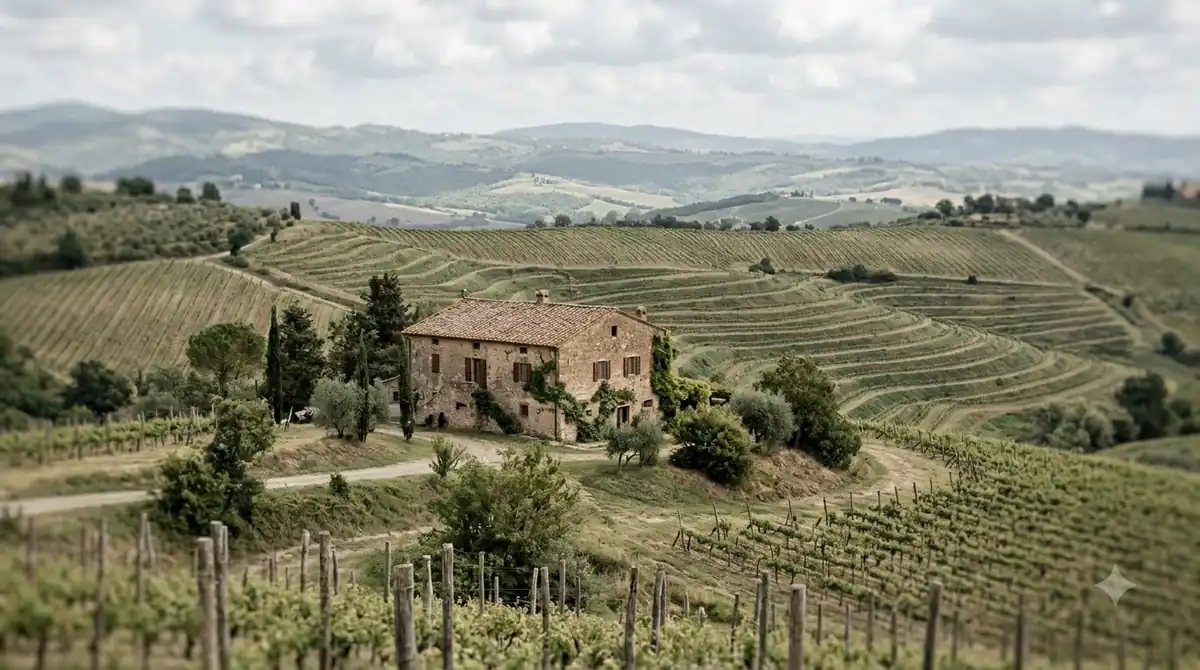
The zone includes Greve in Chianti, Panzano, Radda in Chianti, Gaiole in Chianti, Castellina in Chianti, and Castelnuovo Berardenga, among other local areas. The Consorzio’s boundary includes four municipalities in their entirety—Greve, Castellina, Radda, and Gaiole—and parts of neighboring municipalities. Decanter describes more than 70,000 hectares of territory and roughly 9,600 hectares of vineyards, while about 7,200 hectares are dedicated to Chianti Classico production.
The landscape is a high, rolling plateau rather than a single valley. The Monti del Chianti mark its eastern edge, while rivers and streams define parts of the western and southern boundaries. Slopes, ridges, and valleys create local changes in temperature and airflow, so neighboring estates can have quite different vineyard conditions.
These boundaries matter because Chianti Classico is a protected wine designation, not a general synonym for red wine from anywhere in Tuscany. Grapes for the DOCG must come from within the delimited production area and meet its vineyard and cellar rules. For a wider overview of how this appellation fits into the larger Tuscan picture, browse the site’s Wine Regions resources.
Altitude, Slope, and the Tuscan Growing Season
Elevation is one of the clearest influences on Chianti Classico vineyards: many sit between roughly 250 and 600 meters above sea level, and the highest registered vineyard sites cannot exceed 700 meters. Higher slopes generally bring cooler conditions and a longer, more measured ripening season, while lower and warmer sites can give Sangiovese a riper, broader profile.
Decanter highlights the contrast between Radda, where vineyards at 500 meters and above can show a slender, acidity-led character, and Lamole, where some sites reach 650 meters or more. At the lower end, its reporting places San Casciano’s Romola area around 150 to 200 meters. In the southern commune of Castelnuovo Berardenga, warmer areas tend toward darker, bolder fruit. These are tendencies, not guarantees: slope, exposure, soil depth, vine age, and farming decisions all matter.
Day-to-night temperature changes also matter. Chianti Classico has a temperate continental climate, with warm to hot summers and a notable daily temperature range in many hillside locations. Warm daylight helps Sangiovese ripen, while cooler nights can slow the loss of acidity and help retain aromatic definition. Rainfall, heat, and the timing of seasonal changes vary from year to year, so the same vineyard does not produce an identical wine in every harvest.
Aspect is the direction a slope faces, and it changes how much sunlight vines receive. A sunnier exposure can help grapes ripen in a cool location, while a sheltered or less intense exposure may suit a warmer site. The official production code therefore specifies suitably oriented hillside sites and excludes damp valley floors from the vineyard register.
Galestro, Alberese, Sandstone, and Other Soils
Chianti Classico is known for several contrasting soil types rather than one defining soil. The three names most often used to describe the landscape are galestro, alberese, and macigno del Chianti; their distribution, depth, and mix with clay, sand, and stones contribute to local variation.
Galestro is a friable, schistous clay formation that breaks into thin, angular fragments. Its stony structure can create well-drained, relatively lean vineyard ground, although the exact texture changes across the zone. Alberese is a pale, calcareous formation associated with limestone and marl. It often appears as hard, pale rock in the soil profile, and vineyards planted in it can produce Sangiovese with firm structure and a savory edge. Neither soil type determines flavor by itself; vine roots, rainfall, exposure, and winemaking all play a part.
Macigno del Chianti is a sandstone formation with smaller proportions of clay. Sandstone, limestone, and shale can occur in layers or in mixed formations, meaning a single estate may farm parcels that behave differently in wet weather or during summer heat. Southern areas also include tufa and marine clays, while other sites have sandy-clay or stony-clay soils. The Consorzio’s production rules list sandstone, limestone, marl, clayey schist, sand, and pebbles among the soils suitable for registered vineyards.
Drainage is a practical point behind these geological terms. A well-drained hillside parcel behaves differently from a damp valley floor, and the production code excludes damp soils, valley floors, and markedly clayey ground from registration. This is a rule about the kind of site included in the designation, not proof that one soil always makes better wine.
Tip: When comparing two Chianti Classico bottles, note the village or UGA first, then look for the producer’s vineyard details. “Radda” or “Lamole” gives a useful geographic clue, but a named parcel, elevation, or soil description can tell you more about the individual site.
The Villages and the Eleven Additional Geographical Units
Village names help make sense of the region, but Chianti Classico’s more detailed geographic framework is the Additional Geographical Unit system, usually shortened to UGA. Eleven UGAs identify smaller areas within the appellation, grouping places with related geographic and vineyard characteristics without ranking them from best to least good.
The eleven names are San Casciano, Greve, Montefioralle, Lamole, Panzano, Radda, Gaiole, Castelnuovo Berardenga, Vagliagli, Castellina, and San Donato in Poggio. Some correspond closely to existing municipal areas, while others describe a smaller place within a municipality. Panzano, for example, is a recognized area within Greve, and Lamole and Montefioralle are smaller geographic areas in the same broad part of the zone. The system gives producers a way to communicate provenance with greater precision than the broad appellation name alone.
The UGA project was adopted by the Consorzio’s members in 2021, and the areas are used on labels for Chianti Classico Gran Selezione. The Consorzio explains that a UGA describes where grapes originate, not a separate quality level. Its official explanation of the eleven UGAs also notes that use of the name is not mandatory on a label. A bottle without a UGA name can still come from an outstanding vineyard; the label simply provides less geographic detail.
For a sense of the differences, Castellina is a large, varied area with vineyards at roughly 300 to 500 meters, while Radda is a higher and cooler zone. Lamole is particularly high, with some vineyard sites around 650 meters or more. Castelnuovo Berardenga includes warmer southern exposures as well as cooler, higher terrain around San Gusmè, so even one UGA can contain distinct sub-sites. The label gives you a starting point, not a complete description of the estate’s parcels.
How Sangiovese Is Grown Under the Appellation Rules
Sangiovese is the defining grape of Chianti Classico, and the production code requires it to make up at least 80 percent of the blend. The remaining share may consist of approved red grape varieties, or the wine may be made from 100 percent Sangiovese.
That rule helps explain why the region is so strongly associated with Sangiovese even though international varieties such as Cabernet Sauvignon and Merlot may appear in some blends. Local red grapes such as Canaiolo and Colorino can also be used. White grapes are not permitted in Chianti Classico DOCG wine. The emphasis on Sangiovese makes the vineyard site particularly important: its naturally high acidity and firm tannins can be expressed in a brighter, tauter way on cooler slopes or in a riper, more generous way on warmer exposures.
The appellation also sets limits on which land can be registered and how vines are planted. Under the production code, qualifying vineyards must be on appropriately oriented hillsides and at no more than 700 meters. New plantings must have a minimum density of 4,400 rootstocks per hectare, and the code sets a maximum grape yield of 7.5 metric tons per hectare. These requirements do not mean that every estate farms in exactly the same way; they establish a common framework within which growers make choices about pruning, canopy management, crop levels, and harvest timing.
| Vineyard or wine requirement | Rule or figure | Why it matters |
|---|---|---|
| Sangiovese in the blend | 80–100% | Keeps the appellation centered on its signature grape |
| Maximum vineyard elevation | 700 meters | Defines the upper limit for registered vineyard sites |
| Minimum density for new plantings | 4,400 vines per hectare | Sets a baseline for planting density |
| Maximum grape yield | 7.5 metric tons per hectare | Limits the permitted crop for the designation |
These figures set a framework, not a recipe for quality. Yield limits establish a ceiling rather than a target, and producers may crop below the maximum to suit the site, season, or style they want to make.
Vineyard age can add context, but it is not a simple quality score. An older parcel still depends on suitable soil, healthy vines, and attentive farming, while a younger planting can perform well on a strong site.
Reading Vineyard Character in the Wine and Planning a Visit
Vineyard conditions often show up in the balance and aroma of Chianti Classico, especially in wines where Sangiovese is the main or only grape. Cooler, higher sites may emphasize sour cherry, red berry, violet, herbs, and fresh acidity, while warmer sites can lean toward darker cherry, plum, and more apparent weight. These are broad patterns, not strict tasting rules, and cellar choices such as oak use and extraction also influence the finished wine.
Decanter’s regional overview describes Radda and Lamole as higher-elevation sources of acidity-driven wines, in contrast with the darker and bolder character often associated with warmer Castelnuovo Berardenga. Its town-by-town reporting also notes the range in Gaiole, Castellina, and San Casciano, where hillside position and soil can shift the style within a short distance. The Decanter overview of Chianti Classico is useful background for connecting those regional patterns with the wine styles found in the bottle.
When buying wine, start with the appellation and the producer, then use the place name as a clue. A Chianti Classico Annata is usually the most direct expression of the vintage and the producer’s house style. Riserva and Gran Selezione have longer aging requirements, but a higher category does not automatically mean that the wine will be your preferred style. A fresh, finely balanced Annata from a high site may be more appealing to someone who values lift and acidity than a powerful wine from a warmer slope.
Visiting gives the geography a physical context. Greve is a useful northern starting point; Panzano, Radda, and Castellina suit a route through central villages, while Gaiole and Castelnuovo Berardenga let you compare eastern and southern areas. Since the roads wind through hills, plan two or three appointments rather than crossing the entire appellation in one afternoon.
At the winery, ask which vineyard or UGA its wines represent and whether the tasting includes more than one site. A vertical tasting compares vintages of the same wine; a horizontal tasting compares different sites in one vintage. Ask whether the appointment includes a vineyard walk, cellar visit, or seated tasting, since estates do not all offer the same format.
Use the site’s Chianti Classico wineries directory to shortlist producers, and review Chianti Classico wine tasting options before booking. The Chianti Classico wine festival page can help connect a visit with local celebrations.
Frequently Asked Questions
When was the Chianti Classico area first officially delimited?
The Grand Duke of Tuscany, Cosimo III de’ Medici, issued an edict on September 24, 1716, defining the wine-producing territory between Florence and Siena. The Consorzio describes this as one of the earliest modern designations of origin. The edict gave the district a geographic identity long before Italy’s current DOCG system existed.
What does the Black Rooster symbol represent?
The Gallo Nero, or Black Rooster, was adopted as the symbol of the Chianti wine consortium when it was founded in Radda in 1924. The Consorzio links the emblem to the historic Military League of Chianti. It became a recognizable mark of the district’s collective identity and appears on bottles from member producers.
Can a Gran Selezione with one UGA name include grapes from another UGA?
Yes. The Consorzio states that a Gran Selezione naming a UGA may contain up to 15 percent of grapes from a different UGA. That allowance means the named area remains the primary geographic reference without requiring every grape to come from that one unit.
Is Chianti Classico the same denomination as Chianti?
No. Chianti Classico DOCG and Chianti DOCG are separate designations with different production areas and rules. The word “Classico” identifies the historic central zone between Florence and Siena, rather than simply indicating a style or a longer-aged version of Chianti.
What is the earliest written mention of Chianti wine?
The first notarial deed identifying wine from the area by the name Chianti dates to 1398. This document predates the formal territorial delimitation by more than three centuries. It provides historical evidence of the wine’s established identity in Tuscany.
Chianti Classico is best understood as a mosaic of hillside sites rather than a single uniform vineyard landscape. Once you recognize the roles of elevation, soil, and place names, it becomes easier to connect the geography with the Sangiovese in your glass—and to choose a village or winery to explore next.
More in Wine Regions
 Willcox Wine Trail: Discover Arizona’s High-Elevation Wine CountryUpdated Nov 20, 2026
 Yakima Valley Wine Region: Find the Best Styles to TryUpdated Nov 20, 2026
 Vosne Romanee Wine Tasting: Identify Aromas and Choose Better PairingsUpdated Nov 20, 2026
 Yakima Valley Wine Festival: Find the Best Seasonal Wine EventsUpdated Nov 20, 2026
 Wales Vineyards: Discover Cool-Climate Wines and Where to VisitUpdated Nov 20, 2026
 Yountville Wine Festival: Discover Napa Wines and Local FoodUpdated Nov 20, 2026