

We may earn a commission when you buy through links on this page, at no extra cost to you. Learn more.
The best wine rack shelf depends on how many bottles you keep on hand and where you plan to put the unit, with modular stackable wood shelves offering the strongest balance of stability, capacity, and room to grow. Compact countertop inserts fit inside existing kitchen cabinets or pantries for small weekly rotations, while freestanding baker-style shelves combine horizontal bottle cradles with flat surfaces for glassware and decanters. If floor space is tight, wall-mounted shelving clears counters completely while keeping labels visible at eye level.
A well-built shelf system keeps cork-finished bottles resting horizontally so liquid stays in contact with the seal, prevents rolling, and turns an awkward corner or deep pantry into organized storage. Because bottle shapes vary from slender Riesling flutes to broad-shouldered Champagne and Pinot Noir glass, choosing the right cradle spacing and frame material matters just as much as total bottle count.
Quick Comparison
Each wine rack shelf style solves a distinct storage constraint, from tight apartment cabinetry to expanding basement collections.
| Shelf Type | Typical Capacity | Footprint & Placement | Bottle Compatibility | Best Use Case |
|---|---|---|---|---|
| Modular Stackable Wood | 24 to 96+ bottles | Floor or closet; expands vertically | Standard 750 ml; wider slots fit Champagne | Growing collections and pantry build-outs |
| Countertop & Cabinet Insert | 6 to 18 bottles | Kitchen counter, pantry shelf, or hutch | Standard Bordeaux and Burgundy shapes | Everyday drinkers and small apartments |
| Freestanding Wine & Bar Rack | 18 to 48 bottles | Dining room, kitchen corner, or living area | Mixed 750 ml plus flat tabletop surface | Entertaining stations with stemware storage |
| Wall-Mounted Shelf Unit | 6 to 24 bottles | Empty wall space; requires stud anchoring | Standard 750 ml; label-out or neck-out | Zero-floor-space display and tight kitchens |
| Heavy-Duty Wire & Commercial | 48 to 144+ bottles | Basement, utility room, or dedicated cellar | All 750 ml, Champagne, and magnum formats | High-density bulk storage and case overflow |
Best for Growing Collections: Modular Stackable Wood Shelves
Modular stackable wood wine rack shelves use interlocking horizontal rails and notched crossbars so you can start with two or three tiers and add extra levels as your bottle count climbs. Built from unfinished pine, bamboo, or hardwoods, these systems deliver steady weight distribution without requiring permanent wall fasteners.
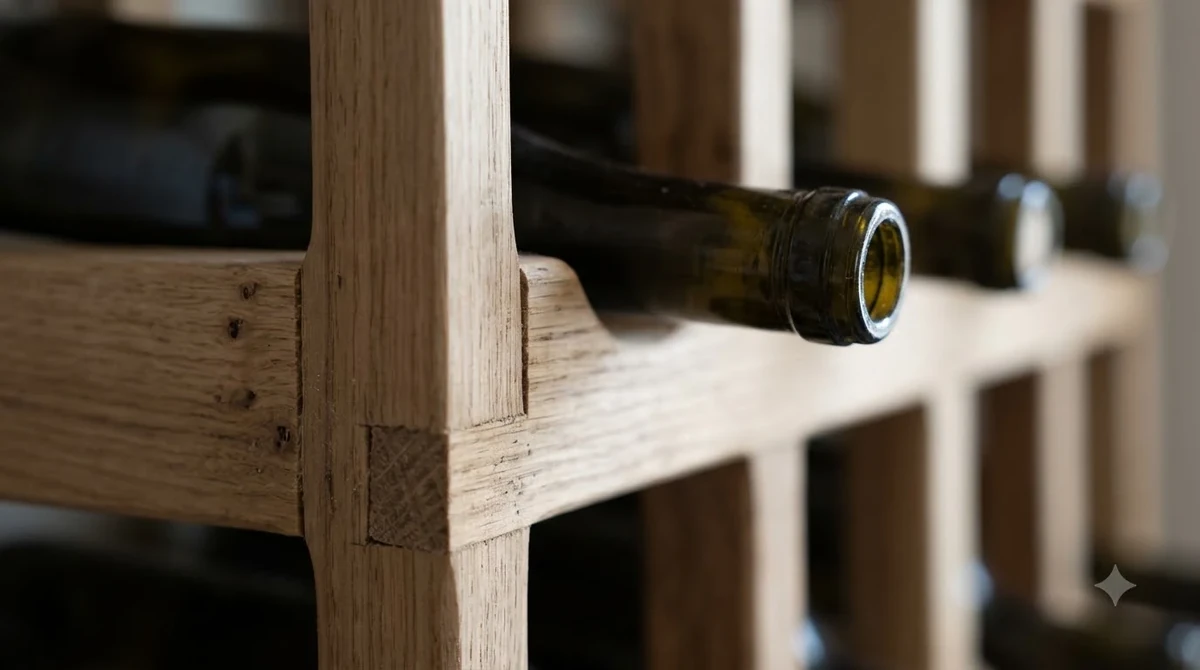
Why it stands out: Unlike fixed-frame furniture that leaves you stranded once every slot is full, stackable wood shelving scales vertically in small increments. The wide wooden cradles support bottles along two contact points—the neck and the body—which reduces vibration and prevents glass-on-glass clinking whenever you pull a bottle from a lower row. According to Wine Enthusiast’s wine rack shopping guide, keeping bottles still in a dedicated rack protects sediment and helps organize selections by varietal or region so older vintages get opened first.
Keep in mind: Measure the distance between vertical uprights before ordering, as narrow cutouts meant strictly for Bordeaux bottles can pinch wider Burgundy, Rhône, or sparkling wine glass. Unfinished softwoods also benefit from a clear coat of water-based polyurethane if the unit will sit in a damp basement where humidity hovers near the upper end of ideal storage ranges. Best for: Collectors who buy mixed cases regularly and want a customizable wine rack that adapts to closets, pantries, or basement walls without replacing the original frame.

- Capacity
- 72 bottles, 8 tiers
- Material
- Bamboo
- Size
- 33.5 x 9.8 x 40.4 in
- Assembly
- No tools, about 5 minutes
Collectors adding bottles every few months can build this shelf out tier by tier. Eight stackable levels hold nine bottles each, and side plates close the gaps for a steadier frame. The bamboo is unfinished, which leaves room to stain, paint, or varnish it to suit a room. Setup takes about five minutes with no tools, and the openings fit standard 750ml bottles.
Pros & ConsView
- Eight modular tiers hold 72 bottles
- Side plates add support and stability
- Assembles in about five minutes, no tools
- Floor-standing frame is tall at 40 inches
- Bottles must be removed before repositioning
Best for Kitchen Counters and Pantries: Compact Shelf Inserts
Compact countertop and cabinet shelf inserts are low-profile, single- or double-tier cradles engineered to slide directly onto an existing pantry shelf, kitchen counter, or sideboard. Most hold between six and eighteen bottles in a tight horizontal grid that stops rolling without taking over prep space.
Why it stands out: Existing kitchen cabinets and deep pantry shelves often waste vertical clearance above stacked cans or dry goods. A slim geometric metal or bamboo shelf insert converts dead air into an orderly cradle that keeps natural corks moist for bottles you plan to open over the next several months. Because these units arrive pre-assembled or snap together in seconds, they require zero tools and can move easily if you reorganize your kitchen.
Keep in mind: Kitchens experience wider temperature swings and brighter ambient light than interior closets or basements, so reserve countertop shelves for everyday bottles rather than age-worthy reds. Place the insert away from dishwashers, ovens, and sunny windows, since heat and ultraviolet light accelerate chemical aging in wine. Best for: Renters, small-kitchen cooks, and casual drinkers who keep a rotating weeknight supply within arm’s reach of the dining table.
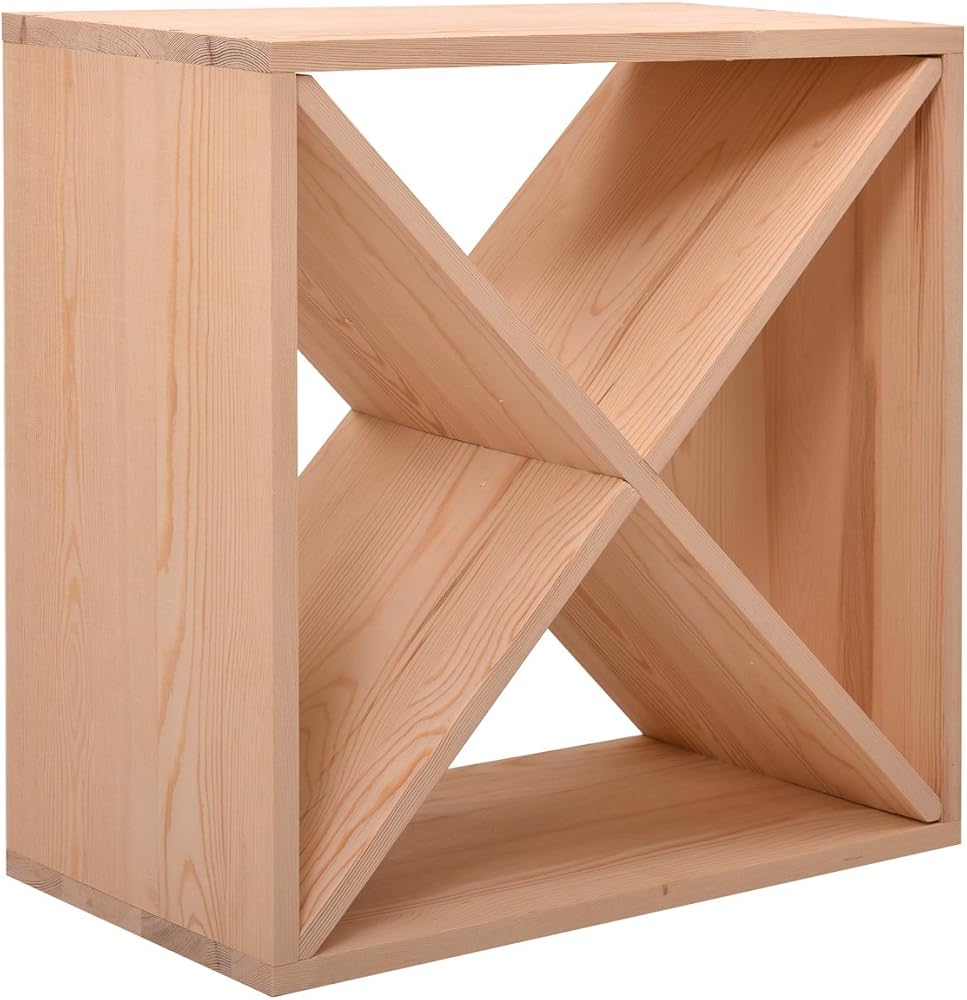
- Capacity
- 24 bottles, 4 cubes
- Material
- Fir wood
- Size
- 19.7 x 10.2 x 19.7 in
- Finish
- Natural, paintable
A counter or pantry corner is the right home for this compact wooden cube. Its four compartments each hold six bottles, and the footprint is under 20 inches in every direction. Extra units can be stacked if the collection outgrows it. The sustainable fir has a natural finish that accepts paint, and the manual numbers every part for a straightforward build.
Pros & ConsView
- Four compartments store six bottles each
- Compact 19.7 inch cube fits counters
- Extra units stack for added capacity
- Requires assembly from a manual
- Natural wood needs painting to change color
Best for Dining Rooms and Entertaining: Freestanding Bar and Stemware Shelves
Freestanding bar and stemware shelves pair horizontal bottle cubbies with flat wood or metal tabletops, utility drawers, and under-shelf stemware rails. Standing roughly waist- to chest-high, these furniture-grade units turn a blank dining room wall into a self-contained pouring station.
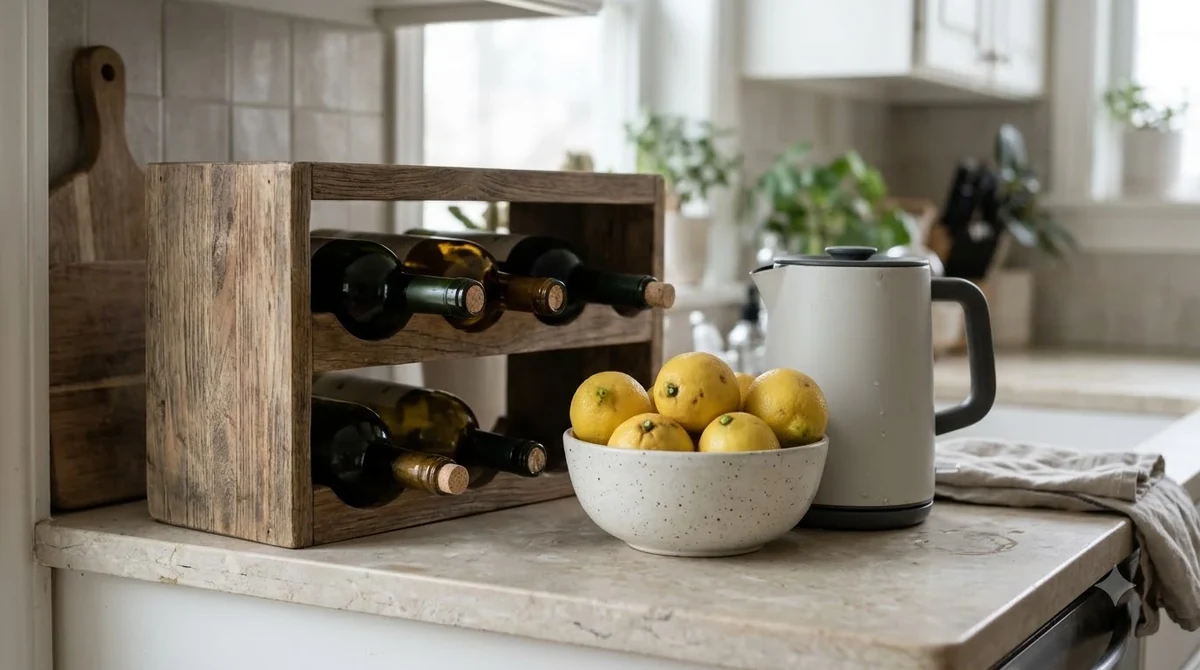
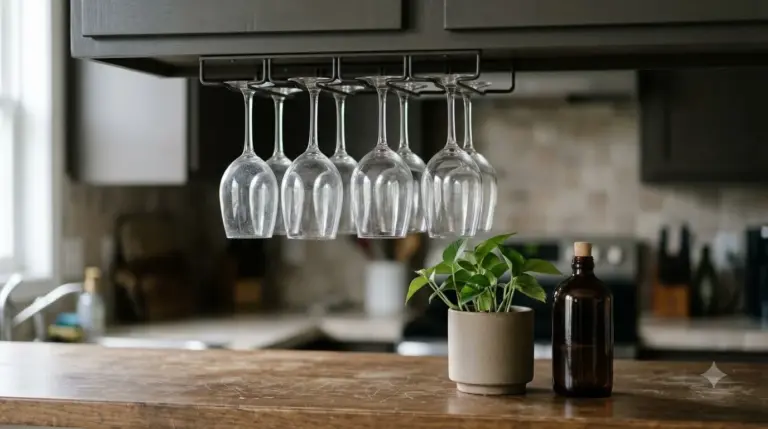
Why it stands out: Storing bottles is only half the workflow when hosting dinner; having a sturdy surface to rest an ice bucket, decanter, and open bottles keeps traffic out of the kitchen. Integrated overhead stemware tracks suspend glasses by the base, freeing up cupboard space while keeping rims dust-free and safe from accidental knocks. Many designs also mix scalloped bottle shelves with open flat shelving so you can store taller spirits bottles, cocktail shakers, and bar towels in one footprint.
Keep in mind: Top-heavy shelving units loaded with glass and liquid need a wide stance or an anti-tip wall strap, especially in homes with children or pets on hardwood floors. Check the clearance between the tabletop and any upper stemware rack to ensure tall Bordeaux or Burgundy glasses hang without touching bottles resting below. Best for: Hosts who want a living- or dining-room centerpiece that blends bottle storage, glassware organization, and serving space in one piece of furniture.

- Type
- Freestanding corner cabinet
- Capacity
- 12 bottle slots
- Material
- Wood top, steel frame
- Size
- 16.8 x 13.4 x 29.5 in
In a dining room, a piece that holds wine and doubles as a small bar earns its footprint. This three-tier unit pairs a wood-grain top with a matte black steel frame. Twelve slots on the middle shelf hold bottles, and the top shelf works as a mini counter for serving. It tucks into a corner or against a wall, and hardware and numbered parts are included.
Pros & ConsView
- Top shelf doubles as a small bar counter
- Twelve dedicated bottle slots on one shelf
- Fits corners or sits flush against a wall
- Twelve slots limit bottle storage
- Open shelves leave bottles exposed
Best for Tight Floor Plans: Wall-Mounted Wine Rack Shelves
Wall-mounted wine rack shelves bolt directly into wall studs to hold bottles horizontally off the floor, often combining metal cradles with a narrow wooden ledge for glasses or decor. Available in vertical columns or horizontal floating-shelf layouts, they turn narrow wall strips into functional vertical storage.
Why it stands out: When narrow galley kitchens or small dining nooks cannot spare twelve to sixteen inches of floor depth, taking storage upward preserves walkways. Label-forward wall racks let you read vintages and producers at a glance without sliding bottles out of deep cubbies, which minimizes handling and sediment disturbance. Combining a floating wood top shelf with metal bottle cradles underneath also adds display room for decanters or framed tasting notes without cluttering counters.
Keep in mind: A full twelve-bottle wall rack plus heavy steel hardware can easily exceed forty pounds, so hollow-wall drywall anchors alone are rarely sufficient—always align mounting brackets with wood studs or use heavy-duty toggle bolts rated well above the loaded weight. Install the shelf on an interior wall away from heating vents and direct afternoon sun. Best for: Small apartments, narrow hallways, and modern dining spaces where a wall mounted wine rack doubles as architectural wall decor.

- Pack
- 2 racks
- Material
- Engineered wood, metal
- Load
- Up to 40 lb each
- Size
- 15 x 5.9 x 5.5 in
Where the floor plan is cramped, moving storage onto the wall is the practical answer. This pair of racks each holds bottles behind a metal fence with a glass cup holder below. They can be arranged top and bottom, side by side, or in a staircase. Two expansion screw types cover concrete and hollow walls, and instructions and tools are in the box.
Pros & ConsView
- Moves bottles and glasses off the floor
- Racks can be arranged in several layouts
- Screws for concrete and hollow walls
- Wall mounting needs drilling
- Small 15 inch racks hold few bottles each
Best for High-Density Case Storage: Heavy-Duty Wire and Commercial Shelves
Heavy-Duty wire and commercial wine rack shelves use thick, powder-coated or chrome-plated steel posts paired with contoured wave shelves to hold large bottle counts in basements, utility rooms, or walk-in cellars. Engineered for high static loads, a single multi-tier unit routinely supports over a hundred bottles without bowing.
Why it stands out: Wire shelving maximizes airflow around every bottle, preventing stagnant pockets of moisture that can encourage mold on paper labels in damp basements. Adjustable shelf collars let you customize tier heights in one-inch increments, making it easy to dedicate one shelf to wide-bellied Champagne or magnum bottles and another to standard Bordeaux shapes, or even reserve a flat wire tier for full cardboard cases—helpful when planning around how many bottles in a case of wine you buy at once. Open-grid construction also lets overhead cellar lighting filter down through lower shelves so dark corners stay visible.
Keep in mind: Industrial steel shelving prioritizes function over living-room polish, so it looks most at home in a basement, garage storage room, or back-of-house pantry. Look for units with leveling feet and wall-anchoring brackets to eliminate wobble on uneven concrete cellar floors. Best for: Serious buyers who purchase wine by the case and need high-capacity, ventilated Racks & Storage that handles mixed bottle diameters effortlessly.

- Capacity
- 26 bottles, 6 glasses
- Material
- Steel frame, wood top
- Feet
- Adjustable, non-slip
- Size
- 31.5 x 12.6 x 32.2 in
Stocking up by the case calls for dense storage that stays steady on uneven floors. This five-tier stand stores 26 standard bottles and hangs six stemmed glasses on side holders with raised end stops. The powder-coated steel frame and engineered wood tabletop add stability, and adjustable leveling feet keep it from wobbling. It fits beside a wall or in a corner.
Pros & ConsView
- Holds 26 bottles plus six stemmed glasses
- Adjustable leveling feet stop wobbling
- Tabletop surface doubles as a bar spot
- Wider footprint than a wall-mounted rack
- Engineered wood top, not solid wood
How to Choose
Selecting the right wine rack shelf starts with matching physical dimensions and environmental conditions to the way you actually buy and drink wine.
- Measure slot diameter, not just total bottle count: Standard Bordeaux bottles measure roughly three inches across, while Burgundy, Pinot Noir, Syrah, and Champagne bottles often reach three-and-a-half inches or wider. If a rack advertises a 36-bottle capacity using tight three-inch slots, wider bottles will either jam or force you to skip every other cradle, cutting usable capacity by nearly a third.
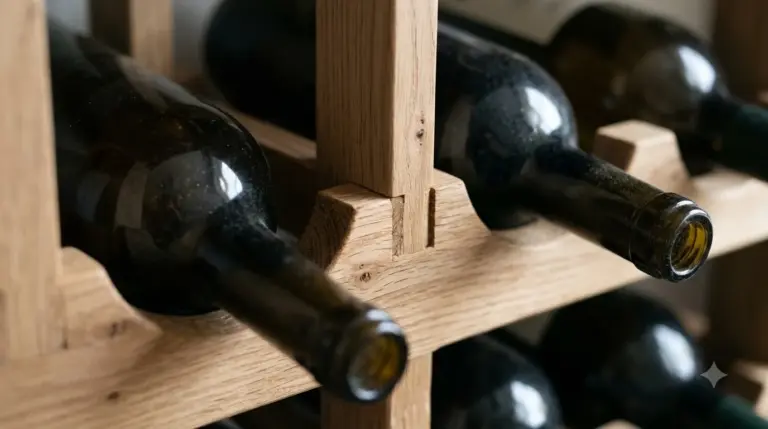
- Prioritize horizontal cradle geometry: Any bottle sealed with natural cork needs to rest on its side so the wine stays in contact with the cork, keeping it swollen and airtight. Look for shelves with dual-point cradles or deep scalloped channels that prevent bottles from tipping forward when someone bumps the frame.
- Check frame rigidity and load ratings: A standard 750 ml bottle weighs between two-and-a-half and three-and-a-half pounds depending on glass thickness. Multiply your target bottle count by three and a half to find the minimum dead weight the shelf must carry without sagging, racking sideways, or pulling loose from wall fasteners.
- Match material to room humidity: Kiln-dried hardwoods like mahogany, redwood, and cedar resist warping in cool, damp basements, whereas powder-coated steel resists rust and wipes clean easily in kitchens. Avoid unsealed particleboard or thin MDF in basements, as moisture causes composite boards to swell and lose screw grip over time.
- Scout the location before buying: Even the sturdiest rack cannot protect wine parked next to a radiator or sunlit window. According to Wine Folly’s wine storage temperature research, wines stored at warm room temperatures age up to four times faster than those kept in cool cellar conditions around 55 to 59 degrees Fahrenheit, so place your shelf in the coolest, darkest interior spot available.
Tip: Before committing to a freestanding or stackable shelf, mock up its footprint on the floor with painter’s tape and test pulling an imaginary bottle straight out—you need at least thirteen inches of clear aisle space in front of the rack to slide a 750 ml bottle out without hitting a wall or cabinet door.
Frequently Asked Questions
Should wine bottles sit completely flat or at a slight angle on a rack shelf?
Either a completely horizontal position or a slight downward tilt works well as long as the wine stays in continuous contact with the inside end of the cork. Keeping the cork wet prevents it from drying out, shrinking, and letting oxygen seep into the bottle. Avoid shelves that tilt bottles upward at the neck, as that leaves an air pocket against the cork.
Can I store screw-cap and sparkling wines on the same horizontal wine rack shelf?
Yes, both screw-cap wines and sparkling wines can rest horizontally on a standard wine rack shelf without any issue. While screw caps do not require liquid contact to maintain their seal, storing them sideways saves space and keeps your collection organized in one grid. Just confirm that the shelf slots are wide enough to accommodate thicker Champagne bottles without scraping the labels.
How much weight does a full 24-bottle wine rack shelf hold?
A filled 750 ml bottle typically weighs around three pounds, meaning a full 24-bottle shelf carries roughly 70 to 80 pounds of glass and liquid before accounting for the weight of the rack itself. If you store heavy-glass Cabernet or Champagne bottles, total weight can climb closer to 90 pounds. Always check manufacturer load limits and anchor taller freestanding or wall-mounted racks into solid framing.
Where is the worst place in a house to put a wine rack shelf?
The worst spots are above a refrigerator, next to an oven or dishwasher, near heating vents, or in front of a window that gets direct sunlight. Appliances generate constant heat and subtle motor vibration, both of which dull aromas and speed up premature aging. An interior closet, basement corner, or shaded dining room wall away from heat sources is a much safer choice.
Finding the right wine rack shelf comes down to balancing where you have open space with how fast you move through your bottles. Start by measuring your widest bottles and scouting a cool, shaded spot away from kitchen appliances, then pick a shelf style that leaves a little breathing room for future finds.
More in Racks & Storage
 Best Wine Barrel Racks for Distinctive Bottle StorageUpdated Nov 20, 2026
 Best Wine Storage Tower: Sizing, Protection and Room LayoutUpdated Nov 18, 2026
 Best Pyramid Wine Rack: Materials, Sizes and Where It FitsUpdated Nov 18, 2026
 Best Kitchen Cabinet Wine Rack Insert for Built-In Bottle StorageUpdated Nov 18, 2026
 Best 16 Bottle Wine Rack Options for Kitchens, Bars and CellarsUpdated Nov 18, 2026
 Best 48 Bottle Wine Rack Options for Cellars, Kitchens, and Tight SpacesUpdated Nov 18, 2026