

We may earn a commission when you buy through links on this page, at no extra cost to you. Learn more.
The best wine fridge end table is a front-venting, low-vibration compressor unit housed inside a solid wood or metal side-table cabinet with a durable, spill-resistant top. For quiet bedrooms or reading nooks, a compact thermoelectric side table prevents compressor hum, while dual-zone units let hosts keep reds and whites at distinct serving temperatures right beside the sofa. If you entertain larger groups, a hybrid beverage-and-wine end table adds drawer or shelf space for cans, mixers, and glassware alongside standard 750 mL bottles.
Replacing a standard living room side table with a refrigerated wine cabinet keeps your favorite bottles within arm’s reach without sacrificing floor space or room aesthetics. Because these pieces sit directly next to sofas, armchairs, and beds, choosing the right cooling mechanism, ventilation clearance, and tabletop surface matters just as much as bottle capacity.
Quick Comparison
Different living spaces call for distinct cooling systems, bottle capacities, and cabinet layouts, so comparing the five primary categories side by side helps narrow down the right fit.
| End Table Type | Cooling System | Typical Capacity | Noise Level | Best Room Placement |
|---|---|---|---|---|
| Compact Thermoelectric Side Tables | Solid-state thermoelectric | 6 to 12 bottles | Near-silent (under 35 dBA) | Bedrooms, quiet studies, reading corners |
| Dual-Zone Living Room End Tables | Low-vibration compressor | 16 to 28 bottles | Quiet hum (38 to 42 dBA) | Living rooms, home theaters, dens |
| Front-Venting Built-In Style Cabinets | Front-exhaust compressor | 18 to 32 bottles | Quiet hum (38 to 42 dBA) | Flush against walls, tight sofa alcoves |
| Hybrid Wine & Beverage End Tables | Compressor with convertible shelves | 12 to 20 bottles plus cans | Moderate hum (40 to 44 dBA) | Game rooms, sunrooms, patio lounges |
| Furniture-Grade Wood & Smart Tables | Inverter compressor | 15 to 24 bottles | Whisper-quiet (36 to 39 dBA) | Formal living spaces, primary seating areas |
Best for Whisper-Quiet Bedrooms and Reading Nooks
Compact thermoelectric wine fridge end tables use solid-state cooling modules without a mechanical compressor, making them virtually silent for spaces where even a faint motor hum feels intrusive.
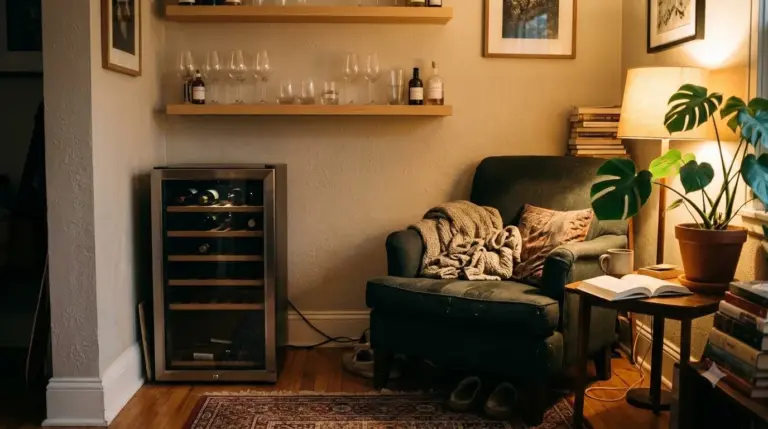
Why it stands out: According to Wine Folly’s wine storage guidelines, thermoelectric units excel at short-term storage because they run quietly and produce zero mechanical vibration. Housed inside a narrow wooden or matte-metal nightstand frame, these models typically hold between six and twelve bottles while offering a flat top surface for a reading lamp, coaster, and book. Because there are no refrigerant coils or heavy compressors inside, the overall cabinet weighs noticeably less and is easy to reposition when rearranging furniture.
Keep in mind: Thermoelectric cooling relies on ambient room temperature, usually cooling bottles about 15 to 20 degrees Fahrenheit below the surrounding air. In a warm living room that climbs above 75 degrees Fahrenheit during summer, a thermoelectric table may struggle to hold crisp white wines at 45 degrees. They also require three to four inches of clearance behind the rear exhaust fan, so you cannot push them completely flush against drywall. Best for light drinkers, bedroom suites, and temperature-controlled apartments where silence is the top priority.
Best for Entertaining Both Red and White Wine Drinkers
Dual-zone compressor wine fridge end tables split the interior into two independently controlled compartments, allowing you to store full-bodied reds and crisp whites at their ideal serving temperatures simultaneously.
Why it stands out: Wine experts at Wine Enthusiast recommend serving white wines between 45 and 52 degrees Fahrenheit while keeping red wines between 58 and 65 degrees Fahrenheit. A dual-zone end table eliminates the compromise of a single thermostat by placing an insulated divider between upper and lower racks. Most designs in this category accommodate 16 to 28 standard Bordeaux bottles, giving you plenty of reserves for dinner parties—especially helpful when you consider how many glasses in a bottle of wine you will need for a group of guests.
Keep in mind: Splitting a compact side-table cabinet into two zones reduces total bottle capacity slightly compared to a single-zone unit of identical exterior dimensions, since the insulated divider and secondary fan take up interior height. You will also hear a soft, steady compressor cycle when the room is completely quiet, though modern rubber-mounted compressors keep vibrations minimal. Best for hosts who regularly pour sparkling, white, and red wines during the same evening and want every bottle ready to uncork without trekking to the kitchen.
Best for Tight Spaces and Flush-Against-the-Wall Placement
Front-venting wine fridge end tables draw and exhaust air through a slotted kickplate at the base of the cabinet, letting you tuck the unit snugly beside a sofa or armchair without leaving rear airflow gaps.
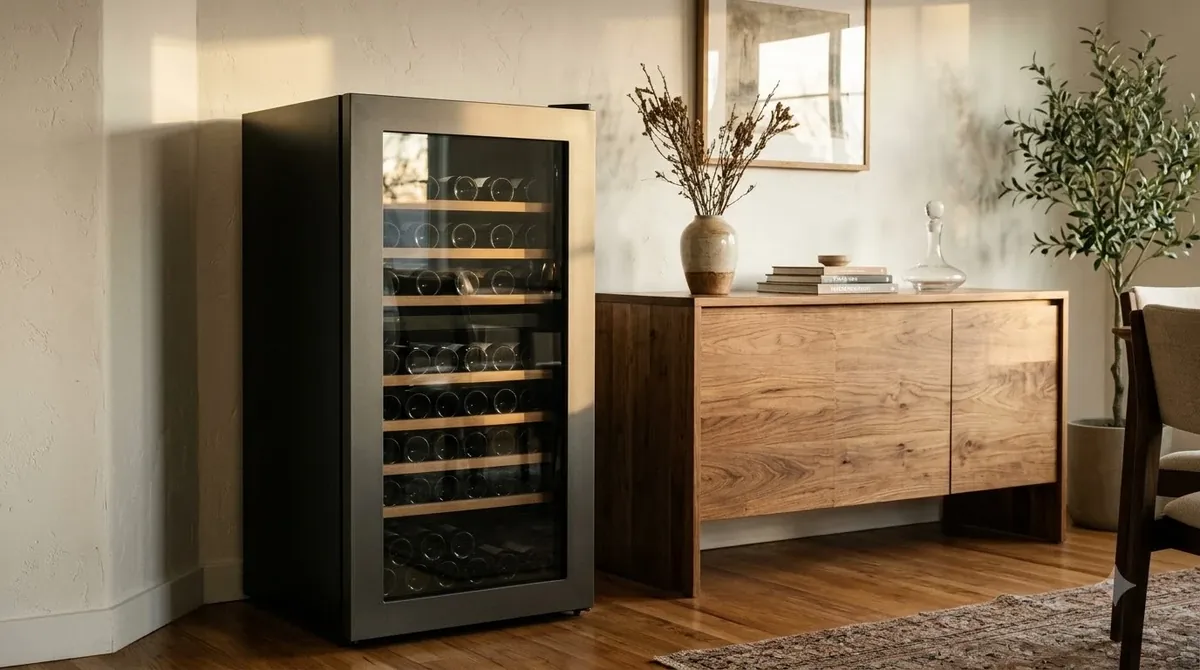
Why it stands out: Standard freestanding mini fridges dissipate heat through coils on the back and sides, which forces you to pull an end table several inches away from the wall and leaves an awkward gap behind your couch. Front-venting models borrow engineering from undercounter kitchen appliances, routing all thermal exhaust forward through a recessed toe-kick grille. This zero-clearance back and side profile preserves clean sightlines in narrow living rooms, hallways, and studio apartments while protecting the compressor from overheating.
Keep in mind: Because front-venting cabinets use heavier-duty internal ductwork and commercial-style fans, they tend to carry a noticeably higher upfront investment than rear-venting equivalents. You must also keep area rugs, pet beds, and floor-length curtains clear of the bottom front grille so intake airflow remains unobstructed. Best for urban apartments, custom built-in alcoves, and living rooms where the side table sits tightly wedged between a sectional sofa and a wall.
Best for Mixed Hosting with Beer, Seltzers, and Mixers
Hybrid wine and beverage end tables combine scalloped wooden wine racks with flat tempered-glass shelves or pull-out drawers, accommodating cans, craft beer bottles, and cocktail mixers alongside wine.
Why it stands out: Standard curved wine racks waste vertical space and allow aluminum cans or stubby beer bottles to roll around whenever you open the door. A dedicated wine and beer fridge built into an end-table silhouette solves this by pairing horizontal bottle cradles on the bottom with flat, adjustable shelving on top—or by dividing the cabinet vertically with French doors. Many hybrid side tables also feature an upper storage drawer or open cubby right beneath the tabletop for corkscrews, coasters, and cloth napkins.
Keep in mind: To chill beer, sparkling water, and canned cocktails down to 37 or 39 degrees Fahrenheit, hybrid units run slightly colder than dedicated wine coolers. If you store red wine inside a single-zone hybrid table set for cold beverages, you will need to pull reds out 20 to 30 minutes before pouring so their aromas can open up. Best for casual family rooms, basement media lounges, and hosts whose guests reach for canned drinks just as often as Pinot Noir.
Best for Smooth Living Room Aesthetics and Multi-Use Surfaces
Furniture-grade wood and smart wine fridge end tables conceal the appliance housing inside finished hardwood veneers, stone tops, and integrated charging ports so the piece reads as fine living room furniture first.
Why it stands out: Rather than exposing a black metal appliance box with a visible plastic hinge, furniture-grade end tables wrap the cooling core in walnut, white oak, or espresso cabinetry topped with tempered glass, faux marble, or sealed solid wood. Many modern iterations incorporate recessed AC outlets, USB-C charging ports, and wireless charging pads directly into the tabletop or rear apron, replacing the power strip beside your armchair. Soft amber or warm-white interior LED lighting with dimmable touch controls adds gentle evening ambiance without glaring into the room.
Keep in mind: Real wood veneers and natural stone tops require coasters to prevent condensation rings, and heavier hardwood cabinetry makes these tables substantial pieces of furniture to move during cleaning. If your bottle collection grows past 25 or 30 bottles and you want matching dining room storage, stepping up to a larger wine fridge sideboard provides expanded credenza counter space and higher bottle counts. Best for design-conscious homeowners who want climate-controlled storage hidden in plain sight next to their main sofa.
How to Choose
Selecting the right refrigerated side table comes down to matching appliance engineering with everyday furniture ergonomics. Review these core specifications and Specs & Features before committing to a footprint:
- Tabletop Height and Depth: Aim for an end table height within two inches of your sofa or armchair arm—typically 22 to 26 inches tall—so reaching for a glass feels natural. Verify that the cabinet depth does not protrude past the front edge of your seating.
- Glass Door UV Protection: Living rooms receive far more natural daylight than basements or pantries. Look for double- or triple-pane tempered glass with a UV-filtering tint to block ultraviolet rays that prematurely age wine and create unwanted sulfur compounds.
- Vibration Dampening: Fine sediment in aged red wine settles at the bottom of the bottle, and constant motor shudder keeps those particles suspended while dulling aromatics. Prioritize units with rubber compressor mounts and solid beechwood or cedar racks that absorb micro-vibrations.
- Door Swing Direction: Check whether the door hinge is reversible. When placing an end table to the right of a sofa, a left-hinged door swings away from you cleanly, whereas a right-hinged door forces you to reach awkwardly around the glass panel.
- Spill-Resistant Surface Material: Condensation from chilled glasses and occasional splashes are inevitable on a side table. Sealed hardwood, tempered glass, sintered stone, and powder-coated steel wipe clean easily without warping or staining.
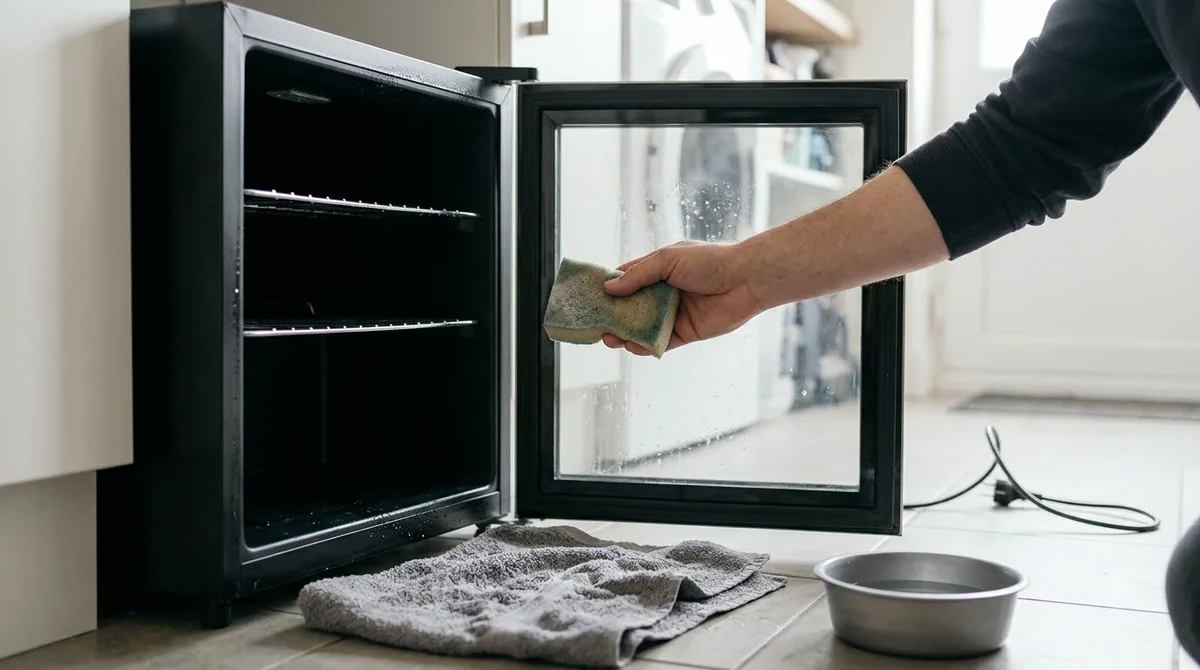
Tip: Before plugging in a compressor-based wine fridge end table after delivery, let it stand upright on a level floor for at least 24 hours so the compressor oil and refrigerant settle back into place.
Frequently Asked Questions
Can I put a heavy lamp or decorative tray on top of a wine fridge end table?
Yes, most wine fridge end tables are engineered with reinforced top panels that support between 50 and 100 pounds of evenly distributed weight. Always check the manufacturer’s weight limit before placing heavy ceramic lamps, stacks of hardcover books, or stone trays on the surface, and keep decorative items clear of any rear ventilation slots.
Are wine fridge end tables too loud to keep next to a couch or bed?
Modern wine fridge end tables typically operate between 35 and 42 decibels, which is roughly equivalent to a quiet library or soft whisper. If you are sensitive to ambient noise in a bedroom or quiet reading nook, choose a solid-state thermoelectric model, which has no compressor and runs nearly silently.
How much clearance does a wine fridge end table need around the cabinet?
Rear-venting freestanding models require three to four inches of open space behind the unit and at least one to two inches on each side so heat can dissipate properly. If you want to push the end table flush against a wall or directly beside a sofa arm, choose a front-venting model that exhausts warm air through a bottom front grille.
Can a wine fridge end table hold Champagne or wider Pinot Noir bottles?
Standard bottle counts are measured using slim 750 mL Bordeaux bottles, so wider Burgundy, Pinot Noir, and Champagne bottles reduce total capacity by 15 to 25 percent. Look for models with removable or adjustable wood shelves so you can create extra vertical spacing for wider bottles without scraping the labels.
Pairing living room furniture with dedicated climate control keeps your favorite bottles at proper serving temperature without sacrificing square footage. Measure your seating height, decide whether quiet thermoelectric cooling or higher-capacity compressor performance fits your room best, and choose a cabinet finish that complements your existing decor.
More in Wine Fridge Features
 Best Wine Fridge Bar Cabinet Setups for a Better Home BarUpdated Nov 20, 2026
 Wine Fridge for Champagne Bottles: Sizes and Storage GuideUpdated Nov 18, 2026
 Best Wine Fridge for Champagne Bottles: Shelf and Bottle FitUpdated Nov 18, 2026
 Best Wine Fridge with Display Shelf: Glass Doors and Open RacksUpdated Nov 18, 2026
 Best Wine Fridge With Drawers for Easy Access to Every BottleUpdated Nov 18, 2026
 Best Wine Fridge With Freezer: Combo Styles for Kitchens and BasementsUpdated Nov 18, 2026