


We may earn a commission when you buy through links on this page, at no extra cost to you. Learn more.
Cuisinart wine opener instructions are simple: charge the opener, remove the bottle foil, position the device upright over the cork, and press the REMOVE button until the cork comes out. Lift the opener away from the bottle and press EJECT to release the cork from the mechanism. The exact charging time and indicator-light behavior depend on your model, so identifying whether you have a CWO-50, CWO-50C, or another Cuisinart opener is an important first step.
Cuisinart electric wine openers are designed to make opening a bottle easier than using a traditional manual corkscrew. Their rechargeable motors handle the twisting, while a separate control releases the extracted cork. However, different models have different charging requirements, battery capacities, and control layouts. This review focuses on the CWO-50 and explains the practical operating steps, common problems, maintenance requirements, and differences that matter when using another Cuisinart model.
Specs and Key Features
The Cuisinart CWO-50 combines a cordless electric corkscrew with a charging station and accessories for opening and preserving wine. Its main advantages are its rechargeable design, compatibility with natural and synthetic corks, and included vacuum-preserving equipment.
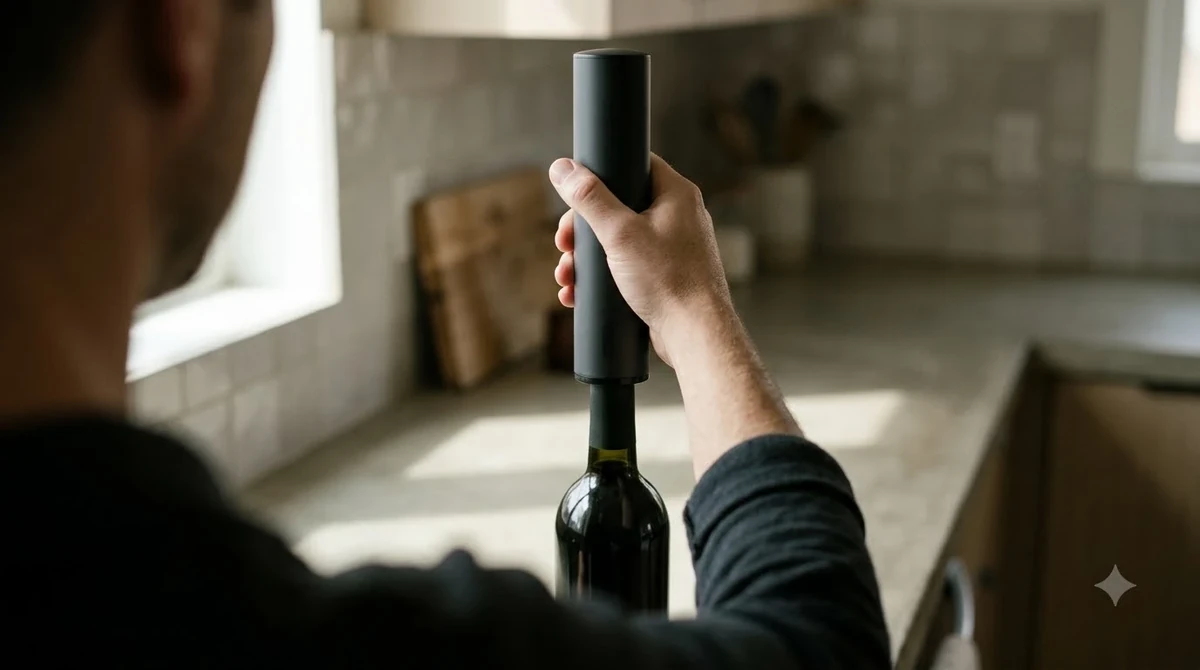
Cuisinart describes the CWO-50 as a black wine opener with brushed stainless accents and a rubberized handset. The charging base provides a dedicated storage location, while the included foil cutter removes the covering from the bottle neck before opening. A vacuum sealer is also included for closing an unfinished bottle.
The manufacturer’s listed capacity is up to 80 corks per full charge. This is a stated maximum rather than a guarantee for every battery condition or cork type. The original product listing also gives dimensions of 5.5 inches long, 4.75 inches wide, and 12.25 inches high, making the charging station a relatively substantial countertop accessory.
| Specification | Cuisinart CWO-50 |
|---|---|
| Product type | Cordless electric wine opener |
| Battery | Rechargeable NiMH battery pack |
| Rated opening capacity | Up to 80 corks per charge |
| Normal recharge time | Approximately 6–8 hours |
| Recommended initial charge | At least 8 hours |
| Charging indicator | Flashing green while charging; solid green when full |
| Compatible corks | Natural and synthetic |
| Included accessories | Charging base, foil cutter, vacuum sealer |
| Exterior | Black with brushed stainless accents |
| Dimensions | 5.5 x 4.75 x 12.25 inches |
These specifications come from Cuisinart’s product information and the CWO-50 instruction booklet. One important distinction is that the CWO-50C is a different model. Its manual recommends a 12-hour initial charge, specifies approximately 12 hours for charging, and gives a capacity of about 50 bottles per full charge. It also uses a blue charging indicator rather than the CWO-50’s flashing and solid green indicators.
That difference matters if you are following instructions found online. A charging procedure that is correct for one Cuisinart opener may not describe another. The model identification printed on the underside of the appliance is the best starting point for finding the appropriate booklet.
What Owners Like About the Cuisinart Design
The CWO-50’s strongest selling points are its cordless operation, two-stage button system, and useful accessories. These features make it particularly convenient for households that open wine regularly and prefer keeping their serving equipment together.
Simple two-button operation. The CWO-50 separates cork extraction from cork release. The lower button, marked with a down arrow, operates the corkscrew inside the bottle. The upper button, marked with an up arrow, reverses the mechanism to release the cork after extraction. This arrangement avoids the need to twist the cork manually or pull it out of a traditional corkscrew.
Rechargeable convenience. The included charging base gives the opener a consistent storage location. Instead of searching for a manual opener in a kitchen drawer, users can keep the electric device upright and ready for another bottle. Cuisinart specifies up to 80 openings per full charge for the CWO-50, which is generous for ordinary household use.
Compatibility with different cork materials. Natural cork and synthetic cork can behave differently during extraction. Synthetic closures can sometimes feel firmer than natural cork, particularly in bottles with tightly fitted closures. Cuisinart specifically lists both materials as compatible with the CWO-50, making it more versatile than an opener intended for only one type.
Useful included accessories. The foil cutter is stored in the base, so users do not need a separate cutting tool to prepare the bottle. The vacuum sealer adds another practical function after pouring. Together, these accessories make the package more complete than a standalone electric corkscrew.
The rubberized handset is another thoughtful design detail. A comfortable exterior can make it easier to maintain a steady grip while the motor works, especially when holding the bottle and opener together. The brushed stainless accents also give the appliance a more finished appearance on a countertop or serving station.
For people who entertain, the main benefit is consistency. The same two-button process works each time, and the included accessories remain in one storage location. A manual corkscrew may take up less room, but it requires more physical effort and technique.
It is important to distinguish these design advantages from independent performance testing. The 80-bottle figure is Cuisinart’s stated specification, not a promise that every aging battery will achieve that result. Actual battery performance depends on its condition, charging history, and usage.
Common Complaints and Operating Limitations
The most important limitations involve charging differences between models, alignment during extraction, and the need to keep the mechanism clean and dry. Understanding these points helps prevent problems that can look like a defective motor but are actually caused by incorrect operation.
Charging information can be confusing. One of the biggest potential sources of frustration is finding multiple versions of the CWO-50 instructions online. The CWO-50 booklet specifies an initial charge of at least eight hours and approximately 6–8 hours for recharging. The CWO-50C booklet specifies a 12-hour initial charge and approximately 12 hours for charging. Their indicator lights also behave differently.
Consequently, users should not assume that every Cuisinart charging base or opener has interchangeable charging specifications. The model number is more useful than the general product name when searching for replacement instructions.
Alignment affects extraction. An electric opener needs to sit vertically over the bottle opening. If the device leans to one side, its corkscrew may enter the cork at an angle. That can make extraction less effective and may leave the cork partially removed. Cuisinart explicitly instructs users to keep the opener as upright as possible throughout the process.
The mechanism is not designed for forcing. The motor should perform the extraction at its intended speed. Pushing the opener aggressively onto the bottle or attempting to speed up the mechanism can damage the appliance or interfere with normal operation. If the cork does not move, stop and check the alignment and battery condition instead of applying additional pressure.
The accessories require separate handling. The foil cutter has a sharp edge, and the corkscrew itself is also sharp. The vacuum pump requires manual pumping rather than automatic operation. These are not serious drawbacks, but they mean the complete set still involves a few simple preparation and cleanup steps.
The original model is discontinued. Cuisinart identifies the CWO-50 as discontinued on its official product page. That is relevant when considering a used appliance or searching for replacement parts. Buyers should confirm the condition of the charging base, adapter, and battery before choosing an older unit.
Another limitation is that an electric wine opener is an indoor household appliance, not a device for outdoor or wet environments. The manual warns against immersing the housing, charging base, or adapter in water. Users who want a compact, travel-friendly opener may prefer a traditional manual design instead.
These limitations do not make the CWO-50 difficult to use. They simply show why correct charging, vertical positioning, and appropriate cleaning matter more than applying force when something goes wrong.
Who Should Buy and Who Should Skip This Wine Opener
The Cuisinart CWO-50 is best suited to households that open wine frequently and appreciate having an electric corkscrew, foil cutter, and vacuum sealer in one package. Its cordless construction is particularly convenient for serving wine at a dining table or on a kitchen counter.
Consider this style of opener if you:
- Open several bottles during family gatherings, dinner parties, or celebrations.
- Prefer pressing a button rather than twisting a manual corkscrew.
- Regularly encounter both natural and synthetic cork closures.
- Have enough countertop space for a charging base measuring 4.75 inches wide.
- Want a foil cutter and vacuum sealer included with the opener.
- Prefer keeping wine accessories together in one location.
The CWO-50’s stated capacity of up to 80 bottles per charge is more than sufficient for many household entertaining situations. Its charging base also makes it convenient to store the appliance vertically instead of leaving a loose electric opener in a drawer.
Skip this style if you:
- Open wine only occasionally and do not need a rechargeable motor.
- Have very limited counter or storage space.
- Prefer a compact manual corkscrew that does not need charging.
- Want a completely maintenance-free accessory.
- Need a currently manufactured model with readily available replacement components.
A manual opener is often the more practical choice for someone who opens one bottle every few weeks. It takes up less room, has no rechargeable battery, and can be kept in a kitchen drawer. A simple wine bottle opener keychain is another option for people who value portability over motorized convenience.
For a household that already owns a collection of serving accessories, the CWO-50 can be a useful addition. It is especially appealing when several people share the responsibility of opening bottles and want a consistent procedure that does not require much practice.
However, because Cuisinart has discontinued the original CWO-50, buyers should approach secondhand listings carefully. An older unit with a weak battery or missing charging base may be less useful than a newer, supported electric opener.
How It Compares to Alternative Wine-Opening Accessories
The CWO-50 occupies the electric, rechargeable end of the wine-opener category. Manual corkscrews, compact keychain openers, and wine opener and preserver sets serve different needs, so the right choice depends on storage space, opening frequency, and the accessories included.
A traditional waiter’s corkscrew is smaller and requires no charging. It can open a bottle efficiently once the user learns the correct lever technique. However, it involves more hand movement and may be less convenient for people who prefer an automatic mechanism.
An electric rechargeable opener reduces the physical work involved. The CWO-50’s two-button arrangement makes it particularly straightforward: one control extracts the cork, and another releases it. Its charging base adds storage convenience, but also introduces another component that occupies countertop or cabinet space.
A compact keychain opener offers the opposite priorities. It is intended for portability rather than high-volume household use. It is suitable for keeping with picnic equipment or travel accessories, but does not offer the motorized extraction or charging station of the Cuisinart.
A wine opener and preserver set may be more attractive to people who want to open bottles and store unfinished wine with matching accessories. The CWO-50 already combines an electric corkscrew with a manual vacuum pump, so it covers both tasks without requiring a separate preservation purchase.
The distinction between the CWO-50 and CWO-50C is particularly important because their published specifications differ. The former has an approximately 6–8-hour recharge time and a stated capacity of up to 80 corks, while the latter specifies approximately 12 hours of charging and about 50 bottles per charge.
For anyone comparing different styles of equipment, a wine opener and preserver set provides another way to organize the opening and storage process. A dedicated bar cart can also provide space for the charging base, foil cutter, vacuum pump, glassware, and other serving essentials.
The best comparison is not simply electric versus manual. It is a question of how often the opener will be used and whether the additional accessories justify the extra storage requirements. For frequent household entertaining, a rechargeable model is convenient. For occasional use or travel, a manual opener is generally simpler.
Using, Cleaning, and Maintaining Your Cuisinart Opener
Good maintenance starts with correct positioning, careful handling of the cutting mechanism, and dry storage. Returning the opener to its charging base after use helps keep the appliance together and ready for the next bottle.
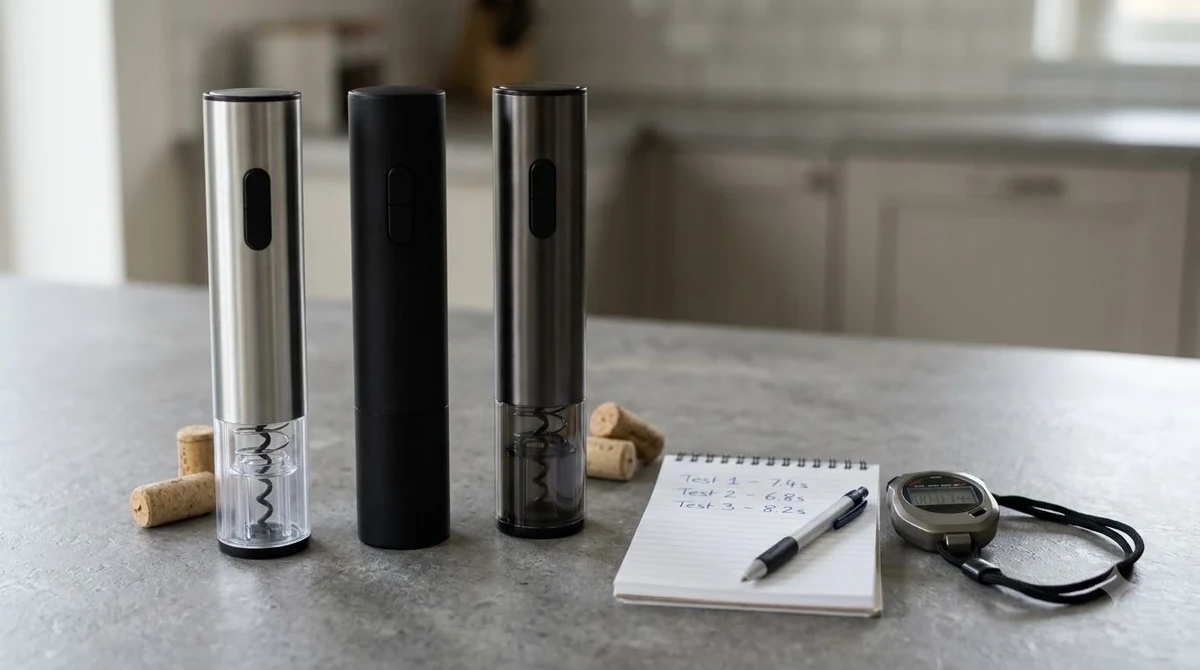
Step-by-step opening procedure
- Prepare the bottle. Place the bottle on a stable, level surface. Remove the foil covering the top of the cork so the corkscrew can enter the closure directly.
- Use the foil cutter carefully. Position the cutter around the bottle top and rotate it to remove the foil. Keep your fingers away from the cutting edges.
- Position the opener. Place the Cuisinart opener vertically over the exposed cork. Align its center with the center of the bottle opening.
- Hold the bottle securely. Keep one hand around the bottle and the other around the opener housing. Avoid touching the internal corkscrew mechanism.
- Press REMOVE. On the CWO-50, press the lower button marked with the down arrow. The spiral turns counterclockwise and gradually pulls the cork out of the bottle.
- Wait for extraction to finish. Allow the motor to complete its movement. When the mechanism stops, the cork should be removed from the bottle.
- Lift the opener. Move the appliance vertically upward and away from the bottle opening.
- Press EJECT. Press the upper button marked with the up arrow. The spiral turns clockwise and releases the cork from the opener.
- Return the appliance to its base. Put the opener back into the charging station after use so it remains protected and ready for the next bottle.
The most important part of this procedure is maintaining a straight position. The motor performs the mechanical work, but the user still needs to align the opener properly. Rushing the process or holding the device at an angle can interfere with extraction.
How to use the included vacuum sealer
The CWO-50 package also includes a manual vacuum pump for preserving unfinished wine. Unlike the electric corkscrew, this accessory does not use the rechargeable motor.
- Place the vacuum pump over the opening of the bottle.
- Press down on the top approximately 20 times or until resistance is felt.
- Twist the top of the pump to mark the sealing date.
- Store the sealed wine bottle upright.
- To remove the pump, pull it straight upward.
The vacuum pump is a useful addition for people who regularly leave wine unfinished after dinner. It provides a simple way to close the bottle without replacing the original cork. It is important to remember that vacuum sealing does not stop every form of wine deterioration, so opened bottles should still be stored appropriately.
Cleaning and storage
Unplug the charging appliance before cleaning. Use a clean, damp cloth to wipe the exterior housing and remove fingerprints or ordinary surface residue. Make sure all parts are clean and dry before putting them away.
Do not place the opener in a dishwasher. Never immerse the power adapter, charging base, or opener housing in water or another liquid. These components contain electrical parts and should only be cleaned according to the manufacturer’s instructions.
The charging station should be kept in a dry indoor location away from sinks, hot surfaces, and areas where the power cord could be pulled or caught. Store the foil cutter securely in its designated location, keeping the sharp edges away from fingers.
Tip: Return your CWO-50 to its charging base after each use, but first make sure the exterior is clean and dry. This simple routine keeps the opener together with its accessories and helps it remain available for the next bottle. If you own a CWO-50C, follow its separate charging instructions rather than assuming the CWO-50 indicator behavior applies.
Basic troubleshooting
If the opener does not operate, start with the simplest possible explanations. A depleted battery, incorrect positioning, or a cork that has not been exposed properly can interfere with the normal opening process.
The motor does not start: Check whether the charging base is connected and whether the opener is seated correctly. Allow the unit to recharge according to the instructions for its exact model. If the switch is damaged or malfunctioning, stop using the appliance.
The cork does not come out: Check that the opener is upright and centered over the bottle. Make sure the foil has been removed from the cork surface. Do not force the device or attempt to accelerate the mechanism manually.
The cork remains inside the opener: Lift the opener away from the bottle and use the designated EJECT control. On the CWO-50, this is the upper button. Allow the mechanism to complete its release cycle before attempting another bottle.
The charging light behaves unexpectedly: First identify the model. The CWO-50 uses a red power indicator and a green charging indicator, with green changing from flashing to solid when fully charged. The CWO-50C uses a blue indicator that remains illuminated during charging, even when the battery is fully charged. These are not interchangeable signals.
The appliance appears damaged: Do not operate an opener with a damaged cord, plug, housing, or malfunctioning switch. The manual directs users to authorized service for repairs beyond ordinary cleaning. Do not open the charging base or attempt to repair the internal battery mechanism yourself.
For additional product information, consult Cuisinart’s official CWO-50 product and support page. The manufacturer’s wine appliance manuals directory is also useful for identifying the correct booklet for other models, including the RWO-100 and CWO-25 series.
Frequently Asked Questions
Where can I find the model number on my Cuisinart wine opener?
Look at the underside of the opener or its base for the product identification information. Cuisinart’s CWO-50 warranty instructions specifically refer users to the model number located on the bottom of the product. Keep that information with your purchase receipt when requesting service or replacement components.
Can a Cuisinart electric wine opener open a bottle with a damaged cork?
A badly deteriorated or crumbling cork can be difficult for an electric spiral to extract cleanly. Older natural corks may break apart even when the opener is correctly positioned. In that situation, a two-pronged cork puller designed for fragile closures may be a more appropriate alternative than repeatedly operating the motor.
Does a Cuisinart cordless wine opener work during a power outage?
A cordless opener with a charged internal battery does not need to remain connected to an electrical outlet while opening a bottle. Its motor draws power from the rechargeable battery. The charging station still requires electricity to replenish the battery after use.
Can I replace the rechargeable battery in a Cuisinart CWO-50 myself?
The CWO-50 instruction booklet identifies the charging base and internal battery components as parts that are not intended for ordinary user servicing. Do not open the appliance or charging base to attempt a battery replacement. Contact an authorized service representative to ask about appropriate repair options for your particular unit.
Is the Cuisinart CWO-50 suitable for commercial restaurant service?
The CWO-50 instruction booklet identifies the appliance as intended for domestic household use rather than commercial, industrial, or outdoor use. A restaurant or bar should therefore select equipment specifically intended for its operating environment and expected workload. Frequent professional service may require a more specialized opener designed for repeated commercial use.
The Cuisinart CWO-50 is a convenient electric wine opener with straightforward controls, a rechargeable base, and practical accessories for serving and preserving wine. Correct alignment, model-specific charging instructions, and careful cleaning are the keys to using it properly. If you are choosing an older CWO-50 or another Cuisinart model, identify the exact model before following a charging procedure or ordering replacement parts.
More in Wine Accessories
 Zwilling Wine Stopper Review: Preserve Open Bottles LongerUpdated Nov 21, 2026
 Wine Enthusiast Wine Preserver Review: Features, Benefits and LimitationsUpdated Nov 21, 2026
 Wine Enthusiast Wine Stopper: An Easier Way to Reseal Open BottlesUpdated Nov 21, 2026
 Vintorio Wine Opener: Two-Step Cork RemovalUpdated Nov 21, 2026
 Zwilling Wine Aerator Review: Aerate, Pour, and Seal With One ToolUpdated Nov 21, 2026
 Zazzol Wine Opener Review: Features, Comfort, and Buying AdviceUpdated Nov 21, 2026