

We may earn a commission when you buy through links on this page, at no extra cost to you. Learn more.
The brumate wine aerator search does not currently point to a dedicated BrüMate wine aerator in the brand’s listed Wine + Barware collection. BrüMate’s published range instead centers on insulated tumblers, a champagne flute, a cocktail shaker, and a bottle-chiller pitcher. If your goal is to expose a young red wine to oxygen as you pour, you will need a purpose-built aerator or a decanter rather than one of these insulated vessels.
This review separates what BrüMate actually lists from what the word “aerator” means in wine service. It also looks at feedback for the closest related BrüMate drinkware, explains where an aerator fits, and identifies the better tool for a bottle that needs time or air.
Specs and Key Features
The important specification is the product category: BrüMate’s current wine collection lists five wine-and-barware items, but no dedicated aerator. Their published capacities run from 12 ounces to 49 ounces, and their stated functions relate to insulated drinking, chilling, or serving.
| Listed BrüMate item | Published capacity | Manufacturer-described purpose | Listed as an aerator? |
|---|---|---|---|
| Uncork’d | 14 oz | Insulated wine tumbler for portable drinking | No |
| Rocks | 12 oz | Insulated vessel for spirits and cocktails | No |
| Cocktail Shaker | 22 oz | Insulated cocktail shaker with a pour top | No |
| Champagne Flute | 12 oz | Insulated flute for sparkling wine and cocktails | No |
| Togosa | 49 oz | Two-in-one bottle chiller and serving pitcher | No |
The 14-ounce Uncork’d is the closest match for someone shopping specifically for wine. BrüMate describes it as an oversized, insulated wine tumbler that holds more than half a standard bottle and uses an OctaLock lid designed to prevent leaks. That makes it a serving and portability accessory, not a pour-through device that draws air into wine. The 12-ounce Champagne Flute is also drinkware: the company describes triple insulation and a sip-through lid intended to keep sparkling drinks cold and retain carbonation.
The 49-ounce Togosa has a different job. BrüMate describes it as a two-in-one travel bottle chiller and pitcher, supplied with two lids so it can secure a wine or champagne bottle or be used to serve a beverage. The 12-ounce Rocks and 22-ounce Cocktail Shaker round out the same barware collection, but neither is listed as a wine-aeration tool. Those distinctions matter because capacity, insulation, and a leak-resistant lid do not tell you whether wine is being aerated.
There is also no verified aerator-specific specification to compare for material, filter, air-intake design, bottle-neck fit, pour speed, cleaning, or warranty. BrüMate’s Help Center says its products use stainless steel, with plastic and rubberized components in gaskets, but that broad material statement is not an aerator specification. Buyers should not assume that an unrelated BrüMate tumbler accessory or replacement lid is a wine aerator just because it appears in an accessories search.
What Owners Like
There is no responsible way to summarize owners’ experiences with a BrüMate-branded aerator when the manufacturer’s listed wine range does not identify one. The nearest useful owner feedback concerns the Uncork’d XL, which is an insulated wine tumbler; those comments can help assess BrüMate’s portable drinkware, but they do not establish that the brand has an aerator or that its drinkware changes a wine’s aroma.
In Best Buy customer comments about the Uncork’d XL, recurring positives include keeping drinks cold, the lid’s spill resistance, and the convenience of carrying wine outdoors without a fragile stemmed glass. One owner specifically praised using the cup for wine on the go, while another described it as a useful alternative to taking glassware outside. These are practical benefits for picnics, patios, or casual entertaining, where keeping a drink cool and reducing the chance of a spill may matter more than aeration.
The distinction is especially important for red-wine drinkers. A tumbler that keeps a drink cold can help with serving temperature, but it does not produce the same result as passing wine through an aerator or giving it time in a broad decanter. If you are setting up a bar cart, an Uncork’d-style cup can sit alongside glassware and an opener as a convenience item. It should not take the place of the tool you choose to open up a young, tightly structured red.
Feedback for the Uncork’d XL is useful only as adjacent evidence. It supports a narrow point: customers value insulated BrüMate drinkware for portability, cold retention, and reduced spill risk. It says nothing about pour-through aeration, oxygen exposure, sediment control, or wine tasting better after use. A product review that treated those customer comments as proof of aerator performance would be mixing up two different jobs.
Common Complaints
The first complaint to consider is a product mismatch: a shopper searching for a BrüMate aerator may reach a collection of drinkware that cannot perform the requested task. There is no verified set of aerator-specific complaints because there is no dedicated aerator in the listed collection to assess; the practical risk is buying a tumbler or pitcher while expecting an aroma or tannin effect.
For the adjacent Uncork’d XL, cleaning is one limitation that appears in owner feedback. A Best Buy purchaser liked the way the cup kept a drink cold but noted that it was intended to be hand-washed. That is a maintenance drawback for a reusable tumbler, not a complaint about a BrüMate aerator. It matters to buyers who want an accessory that can go straight into a dishwasher after a gathering, so confirm care instructions for the exact drinkware version before buying.
There is a separate caution around warranty expectations. BrüMate’s Help Center advertises a Limited Lifetime Warranty, but it also says cosmetic or accessory damage has a 60-day warranty period, some products are not eligible for replacement, and a replacement accessory may be the remedy instead of a whole new unit. The company also says accidental damage from misuse is not covered. Those qualifications are more useful to a buyer than treating the phrase “lifetime warranty” as unlimited coverage for every part and every kind of damage.
Aerators as a category have limitations of their own. Their fast pour can be handy for a young wine that seems closed, but a quick passage through a small device is not the same as controlled aeration over time. The Wine Enthusiast comparison of aerators and decanters explains that small aerators increase air contact during pouring, while a decanter provides a different approach and can be preferable for older wines. A buyer should treat speed as a convenience, not proof that an aerator will improve every bottle.
Who Should Buy and Who Should Skip
Buy BrüMate drinkware if your priority is carrying wine, keeping it cool, or serving drinks with less risk of a broken glass. Skip the search for a BrüMate aerator if your priority is exposing wine to oxygen: the brand’s listed 14-ounce Uncork’d and 49-ounce Togosa are designed for drinking, chilling, and serving, not for aerating wine as it is poured.
The Uncork’d makes sense for someone who wants a reusable cup for a patio, picnic, concert, or outdoor meal. Its 14-ounce capacity is larger than a typical five-ounce wine pour, and the company describes the model as holding over half a bottle. That capacity is useful for a relaxed outing, but it is not a reason to pour half a bottle into a single glass at a formal tasting. For a wine dinner, a standard stemmed glass gives you more room to swirl and smell the wine, while a small initial pour makes it easier to assess how the aromas change.
The Togosa is a better fit for hosting than for individual sipping. At 49 ounces, it is listed as a bottle chiller and pitcher combination, so it may suit a table where guests are sharing wine or another chilled drink. It can complement serving pieces, an ice bucket, and glassware, but it still does not replace an aerator. A host assembling a wine-themed present might pair a portable tumbler with a wine advent calendar, while keeping a separate aeration tool for the bottles that benefit from it.
Choose a purpose-built aerator if you want wine to meet more air during the pour and you usually open young, concentrated reds. Wine.com’s decanting guidance identifies young Cabernet Sauvignon, Petite Sirah, and Nebbiolo as examples that can benefit from 30 to 60 minutes in a decanter. That longer approach is useful when the wine needs time before dinner; an aerator is more attractive when you want to pour a glass immediately and assess the change as you go.
Skip rapid aeration for delicate older bottles unless you have a reason to use it. Older wines can be more fragile, and a quick, vigorous treatment may expose them to more air than they need. If you are shopping for accessories from the broader brand category, browse the Accessory Brands collection with the purpose of each tool in mind: a tumbler, stopper, decanter, and aerator solve different problems even if all appear in the same wine-barware aisle.
How It Compares to Alternatives
For aeration, the meaningful comparison is not between BrüMate drinkware models; it is between a pour-through aerator, a decanter, and the simple option of swirling wine in a glass. Each method exposes wine to air differently, and the right choice depends on the wine’s age, structure, and how soon you plan to serve it.
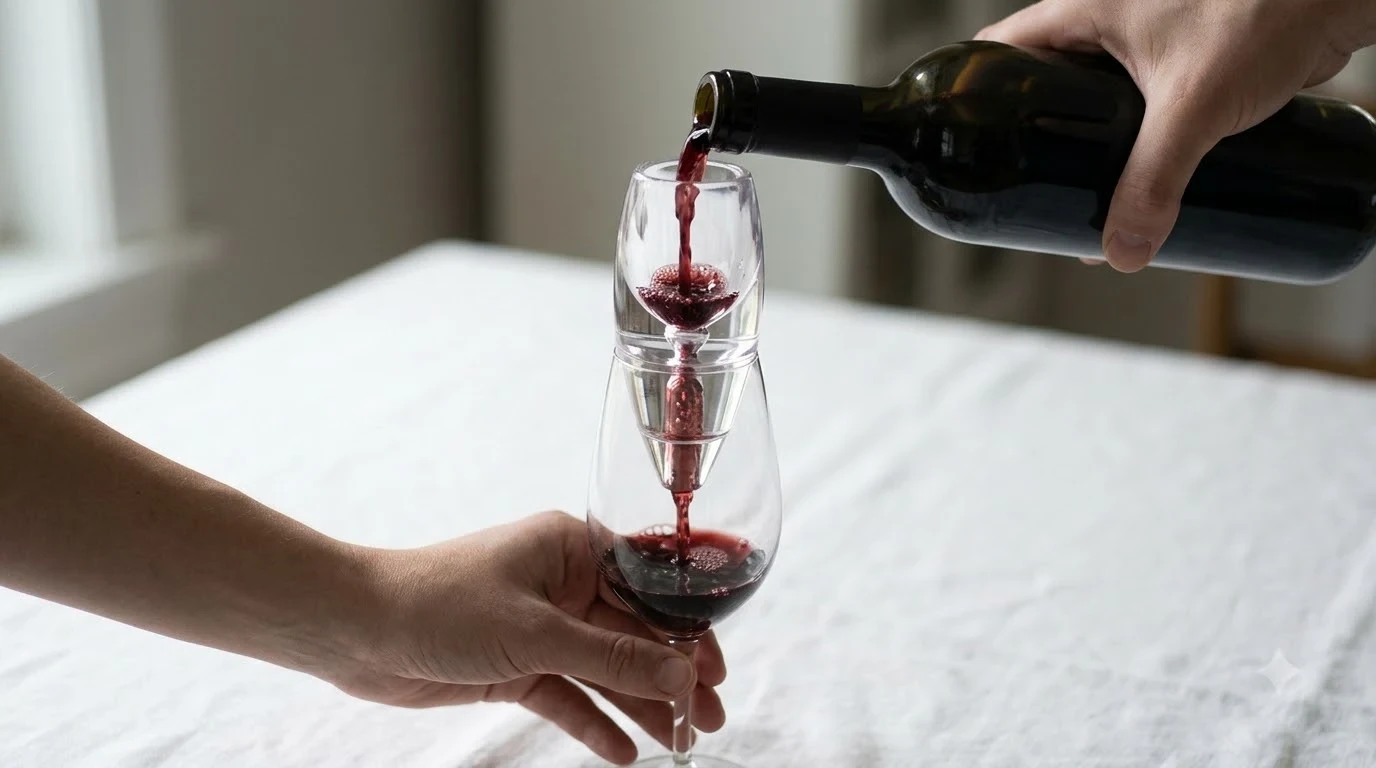
A pour-through aerator sits in or over a bottle opening, or is held over the glass, so wine meets air as it flows. This is convenient for a glass poured at the counter because it requires little advance planning and can make a young, tannic red seem more expressive sooner. It is not a substitute for a vessel that lets an entire bottle rest with a wider surface exposed to air, and the effect varies with the wine. If you are buying this type, look for a stable fit, a pour that does not splash, and parts that can be cleaned without trapping wine residue.
A decanter is a better choice when you want more control over contact with air or need to separate wine from sediment. Wine.com describes 30 to 60 minutes as a useful starting point for young, tannic Cabernet Sauvignon, Petite Sirah, and Nebbiolo; it also notes that older reds with sediment should be handled gently. A wide-base vessel gives a larger wine surface for aeration, and a decanter with aerator can combine an aerating pour with a serving vessel. For a bottle that is already expressive, start with a small pour and give it a few minutes in the glass rather than assuming more oxygen is always better.
Swirling in a glass is the least complicated option. It costs nothing, lets you observe the wine as aromas emerge, and avoids adding another object to the cupboard. A broad glass and a modest pour give the wine room to move; try a few gentle turns, smell, and taste before deciding that a gadget is necessary. This is a particularly sensible first step when you are unsure how a bottle will react.
BrüMate’s insulated pieces solve a different problem again: keeping a drink cold and making it easier to transport or serve. The manufacturer’s current collection includes the 12-ounce Champagne Flute, 14-ounce Uncork’d, and 49-ounce Togosa, but not a dedicated aerator. Think of those products as companions to wine service rather than alternatives to aeration. A useful setup can include an insulated piece for outdoor occasions and a separate glass or decanter for a bottle that needs air.
Frequently Asked Questions
These answers cover basic aeration questions that are easy to confuse with the job of insulated drinkware. The examples include named wines and practical serving situations, because a tool that suits a young Cabernet may be too forceful for an older Pinot Noir.
Can I aerate wine just by pulling the cork and leaving the bottle open?
Very little wine touches the air inside a bottle’s narrow neck, so removing the cork alone has limited effect. Pour a glass and swirl it, or transfer the wine to a suitable vessel when more exposure is needed. The aroma can change more noticeably once the wine has a larger exposed surface.
Can white wine benefit from aeration?
Yes, some complex whites can benefit from a little air. Decanter identifies examples such as Puligny-Montrachet and Alsace or German Riesling, while a simple, youthful Muscadet or New Zealand Sauvignon Blanc is less likely to need it. Start with a small pour and reassess before giving the whole bottle extended air.
Will a wine aerator remove sediment from an older bottle?
Most aerators are not sediment-removal tools, and particles can clog some designs or interrupt the pour. For a bottle with sediment, stand it upright ahead of service and pour slowly into a decanter, stopping when the sediment approaches the neck. A candle or flashlight behind the bottle can help you see when to stop.
Does aerating make every wine taste better?
No. Aeration can reveal aromas more quickly, but it cannot turn a simple wine into a more complex one or repair a faulty bottle. Taste a small amount first, then decide whether the wine needs air rather than treating an aerator as a required step for every opening.
How long can an opened bottle continue to change after aeration?
Some age-worthy wines continue to evolve over a day or two after opening. Decanter recommends replacing the closure and refrigerating the bottle between pours to slow oxidation. That gradual change is different from leaving a delicate wine exposed to air for a long period before serving.
BrüMate is a reasonable brand to consider for insulated wine drinkware, but the current listed collection does not provide the dedicated aerator implied by this search term. Match the accessory to the task: choose BrüMate for portable chilling and serving, and choose an aerator, decanter, or glass swirl when the wine itself needs air.
More in Wine Accessories
 Zwilling Wine Stopper Review: Preserve Open Bottles LongerUpdated Nov 21, 2026
 Wine Enthusiast Wine Preserver Review: Features, Benefits and LimitationsUpdated Nov 21, 2026
 Wine Enthusiast Wine Stopper: An Easier Way to Reseal Open BottlesUpdated Nov 21, 2026
 Vintorio Wine Opener: Two-Step Cork RemovalUpdated Nov 21, 2026
 Zwilling Wine Aerator Review: Aerate, Pour, and Seal With One ToolUpdated Nov 21, 2026
 Zazzol Wine Opener Review: Features, Comfort, and Buying AdviceUpdated Nov 21, 2026