


We may earn a commission when you buy through links on this page, at no extra cost to you. Learn more.
The koolatron 20 bottle wine cooler is a compact, freestanding wine refrigerator best suited to casual wine drinkers who want organized storage for a small collection without buying a large cabinet. The WC20 holds up to 20 standard Bordeaux bottles, uses thermoelectric cooling, and offers an adjustable temperature range of 46°F to 66°F. Its removable racks, mirrored glass door, and external controls make it convenient for everyday home use, although its single temperature zone, ventilation requirements, and limited accommodation for unusually shaped bottles deserve consideration before purchasing.
A small wine refrigerator can make a noticeable difference in how a home wine collection is organized. Bottles are easier to find, whites can be kept ready for chilling, and reds can be stored away from the temperature fluctuations of a busy kitchen. The Koolatron WC20 occupies an interesting middle ground between a countertop beverage cooler and a larger wine cabinet. It offers more capacity than many compact models while remaining relatively small. However, advertised bottle capacity is only one part of the purchasing decision. Cooling performance, available space, bottle dimensions, and the kind of wine being stored all affect whether this appliance makes sense.
Specs and Key Features
The Koolatron WC20 combines a 20-bottle advertised capacity with thermoelectric cooling and a single adjustable temperature zone. Its most appealing features are the removable shelving, compact footprint, and external digital controls, although the temperature range and installation requirements deserve close attention.
The manufacturer identifies the appliance as model WC20. It is a freestanding unit with a black finish, mirrored glass door, and five removable wire racks. The controls are positioned externally, allowing temperature adjustments and interior lighting operation without opening the door. This is a practical arrangement because frequent door openings can interfere with temperature stability.
The cooling system is thermoelectric. Instead of relying on a conventional compressor arrangement, this technology uses an electrical cooling element and heat dissipation system. Koolatron promotes the system as quiet and vibration-free, which is attractive for people who keep wine in a living area, apartment kitchen, or home bar. Thermoelectric appliances nevertheless depend heavily on their surroundings, so a warm room or inadequate ventilation can affect results.
| Specification | Koolatron WC20 |
|---|---|
| Model | WC20 |
| Advertised capacity | 20 standard Bordeaux bottles |
| Cooling technology | Thermoelectric |
| Temperature range | 46°F–66°F (8°C–18°C) |
| Temperature zones | 1 |
| Dimensions (W × D × H) | 15.75 × 20.25 × 21.25 inches |
| Racks | 5 removable wire racks |
| Door | Mirrored glass with UV protection |
| Lighting | Interior LED lighting |
| Electrical supply | 110–120V AC, 60Hz |
| Installation | Freestanding |
| Warranty | 1-year limited warranty |
These specifications come from the manufacturer’s product listing and WC20 user manual. The published dimensions are particularly useful when planning a kitchen counter, home bar, or dedicated storage area. At 15.75 inches wide and 21.25 inches high, the cabinet has a compact footprint, but its 20.25-inch depth means it still needs a reasonably deep surface. Remember that the actual installation space must also accommodate ventilation and access to the electrical outlet.
The temperature range is another important consideration. A minimum setting of 46°F is suitable for chilling many white wines and sparkling wines, while the upper end can accommodate red wine storage and serving preparation. However, the WC20 cannot independently maintain two different temperatures. People who regularly keep Champagne, Sauvignon Blanc, Chardonnay, Pinot Noir, and Cabernet Sauvignon ready at different temperatures may find that limitation inconvenient.
For further technical information, the official Koolatron WC20 product specifications provide the manufacturer’s feature list and product identification. The published figures should be used as the starting point for checking whether the refrigerator fits a particular room and collection.
What Owners Like
Owner feedback highlights the WC20’s convenient capacity, relatively quiet operation, and compact dimensions. These qualities make it attractive for households that want a dedicated place for everyday bottles without giving up a large amount of kitchen or living space.
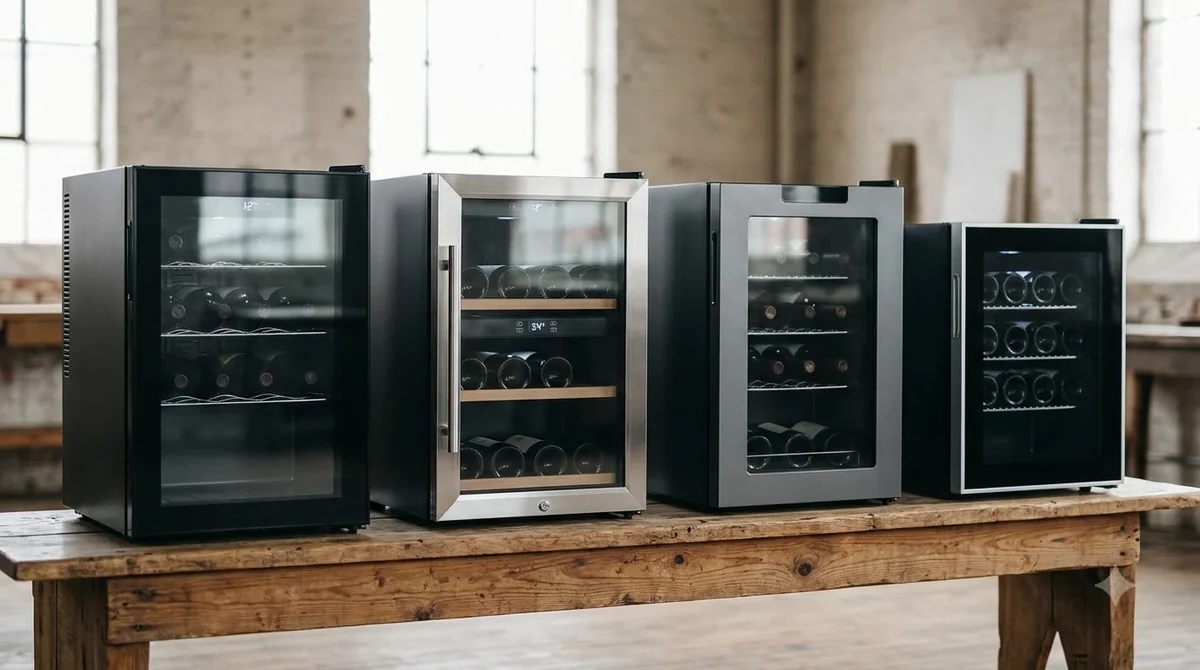
One of the main advantages is the advertised 20-bottle capacity. For a casual collector, that can be enough room for several bottles of red, a few whites, sparkling wine, and bottles reserved for upcoming dinners. A household that buys wine regularly but does not maintain a large cellar may find this capacity more practical than a much larger refrigerator.
The five removable racks provide some flexibility. Different bottles can have different shapes, and the ability to remove a rack helps create additional room when a particular bottle needs more vertical clearance. This is useful for occasional purchases of sparkling wine or bottles with wider shoulders. However, removable shelving should not be confused with unlimited flexibility: taking out racks reduces the number of bottles that can be stored in the cabinet.
Owners also have reason to appreciate the external controls. Adjusting a temperature setting without opening the door avoids unnecessary warm-air exchange. The same arrangement allows the interior light to be switched on from outside. For a compact refrigerator used throughout the week, this small convenience can make everyday operation easier.
Noise is another frequently relevant consideration. A wine refrigerator placed in an open-plan kitchen or apartment living room should not produce an intrusive mechanical sound. Koolatron describes the WC20’s thermoelectric system as quiet, and an owner review on Home Depot specifically describes the appliance as having little to no noise. That feedback is encouraging, although perceived noise can vary with installation, room acoustics, and individual expectations.
The mirrored door also contributes to the appearance of the appliance. Rather than looking like a basic utility refrigerator, the WC20 can fit into a home bar or contemporary kitchen arrangement. The dark finish makes it relatively easy to coordinate with black appliances, while the glass front gives the cabinet a recognizable wine-storage appearance.
Another practical benefit is the relatively straightforward control system. The user manual explains how to adjust the temperature and switch between Fahrenheit and Celsius. The interior light can also be operated through the central touch control. Buyers who prefer a simple appliance rather than an elaborate connected refrigerator may appreciate this approach.
Home Depot owner feedback provides useful context beyond the manufacturer’s feature descriptions. One reviewer described using the cooler as a compact living-room storage piece, while another highlighted how conveniently it fitted beneath a desk in a kitchen area. Such comments illustrate the flexibility of its small footprint, but they should be treated as individual experiences rather than guarantees about every installation.
Common Complaints
The main limitations to consider are the difference between advertised and practical bottle capacity, the single-zone temperature arrangement, and the dependence of thermoelectric cooling on room conditions. Owner feedback also raises a question about the brightness of the interior lighting.
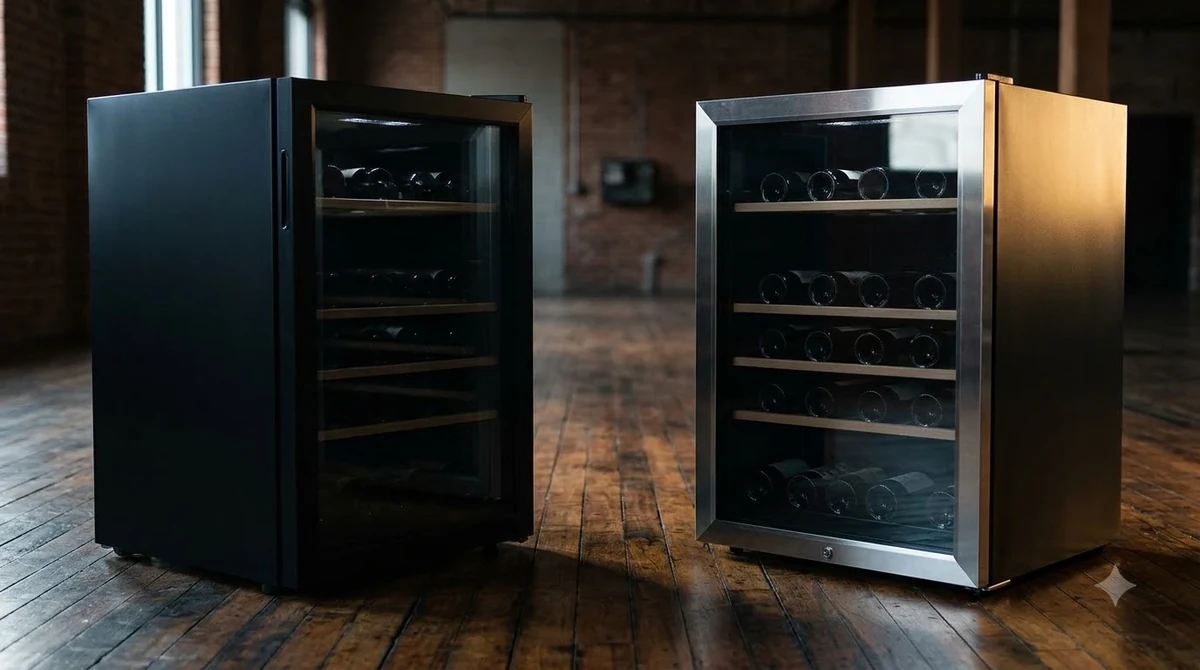
The first concern is bottle fit. The advertised 20-bottle capacity refers to standard Bordeaux-style bottles, not every bottle sold by a winery. Pinot Noir and Burgundy bottles often have wider bodies, while sparkling wine bottles can be larger in diameter. Some bottles may require rearranging the racks, alternating their orientation, or removing a shelf. A full 20-bottle load should therefore be considered a best-case capacity rather than a guaranteed fit for a mixed collection.
A Home Depot reviewer specifically mentioned alternating bottles front-to-back to fit them into the available space. That is an important practical observation for anyone who regularly purchases wines in different bottle formats. If a collection contains many Champagne bottles, large Burgundy bottles, or unusually shaped packaging, the advertised capacity may overstate the number of bottles that can be stored comfortably.
The second concern is temperature management. The WC20 has one temperature zone, meaning all bottles share the same cooling environment. A person cannot set the upper shelves to 48°F for white wine and the lower shelves to 60°F for red wine as separate controlled zones. The appliance can still hold different wine styles, but owners must choose a compromise temperature or adjust the setting according to the wines currently being stored.
Thermoelectric cooling also requires realistic expectations. It is not designed to overcome unlimited external heat. The user manual specifies an ambient operating range of 59°F to 77°F and warns that performance may be affected outside those conditions. Placing the appliance next to an oven, in direct sunlight, or inside an unusually hot room can lead to disappointing results. This matters particularly in homes where kitchen temperatures rise considerably during cooking.
Lighting is another possible weakness. Koolatron describes the interior lighting as LED, but the presence of an LED does not necessarily mean it will illuminate every bottle brightly. One Home Depot reviewer specifically complained that the light was extremely dim. Shoppers who want a display refrigerator with dramatic illumination should consider that feedback before choosing this model.
There is also a distinction between quiet operation and complete silence. Thermoelectric systems can produce fan and airflow sounds because heat must be transferred away from the cooling components. A properly leveled unit with sufficient ventilation should operate more comfortably, but buyers who expect absolute silence may still notice some operating noise.
Finally, the WC20 is a freestanding household appliance. Its compact dimensions may tempt buyers to treat it as a built-in refrigerator, but the manufacturer does not identify it as a built-in installation model. Enclosing it inside cabinetry without the specified clearances can restrict heat dissipation and affect cooling performance. This is not a cosmetic detail; ventilation is part of the appliance’s operating requirements.
Who Should Buy and Who Should Skip
The WC20 makes the most sense for casual wine drinkers and smaller households that need convenient storage for approximately 20 standard bottles. It is less suitable for serious collectors, households with extensive sparkling wine selections, or buyers who require independently controlled temperatures.
Who should consider it
Apartment residents and homeowners with limited storage space are natural candidates. The cabinet measures 15.75 inches across and stands 21.25 inches high, so it can fit into areas where a tall wine refrigerator would be impractical. A kitchen counter, home bar, or dedicated beverage station may provide a suitable location if the required ventilation space is available.
Casual collectors who buy a few bottles at a time may also appreciate the capacity. For example, a household might keep six bottles of Cabernet Sauvignon or Merlot, four bottles of Pinot Noir, six bottles of Sauvignon Blanc or Chardonnay, and four bottles of sparkling or other wine. That is a varied collection of 20 bottles without requiring a large cellar.
People who value low-vibration storage may also find the thermoelectric design appealing. The manufacturer specifically promotes vibration-free cooling, which is relevant to people who prefer keeping wine undisturbed during ordinary household storage. The mirrored door and removable racks add practical convenience without introducing a complicated control interface.
Who should skip it
Serious wine collectors who maintain bottles for extended aging should think carefully before choosing a compact thermoelectric refrigerator. Long-term storage requires stable conditions, and a small appliance with a relatively narrow operating range and sensitivity to room temperature may not provide the environmental control that a dedicated wine cellar offers.
People who regularly serve both red and white wine at different temperatures may prefer a dual-zone model. For instance, Sauvignon Blanc is generally served around 45°F to 50°F, while full-bodied Cabernet Sauvignon is better served around 60°F to 65°F. The WC20 cannot independently maintain those two serving environments.
Buyers with large Burgundy or Champagne collections should also look elsewhere if they need predictable maximum capacity. The advertised 20 bottles are based on standard Bordeaux bottles. A refrigerator with wider shelves or adjustable bottle supports may be more appropriate for a collection dominated by larger formats.
Finally, anyone planning to install a wine refrigerator inside a tight cabinet opening should select an appliance specifically designed and approved for built-in use. The WC20’s freestanding designation means it should not be treated as an undercounter built-in model simply because its height appears convenient.
How It Compares to Alternatives
The most useful comparison is not simply the number of bottles advertised. Buyers should compare cooling technology, temperature zones, cabinet dimensions, bottle flexibility, and installation requirements before deciding whether the WC20 is the right type of appliance.
A small thermoelectric refrigerator like the Koolatron is designed around compact storage and relatively quiet operation. A larger compressor-based wine refrigerator may be a better choice for people who want greater capacity or need an appliance that can handle a warmer installation environment. Neither technology automatically guarantees better wine storage; the actual operating conditions and product design matter.
Compact thermoelectric refrigerators
These appliances are generally attractive for small collections and residential spaces. Their lower-vibration operation and compact designs are useful features for people who do not need a large cellar. The WC20 fits this category, with its five removable racks and 20-bottle advertised capacity.
The trade-off is sensitivity to surrounding temperatures. If the appliance is placed in a warm kitchen or next to a heat-producing appliance, its cooling performance may be affected. Buyers should compare the manufacturer’s stated ambient operating conditions rather than relying solely on the advertised minimum temperature.
Compressor wine refrigerators
Compressor models use a refrigeration system more familiar from conventional refrigerators. Depending on the particular design, they may offer greater cooling capacity and more suitable operation in warmer environments. They are worth considering for people who store larger collections or need more substantial cooling performance.
However, compressor models are not automatically superior in every home. Noise, vibration, cabinet size, energy consumption, and installation requirements all differ between models. A larger compressor refrigerator may be excessive for someone who only wants a convenient place for a dozen or two everyday bottles.
Single-zone versus dual-zone refrigerators
The WC20’s single-zone arrangement is simple and appropriate for buyers who prefer keeping most of their collection at one general storage temperature. A dual-zone refrigerator offers more flexibility by allowing different sections to maintain separate settings.
For example, a household that frequently serves sparkling wine, dry whites, and light reds may appreciate separate temperature controls. Sparkling wine is generally served around 40°F to 50°F, while light reds are often served around 55°F to 60°F. Those requirements are difficult to accommodate simultaneously in a single-zone appliance.
Readers comparing different appliance categories can also explore our Model reviews for additional product assessments. For a smaller collection, the WC20 offers a straightforward combination of compact dimensions and everyday storage. For a more demanding collection, the additional flexibility of a dual-zone or larger compressor model may justify choosing a different category altogether.
Wine storage also works best when the refrigerator complements how bottles are actually served. For a casual gathering, chilled sparkling cocktails such as an Aperol Spritz recipe can make use of appropriately chilled sparkling wine, while a dinner featuring chicken Marsala may call for a bottle of medium-bodied red stored at a suitable serving temperature.
Installation, Warranty, and Support
Correct installation is particularly important with the WC20 because thermoelectric cooling depends on effective heat dissipation. The user manual provides specific ventilation and operating-temperature guidance, while the manufacturer lists a one-year limited warranty for normal household use.
Start by selecting a stable indoor location away from direct sunlight, ovens, radiators, and other heat-producing equipment. The manual specifies at least 4 inches of clearance around the unit for ventilation. Follow the appliance’s specified spacing rather than squeezing it into a decorative cabinet opening.
The floor or counter must support the refrigerator when fully loaded. The adjustable leveling leg helps stabilize the cabinet, which is important because an uneven appliance can cause vibration, door-sealing problems, or difficulty closing the door properly. Position the cooler near a suitable grounded electrical outlet, using the required 110–120V AC, 60Hz supply. The manufacturer advises against using an extension cord.
After installation, remove the packaging and clean the interior with a soft cloth and lukewarm water. The manual recommends allowing the empty appliance to operate for approximately three hours before loading it. Once bottles are inside, allow approximately 24 hours for them to reach the selected temperature. This initial waiting period is important because filling a newly switched-on cooler immediately does not mean the wine will already be chilled.
The manual also recommends an ambient room temperature between 59°F and 77°F. This is a meaningful limitation for buyers who plan to put the cooler in an unheated garage, a hot enclosed porch, or an area exposed to seasonal temperature extremes. A suitable indoor location is much more likely to deliver consistent performance.
For warranty coverage, the manufacturer specifies one year against defects in materials or workmanship under normal household use. The manual explains that the dated purchase receipt should be retained and that warranty service must be performed by an authorized Koolatron Master Service Centre. Damage caused by misuse, unauthorized repairs, improper maintenance, or commercial use is excluded from the stated warranty terms.
Before purchasing, it is sensible to confirm the warranty documentation supplied with the particular unit and identify the appropriate support contact. The WC20 manual provides additional instructions for installation, operation, cleaning, troubleshooting, and warranty procedures.
Tip: Do not set the WC20 into a tightly enclosed cabinet simply because its 21.25-inch height appears to fit. Allow the manufacturer’s required ventilation clearance, keep it away from heat sources, and give the empty refrigerator approximately three hours to cool before loading your bottles.
Routine maintenance is relatively simple. Unplug the appliance before cleaning, remove the bottles and racks, and clean the interior using the manual’s recommended solution of two tablespoons of baking soda per quart of water. Use a mild detergent solution for the removable shelves and dry the surfaces thoroughly before returning everything to the cabinet.
If the cooler seems insufficiently cold, first check the temperature setting, door seal, room temperature, and ventilation. The manual identifies frequent door openings, excessive ambient heat, and poor door closure as possible reasons for inadequate cooling. If vibration becomes noticeable, check that the appliance is level and that the removable shelves are properly positioned.
For extended periods without use, the manual recommends emptying and cleaning the refrigerator, drying the interior, and leaving the door slightly open to help prevent unwanted odors and mold growth. These basic practices help keep a small wine refrigerator in good condition without requiring complicated maintenance.
Frequently Asked Questions
Can the Koolatron WC20 be used as a regular beverage refrigerator?
The WC20 is designed primarily for wine storage, and its 46°F minimum temperature is warmer than many conventional beverage refrigerators can achieve. It can accommodate certain canned beverages if the shelves are rearranged, but its dimensions and rack design are optimized for wine bottles. Buyers wanting consistently cold soft drinks may prefer a dedicated beverage refrigerator.
Does the WC20 remember its temperature setting after a power outage?
The published user manual discusses power failures but does not establish a guaranteed memory or automatic restart behavior for every production version. After an outage, check the display and verify the selected temperature rather than assuming the appliance has resumed its previous settings. Minimize door openings while power is unavailable to help protect the stored bottles.
Can the Koolatron 20-bottle cooler accommodate bottles taller than standard Bordeaux bottles?
Its removable racks offer some flexibility for bottles with different shapes and heights. However, the manufacturer does not publish a universal maximum bottle-height specification on its product listing. Measure unusually tall bottles and compare them with the usable interior clearance before relying on the advertised capacity.
Does the WC20 require manual defrosting?
The manufacturer’s main product listing does not clearly establish a specific defrost schedule for the WC20. Keep the interior clean and dry, and consult the manual supplied with the exact production version if frost or condensation becomes noticeable. Persistent moisture or unusual cooling behavior should be investigated rather than ignored.
Is the WC20 suitable for a wine collection worth keeping for decades?
It is better regarded as a compact everyday wine refrigerator than as a dedicated long-term aging cellar. Collectors planning to keep bottles for many years should prioritize consistently controlled temperature, humidity management, protection from light, and suitable storage conditions. A purpose-built wine cellar may be a more appropriate investment for that requirement.
The Koolatron WC20 is a practical option for people who want a compact, relatively quiet refrigerator for a modest collection of everyday wines. Its 20-bottle advertised capacity, removable racks, external controls, and straightforward operation are appealing, provided the room offers adequate ventilation and the collection mainly uses standard bottle shapes. Buyers who need dual-zone cooling, substantial long-term aging conditions, or reliable capacity for larger bottles should compare other wine refrigerators before making a decision.
More in Model Reviews
 Magic Chef 44 Bottle Wine Cooler Review for Flexible StorageUpdated Nov 21, 2026
 Whynter 164 Bottle Wine Cooler Review: Capacity, Features, and FitUpdated Nov 21, 2026
 Insignia NS WC16BK6 Review: Compact 16-Bottle Wine StorageUpdated Nov 21, 2026
 Wine Enthusiast Electric Blue Omega Review: Opening, Pouring, and Preserving Made EasierUpdated Nov 21, 2026
 NewAir AWC 330E Review for Home Wine StorageUpdated Nov 21, 2026
 Ivation 18 Bottle Wine Cooler Review for Compact Home StorageUpdated Nov 21, 2026