

We may earn a commission when you buy through links on this page, at no extra cost to you. Learn more.
The frigidaire 52 bottle wine fridge, specifically the Frigidaire Gallery FGWC5233TS, is a single-zone wine cooler with room for up to 52 standard bottles, adjustable temperatures from 41°F to 64°F, and flexible built-in or freestanding installation. Its stainless-steel appearance, tinted glass door, LED lighting, and reversible door make it an attractive option for a kitchen or entertaining area. However, limited shelf extension, restrictions on larger bottles, and mixed long-term reliability feedback are important considerations before buying. It is best suited to households that want substantial everyday wine storage rather than two independently controlled serving temperatures.
A wine refrigerator needs to do more than look attractive beneath a kitchen counter. It should maintain a dependable temperature, accommodate the bottles you actually collect, and provide convenient access without making everyday storage frustrating. The Frigidaire Gallery 52-bottle model offers several useful features on paper, but its practical performance deserves a closer look. This review examines the manufacturer’s specifications, installation requirements, owner feedback, and the situations in which this appliance makes the most sense.
Specs and Key Features of the Frigidaire Gallery FGWC5233TS
The FGWC5233TS combines a 52-bottle advertised capacity with a single temperature zone and an adjustable 41°F to 64°F range. Its 5.3-cubic-foot interior, reversible door, electronic controls, and convertible shelf make it a flexible storage appliance for a household wine collection.
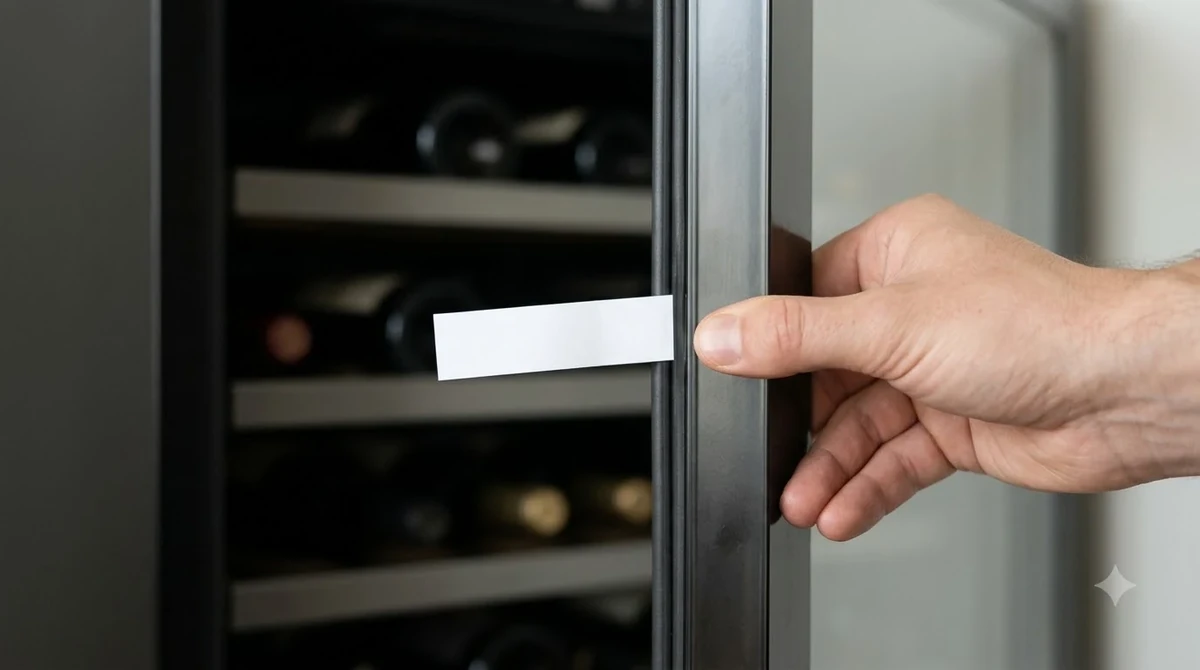
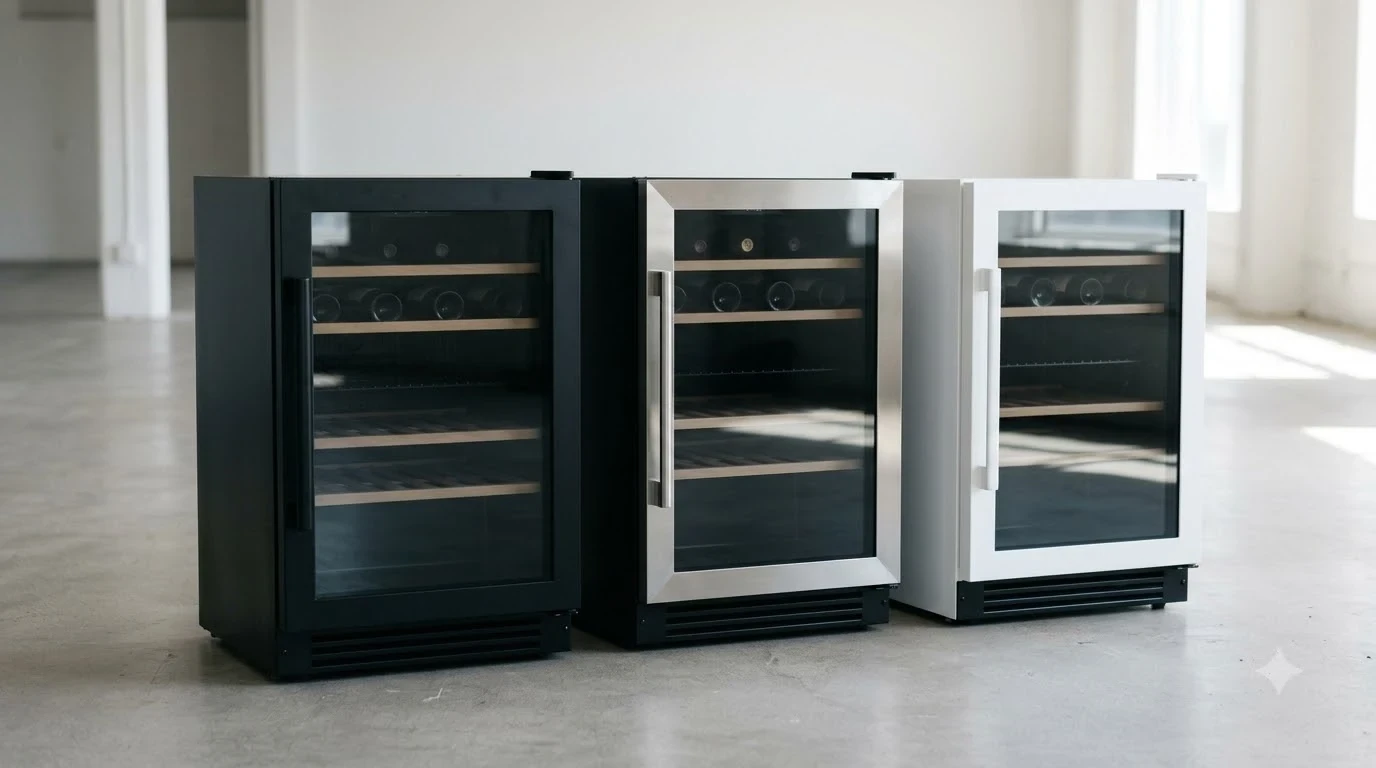
The exterior has a stainless-steel door frame and handle, a tinted glass window, and a black cabinet. The overall design is relatively understated, allowing the bottles and natural wood rack fronts to remain visible without making the cooler look like a commercial cellar. White LED controls provide a clear temperature readout, while interior LED lighting makes it easier to identify bottles without relying on the room’s lighting.
The most important distinction is that this is a single-zone refrigerator. The entire interior operates around one selected temperature rather than providing separate cooling compartments for reds and whites. The temperature range is broad enough to accommodate different wine styles, but anyone expecting independent red-wine and white-wine settings will need a different appliance.
| Specification | Frigidaire FGWC5233TS |
|---|---|
| Advertised capacity | 52 bottles |
| Interior volume | 5.3 cubic feet |
| Temperature range | 41°F–64°F |
| Temperature zones | 1 |
| Height | 34 1/4 inches |
| Width | 23 7/16 inches |
| Depth with handle | 25 3/4 inches |
| Depth with door open 90 degrees | 45 3/4 inches |
| Electrical requirements | 115V / 60Hz / 15-amp minimum circuit |
| Door | Reversible, tinted glass, stainless steel |
| Controls | Electronic LED display |
| Installation | Built-in or freestanding |
| Convertible shelf | 1 bottle-or-can shelf |
These specifications come from the manufacturer’s FGWC5233TS product documentation, including its Frigidaire Gallery wine cooler specifications. They establish what the appliance is designed to offer, but they do not guarantee that every collection will fit the full advertised capacity.
The sliding racks use soft-coated wire construction with natural wood fronts. This combination provides a more finished appearance than basic exposed metal shelving, while allowing bottles to rest horizontally. One convertible shelf can accommodate wine bottles or standard 12-ounce cans, giving the appliance some additional flexibility for entertaining.
Another useful feature is the reversible door. Depending on the layout of the kitchen or beverage area, the hinge can be configured for left- or right-side opening. Four adjustable leveling legs help accommodate minor differences in floor height, although the available adjustment should not be treated as a substitute for accurate cabinet measurements.
The manufacturer also lists a dynamic condenser, frost-free performance, and a high-temperature acoustic alarm in its specifications. These are practical features for an appliance that may hold a collection of wine for extended periods. The alarm is particularly useful because an unexpected temperature increase can otherwise go unnoticed until someone opens the refrigerator.
What Owners Like About Its Cooling and Appearance
Owner feedback generally identifies three strengths: attractive styling, useful temperature control, and relatively quiet operation. Best Buy customer comments also highlight the appliance’s suitability for under-counter placement and everyday storage of a substantial wine collection.
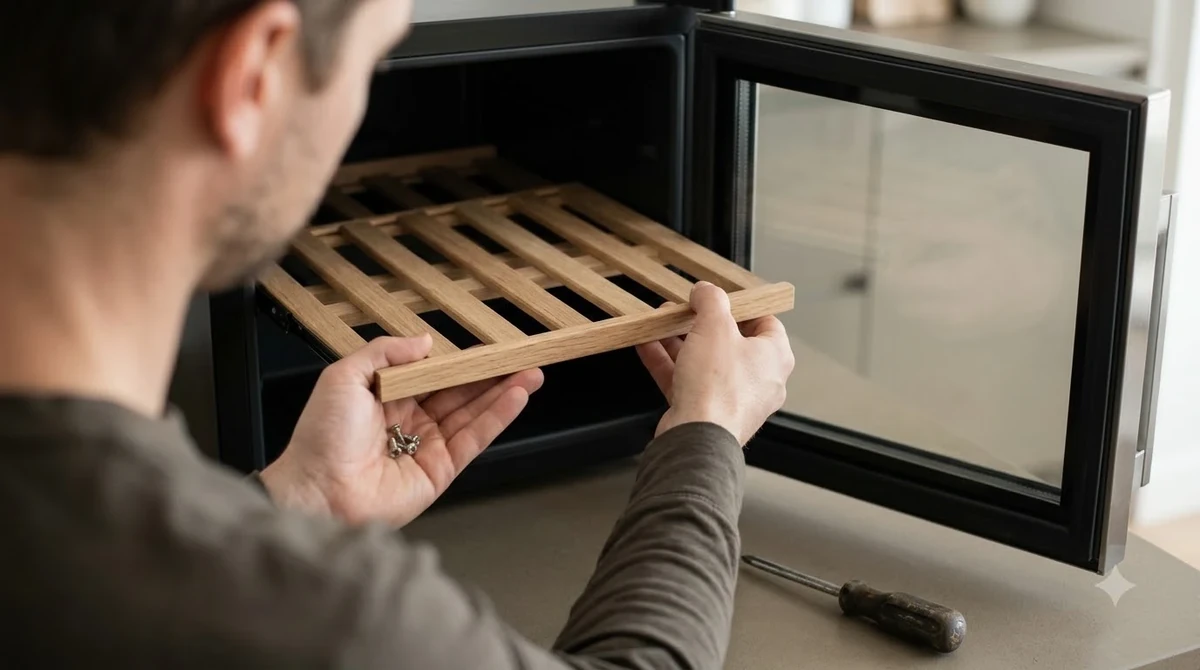
The stainless-steel finish and tinted glass door are among the most immediately noticeable advantages. The appliance looks more integrated than a basic freestanding beverage refrigerator, especially when installed alongside stainless-steel kitchen appliances. The visible wood-trim rack fronts add warmth to the otherwise dark interior, making the cooler appropriate for a kitchen, dining room, or dedicated beverage area.
Temperature control is another positive theme. The electronic display makes adjustments straightforward, and the 41°F to 64°F range gives owners room to select a suitable setting for their collection. A household primarily storing white wines, rosé, sparkling wines, and lighter reds can use one carefully selected temperature without needing multiple compartments.
Best Buy’s customer feedback includes several owners who describe the refrigerator as quiet and consistent during normal operation. One reviewer reported using a separate refrigerator thermometer and finding a difference of approximately 3°F to 4°F between the display and the independent measurement. That is an individual experience rather than a universal performance measurement, but it illustrates why checking actual interior conditions can be useful after installation.
Some owners also appreciate the ability to store beverages alongside wine. The convertible shelf is a practical addition for people who occasionally want space for canned drinks rather than dedicating every available position to bottles. For a household that entertains regularly, that flexibility can make the refrigerator more useful throughout the week.
Capacity is another attraction. Fifty-two standard bottles represent a meaningful amount of storage for a home collection. For someone who regularly buys several bottles at a time, keeps different wines for dinner, and maintains a small selection for guests, this format can reduce dependence on ordinary kitchen refrigeration.
There is also a practical advantage to having the controls on the appliance itself. No smartphone connection, wireless setup, or separate application is required to adjust the temperature. The straightforward interface suits buyers who prefer a conventional appliance rather than another connected device to manage.
For wine drinkers who frequently prepare cocktails, the convertible storage arrangement can also be useful. A chilled bottle of sparkling wine can be ready for an Aperol spritz recipe, while other shelves remain dedicated to everyday bottles. The appliance is not a dedicated cocktail station, but its mixed-use potential adds convenience.
Common Complaints and Practical Limitations
The most consistent owner complaint concerns the wire racks, particularly their limited extension and the difficulty of reaching bottles toward the back. Some owners also report that larger-diameter bottles reduce the usable capacity, while durability concerns appear in a portion of the customer feedback.
Although the product description identifies the racks as slide-out shelves, that does not mean every rack travels fully outside the cabinet. Best Buy reviews repeatedly mention that the lower shelves, in particular, do not extend far enough for completely unrestricted access. A bottle positioned toward the rear may require careful handling instead of simply pulling the shelf forward.
This matters more as a collection becomes organized. Someone storing bottles by producer, grape variety, or drinking occasion may find limited shelf movement frustrating when retrieving a particular wine. A refrigerator with fully extending telescopic shelves would provide a more convenient experience, especially for people who frequently rotate their collections.
Bottle dimensions are another important limitation. The advertised capacity should be treated as a maximum under the manufacturer’s intended bottle arrangement, not a promise that every combination of wine bottles will fit. Standard Bordeaux-shaped bottles are generally more straightforward to arrange than wider Champagne, sparkling wine, or Burgundy-style bottles.
One Lowe’s reviewer specifically reported that the shelves were not wide enough to accommodate bottles arranged across the shelf in the desired way. Another Best Buy reviewer mentioned difficulty fitting larger-diameter bottles. These comments indicate that the actual capacity can be lower for collections containing substantial numbers of wider bottles.
Durability deserves attention as well. Some Lowe’s reviewers describe units that stopped cooling after approximately two or three years, while other complaints concern error codes and repair costs. These reports should not be interpreted as proof that every FGWC5233TS will develop a fault, but they are relevant when evaluating an appliance intended to protect a valuable collection.
The shelf construction itself is another source of mixed feedback. Some owners describe the wire drawers as less substantial than expected, and others are disappointed with their movement. The natural wood fronts improve the visual presentation, but they do not turn the racks into premium, full-extension wooden drawers.
Noise feedback is generally more favorable, although not every owner describes the refrigerator as silent. Compressor-based refrigeration can produce operating sounds as the cooling system cycles. A reviewer who expects complete silence in a quiet living space should consider the intended installation location rather than assuming that positive quiet-operation comments mean the appliance makes no noise.
Tip: Before purchasing, compare the dimensions of your widest bottles with the usable shelf space. If your collection contains Champagne, sparkling wine, or wider Burgundy bottles, plan for a lower practical capacity than the advertised 52-bottle maximum.
The overall lesson is that the FGWC5233TS prioritizes storage volume and appearance over premium shelf ergonomics. That trade-off may be acceptable for someone who mostly stores standard bottles and does not access the rear rows every day. It is less appealing for collectors who regularly rearrange bottles or want easy access to every position.
Who Should Buy This Wine Cooler and Who Should Skip It
The Frigidaire 52-bottle refrigerator is most appropriate for households with a growing collection of standard-sized bottles, an available under-counter or freestanding location, and a preference for one shared storage temperature. Buyers who need separate red and white compartments or specialized bottle accommodation should consider another design.
Who should consider buying it
Casual and intermediate wine collectors are the most natural audience. If you usually maintain 20 to 45 bottles, occasionally expand your collection, and want a dedicated appliance rather than storing everything in a kitchen refrigerator, the stated capacity offers room to grow.
It also suits households that drink a mixture of white, red, rosé, and sparkling wines but do not need them held at different temperatures simultaneously. One temperature setting can work well for general storage, particularly when bottles are moved to an appropriate serving temperature before drinking.
People renovating a kitchen may appreciate the built-in or freestanding installation options and reversible door. The stainless-steel appearance is relatively easy to coordinate with other appliances, while the 34 1/4-inch specified height makes it relevant to under-counter planning. Accurate measurements remain essential because the hinge and surrounding cabinetry can affect the final fit.
Another suitable buyer is someone who values a conventional digital control system. There is no need to configure wireless connectivity or maintain a dedicated application. The LED display, adjustable temperature, and interior light cover the basic controls most household wine drinkers need.
Who should look elsewhere
Serious collectors with a substantial selection of Champagne, large-format bottles, or unusually wide Burgundy bottles should investigate a refrigerator designed around more accommodating shelf spacing. A nominal 52-bottle rating is not particularly useful if the actual bottle shapes in a collection prevent the expected arrangement.
Buyers who want separate temperatures for red and white wines should also skip this model. A single-zone refrigerator cannot independently maintain one compartment at 46°F and another at 58°F. The entire interior uses one selected setting, so it cannot replace a properly configured dual-zone wine refrigerator.
People who frequently retrieve bottles from the rear of their collection may find the limited shelf extension inconvenient. This is especially relevant for an appliance installed beneath a counter, where reaching into the back of the refrigerator can be awkward.
Finally, anyone whose main priority is long-term reliability should investigate warranty coverage, service availability, and repair options before committing. Reports of cooling failures are not enough to establish a failure rate, but they justify careful consideration when comparing appliances.
How It Compares to Alternative Wine Storage Options
The FGWC5233TS occupies a middle ground between a small beverage refrigerator and a more specialized wine-storage cabinet. Its 52-bottle rating and 41°F to 64°F range provide flexibility, but its single-zone design and conventional wire racks distinguish it from more specialized alternatives.
A small countertop or freestanding wine cooler generally makes more sense for someone with fewer than 20 bottles. Such appliances require less installation space and may be easier to move, but their limited capacity can become restrictive as a collection grows. The Frigidaire’s larger interior is more suitable for people who regularly purchase wine in cases or keep several styles available.
A dual-zone wine refrigerator is a more appropriate alternative for households that regularly serve different wine styles at different temperatures. For example, someone who wants white wine at approximately 48°F and lighter reds around 58°F benefits from independently controlled compartments. The Frigidaire cannot provide those two separate settings.
A dedicated wine cellar or temperature-controlled storage cabinet is a better match for collectors focused on long-term aging. Such storage arrangements are generally selected for stable conditions and collection management rather than simply making bottles ready for immediate consumption. The Frigidaire is a household wine refrigerator, not a substitute for every feature of a dedicated cellar.
There are also differences between single-zone wine refrigerators and ordinary beverage centers. The convertible shelf gives the Frigidaire some versatility, but its rack arrangement remains designed around horizontally stored bottles. A beverage refrigerator intended primarily for cans and upright bottles may be easier to organize for soft drinks, mixers, and other refreshments.
For a broader look at comparable appliances, the wine cooler model reviews section provides a useful starting point for evaluating different capacities and configurations. The key comparison is not simply the number of bottles advertised. Shelf movement, bottle clearance, temperature zones, and installation dimensions have a substantial effect on everyday usability.
One particularly important distinction is the difference between storage temperature and serving temperature. A single-zone refrigerator can maintain a general storage setting for a mixed collection, but that does not mean every wine is ready to serve immediately. A bottle of sparkling wine may need additional chilling, while a full-bodied red may need time outside the refrigerator before serving.
For food-pairing occasions, this flexibility can still be useful. A bottle stored at a moderate cellar-style temperature can be prepared for dinner alongside a chicken Marsala recipe or another meal without requiring a second wine refrigerator. The important consideration is allowing enough time to bring the wine to its preferred serving temperature.
Installation, Temperature Settings, and Everyday Use
Installation is one of the most important parts of buying the FGWC5233TS because the appliance needs adequate space for its dimensions, door movement, and ventilation. Its specified 23 7/16-inch width and 34 1/4-inch height make careful measurement essential before placing an order.
The manufacturer’s dimensional documentation gives a depth of 25 3/4 inches including the handle. The refrigerator also requires approximately 45 3/4 inches of total depth when the door is open to 90 degrees. That additional space matters when the appliance sits near an island, opposite cabinetry, or in a narrow kitchen walkway.
The manufacturer’s installation specifications identify this model as suitable for built-in or freestanding use. The published planning information also calls for 3 inches of clearance at the back, sides, and above the unit for adequate air circulation. These requirements should be considered before choosing a cabinet opening or enclosed storage location.
Electrical planning is equally important. The specification identifies a 115-volt, 60-Hz supply and a minimum 15-amp circuit. The power connection is located toward the lower right rear corner, so the outlet position should be considered when measuring the installation space.
For under-counter installation, do not assume that the nominal cabinet opening automatically accommodates the refrigerator. Account for the specified height, hinge position, door swing, ventilation, and any surrounding trim. The installation guide should take precedence over assumptions based on another refrigerator’s dimensions.
Choosing a temperature
The available 41°F to 64°F range allows the appliance to store different categories of wine, but a single setting requires a compromise when the collection contains several styles. A moderate setting around 55°F is a practical starting point for general mixed-wine storage, while dedicated serving adjustments can be made outside the refrigerator.
For reference, sparkling wine is generally served around 40°F to 50°F, light whites and rosé around 45°F to 50°F, fuller-bodied whites around 50°F to 55°F, light reds around 55°F to 60°F, and fuller-bodied reds around 60°F to 65°F. These are serving ranges rather than instructions to keep every bottle permanently at the same temperature.
For example, a collection dominated by Sauvignon Blanc, Riesling, and rosé may benefit from a cooler general setting than one containing mostly Cabernet Sauvignon, Syrah, and other fuller-bodied reds. The Frigidaire’s broad adjustment range allows some flexibility, but the single-zone arrangement means there is no independent temperature control for different shelves.
Organizing bottles efficiently
Place standard Bordeaux-shaped bottles in the positions that provide the most consistent fit. Keep wider bottles in locations where shelf spacing allows them to rest securely, and avoid forcing bottles into spaces that could damage the rack or make retrieval difficult.
It is also useful to group bottles by drinking occasion rather than simply by producer. Everyday wines can occupy accessible positions, while bottles intended for future meals or longer storage can be placed farther back. This approach reduces unnecessary movement and makes the limited shelf extension less troublesome.
Use the convertible shelf according to your actual beverage needs. If wine occupies most of the refrigerator, leave it configured for bottles. If you regularly serve canned beverages, reserve that shelf for standard 12-ounce cans rather than trying to turn every rack into a general-purpose storage surface.
Warranty, Maintenance, and Long-Term Ownership
Long-term ownership depends on proper installation, sensible bottle loading, and an understanding of the appliance’s support arrangements. The Lowe’s listing identifies a one-year limited warranty, while customer feedback suggests that potential cooling and shelf problems deserve attention before purchase.
Warranty coverage should be reviewed in the documentation supplied with the exact appliance. A retailer’s listing is a useful starting point, but the actual terms determine which components and service expenses are covered. Buyers should also establish whether local authorized repair service is available and how replacement parts can be obtained.
The one-year limited warranty listed by Lowe’s is particularly relevant because some owner complaints describe problems appearing after a longer period of use. A warranty does not guarantee that an appliance will operate without faults, and a report of a cooling failure does not establish that every unit will experience the same issue. Still, potential repair costs belong in the purchasing decision.
Routine maintenance begins with keeping the refrigerator properly positioned and ensuring that ventilation space is not obstructed. Avoid placing storage boxes, kitchen equipment, or other objects against ventilation areas. The manufacturer’s clearance recommendations are part of the installation requirements, not optional suggestions for appearance.
Keep the glass door and stainless-steel exterior clean using suitable appliance-safe cleaning materials. Avoid abrasive pads that can scratch the finish or damage the glass. The interior racks should be handled carefully, particularly when loaded with several bottles, because excessive force can make an already limited shelf movement more troublesome.
Temperature monitoring is another sensible ownership habit. An independent refrigerator thermometer can help confirm that the interior is close to the selected setting. If the display and measured temperature differ substantially or the high-temperature alarm activates unexpectedly, consult the operating instructions and seek qualified service rather than repeatedly changing the controls without identifying the cause.
Wine storage itself also benefits from a little organization. Keep bottles horizontal where appropriate, minimize unnecessary door opening, and avoid exposing the collection to repeated temperature fluctuations. For wines intended for longer aging, stable storage conditions are more important than frequently changing the refrigerator setting to suit individual bottles.
Owners who regularly entertain may also find it useful to keep an inventory. A simple record of producer, grape variety, vintage, and shelf location reduces the need to move several bottles when searching for one particular wine. That small organizational step is particularly helpful when shelves do not extend fully.
The Frigidaire is therefore best approached as a relatively straightforward household wine refrigerator. Its specifications cover the essential features, but the rack design and owner-reported durability concerns mean that careful installation and sensible expectations are important parts of ownership.
Frequently Asked Questions
These answers address practical details that can influence the purchase decision, including bottle compatibility, electrical planning, temperature accuracy, and the distinction between different Frigidaire 52-bottle product identifiers.
Can the FGWC5233TS accommodate magnum bottles?
The advertised 52-bottle capacity refers to the manufacturer’s intended standard-bottle arrangement, not a guaranteed magnum capacity. Magnum bottles are larger than standard 750 ml bottles and may not fit the rack spacing or available shelf depth. Measure the bottle and compare its dimensions with the actual interior before attempting to store larger formats.
Does the refrigerator have a door lock or child lock?
The Lowe’s specifications for this model identify it as non-lockable. Buyers who require a physical lock for a shared household or commercial environment should consider a different refrigerator or investigate an appropriate manufacturer-approved solution. The electronic temperature controls should not be confused with a security lock.
Can the temperature display be changed from Fahrenheit to Celsius?
Yes. The manufacturer’s specifications identify an LED display that supports both Fahrenheit and Celsius. This is useful for households accustomed to metric temperature measurements or owners who compare wine-storage recommendations published in different measurement systems.
Does the refrigerator connect to Wi-Fi or a smartphone application?
No connected-home functionality is listed for this model. Its temperature adjustment is handled through the onboard electronic control panel rather than a smartphone application. Owners who want remote temperature notifications, application-based adjustments, or connected-home integration should investigate models specifically designed with those features.
Is the FGWC5233TS the same model as FGWC52L3TS?
They are distinct model identifiers associated with Frigidaire Gallery 52-bottle wine coolers. Their published specifications share several important characteristics, including a 52-bottle capacity, a single temperature zone, and a 41°F to 64°F range. Buyers should nevertheless compare the complete model number on the appliance identification label with the documentation supplied for their particular unit before ordering replacement parts.
The Frigidaire Gallery FGWC5233TS offers attractive styling, useful temperature adjustment, and substantial advertised capacity in a relatively compact under-counter format. Its limited shelf extension, single-zone design, and mixed durability feedback are meaningful compromises, so it makes the most sense for buyers who prioritize straightforward household storage over premium collector features. Measure the installation area and consider your bottle shapes carefully before deciding whether this 52-bottle refrigerator fits your collection.
More in Model Reviews
 Magic Chef 44 Bottle Wine Cooler Review for Flexible StorageUpdated Nov 21, 2026
 Whynter 164 Bottle Wine Cooler Review: Capacity, Features, and FitUpdated Nov 21, 2026
 Insignia NS WC16BK6 Review: Compact 16-Bottle Wine StorageUpdated Nov 21, 2026
 Wine Enthusiast Electric Blue Omega Review: Opening, Pouring, and Preserving Made EasierUpdated Nov 21, 2026
 Koolatron 20 Bottle Wine Cooler Review: Features, Fit, and PerformanceUpdated Nov 21, 2026
 NewAir AWC 330E Review for Home Wine StorageUpdated Nov 21, 2026