

We may earn a commission when you buy through links on this page, at no extra cost to you. Learn more.
The frigidaire 34 bottle wine fridge is a compact, single-zone wine cooler with advertised capacity for 34 standard bottles, six removable shelves, and digital temperature controls. Its model number is FRWW3433AV, and its approximately 19-inch width makes it suitable for homes with limited floor space. However, Frigidaire has discontinued this model, so buyers should pay particular attention to availability, condition, warranty coverage, and possible temperature variation before purchasing remaining inventory.
The Frigidaire 34-bottle cooler occupies an interesting position between small countertop wine refrigerators and larger collection-storage appliances. It offers more capacity than many compact units without requiring the footprint of a full-size wine cabinet. Its practical appeal comes from straightforward controls, a glass-front design, and removable shelving rather than sophisticated wine-preservation technology. This review examines the FRWW3433AV’s specifications, owner experiences, limitations, and the situations in which buying an available unit still makes sense.
Specs and Key Features of the FRWW3433AV
The FRWW3433AV is designed around straightforward household wine storage, with one cooling zone, a 34-bottle advertised capacity, and a digital control panel. Its dimensions are relatively narrow, but buyers should distinguish between the cabinet depth and the clearance required to open the door fully.
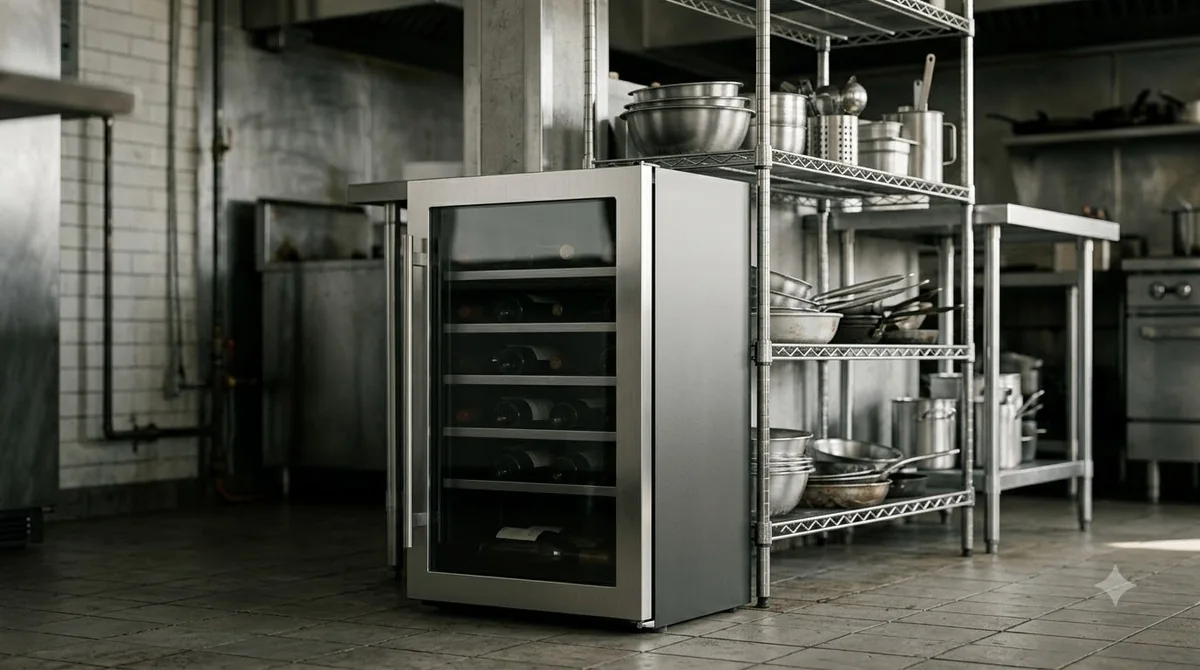
Frigidaire specifies a 3.3-cubic-foot interior, six removable shelves, and a single evaporator cooling system. The black exterior and stainless-steel-look trim give the appliance a conventional modern appearance, while the glass door makes it possible to see the collection without opening the refrigerator. The manufacturer also includes practical controls such as a door-ajar alarm and a control lock.
| Specification | Frigidaire FRWW3433AV |
|---|---|
| Advertised bottle capacity | 34 bottles |
| Interior volume | 3.3 cubic feet |
| Temperature zones | 1 |
| Cooling system | Single evaporator |
| Removable shelves | 6 |
| Stated bottle capacity per shelf | 5 bottles |
| Height with hinge | 33 1/8 inches |
| Height without hinge | 32 5/8 inches |
| Overall width | 19 1/8 inches |
| Cabinet depth | 15 1/2 inches |
| Depth with door | 17 1/4 inches |
| Depth with door open 90 degrees | 35 1/8 inches |
| Annual energy consumption | 300 kWh |
| Door configuration | Right hinge |
| Listed parts and labor warranty | 1 year each |
These specifications come from Frigidaire’s product specification sheet, rather than estimates based on photographs or retailer descriptions. The listed five-bottle shelf capacity is a useful planning figure, but the total advertised capacity of 34 bottles is the more relevant number for understanding the appliance’s intended storage role. Bottle shape and dimensions can affect how much wine fits in practice.
The electronic display makes temperature adjustments easier than using a basic mechanical dial. Frigidaire also specifies a door-ajar alarm, control lock, and mute sound control. These features are useful in a household where the refrigerator might be accessed frequently or installed in a shared living area.
There are also some notable omissions. The specification sheet does not list an air filter, power-failure alarm, exterior door lock, or ENERGY STAR certification. Buyers looking for advanced monitoring or additional security should not assume these capabilities are included simply because the refrigerator has electronic controls.
Another important detail is the door clearance. Although the appliance is only 17 1/4 inches deep with the door closed, it requires 35 1/8 inches of depth when the door opens to 90 degrees. This distinction can affect placement beside a kitchen cabinet, wall, or other appliance.
For the complete manufacturer documentation, the official Frigidaire FRWW3433AV support page provides the product specifications, owner’s guide, energy guide, warranty information, and access to replacement-parts resources.
What Owners Like About the Wine Cooler
Owner feedback highlights three recurring advantages: useful storage capacity, a compact exterior, and straightforward temperature controls. The Lowe’s customer-review page also includes positive comments about quiet operation and the refrigerator’s appearance.
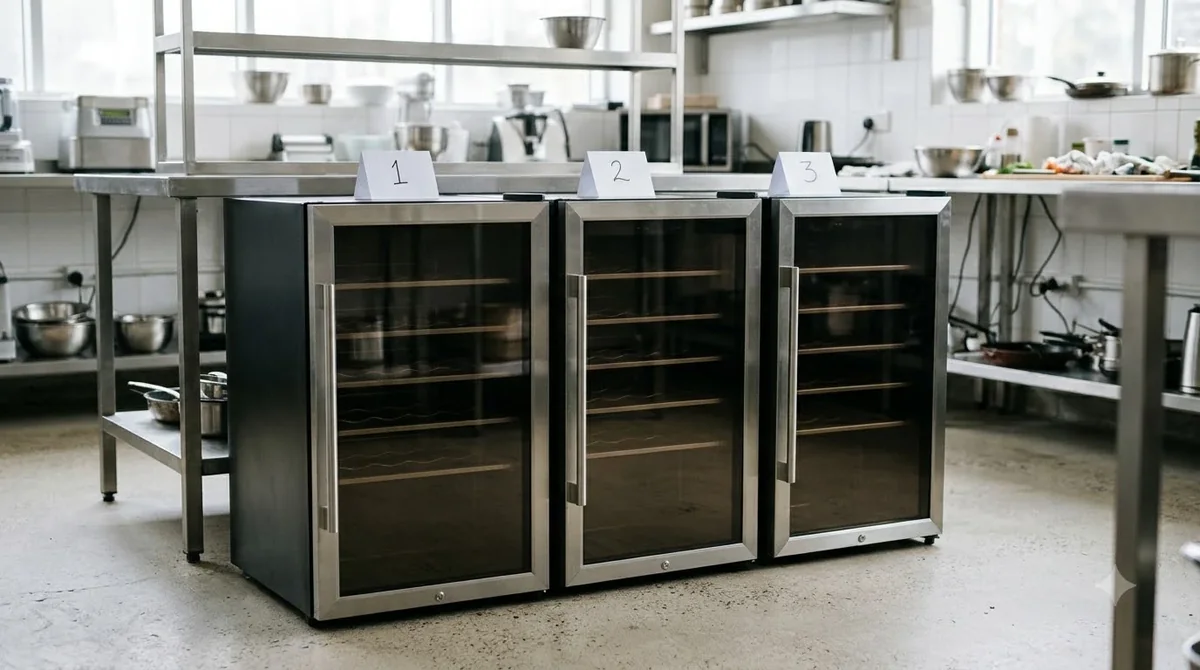
The 34-bottle capacity is the clearest attraction. For a household that regularly purchases several bottles at once, the unit offers a dedicated place for reds, whites, rosés, and sparkling wines. It can also help separate wine from the changing temperatures and frequent door openings associated with an ordinary kitchen refrigerator.
Several owners appreciate that the refrigerator does not occupy a particularly large amount of floor space. At approximately 19 1/8 inches wide, it can fit into narrower areas where a wider wine cabinet would be inconvenient. Its glass door and dark finish also make the collection visible without giving the appliance the appearance of a traditional utility refrigerator.
The digital display receives favorable comments as well. An illuminated temperature reading is easier to check than an unmarked dial, particularly in a dimly lit room. The control lock adds another layer of convenience for households where children or guests might accidentally change the settings.
Capacity and everyday convenience
Some owners specifically mention being satisfied with the advertised 34-bottle capacity and the unit’s ability to maintain their chosen temperature. One Lowe’s reviewer described keeping the appliance full and using a 55-degree setting. Another positive review highlighted the illuminated thermostat and the refrigerator’s compact design.
These comments are useful because they show how owners use the appliance in ordinary homes rather than relying exclusively on manufacturer specifications. Nevertheless, individual experiences do not establish that every unit will maintain precisely the same temperature under different room conditions or loading patterns.
Noise is another area in which some owners report positive experiences. Reviews describe quiet operation, which matters if the cooler is placed in a dining room, living room, or open-plan kitchen. However, a wine refrigerator still has a mechanical cooling system, so owners should not expect complete silence.
The removable shelving also contributes to everyday flexibility. A household that stores a mixture of bottle sizes can rearrange the interior instead of being restricted to one fixed configuration. This is particularly useful when a collection includes occasional larger-format bottles alongside conventional 750 ml bottles.
Overall, the owner feedback suggests that the FRWW3433AV can provide convenient everyday storage when the particular unit is operating properly. Its straightforward feature set is likely to appeal more to casual collectors than to wine enthusiasts who need multiple independently controlled storage environments.
Common Complaints and Ownership Risks
The main concerns involve long-term reliability, temperature consistency, and the limitations of the single-zone design. These issues deserve particular attention because the FRWW3433AV is discontinued and replacement options may depend on the availability of compatible parts.
Some Lowe’s reviewers describe units that stopped working after relatively short periods of ownership. One customer reported a failure at approximately 16 months, while another described a refrigerator that stopped operating after around 2.5 years. These are individual accounts, not proof that every unit has the same reliability problem, but they are relevant warning signs when considering used or old inventory.
Warranty coverage is particularly important in this situation. Frigidaire’s specification sheet lists one year of parts coverage and one year of labor coverage. A buyer purchasing remaining stock should establish whether the manufacturer’s warranty applies to that particular transaction and when coverage begins. A used refrigerator may have a different practical level of protection than a newly purchased appliance.
Temperature variation between shelves
Another issue appears in owner feedback concerning differences between the upper and lower sections. One Lowe’s reviewer reported measuring the upper area at approximately 8 to 10 degrees Fahrenheit warmer than the lower shelves using a temperature gun. That measurement represents one owner’s experience rather than an independently verified characteristic of every FRWW3433AV.
Nevertheless, it illustrates why the displayed temperature should not automatically be treated as the exact temperature of every bottle. The owner’s guide explains that the digital display shows the set temperature. Air movement, bottle placement, room temperature, cooling cycles, and how frequently the door is opened can all influence the environment inside a compact refrigerator.
A single-zone appliance is also inherently limited in how it handles different wine-serving preferences. It cannot maintain separate red-wine and white-wine temperatures simultaneously. The advertised 34-bottle capacity therefore does not mean that the refrigerator can provide 34 bottles with individually optimized serving conditions.
Discontinued availability
Frigidaire’s official product-support page identifies model FRWW3433AV as discontinued. Lowe’s also lists the model as no longer sold through its website. This is an important purchasing consideration because finding a unit does not necessarily mean that it is current inventory, factory-fresh, or covered by the same protections as a newly introduced appliance.
Replacement shelves, electronic components, and other parts may also become more difficult to source over time. Frigidaire continues to provide an owner-support resource for the model, including access to documentation and replacement-parts information, but buyers should verify the availability of specific components rather than assume every repair will be straightforward.
The strongest approach is to treat this as a discontinued appliance with a known specification sheet and a mixed collection of owner experiences. A particularly attractive used unit may still be suitable, but its operating condition and service history matter more than the original advertised capacity.
Who Should Buy It and Who Should Skip It
The FRWW3433AV makes the most sense for households that want a relatively narrow, dedicated wine refrigerator with room for approximately 34 standard bottles. It is less suitable for collectors who need separate temperature zones, advanced monitoring, or dependable access to a current manufacturer-supported product line.
Who should consider it
Casual wine drinkers with a collection of roughly 15 to 30 bottles may appreciate the additional room for future purchases. The nominal capacity of 34 bottles leaves some organizational flexibility, although actual capacity depends on bottle shapes and shelf arrangements.
People who regularly serve both red and white wines can also use this refrigerator, provided they understand its single-zone operation. A setting around 55 degrees Fahrenheit is a reasonable general storage compromise for a mixed collection. Reds can be allowed to warm slightly before serving, while whites and sparkling wines can be chilled further before opening.
Apartment residents and homeowners with limited floor space may find the relatively narrow cabinet particularly attractive. Its 19 1/8-inch specified width is easier to accommodate than many wider wine refrigerators. The black finish and glass door also suit a range of conventional kitchen and entertainment-room designs.
It may be especially appealing to someone who has located a clean, properly functioning unit with documented ownership history and verified warranty or repair support. In that situation, the simple controls and moderate storage capacity can still provide useful everyday service.
Who should skip it
Collectors who want separate environments for Cabernet Sauvignon and Sauvignon Blanc should look for a dual-zone refrigerator instead. The FRWW3433AV has only one temperature zone, so every bottle shares the same general cooling environment.
Long-term collectors with valuable bottles should also consider a more specialized wine-storage appliance. Consistent temperature management matters more for wines intended to mature over several years than for bottles purchased for consumption within a few weeks or months.
Buyers who prioritize current warranty support should be cautious. Because Frigidaire has discontinued the model, it may take additional effort to establish the availability of replacement parts and confirm coverage for a particular unit.
Finally, anyone with a narrow installation space that requires the door to open toward the opposite side should reconsider. The manufacturer specifies a right-hinged door, and the listed specifications do not establish that the door can be reversed.
Tip: Before buying a discontinued FRWW3433AV, request a photograph of the model and serial label, test the appliance at its intended temperature for at least 24 hours, and measure temperatures on more than one shelf with an independent thermometer. Confirm the warranty and replacement-parts situation before completing the purchase.
How It Compares to Alternative Wine Storage Options
The Frigidaire 34-bottle refrigerator competes primarily with other compact wine coolers and larger dual-zone appliances. Its main advantage is the combination of a relatively narrow cabinet and a 34-bottle advertised capacity, while its principal limitation is the absence of independently controlled temperature zones.
Single-zone versus dual-zone refrigerators
A single-zone refrigerator maintains one general temperature environment throughout its interior. This arrangement is straightforward and works well for a collection consisting mainly of one wine category or bottles being held at a common storage temperature.
A dual-zone refrigerator has two separately controlled temperature areas. This is more convenient for households that regularly keep red wines and whites ready for different serving temperatures. For example, a collection might include Cabernet Sauvignon, Pinot Noir, Chardonnay, and Riesling, each with different serving preferences.
The FRWW3433AV cannot provide that separation. Its one-zone system means that owners need to compromise on temperature or adjust their serving routine. For many casual collectors, this is manageable. For frequent entertainers, a dual-zone design may be more practical.
Compact wine coolers versus larger cabinets
A compact cooler is usually easier to fit into a small room, but a larger cabinet may offer more flexibility for organizing a growing collection. The Frigidaire’s 3.3-cubic-foot capacity and approximately 19-inch width make it a relatively space-conscious option.
Larger refrigerators can provide more shelf space, greater capacity, and potentially separate storage areas. However, they require additional floor space and may be excessive for households that only maintain a few dozen bottles.
It is also important to distinguish advertised capacity from practical capacity. A refrigerator rated for 34 standard bottles may hold fewer bottles if the collection includes wider sparkling-wine bottles, Burgundy shapes, or oversized formats. A larger cabinet can provide useful breathing room for mixed collections.
Wine refrigerator versus ordinary refrigerator
An ordinary kitchen refrigerator is designed primarily for food storage rather than maintaining a dedicated wine environment. Its typical operating temperature is colder than the temperature many people prefer for general wine storage, and frequent opening can introduce additional temperature changes.
A dedicated wine cooler offers more suitable temperature control for bottles that are being held for regular consumption. It also provides a designated place for a collection instead of competing with food, drinks, and leftovers.
For someone who regularly purchases wine, a dedicated refrigerator is generally more convenient. The Frigidaire can serve that purpose if the appliance is functioning correctly, but its discontinued status makes a current model with established service support an appealing alternative.
How to evaluate alternatives
Start with capacity rather than appearance. A household that stores 20 bottles most of the time may not need a refrigerator rated for 50 or more. Conversely, someone who regularly buys wine by the case may quickly outgrow a 34-bottle unit.
Next, consider whether a single temperature environment meets the collection’s needs. A dual-zone model is useful when serving convenience is important, while a single-zone model may be sufficient for bottles kept primarily for general storage.
Finally, compare door configuration, installation dimensions, noise expectations, warranty terms, and replacement-parts availability. A refrigerator with a slightly smaller advertised capacity may be a better long-term purchase if it has more suitable shelves and stronger service support.
For additional appliance comparisons and product evaluations, the Brand x Capacity model reviews section provides another starting point for comparing household storage equipment.
Temperature Settings, Installation, and Everyday Use
Getting useful performance from the FRWW3433AV requires suitable placement, sensible temperature settings, and enough clearance for ventilation and door movement. These practical considerations can make a noticeable difference to everyday convenience.
Choosing a temperature
A setting near 55 degrees Fahrenheit is a practical starting point for general wine storage. It provides a middle-ground environment for a collection containing reds and whites without treating the appliance as a specialized serving refrigerator.
Temperature preferences differ by wine style. Light-bodied reds such as Pinot Noir are generally served around 55 to 60 degrees Fahrenheit, while fuller reds such as Cabernet Sauvignon are typically served around 60 to 65 degrees. Light whites and rosés are commonly served around 45 to 50 degrees, and fuller-bodied whites such as Chardonnay are often served around 50 to 55 degrees.
Those are serving-temperature ranges, not a requirement to maintain separate storage environments for every bottle. Since the Frigidaire has one zone, owners can use a consistent storage setting and adjust individual bottles before serving.
For example, someone serving Chardonnay can chill the bottle further before dinner, while a Cabernet Sauvignon stored at the same general refrigerator setting can be allowed to warm slightly before pouring. A 5-ounce serving is a useful standard when planning how many glasses a 750 ml bottle will provide.
Planning the installation
The manufacturer’s dimensions should be used when planning the installation. The cabinet is 19 1/8 inches wide, 33 1/8 inches high with the hinge, and 15 1/2 inches deep. The door increases the depth to 17 1/4 inches when closed.
Door movement needs additional consideration. With the door open to 90 degrees, the stated depth reaches 35 1/8 inches. A refrigerator that fits neatly between cabinets when closed may therefore be inconvenient if there is not enough space in front of it.
The right-hinged configuration is another installation consideration. Check the location of nearby walls, counters, and appliances before deciding where the cooler will stand. The specification sheet also lists adjustable leveling legs, which help compensate for minor floor irregularities.
The owner’s guide recommends an ambient room temperature between 70 and 78 degrees Fahrenheit and two inches of clearance behind the cooler for air circulation. It also specifies a dedicated, grounded 115-volt, 60-Hz, 15-amp electrical outlet. Avoid improvised electrical arrangements or placing the cooler in an environment outside the manufacturer’s recommended operating conditions.
Organizing different bottles
The six removable shelves provide some flexibility for different bottle shapes. Standard Bordeaux-style bottles are generally easier to organize than broad Burgundy bottles or wider sparkling-wine bottles.
Do not assume that the advertised 34-bottle capacity will always be achievable with a mixed collection. A bottle with a wider base or shoulder can occupy more room than a conventional bottle. Removing a shelf can provide additional vertical space, but doing so also reduces the number of available storage positions.
The owner’s guide specifically warns that bottle capacity varies according to bottle shape and size. It also advises leaving space between bottles and the rear panel to maintain air circulation. Organize frequently used bottles where they are easy to reach and avoid packing the interior so tightly that removing one bottle disturbs several others.
For households that regularly prepare wine-based drinks, a dedicated storage area can be especially useful. An Aperol Spritz recipe or a Hugo Spritz recipe can call for chilled sparkling wine, so having a consistent place for bottles makes entertaining easier. Remember that a single-zone wine cooler is not necessarily as cold as a conventional beverage refrigerator.
Frequently Asked Questions
What is the difference between the FRWW3433AV and FRWW3433A?
FRWW3433AV is the complete product identifier listed by Frigidaire for this 34-bottle cooler. The FRWW3433A designation appears in the name of the manufacturer’s specification document, which is why both forms may appear in online searches. For replacement components and product registration, use the complete model number shown on the appliance’s identification label.
Does the Frigidaire 34-bottle cooler have an interior light that stays on?
Yes. The owner’s guide explains that the interior LED lighting can be switched on or off using the light control. It also describes a display mode that allows the light to remain on after the door closes until it is manually switched off. This is useful for owners who want the bottles visible in a dark entertainment area.
Can the Frigidaire FRWW3433AV be used for beer and canned drinks?
The cooler’s primary manufacturer designation is a wine-storage appliance, with a capacity specified in wine bottles rather than beverage cans. Although retailer descriptions mention canned beverages as a possible use, the space and shelf arrangement may not be optimized for them. A dedicated beverage refrigerator is a more appropriate choice for households that primarily store cans and bottles of beer or soft drinks.
Does the FRWW3433AV have a child-safety door lock?
The manufacturer’s specification sheet lists a control lock, which protects the electronic settings from accidental changes. It separately lists no exterior door lock. These are different functions, so the control lock should not be interpreted as a physical security lock that prevents someone from opening the refrigerator.
What refrigerant does the Frigidaire 34-bottle wine cooler use?
Frigidaire specifies R-600A refrigerant for the FRWW3433AV. The owner’s guide identifies this refrigerant as flammable and warns against puncturing refrigerant tubing or attempting unauthorized repairs. Refrigerant-related service should be handled by qualified personnel using equipment designed for this type of system.
The Frigidaire 34-bottle wine fridge remains an appealing compact-storage concept, with a useful advertised capacity, digital controls, and a relatively narrow cabinet. Its single-zone configuration and mixed long-term owner feedback prevent it from being an automatic recommendation, however. Since the FRWW3433AV is discontinued, the best purchasing decision depends on the individual unit’s condition, verified operating temperatures, available support, and warranty protection rather than capacity alone.
More in Model Reviews
 Magic Chef 44 Bottle Wine Cooler Review for Flexible StorageUpdated Nov 21, 2026
 Whynter 164 Bottle Wine Cooler Review: Capacity, Features, and FitUpdated Nov 21, 2026
 Insignia NS WC16BK6 Review: Compact 16-Bottle Wine StorageUpdated Nov 21, 2026
 Wine Enthusiast Electric Blue Omega Review: Opening, Pouring, and Preserving Made EasierUpdated Nov 21, 2026
 Koolatron 20 Bottle Wine Cooler Review: Features, Fit, and PerformanceUpdated Nov 21, 2026
 NewAir AWC 330E Review for Home Wine StorageUpdated Nov 21, 2026