

We may earn a commission when you buy through links on this page, at no extra cost to you. Learn more.
An icyglee wine fridge is a compact wine-storage option with single-zone and dual-zone models, digital temperature controls, compressor cooling, and advertised capacities ranging from smaller collections to 45 bottles. The brand also sells beverage refrigerators that can accommodate wine alongside cans and other drinks. Its strongest attractions are flexible shelving, glass-door designs, and multiple size choices. However, buyers should verify installation requirements, warranty terms, and long-term reliability before choosing a model.
Icyglee is a name worth investigating if you want a dedicated refrigerator for wine without moving into a large, traditional wine-cellar cabinet. Its product lineup includes narrow wine coolers, larger freestanding units, and combination beverage refrigerators. The important distinction is that not every Icyglee refrigerator is designed primarily for wine storage. Comparing temperature zones, usable bottle capacity, ventilation, and support policies will help identify which product actually fits your collection.
Brand Overview: What Icyglee Offers Wine Buyers
Icyglee sells wine refrigerators and beverage coolers through its online storefront, with products aimed at home kitchens, apartments, offices, and home bars. The range emphasizes compact dimensions, glass doors, adjustable storage, and electronic temperature controls rather than large, traditional cellar installations.
The brand’s official catalog includes a 15-inch wine cooler advertised for 30 bottles, a 4.5-cubic-foot wine refrigerator advertised for 45 bottles, and beverage refrigerators that can also accommodate wine bottles. This gives shoppers several storage formats to consider. The difference matters because a wine-focused refrigerator and a general beverage cooler do not necessarily offer the same shelf arrangement or temperature configuration.
The 15-inch wine refrigerator is particularly interesting for people with limited floor space. Its product description identifies a 3.6-cubic-foot interior, six removable shelves, and a stainless-steel-framed double-glazed glass door. Buyers can choose between single-zone and dual-zone versions, which makes this product more flexible than a basic beverage refrigerator with one shared temperature setting.
The larger 45-bottle model offers another option for households that have outgrown a small countertop or compact wine cooler. It uses compressor cooling, digital temperature adjustment, removable shelves, and a double-layered glass door. The advertised temperature range is 40°F to 61°F.
One important limitation is that the available product information does not establish a detailed corporate history, manufacturing ownership structure, or extensive service-center network. Buyers should therefore evaluate the actual refrigerator, documentation, and seller support rather than assuming that the brand has the same established service infrastructure as major appliance manufacturers.
For shoppers comparing less familiar appliance names, it can also help to examine whether Black and Decker is a good brand and how its product positioning differs from smaller appliance labels. Brand recognition alone, however, does not establish whether a particular refrigerator has the right dimensions or cooling performance.
Icyglee Product Lines Explained
Icyglee’s wine-storage selection includes dedicated wine coolers and multipurpose beverage refrigerators. The dedicated models make more sense for collections that need organized bottle storage, while beverage models prioritize flexible space for cans, bottles, and everyday drinks.
The following comparison summarizes the main product configurations using the capacities and specifications stated in the available product descriptions and manual. These figures are advertised capacities, not guarantees that every bottle shape will fit without rearranging shelves.
| Product type | Advertised capacity | Temperature range | Notable features |
|---|---|---|---|
| 15-inch wine cooler | 30 bottles; 3.6 cu. ft. | Dual-zone: 40°F–55°F and 55°F–65°F | Six adjustable shelves, compressor, double-glazed door |
| 4.5-cu.-ft. wine refrigerator | 45 bottles | 40°F–61°F | Removable shelves, digital controls, LED lighting |
| 100-can beverage refrigerator | 100 cans or up to 22 standard wine bottles | 40°F–61°F | Three removable shelves, compressor, glass door |
| 126-can beverage refrigerator | Approximately 126 cans; 3.2 cu. ft. | 34°F–64°F | Four removable wire shelves, digital controls, reversible door |
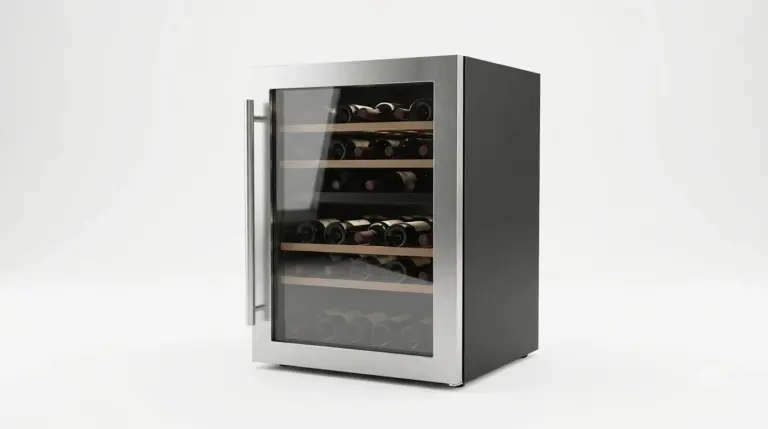
Dedicated wine refrigerators: The 15-inch and 4.5-cubic-foot models are the main options to investigate if wine is the primary reason for buying an appliance. The narrower refrigerator is especially interesting for a small kitchen or bar, while the 45-bottle configuration provides more room for a growing collection. Both have compressor-based cooling, although their temperature ranges and storage arrangements differ.
Dual-zone and single-zone options: The 15-inch refrigerator has two configurations. Its dual-zone version provides one compartment adjustable from 40°F to 55°F and another from 55°F to 65°F. This is useful for people who want to keep different wine styles at different serving temperatures. The single-zone version is a simpler choice if most of the collection will be kept at one consistent setting.
Beverage refrigerators: The 100-can and 126-can models are more versatile for mixed household storage. Their adjustable shelving can accommodate different drink formats, but their stated bottle capacities should not be treated as equivalent to a dedicated wine cabinet’s advertised bottle capacity.
What Icyglee Does Well: Storage Flexibility and Cooling Features
Icyglee’s clearest strengths are its range of compact formats, adjustable temperature controls, and removable shelving. These features give buyers practical ways to organize a mixed collection without committing to a large standalone wine cabinet.
The 15-inch wine refrigerator provides six adjustable shelves, giving owners options for arranging standard bottles and making room for different bottle shapes. This is a useful feature because sparkling wine bottles and many Champagne bottles are wider than conventional Bordeaux-style bottles. A refrigerator that reaches its advertised capacity with standard bottles may hold fewer bottles when the collection includes larger formats.
The 45-bottle model also uses removable shelving, allowing the interior arrangement to be changed. For someone buying wine regularly, this flexibility can be more useful than a fixed shelf layout. It can accommodate changes in the balance between standard bottles, sparkling wines, and larger formats, although the actual fit will depend on the interior dimensions.
Compressor cooling is another positive feature. The dedicated wine models identify compressor systems, while the 15-inch dual-zone listing specifically names R-600 refrigerant. Compressor-based designs are commonly chosen for refrigerators that need active cooling and adjustable temperature settings. They can be suitable for rooms where ambient temperatures vary, although actual performance depends on insulation, ventilation, room conditions, and the appliance’s temperature-control system.
Glass doors and interior presentation
The 15-inch wine refrigerator uses a double-glazed glass door that Icyglee describes as UV-resistant and heat-insulating. The larger wine cooler also advertises a double-layered tempered-glass door. These are attractive features for a home bar or kitchen because the bottles remain visible without requiring the door to be opened repeatedly.
UV protection is particularly relevant to wine storage. Light exposure can be undesirable for wine, especially for bottles intended to remain stored for longer periods. A protective glass door is therefore a useful design consideration, although it should not replace sensible placement away from direct sunlight.
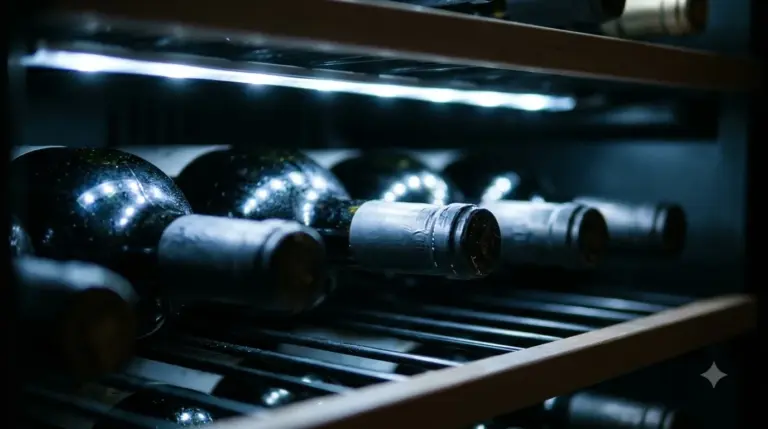
Interior LED lighting is another practical addition. It makes labels and bottle positions easier to see, particularly in a darker home bar. The beverage refrigerator manual also describes a dedicated touch control for switching the interior light on and off.
Temperature adjustment
Digital temperature controls make everyday operation relatively straightforward. The 15-inch dual-zone model separates its two temperature settings, while the 45-bottle wine refrigerator offers a shared range from 40°F to 61°F. The beverage refrigerator manual describes one-degree adjustment increments across its specified 34°F to 64°F range.
These specifications provide useful flexibility, but buyers should distinguish between storing wine and serving it. Long-term wine storage generally benefits from a relatively stable temperature, commonly around 55°F. Serving temperatures vary according to wine style: light whites and rosé are generally served around 45°F to 50°F, while full-bodied reds are commonly served around 60°F to 65°F.
For a practical explanation of wine storage conditions, the Wine Enthusiast guide to storing wine discusses the importance of temperature, light, and bottle positioning. These considerations apply regardless of which refrigerator brand a buyer chooses.
Common Complaints and Limitations to Consider
Icyglee has some attractive product specifications, but the available independent owner feedback also identifies potential problems. The most important concerns involve long-term reliability, shipping damage, noise variation, and uncertainty surrounding certain installation descriptions.
An independent review of the 15-inch dual-zone refrigerator describes positive owner comments about its appearance, shelving, and relatively quiet operation. Some owners also report that the refrigerator cools quickly and maintains its selected temperature. These are encouraging observations, but they do not establish consistent performance across every unit.
The same review reports a smaller number of negative experiences. One owner described receiving a unit with a broken hinge, while another reported that a refrigerator stopped cooling after approximately 18 months. The review also mentions a defective initial shipment that was replaced by the seller.
These reports deserve attention without being treated as proof that every Icyglee refrigerator has a reliability problem. A limited collection of owner experiences cannot establish a brand-wide failure rate. However, they do make return procedures, replacement availability, and written warranty coverage important buying considerations.
Built-in installation is not always clear
One of the most important issues involves the 15-inch refrigerator’s installation description. Its product title and marketing language refer to built-in and under-counter applications, but the independent review identifies freestanding installation in the detailed specifications.
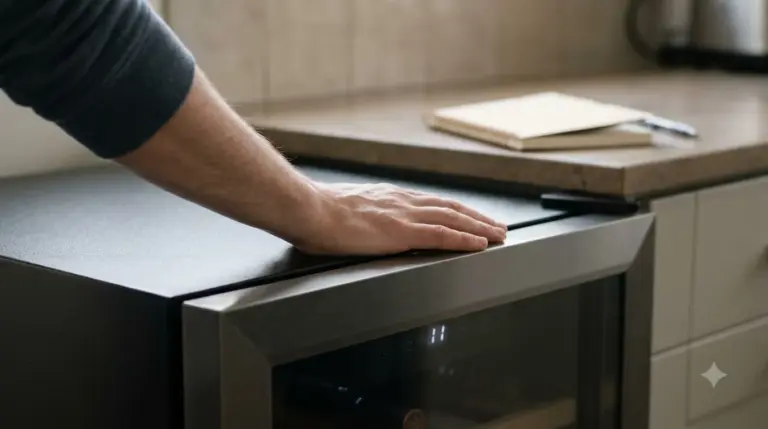
This distinction should not be overlooked. A freestanding refrigerator may require open space around its cabinet to release heat. A genuine front-vented built-in appliance is designed differently, with ventilation intended to function within a cabinet opening. Placing a freestanding model in an enclosed kitchen cabinet can interfere with heat removal and affect cooling performance.
Before purchasing for an under-counter location, obtain written confirmation of the required installation clearances and ventilation design. Measure the opening, including its height, width, and depth, and allow room for the door to open fully. Do not rely solely on a product title that uses the phrase built-in.
Noise and temperature expectations
Some owners describe the 15-inch model as very quiet, while other feedback indicates that compressor operation can be audible in an adjoining room. That variation is not unusual among compact refrigeration appliances, but it matters if the refrigerator will sit in a bedroom, study, or open-plan living area.
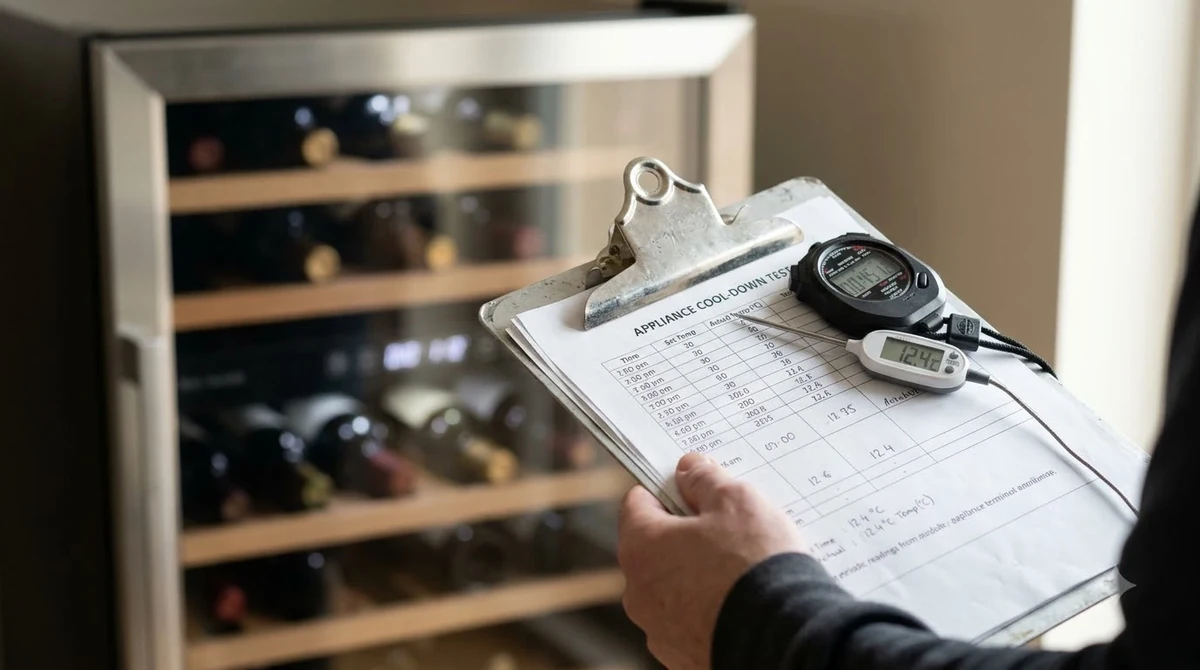
Temperature performance also deserves realistic expectations. A digital display shows the selected setting, but it does not independently prove that every shelf maintains precisely the same temperature. Bottle placement, frequent door opening, warm items, and inadequate ventilation can all affect internal conditions.
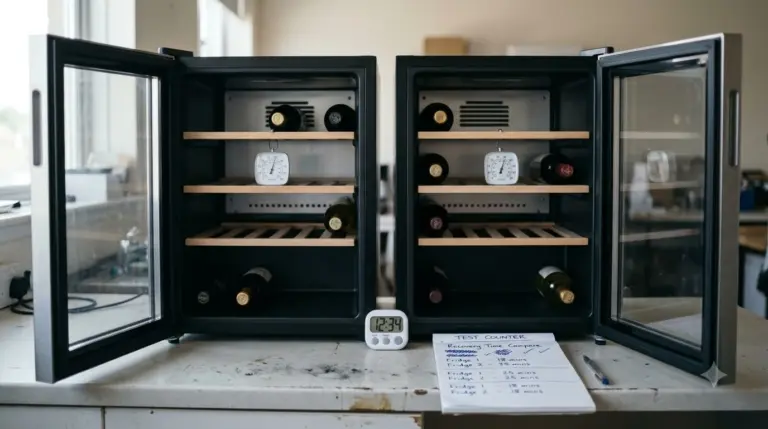
For a collection containing expensive or particularly important bottles, a separate refrigerator thermometer can help check actual cabinet conditions. This is especially useful when the refrigerator is first installed and after major changes to the shelf arrangement.
How to Choose an Icyglee Wine Fridge
The right Icyglee model depends on how many bottles you own, whether you need separate temperature zones, and where the refrigerator will be installed. Start with the collection rather than choosing a refrigerator based on appearance or its largest advertised capacity.
1. Match the bottle capacity to your collection
The 30-bottle 15-inch refrigerator is a reasonable starting point for a modest collection. It is suitable for households that want to keep a selection of everyday wines and a few special bottles organized in one place.
The 45-bottle refrigerator is more appropriate for someone who buys wine regularly or wants additional room for different styles. However, remember that advertised bottle capacities generally assume conventional bottle dimensions. A collection containing substantial numbers of Champagne, Burgundy, or unusually shaped bottles can reduce practical capacity.
2. Decide between single-zone and dual-zone storage
A single-zone refrigerator is easier to manage if most of the collection consists of similar wines and you prefer one stable temperature. It is also a sensible choice when the appliance is being used mainly for storage rather than keeping different wines immediately ready to serve.
The dual-zone 15-inch version is more flexible for households that regularly drink both reds and whites. Its advertised settings of 40°F to 55°F and 55°F to 65°F allow separate temperature adjustments. For example, a household might keep a lighter white wine cooler than its red wine selection.
Keep in mind that serving temperatures and storage temperatures are not interchangeable. A refrigerator designed to hold wine at serving temperature may not be the ideal solution for every long-term collection.
3. Check the actual installation requirements
Measure the intended location before comparing product capacities. A refrigerator that fits the width of a cabinet may still be too deep, too tall, or unable to ventilate properly.
For the 15-inch wine cooler, the independent review lists dimensions of approximately 14.9 inches wide, 23 inches deep, and 34.25 inches high. Those measurements are useful starting points, but the manufacturer should confirm the current installation requirements for the exact configuration being purchased.
For the BR-110-IG-02X beverage refrigerator, the manual lists dimensions of 18.9 inches deep, 17.5 inches wide, and 31.3 inches high. These measurements illustrate why model-specific identification matters: similarly named refrigerators can have substantially different cabinet dimensions.
4. Consider what else you plan to store
If the refrigerator will mainly hold wine, choose a dedicated wine cabinet with appropriate bottle shelving. If you want a combination of wine, soda, beer, and bottled water, one of the beverage refrigerators may be more practical.
The 100-can beverage refrigerator is advertised to hold up to 22 standard wine bottles. This can be attractive for mixed storage, but the shelf layout is not necessarily as convenient for organizing a collection of 30 or 45 bottles.
Consider the dimensions of your most frequently purchased bottles, too. If your collection contains larger sparkling bottles, check whether a shelf can be removed without interfering with other bottles or the door.
5. Compare support and return policies
Before placing an order, confirm the exact model number, included accessories, delivery arrangements, and support period. Ask how defective units are handled and whether replacement parts are available for components such as door hinges, shelves, and temperature-control panels.
The advertised 12-month support period is useful information, but it should not be assumed to mean that every component is covered under identical conditions. Written warranty terms are more important than a general promise of customer assistance.
Tip: Ask Icyglee to confirm the installation type, ventilation clearance, and written warranty for the exact refrigerator model before ordering. This is particularly important for the 15-inch cooler because its marketing description and independently reported installation specifications are not fully consistent.
For additional brand comparisons, the guides covering whether ROVSUN is a good brand and whether Galanz is a good brand can help put smaller appliance manufacturers into context. Compare the actual refrigerator specifications and service arrangements rather than relying on brand names alone.
Warranty and Customer Support
Icyglee product descriptions advertise 12 months of product support on several refrigerators. That gives buyers a starting point for understanding the support commitment, but the distinction between customer service, product support, and a formal written warranty is important.
The 4.5-cubic-foot wine refrigerator listing specifically mentions 12 months of product support and states that the customer service team aims to respond within one day. The 100-can beverage refrigerator also advertises a 12-month support period and a response commitment for customer questions.
The BR-110-IG-02X beverage refrigerator manual provides additional information about support. It identifies 12 months of product support and describes 24-hour online customer service. It directs customers to the contact details on the product packaging or the official website for current assistance information.
These details are useful, but a support promise is not the same as a complete warranty document. Before buying, check whether the manufacturer or seller provides a written warranty covering parts, labor, compressor failures, and other major components. Confirm whether the customer must pay return shipping or arrange service independently.
What to do when the refrigerator arrives
Inspect the packaging and refrigerator before disposing of the shipping materials. Look for damaged glass, bent hinges, loose handles, cracked shelves, and dents around the cabinet. Photograph any visible damage and contact the seller promptly if something is wrong.
Keep the order confirmation, model number, product description, and support correspondence together. These records can help resolve disputes if the delivered configuration differs from the one advertised.
The beverage refrigerator manual also provides useful setup guidance. It instructs owners to position the appliance on a stable, level surface, away from direct sunlight and heat sources, while maintaining sufficient ventilation. It specifies that the BR-110-IG-02X should remain upright for at least 24 hours before being plugged in.
That 24-hour instruction belongs to the identified beverage refrigerator manual. Owners should follow the setup instructions supplied for their particular wine refrigerator rather than assuming that every Icyglee model has identical requirements.
For maintenance, the BR-110-IG-02X manual specifies manual defrosting and recommends defrosting when frost reaches approximately 1/4 inch. It also instructs users to unplug the refrigerator before cleaning and to use a soft cloth with mild detergent. These are useful details for owners of that specific model, although other models may have different maintenance procedures.
Frequently Asked Questions
Where are Icyglee wine refrigerators manufactured?
The BR-110-IG-02X beverage refrigerator manual identifies China as its country of origin. That information applies to the specific appliance documented in the manual, not necessarily every refrigerator sold under the Icyglee name. Buyers seeking country-of-origin information for another model should request its individual product documentation.
Does Icyglee make thermoelectric wine coolers?
The wine refrigerator listings discussed here identify compressor-based cooling rather than thermoelectric cooling. The 15-inch model specifically identifies an R-600 compressor system. Check the technical documentation for any other model rather than assuming the entire product catalog uses identical cooling technology.
Can an Icyglee wine refrigerator store opened bottles?
Yes, provided the bottles are securely closed and fit within the available shelf arrangement. Opened wine generally benefits from refrigeration and a suitable closure, although the ideal temperature depends on the wine style. Sparkling wine also requires a stopper designed to retain carbonation.
Does Icyglee offer reversible refrigerator doors?
The BR-110-IG-02X beverage refrigerator manual specifically describes reversible door hinges and provides instructions for changing the door swing. This feature should not automatically be assumed on every Icyglee wine refrigerator. Confirm the hinge configuration for the exact model before arranging a tight installation.
Do Icyglee refrigerators require manual defrosting?
The BR-110-IG-02X manual identifies a manual-defrost system and gives a frost threshold of approximately 1/4 inch for defrosting. This is a model-specific specification rather than a confirmed rule for the complete wine refrigerator lineup. Check the maintenance instructions supplied with the appliance you purchase.
Icyglee offers several useful refrigerator formats, particularly for buyers who want compact wine storage, adjustable shelving, and straightforward digital controls. The 15-inch dual-zone cooler is an interesting option for separating reds and whites, while the 45-bottle refrigerator offers more dedicated storage capacity. Compare the exact installation requirements, written support coverage, and real-world bottle fit before committing to a model. For a broader comparison of manufacturers and appliance options, explore our brand hubs.
More in Brand Hubs
 Fomup Wine Fridge: Explore Models, Features, and Buying TipsUpdated Nov 20, 2026
 Aaobosi Wine Fridge: Compare Models and Choose the Right CoolerUpdated Nov 20, 2026
 Orymuse Wine Fridge Reviews: Compare Capacities, Features and WarrantyUpdated Nov 20, 2026
 Tylza Wine Fridge: Find the Right Cooler for Your CollectionUpdated Nov 20, 2026
 Vintec Wine Fridge: Features, Warranty, and Buying AdviceUpdated Nov 20, 2026
 Phiestina Wine Cooler Options for Better Wine StorageUpdated Nov 20, 2026