

We may earn a commission when you buy through links on this page, at no extra cost to you. Learn more.
A Phiestina wine cooler is a practical option for homeowners who want compact, dual-zone wine storage, under-counter installation, or a combination wine and beverage refrigerator. The brand offers models with stated capacities ranging from 29 to 46 wine bottles, along with combination units that accommodate wine bottles and cans. Its appeal comes from flexible installation options, separate temperature controls, and removable shelving, although buyers should pay close attention to warranty coverage, actual bottle dimensions, and mixed owner feedback.
Choosing a wine refrigerator involves more than finding a cabinet that fits beneath a counter. Temperature consistency, ventilation, shelf configuration, operating noise, and access to replacement parts all influence whether a cooler remains useful over time. Phiestina has several configurations worth comparing, particularly for households that want separate storage temperatures for red and white wines or need additional beverage space. This brand overview explains the product lineup, what owners report, how to find the correct manual, and what to verify before purchasing.
Brand Overview
Phiestina focuses on compact refrigeration for wine and beverages, with products designed for home kitchens, bars, offices, and other indoor spaces. Its catalog includes dedicated wine refrigerators, beverage coolers, and combination units, giving buyers several ways to organize drinks without dedicating space to a full-size refrigerator.
The company’s product range emphasizes compressor-based cooling, dual-zone temperature control on selected wine models, glass doors, removable shelves, and installation flexibility. Several products are designed to fit common under-counter spaces, while narrower freestanding configurations suit rooms with limited floor space. The official product catalog also includes beverage refrigerators intended primarily for cans rather than traditional wine storage.
Is Phiestina a good brand? The answer depends on what matters most. Its specifications are attractive for buyers seeking relatively compact dual-zone storage, and the manufacturer publishes useful measurements and operating information for several models. However, independent owner-feedback summaries describe inconsistent experiences with noise, shelf construction, and long-term reliability. That makes warranty terms and local repair options important parts of the purchasing decision.
Phiestina is best approached as a feature-focused appliance brand rather than a premium wine-cellar specialist. Buyers should evaluate the exact refrigerator model instead of assuming that every product offers the same cooling arrangement, ventilation, or warranty.
Product Lines Explained
Phiestina’s wine refrigerator lineup includes narrow 15-inch units, wider 24-inch cabinets, and combination wine-and-beverage refrigerators. The biggest differences are storage capacity, temperature configuration, ventilation location, and whether the appliance is designed primarily for wine or mixed drinks.
The following comparison uses manufacturer-published specifications. Capacities are advertised maximums, not guarantees that every bottle shape will fit without rearranging shelves.
| Model | Configuration | Advertised Capacity | Temperature Range | Ventilation |
|---|---|---|---|---|
| PH-29BDSP | 15-inch dual-zone wine cooler | 29 bottles | 40–50°F upper; 50–66°F lower | Front-bottom |
| PH-CWR100 | 16-inch dual-zone wine cooler | 33 bottles | 40–50°F upper; 50–66°F lower | Side |
| PH-46BD3L | 24-inch dual-zone wine cooler | 46 bottles | 40–50°F upper; 50–66°F lower | Front-bottom |
| PH-150BCW3L | 24-inch wine and beverage cooler | 20 bottles and 78 cans | 40–66°F left; 38–50°F right | Front-bottom |
One distinction matters when comparing product names. The PH-29BDSP and PH-46BD3L are identified on the manufacturer’s current product pages, while the downloadable instruction manual discussed below identifies the PH-29DB and PH-46DB. These model designations should not automatically be treated as interchangeable. Owners should match the manual to the exact identification label on their appliance.
The narrow PH-29BDSP is aimed at households with a modest wine collection and limited cabinet width. Its advertised 29-bottle capacity and 2.8-cubic-foot interior provide a useful starting point for planning, while five removable shelves allow some flexibility for different bottle heights.
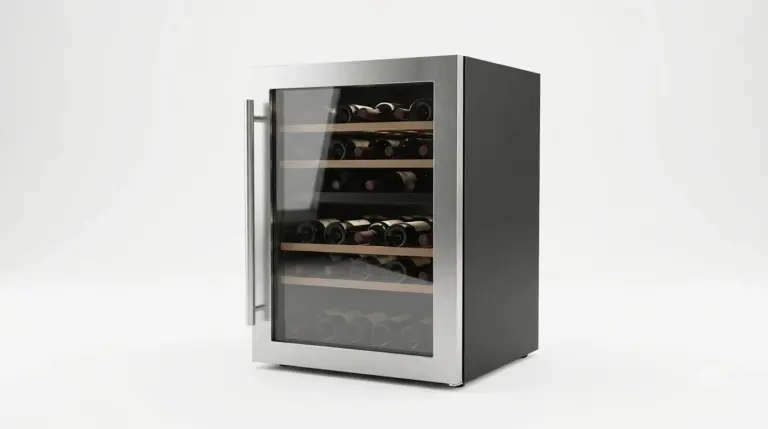
The PH-46BD3L increases advertised capacity to 46 bottles and provides 4.9 cubic feet of wine storage. Its wider cabinet makes it more appropriate for a growing collection, although its 23.4-inch width requires a larger installation opening.
The PH-CWR100 occupies a middle position with a 33-bottle capacity and seven removable shelves. Its side ventilation is particularly important because the installation requirements differ from those of the front-vented models.
For households that also store soda, beer, or sparkling water, the PH-150BCW3L offers a different arrangement. Its two sections accommodate up to 20 wine bottles and 78 cans, with separate temperature settings for the wine and beverage compartments.
Explore other appliance manufacturers through our Brand hubs collection if you want to compare different approaches to home refrigeration.
What the Brand Does Well
Phiestina’s strongest selling points are its dual-zone configurations, compact cabinet dimensions, and flexible shelving. These features address practical storage problems for households that want to keep several wine styles available without using a large refrigerator.
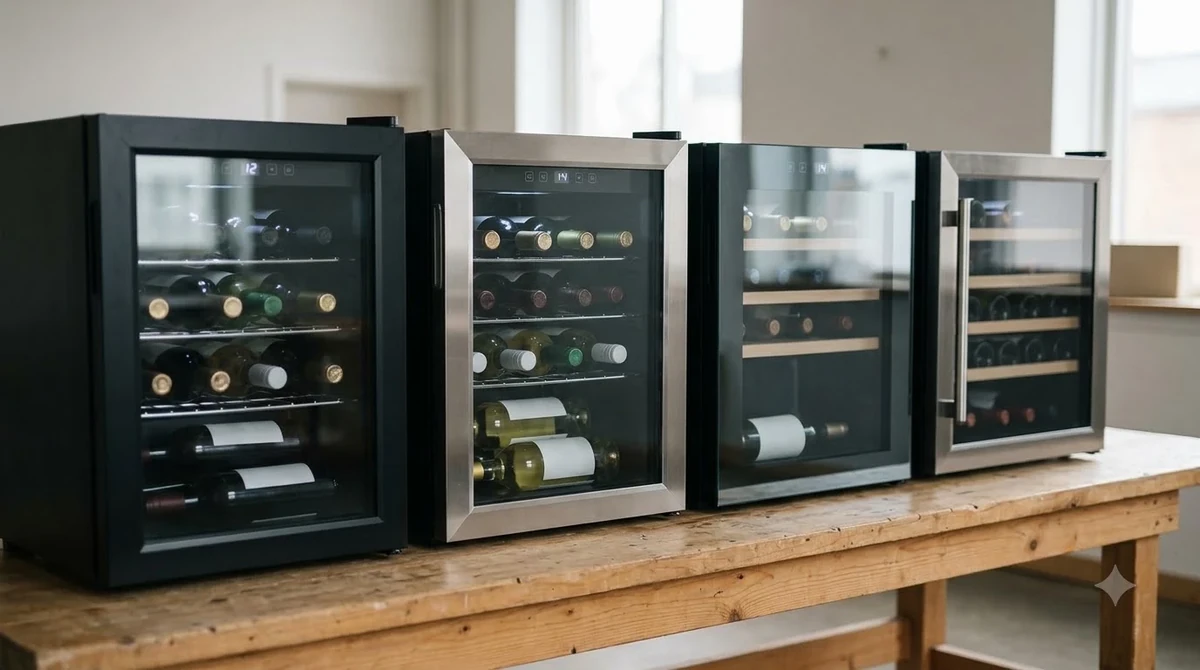
Dual-zone refrigeration is particularly useful for people who regularly serve both red and white wine. The PH-29BDSP and PH-46BD3L list an upper-zone range of 40–50°F and a lower-zone range of 50–66°F. This allows owners to maintain different serving temperatures within one appliance.
For example, a household might use a setting around 45°F for white wines and approximately 55°F for lighter reds. Full-bodied reds generally benefit from slightly warmer serving temperatures, so a lower compartment that reaches 66°F offers additional flexibility.
It is important to distinguish storage temperature from serving temperature. A cooler’s ability to maintain a temperature does not mean every wine should be served at that exact setting. Wine style and personal preference still matter.
Compact installation choices
The manufacturer’s 15-inch and 24-inch configurations give buyers different ways to use kitchen space. A narrower unit can fit a smaller cabinet opening, while a 24-inch model provides more room for bottles and accessories.
The PH-46BD3L measures 23.4 inches wide, 33 inches high, and 22.4 inches deep. Its suggested built-in opening is 23.8 inches wide, 33.2 inches high, and 25.4 inches deep. These measurements illustrate why installation planning should happen before ordering.
Removable shelving
Removable shelves make it easier to accommodate bottles that differ from standard Bordeaux dimensions. Champagne bottles, wider Burgundy bottles, and larger-format containers can require additional space between shelves.
Some Phiestina models use painted wire shelves with aluminum front bars, while the PH-CWR100 listing describes removable beechwood racks. This difference can influence appearance, bottle handling, and the available interior arrangement.
Combination beverage storage
The PH-150BCW3L is particularly useful for a household that also stores soda, beer, or sparkling water. Its 20-bottle wine section and 78-can beverage section reduce the need for a separate small beverage refrigerator.
Independent temperature settings also make the arrangement more practical. The beverage compartment can operate between 38°F and 50°F, while the wine compartment has a wider 40°F to 66°F range.
Tip: Before choosing a Phiestina dual-zone wine cooler, decide which wines and beverages will occupy each compartment. A 45°F setting is useful for many whites, while approximately 55°F can work for lighter reds. Leave enough room for air circulation and avoid packing bottles tightly against the interior walls.
For buyers comparing brands, it can also help to read our guides on whether Black and Decker is a good brand and whether Galanz is a good brand. Comparing individual model specifications is more useful than relying on brand names alone.
Common Complaints
Phiestina owner feedback is mixed rather than uniformly positive or negative. Independent reporting identifies attractive styling and useful temperature controls as recurring positives, while noise, shelf stability, and reliability deserve closer attention.
An independent review of the 24-inch wine-and-beverage refrigerator discusses feedback associated with the advertised 20-bottle and 78-can configuration. Some owners appreciate its appearance, cooling performance, and ability to fit into a home bar. Others describe rattling sounds or shelves that feel less substantial than expected.
These experiences are not proof that every Phiestina refrigerator has the same problems. They do, however, indicate why buyers should consider the location of the appliance. A refrigerator installed in a separate utility area may be less disruptive than one positioned beside a living room or bedroom.
Operating noise
Compressor refrigerators make operating sounds as their cooling systems cycle. Fans also contribute to the overall noise level. Some owners describe their Phiestina units as quiet, while others report rattling or louder operation over time.
Before installation, make sure the cabinet is level and the appliance has the required clearance. Poor positioning can introduce vibration that makes an otherwise manageable operating sound more noticeable.
Shelf strength and bottle capacity
Wire shelving offers flexibility, but it may not feel as substantial as heavier wooden racks. Owners with heavier bottles or collections containing many oversized formats should pay attention to the shelf arrangement.
Advertised bottle capacities generally assume standard bottle dimensions and a particular loading pattern. A nominal 46-bottle cabinet may hold fewer bottles if the collection contains many wide Champagne or Burgundy bottles.
Long-term reliability
Reliability concerns deserve particular attention because refrigeration appliances contain components that may eventually need replacement. Independent owner-feedback summaries include reports of units developing problems and concerns about repair options after warranty coverage ends.
These reports should be treated as potential ownership risks, not a measured failure rate. There is not enough evidence to conclude that every Phiestina model has a widespread defect. Nevertheless, prospective buyers should confirm how replacement parts can be obtained and whether a local appliance technician is willing to service the specific model.
The manufacturer’s own FAQ also illustrates the importance of identifying the exact problem. It directs customers with a PH-29DB circuit-board question to its service contact and provides separate responses to questions about replacement parts and unusual beeping.
For a more detailed discussion of owner feedback, see the independent Phiestina 24-inch refrigerator review.
How to Choose a Phiestina Model
The right Phiestina wine fridge depends on collection size, available cabinet space, ventilation requirements, and whether you need separate storage for beverages. Start with the physical installation measurements, then compare capacity and temperature settings.
1. Measure the installation space
Measure the opening’s width, height, and depth rather than relying on the nominal cabinet size. A refrigerator advertised as 15 inches wide may require a slightly different opening, depending on its installation design and surrounding cabinetry.
For the PH-29BDSP, the listed dimensions are 14.9 by 33.9 by 22.4 inches. The PH-46BD3L is 23.4 inches wide, 33 inches high, and 22.4 inches deep.
2. Check ventilation requirements
Ventilation is one of the most important distinctions between Phiestina models. The PH-29BDSP and PH-46BD3L use front-bottom ventilation, while the PH-CWR100 uses side ventilation.
Do not assume that a unit designed for freestanding installation can be placed inside any cabinet without additional planning. The ventilation design must match the intended installation arrangement.
The manufacturer’s FAQ recommends leaving at least 3 inches behind the cabinet for power-plug space. The installation manual also emphasizes keeping ventilation openings unobstructed.
3. Choose an appropriate capacity
Consider the number of bottles you actually keep rather than buying according to the largest advertised capacity. A 29-bottle cooler may be sufficient for occasional entertaining, while a 46-bottle unit provides more room for a collection that includes several wine styles and producers.
Remember that bottle capacity depends on bottle shape. A collection dominated by standard 750 ml Bordeaux bottles will usually be easier to arrange than one containing numerous oversized sparkling wine bottles.
4. Decide whether dual-zone storage matters
A dual-zone cooler is useful if you regularly keep reds and whites ready for different serving temperatures. The standard wine-oriented Phiestina configurations offer an upper range of 40–50°F and a lower range of 50–66°F.
If you mainly want to chill cans and other beverages, a single-zone beverage refrigerator may be more appropriate. The PH-CBR100, for example, is listed with a 96-can capacity and a temperature range of 38–50°F.
5. Consider the bottle arrangement
Look beyond the headline capacity and count the shelves. The PH-29BDSP has five removable shelves, the PH-CWR100 has seven, and the PH-46BD3L has five.
Think about the types of wine you buy. Sparkling wines often need more vertical or horizontal room than conventional bottles. If the cooler will hold a mixed collection, shelf flexibility can be more valuable than the highest advertised bottle count.
6. Investigate support before purchasing
Ask how the manufacturer handles replacement parts, technical questions, and warranty claims. Find out whether the compressor, electronic control panel, fans, and other major components can be serviced.
For a comparison with another compact-appliance option, see our overview of whether ROVSUN is a good brand. The same buying principle applies: confirm the exact specifications and support arrangements rather than choosing by appearance alone.
Warranty and Support
Phiestina product pages list a limited one-year replacement-parts warranty for several wine refrigerator models. That is a relatively short stated coverage period for an appliance that buyers may expect to keep in a kitchen or home bar for many years.
Warranty wording matters because replacement parts and complete appliance replacement are not necessarily the same benefit. Buyers should establish what is covered, whether labor is included, who pays shipping, and how a claim is processed before committing to an installation.
Finding a Phiestina wine cooler manual
The most useful starting point is the manufacturer’s product documentation and FAQ. However, the availability of downloadable manuals can vary by model.
One publicly accessible instruction manual covers the PH-29DB and PH-46DB compressor dual-zone wine refrigerators. It contains technical data, safety precautions, installation instructions, operating information, maintenance guidance, troubleshooting, and warranty information.
The manual lists a 110V supply, 60Hz frequency, 90W input power, and upper and lower temperature ranges of 40–50°F and 50–66°F for those two models. It also describes the separate fans, lights, temperature controls, and interior components.
Read the Phiestina PH-29DB and PH-46DB instruction manual for the specific models it identifies. Do not assume that its instructions apply to every newer model with a similar capacity.
What to do if the manual is unavailable
Phiestina’s FAQ includes a question about obtaining the PH-150BV manual. The company’s response says that the document was sent to the customer by email. This suggests that contacting support may be necessary when a direct PDF download is unavailable.
When requesting documentation, provide the complete model number and, if possible, the serial number. A photograph of the appliance identification label can also help customer service identify the correct version.
Replacement parts and technical questions
The manufacturer’s FAQ directs customers seeking a PH-29DB circuit board to its service contact. It also states that free replacement parts are provided within the warranty period for qualifying product issues.
Other FAQ entries address practical ownership questions, including LED lighting, door hinges, replacement glass, condensation trays, and ventilation clearance. These answers can be useful, but customers should obtain confirmation of the specific parts and coverage applicable to their own appliance.
Before buying, save the invoice, warranty information, model number, and installation documentation. These records can make a later service request easier to handle.
Frequently Asked Questions
Is Phiestina a good brand for wine refrigerators?
Phiestina offers several configurations with compressor cooling and separate temperature zones. Its products are designed for household and similar indoor environments rather than professional wine-cellar installations. The main consideration is whether the available service arrangements and limited warranty coverage meet your expectations.
Can a Phiestina wine cooler be used without installing it under a counter?
Selected Phiestina models are listed for both built-in and freestanding installation. The PH-29BDSP and PH-46BD3L are examples. However, their ventilation arrangements must still be respected, and the manufacturer’s installation instructions should determine the appropriate placement.
Does Phiestina offer a reversible wine cooler door?
Door direction varies by model. The PH-29BDSP and PH-46BD3L product specifications list non-reversible doors, while the manufacturer’s FAQ explains that certain built-in models include a replacement hinge for changing the opening direction. Confirm hinge compatibility before planning a cabinet installation.
Does a Phiestina wine refrigerator have a carbon filter?
The PH-29DB instruction manual identifies a carbon filter among its interior components. However, that detail should not be assumed to apply to every Phiestina wine refrigerator. Check the documentation for the exact model when evaluating replacement filter requirements.
Can a Phiestina wine cooler protect wine from ultraviolet light?
Not every Phiestina glass door provides complete UV protection. The manufacturer’s FAQ explicitly states that its products are intended for indoor use and that the glass door cannot protect against UV light. Keep the appliance away from direct sunlight rather than relying on the tinted glass as complete protection.
Phiestina is worth considering if you want a compact dual-zone wine refrigerator, flexible bottle storage, or a combination cooler for wine and everyday beverages. The PH-29BDSP, PH-CWR100, and PH-46BD3L address different collection sizes, while the PH-150BCW3L suits households that want wine and cans in one appliance. Compare the exact model specifications, ventilation requirements, manual, and warranty before purchasing so the refrigerator fits both your kitchen and your long-term storage needs.
More in Brand Hubs
 Icyglee Wine Fridge: Compare Capacities, Features and ModelsUpdated Nov 20, 2026
 Fomup Wine Fridge: Explore Models, Features, and Buying TipsUpdated Nov 20, 2026
 Aaobosi Wine Fridge: Compare Models and Choose the Right CoolerUpdated Nov 20, 2026
 Orymuse Wine Fridge Reviews: Compare Capacities, Features and WarrantyUpdated Nov 20, 2026
 Tylza Wine Fridge: Find the Right Cooler for Your CollectionUpdated Nov 20, 2026
 Vintec Wine Fridge: Features, Warranty, and Buying AdviceUpdated Nov 20, 2026