


We may earn a commission when you buy through links on this page, at no extra cost to you. Learn more.
The vinabon wine opener is a worthwhile electric corkscrew for wine drinkers who want fast, convenient bottle opening without manually twisting or pulling a cork. Its compact matte black design, simple operation, and reported cork-removal time of under six seconds make it an appealing option for home entertaining. However, buyers should distinguish between VINABON’s rechargeable EWO2 and its battery-operated EWO1, and consider potential problems with fragile corks before choosing a model.
Opening wine should be a straightforward part of serving dinner, entertaining friends, or enjoying a bottle after work. An electric corkscrew can make that process easier, particularly for people who dislike traditional corkscrews or regularly open several bottles in one sitting. VINABON offers several wine-opening tools, but its electric model attracts particular attention for its speed and compact footprint. This review examines its construction, available features, reported owner experiences, and practical alternatives to help determine whether it belongs in your kitchen or home bar.
Specs and Key Features
The VINABON electric wine opener combines an automated corkscrew mechanism with a compact housing and a straightforward operating system. Its most attractive specifications include a reported extraction time under six seconds, a claimed capacity of up to 100 bottles per charge for the rechargeable version, and a stainless-steel spiral designed for repeated use.
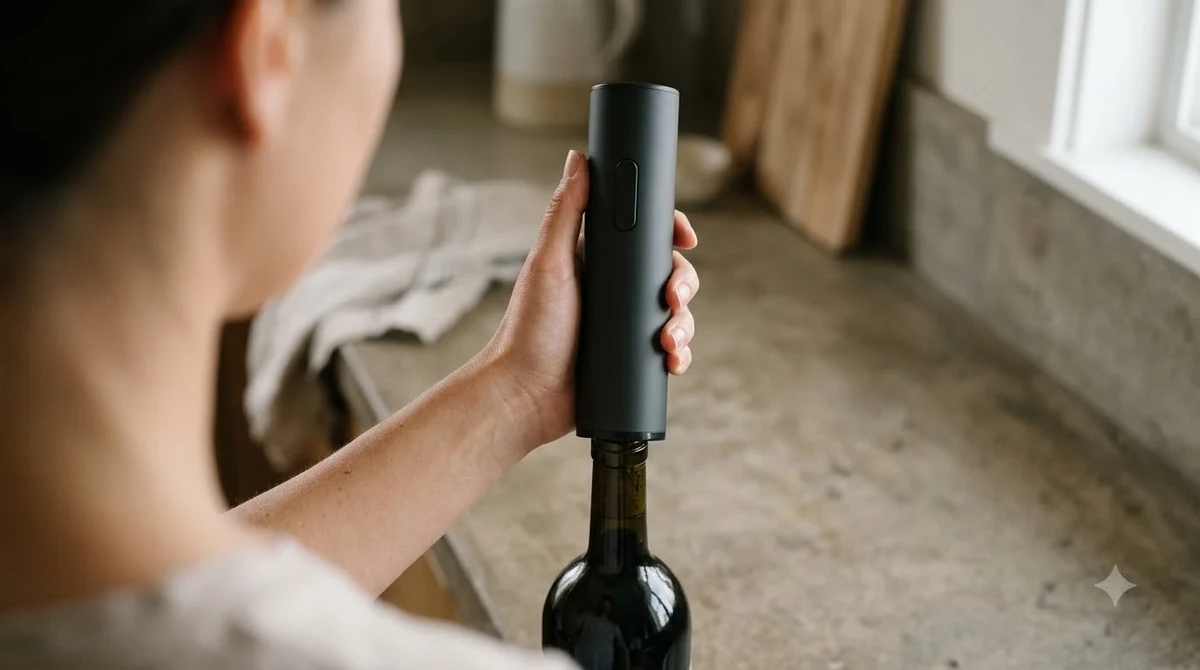
Food & Wine selected VINABON as its best compact electric wine opener after evaluating 16 electric models. Its published testing results are particularly useful because they provide measurable comparisons rather than relying exclusively on manufacturer descriptions. The tested opener measures 7.8 x 2.8 x 2.3 inches, making it relatively easy to accommodate on a kitchen counter, inside a cabinet, or alongside other wine accessories.
| Specification | VINABON EWO2 |
|---|---|
| Product category | Electric wine opener |
| Body material | ABS plastic |
| Exterior finish | Matte black |
| Corkscrew material | Teflon-coated stainless steel |
| Published dimensions | 7.8 x 2.8 x 2.3 inches |
| Reported cork-removal time | Under 6 seconds |
| Claimed battery capacity | Up to 100 bottles per charge |
| Operation | One-touch electric |
| Battery indicator | LED indicator |
| Included accessories | Foil cutter and rechargeable cable |
These specifications describe the rechargeable EWO2 configuration, rather than every VINABON electric opener. Product listings also identify an EWO1 battery-operated configuration that uses four AA batteries. These versions should not be treated as interchangeable: their power arrangements differ, and the accessories and specifications can vary between listings.
The matte black ABS body gives the opener a relatively understated appearance. Rather than using a large decorative charging station, the compact cylindrical design emphasizes portability and simple storage. The stainless-steel spiral is another useful feature because it provides the working mechanism responsible for extracting the cork.
The included foil cutter handles the preliminary step of removing a bottle’s capsule. This means buyers do not necessarily need to purchase a separate cutting tool to get started. The rechargeable package also includes a cable, although buyers should confirm the exact charging arrangement and accessories supplied with their particular version.
For independent performance context, Food & Wine’s electric wine opener evaluation provides a useful comparison of the VINABON with other electric corkscrews. Its findings support the opener’s strongest selling points: speed, manageable dimensions, and stable operation.
What Owners Like
The strongest appeal of the VINABON electric opener is convenience. Owners frequently praise its straightforward operation, compact construction, and ability to remove corks without the repeated twisting and pulling required by a traditional corkscrew.
Simple electric operation
Manual corkscrews require some coordination. The user must position the spiral, drive it into the cork, and apply enough leverage to remove the cork without damaging it. This can become frustrating when a cork is particularly tight or when the bottle is being opened during a busy dinner.
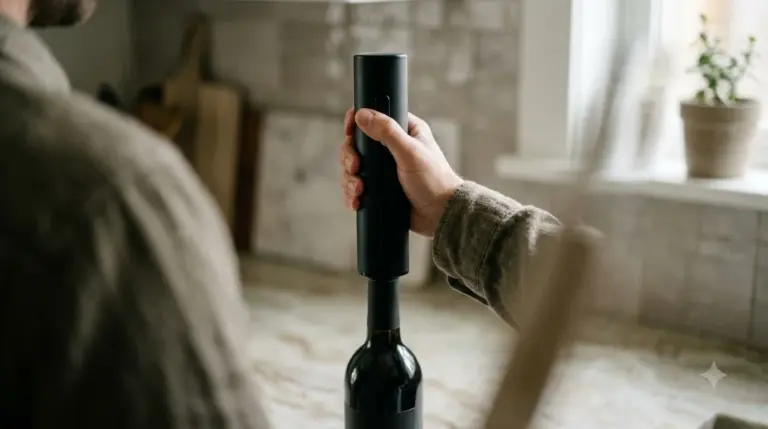
The VINABON electric opener simplifies the process. The user places the device vertically over the bottle opening and activates its operating button. The motor rotates the spiral into the cork and pulls it upward. Once the cork has been removed, the mechanism can release it from the opener.
This operating style is particularly attractive to beginners. There is less need to understand corkscrew leverage, and the opening process becomes more consistent once the user learns to align the device properly.
Compact size for home storage
Storage is another advantage mentioned in owner feedback. Large electric openers can occupy considerable counter space, especially when they come with a charging station and several accessories. VINABON’s relatively compact design is easier to accommodate in smaller kitchens and apartments.
The dimensions reported by Food & Wine, 7.8 x 2.8 x 2.3 inches, provide a useful reference when planning storage. The opener can fit into many kitchen drawers and can be stored with other wine tools rather than requiring a dedicated countertop location.
Its matte black finish also suits a range of home-bar arrangements. It can sit beside glassware, a wine decanter, or a collection of bottle stoppers without looking particularly out of place.
Fast cork extraction
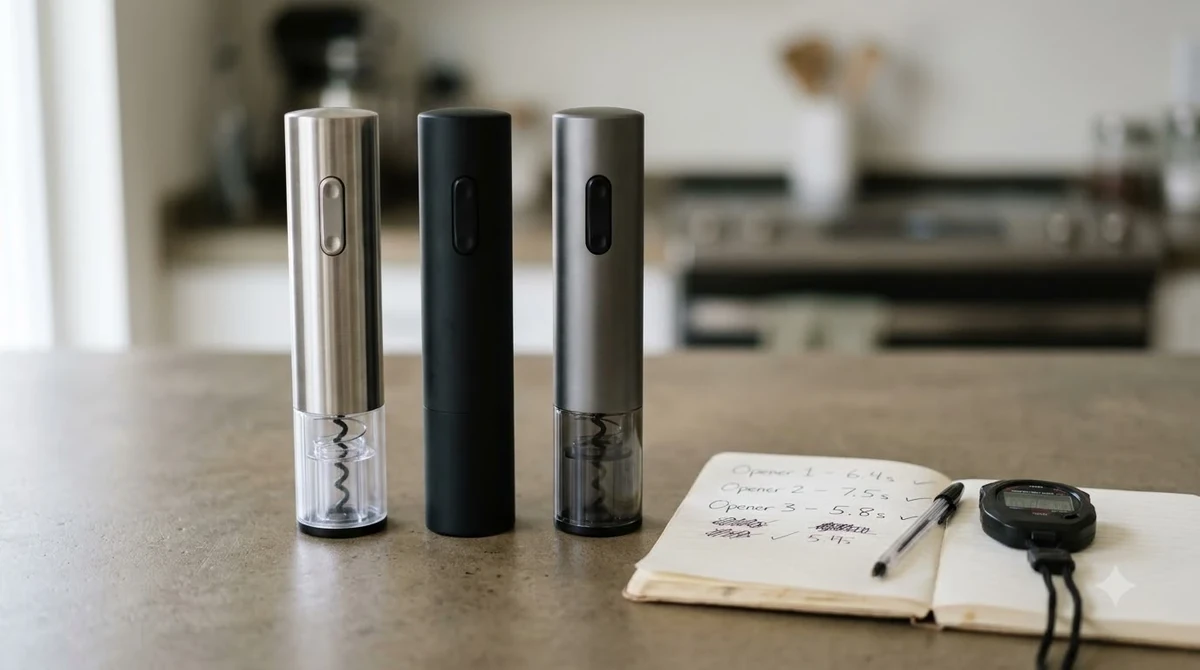
Speed is one of the most impressive aspects of the product. Food & Wine reports that the tested VINABON model removed corks in under six seconds. This is a useful advantage when opening multiple bottles for a dinner party or serving wine to a group.
Fast extraction does not mean that every bottle will open in exactly the same amount of time. Cork condition, bottle alignment, and the material used for the closure can influence performance. Nevertheless, the reported result suggests that the opener is capable of handling ordinary bottle-opening tasks quickly.
Battery convenience
The rechargeable EWO2 is advertised with a capacity of up to 100 bottles per charge. This is a manufacturer or product-listing claim, not a guarantee that every user will achieve that number. Battery performance depends on operating conditions, the condition of the mechanism, and how frequently the opener is used.
For someone who regularly hosts dinner parties, a high stated capacity can reduce the frequency of charging interruptions. An LED indicator also provides a convenient way to monitor the remaining battery level instead of discovering that the opener needs charging halfway through an evening.
Appearance and handling
VINABON uses a soft-looking matte black exterior and a relatively simple control arrangement. Owner feedback summarized by Kitchen Gear Dude frequently mentions the compact feel and attractive appearance. These details matter for a product that may remain visible on a kitchen counter or bar cart.
The electric design also removes much of the physical twisting associated with a conventional corkscrew. However, it does not eliminate every physical movement. The bottle still needs to be held securely, and the opener must be positioned correctly to prevent unnecessary movement during extraction.
For people putting together a dedicated serving area, pairing the opener with a suitable bar cart can keep the bottle-opening equipment organized and readily available.
Common Complaints and Limitations
The VINABON electric wine opener has several attractive features, but it is not immune to the problems associated with motorized corkscrews. Fragile corks, trapped cork fragments, and uncertainty about servicing are important considerations before purchasing.
Fragile corks can break
One recurring issue in owner feedback concerns very dry natural corks and certain synthetic closures. These materials can behave differently from an intact, moderately flexible natural cork. A dry cork may crack or crumble when the spiral enters it, while some synthetic versions can require repeated attempts before extraction is complete.
This is not an issue unique to VINABON. Electric openers rely on a rotating spiral and motorized pulling action. When a cork is already deteriorating, the mechanism cannot restore its structural integrity.
Older bottles deserve particular attention. Wine stored for many years can develop fragile corks that are more likely to break during removal. Collectors who frequently open mature Bordeaux, Burgundy, or other aged wines may prefer a traditional two-pronged opener, commonly called an Ah-So, because it can remove delicate corks without drilling through them.
Cork fragments can become stuck
A second complaint involves cork debris remaining inside the opener’s cylinder. If a cork disintegrates during extraction, small pieces can become difficult to remove. This is an especially inconvenient problem because the device depends on an unobstructed spiral mechanism to function correctly.
Buyers should therefore pay attention to cleaning and maintenance instructions. The available EWO2 listing does not clearly explain whether the internal corkscrew assembly can be removed for user servicing. It also does not establish a detailed procedure for extracting fragments that become lodged inside the chamber.
Do not force a stuck cork fragment deeper into the mechanism or attempt to operate the opener repeatedly when the spiral is obstructed. Stop using the device and consult the manufacturer’s support guidance before attempting any internal cleaning.
Not completely hands-free
The one-touch description can create the impression that the opener operates without any assistance. In practice, electric corkscrews still require correct positioning and a stable bottle. Food & Wine specifically notes that electric openers generally benefit from two-handed operation, with one hand holding the bottle and the other controlling the device.
The bottle should rest on a stable surface, and the opener should remain centered above the cork. Excessive downward pressure is unnecessary and can place additional strain on the device. A controlled, upright position is more important than trying to force the spiral through the closure.
Battery specifications need attention
Another consideration is the difference between VINABON’s electric configurations. The EWO2 is presented as a rechargeable product, while the EWO1 listing describes a model powered by four AA batteries. A buyer who expects a rechargeable opener could be disappointed if a retailer’s listing describes the battery-operated configuration instead.
Charging time, battery chemistry, and detailed replacement procedures are not consistently documented in the available product information. Buyers who require precise battery specifications or specific electrical safety documentation should obtain those details before ordering.
Warranty details require confirmation
The EWO2 product information summarized by Kitchen Gear Dude mentions a lifetime warranty and a performance claim of at least 10,000 bottles or 10 years. These are product-listing claims, rather than independently verified durability results.
VINABON also advertises lifetime product warranty benefits through its VIP club. However, buyers should establish the applicable warranty terms for the exact product and purchase channel. In particular, it is useful to confirm registration requirements, exclusions, and the process for requesting a replacement if the motor stops working.
Tip: Before using an electric corkscrew on an older bottle, inspect the cork and capsule carefully. If the cork looks unusually dry, cracked, or fragile, consider a manual two-pronged opener instead of risking fragments inside the electric mechanism.
Who Should Buy and Who Should Skip
The VINABON electric opener makes the most sense for people who value convenience, speed, and straightforward operation. It is less compelling for collectors who regularly open very old bottles or buyers who prefer a completely manual tool with minimal maintenance requirements.
Good fit for frequent home entertainers
People who regularly host dinner parties can benefit from the electric operation. Opening several bottles during an evening becomes easier when the user does not need to repeatedly twist and pull a manual corkscrew.
The EWO2’s claimed capacity of up to 100 bottles per charge is particularly attractive for this type of use. Even if actual results vary, the stated capacity suggests that the opener is designed for more than occasional single-bottle use.
Its small dimensions are also helpful when a home bar contains several accessories. Rather than dedicating a large amount of space to an electric opener, users can store it alongside wine glasses, bottle stoppers, and pouring accessories.
Good fit for beginners
People new to wine accessories may find an electric opener easier to operate than a waiter’s corkscrew. Manual models require some practice to position the spiral and use the lever without damaging the cork.
VINABON reduces the number of steps involved. The user still needs to remove the foil, stabilize the bottle, and align the device, but the motor performs the main extraction work.
It can also make a practical gift for someone who enjoys wine but does not want to learn several different corkscrew techniques. Its understated appearance makes it suitable for a kitchen or home bar.
Who should consider another opener?
Wine collectors who frequently open mature bottles should think carefully before selecting an electric corkscrew. Old corks can become brittle, and even a powerful motor cannot guarantee that a deteriorating closure will remain intact.
People who open only one or two bottles occasionally may also prefer a traditional waiter’s corkscrew. A manual opener does not require batteries, charging cables, or internal motor maintenance. It can be carried in a kitchen drawer and used whenever needed.
Similarly, buyers who want a complete wine-service package should not assume that the basic VINABON electric opener includes preservation equipment. A foil cutter helps with opening a bottle, but it does not replace an aerator, vacuum pump, or wine stopper.
Those accessories are more important if a household frequently opens bottles that are not finished in one sitting. In that situation, a dedicated wine opener and preserver set may provide better overall utility.
How It Compares to Alternatives
VINABON competes in a category that includes traditional manual corkscrews, lever-operated openers, and other electric models. Its strongest distinction is the combination of compact dimensions and rapid electric extraction, rather than an unusually broad collection of wine-service accessories.
VINABON versus a waiter’s corkscrew
A waiter’s corkscrew is the familiar folding tool used by restaurant servers and wine professionals. It typically combines a spiral, a small foil-cutting blade, and a lever that rests against the bottle neck.
Its primary advantage is simplicity. There is no motor or rechargeable battery, and a good manual corkscrew can remain useful for years with relatively little maintenance. It is also small enough to fit into a kitchen drawer or carry in a pocket.
VINABON offers a more convenient experience for users who dislike manual extraction. Instead of applying leverage repeatedly, the motor handles the cork-removal process. The tradeoff is that the electric version introduces charging requirements and additional mechanical components.
VINABON versus a Rabbit-style opener
A Rabbit-style corkscrew uses a lever mechanism and gripping handles to secure the opener around the bottle neck. The lever drives the spiral into the cork and then extracts it through a mechanical pulling motion.
VINABON’s electric design requires fewer physical movements. It is also easier to store than some larger lever-operated designs. A Rabbit-style opener, however, does not depend on a rechargeable battery and gives the user a direct mechanical connection to the cork.
VINABON itself offers a Rabbit wine opener as part of its broader accessory range, so buyers can choose between the brand’s manual and electric approaches. The better option depends on whether compact storage and motorized operation are more important than mechanical simplicity.
VINABON versus other electric models
Food & Wine evaluated several electric corkscrews alongside VINABON, including the Peugeot Elis Touch, Zwilling Enfinigy, Tomentific, and Vacu Vin models. Their findings provide useful context for understanding where VINABON fits.
The Peugeot Elis Touch was selected as the best overall model. Its reviewers appreciated its quiet operation and sturdy construction, although they noted that it requires downward pressure to activate the mechanism.
The Zwilling Enfinigy stood out for its design and compact storage. Its foil cutter clips into the opener body, reducing the likelihood of losing the accessory. However, reviewers encountered occasional cork-sticking problems and found the cutter difficult to operate.
The Tomentific was recognized for quiet operation and quick extraction, but its operation requires significant downward pressure. The Vacu Vin model provides a broader package with preservation equipment and stoppers, making it more appropriate for buyers who want more than an opener.
VINABON’s advantage is its particularly fast reported extraction time and compact construction. Its main tradeoff is that its basic package focuses on opening bottles rather than providing a complete wine-serving and preservation system.
Choosing the right category
The following comparison summarizes the practical differences between the available approaches.
| Opener type | Main advantage | Main limitation | Best suited to |
|---|---|---|---|
| VINABON electric | Fast motorized extraction | Requires battery power or charging | Frequent home use |
| Waiter’s corkscrew | Compact and mechanically simple | Requires manual leverage | Everyday and travel use |
| Rabbit-style opener | Lever-assisted extraction | Generally bulkier | People who prefer mechanical assistance |
| Two-pronged Ah-So | Can remove delicate corks without drilling through them | Requires a different removal technique | Older wine bottles |
| Electric opener and preserver set | Combines opening and wine-storage accessories | More components to store | Households that regularly save unfinished wine |
There is no universal winner in this category. VINABON is a sensible choice for people who prioritize electric convenience, while manual alternatives remain attractive for portability, simplicity, and older bottles. Buyers interested in browsing other manufacturers can also explore the Accessory Brands category to compare the broader wine-accessory market.
Frequently Asked Questions
Does the VINABON wine opener work with synthetic corks?
Electric corkscrews are generally compatible with both natural and synthetic corks. However, synthetic closures can have different friction and compression characteristics, so extraction may take more than one attempt. Avoid forcing the device if the cork does not move normally.
What should I do if the electric opener stops halfway through extraction?
Keep the bottle stable and stop applying pressure if the mechanism appears obstructed. Check the battery indicator and inspect the cork for visible damage after safely disengaging the device according to its instructions. If the spiral remains jammed, contact the manufacturer rather than attempting to dismantle the motor assembly.
Can the VINABON opener be used on sparkling wine bottles?
Traditional sparkling wine bottles are normally sealed with mushroom-shaped corks held in place by wire cages. They require a different opening technique because the pressure inside the bottle can eject the cork unexpectedly. An electric wine corkscrew intended for conventional still-wine corks should not be substituted for the standard sparkling-wine opening method.
How should the VINABON electric opener be stored between uses?
Store the opener in a dry location away from direct heat, moisture, and accidental impacts. Keep its foil cutter separate from children’s reach because the cutting edges are sharp. For rechargeable versions, follow the manufacturer’s battery-storage and charging recommendations rather than leaving the unit connected indefinitely.
Does VINABON manufacture manual wine openers too?
Yes. VINABON’s product collection includes a Rabbit wine opener, a traditional waiter’s corkscrew, and a self-pulling twist wine corkscrew. This gives buyers several ways to open bottles without committing to the electric model. The manual options can be useful as backups when an electric opener needs charging or encounters a difficult cork.
The VINABON wine opener is a compelling option for households that want quick, straightforward cork removal in a compact package. Its reported performance, simple controls, and convenient design make the rechargeable EWO2 particularly appealing to frequent wine drinkers, although cork breakage and unclear servicing details deserve consideration. Before purchasing, confirm whether the listing describes the rechargeable EWO2 or the four-AA-battery EWO1 so the power arrangement and included accessories match your expectations.
More in Wine Accessories
 Vinglace Wine Tumbler Review: A Glass-Lined Choice for Better SippingUpdated Nov 20, 2026
 ZWILLING Electric Wine Opener Review: Features and DrawbacksUpdated Nov 20, 2026
 Vinturi Electric Wine Opener Review for Easy UncorkingUpdated Nov 20, 2026
 Vinabon Wine Aerator Review for Easier, Cleaner Wine ServingUpdated Nov 20, 2026
 Vacu Vin Electric Wine Opener Review: Easy Cork Removal for Home Wine LoversUpdated Nov 20, 2026
 Rabbit Wine Accessories for Easier Home Wine ServiceUpdated Nov 20, 2026