


We may earn a commission when you buy through links on this page, at no extra cost to you. Learn more.
The brookstone corkscrew is a practical wine-opening option for people who want a straightforward way to remove traditional corks without relying on a fully electric appliance. Brookstone has produced several distinct wine opener designs, including a compact lever model, a manual twist opener, and battery-powered versions. The Compact Wine Opener, model 324366, stands out for its integrated foil cutter, bottle-gripping handle, and replaceable corkscrew mechanism, although buyers should distinguish it from the brand’s other models before purchasing.
Brookstone wine accessories are not all built around the same opening mechanism. Some require physical lever movement, others use a rotating handle, and automatic versions depend on batteries. Understanding those differences makes it easier to select an opener that fits your kitchen, wine habits, and expectations. This review examines the documented features, operating instructions, strengths, limitations, and ownership considerations of the Brookstone corkscrew range, with particular attention to the Compact Wine Opener.
Specs and Key Features of the Brookstone Corkscrew
The Brookstone Compact Wine Opener combines a manual lever system with a bottle-gripping handle and integrated foil cutter. Its relatively narrow profile makes it a practical option for a kitchen drawer or a small home bar, while its mechanical design avoids the need for batteries or a charging station.
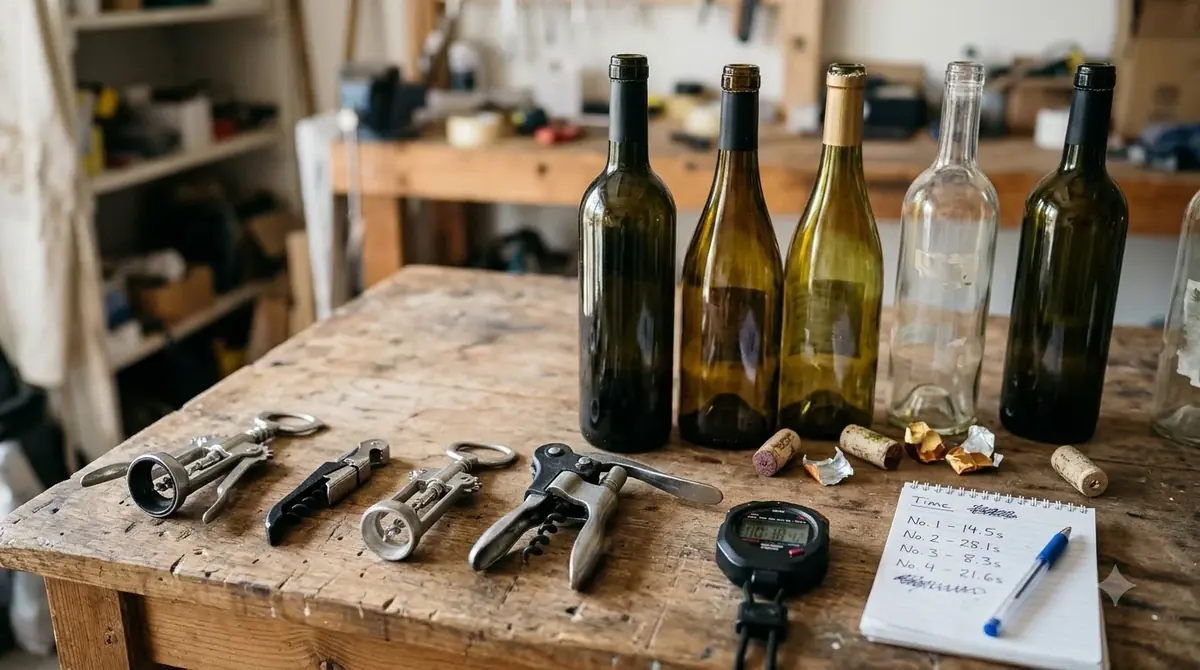
The manufacturer’s instruction manual identifies the compact model as 324366. Its construction centers on five working components: the arm, handle, foil cutter, corkscrew, and shaft. Instead of asking the user to rotate a traditional screw several times, the opener uses a lever movement to drive the spiral into the cork and lift it from the bottle. The handle keeps the bottle neck positioned during that process.
The documented measurements are useful when deciding whether the opener will fit a particular storage area. At approximately 11.72 inches tall, it is longer than many small waiter-style corkscrews. Its 3.1-inch width and 2.1-inch depth, however, give it a relatively slim footprint. The listed weight of approximately 1.29 pounds also means it is not an especially lightweight pocket accessory.
| Specification | Brookstone Compact Wine Opener |
|---|---|
| Model number | 324366 |
| Opening mechanism | Manual lever |
| Height | 11.72 inches |
| Width | 3.1 inches |
| Depth | 2.1 inches |
| Weight | 1.29 pounds |
| Foil cutter | Integrated cutting wheels |
| Replacement spiral | Described in the manual |
| Warranty | One-year limited warranty stated in the manual |
| Cleaning | Damp cloth; do not submerge |
One useful distinction is that the compact lever opener is not the same product as Brookstone’s automatic wine opener. Kohl’s lists a separate automatic version that requires four AA batteries and measures 9 x 6.5 x 28 centimeters. That product also includes a foil cutter, but its battery-powered operation makes it a different purchase proposition.
For buyers who prefer manual equipment, the compact model offers a mechanical alternative without a battery compartment or charging requirement. The trade-off is that the user still has to position the bottle correctly and operate the lever through its full range of movement. It reduces the complexity of traditional screw-and-pull opening, but it is not an automatic appliance.
For the precise operating sequence and manufacturer specifications, consult the Brookstone Compact Wine Opener instruction manual. It is particularly useful when identifying replacement parts or checking the correct position of the bottle during use.
What Owners Like About the Brookstone Opener
The clearest advantages of the Brookstone Compact Wine Opener are its integrated components, defined operating sequence, and replaceable corkscrew. These features make it more convenient than a basic spiral opener for someone who wants a dedicated tool that stays ready in a kitchen or home bar.
The built-in foil cutter is particularly useful because it keeps the opening accessories together. The manufacturer describes two cutting wheels that contact the foil when the handle is squeezed. After positioning the opener at the marked cutting position, the user twists the bottle to score the covering. This avoids having to locate a separate foil knife before opening a bottle.
Another practical advantage is the handle that grips the bottle neck. With an ordinary handheld corkscrew, the user must stabilize the bottle while applying force to the cork. Brookstone’s lever arrangement provides a more structured opening process: the bottle is secured, the spiral enters the cork, and the arm lifts the cork out.
Replaceable corkscrew mechanism
The manufacturer’s instructions also explain how to replace the corkscrew. The process involves raising the arm, unscrewing the corkscrew cap, turning the spiral counterclockwise to remove it, and installing the replacement. The new spiral must be aligned carefully before the cap is secured again.
This is a meaningful maintenance feature. A damaged or worn spiral does not necessarily mean the complete opener has to be discarded. Replacement availability should still be confirmed before purchasing an older or secondhand unit, because the existence of a replacement procedure in a manual does not guarantee that compatible parts remain in stock.
The manual’s one-year limited warranty is another useful ownership detail. It describes coverage for defects in materials and workmanship under normal use, subject to the stated conditions and exclusions. Buyers should retain proof of purchase and confirm that the warranty applies to the specific product and purchase rather than assuming that every Brookstone opener has identical coverage.
What customer feedback can and cannot establish
Retailer feedback should be considered separately from manufacturer specifications. Kohl’s product information for its Brookstone Automatic Wine Opener displays customer feedback, including reports involving cork removal, foil cutting, and operating performance. Those comments are relevant to the automatic model listed by that retailer, not direct proof of the performance of the 324366 manual lever opener.
This distinction matters because the Brookstone name appears on several different wine accessories. A buyer reading comments about a battery-operated device could mistakenly apply them to a manual model with a different mechanism. Product identification, operating instructions, and compatible replacement parts are more useful starting points than a general brand-name search alone.
For readers comparing other manual mechanisms, our rabbit corkscrew reviews provide a useful reference for understanding how lever-style openers differ in their bottle-gripping arrangements and opening movements.
Common Complaints and Practical Limitations
The Brookstone compact opener is not without compromises. Its manual lever requires correct positioning, its relatively tall construction needs dedicated storage space, and its cutting mechanism contains sharp parts that require careful handling.
The operating instructions are specific about bottle alignment. The neck should enter the shaft until the top of the bottle is flush with the top of the shaft. The handle must then secure the bottle before the arm is lowered. If the bottle is positioned incorrectly, the corkscrew may not enter the cork as intended.
Incomplete lever movement is another potential source of frustration. Brookstone instructs users to pull the arm all the way down so that the spiral enters the cork fully. A partial stroke may leave the cork inadequately engaged, making extraction more difficult. This is an important difference from an electric opener, where the motor controls much of the movement after activation.
Storage and handling considerations
At nearly 12 inches tall, the compact opener may not fit comfortably in a shallow utensil drawer. It is better suited to a deeper drawer, a dedicated accessory compartment, or a shelf near the wine glasses. Its 1.29-pound weight is manageable for ordinary household storage, but it is less convenient than a small folding waiter-style corkscrew for travel.
The foil cutter also needs attention. Its two cutting wheels are designed to score bottle foil, and the manual warns that the product contains sharp parts. Care is particularly important when cleaning around the cutting assembly or handling the exposed corkscrew. This is not an appropriate tool to leave accessible to children.
Another limitation is that manual lever systems are not entirely free of user effort. The handle must be squeezed, the bottle must be held in position, and the lever must travel through its complete movement. People expecting the convenience of a push-button electric appliance may prefer a different Brookstone model.
Finally, replacement-part availability deserves attention. Although the 324366 manual describes replacement corkscrews, an older unit may be harder to maintain if its specific spiral or other components are no longer available. This is particularly relevant when buying from a secondhand marketplace without original packaging or documentation.
Tip: Before using a Brookstone lever opener, check that the bottle neck sits flush with the shaft, secure the handle, and lower the arm completely. Correct alignment and a full lever stroke are central to the manufacturer’s opening procedure.
Who Should Buy the Brookstone Corkscrew and Who Should Skip It
The Brookstone Compact Wine Opener is best suited to casual wine drinkers who want a dedicated manual lever tool with an integrated foil cutter. It makes the most sense for a home setting where the opener can remain in a convenient storage location and where the user is comfortable operating a mechanical lever.
It may appeal to people who regularly open standard bottles of still wine and want something more structured than a basic handheld spiral. The bottle-gripping handle helps establish a consistent position, while the arm supplies the movement needed to extract the cork. Having the foil cutter built into the same assembly also reduces the number of separate accessories needed.
Good fit for home wine drinkers
Someone who opens a few bottles during dinners, family gatherings, or weekend entertaining may appreciate the compact model’s simple mechanical arrangement. It does not depend on batteries, so there is no need to replace AA cells or remember to charge a base before opening a bottle.
It can also suit a home bar where accessories are kept together. A dedicated opener, a wine stopper, a pouring accessory, and a few appropriate glasses make a useful basic setup. Readers organizing that space can find additional ideas in our guide to a bar cart.
People who value replaceable components may also appreciate the documented spiral replacement procedure. Instead of treating the corkscrew as a permanently fixed component, the manufacturer provides instructions for removing and installing a replacement. This is a practical advantage if compatible parts are available.
Who should consider another design?
People who want fully automatic operation should consider a battery-powered model instead. Brookstone’s separately listed automatic opener uses four AA batteries, allowing the motor to perform the cork-removal movement. It is a different type of product and should be evaluated according to its own instructions and customer feedback.
Frequent travelers may prefer a folding waiter-style corkscrew because it takes up less room and is easier to pack. Restaurant professionals may also prefer a traditional waiter’s friend, which offers a compact design and familiar mechanical control without requiring a relatively tall dedicated opener.
Anyone looking for an opener that requires almost no physical interaction should also look beyond the manual compact model. The lever reduces the need to twist a conventional spiral repeatedly, but the bottle still has to be secured and the arm operated. That distinction is important for buyers choosing an opener primarily for convenience.
Buyers who cannot confirm the model number, condition, or replacement-part compatibility should be cautious about purchasing older Brookstone inventory. A product that appears similar in photographs may use a completely different mechanism. The manual for model 324366 should not be assumed to describe every opener carrying the Brookstone name.
How It Compares to Alternative Brookstone Openers
Brookstone’s different wine opener designs serve different preferences. The Compact Wine Opener uses a lever, the Twist Wine Opener relies on a rotating handle and rubber arms, and the separately listed automatic version uses batteries to power cork removal.

The compact lever model offers a middle ground between a conventional handheld corkscrew and an electric appliance. It provides a guided mechanical movement without requiring a battery supply. The Twist model is more directly manual, asking the user to rotate a handle clockwise to insert the spiral and counterclockwise to release the cork.
Compact lever versus Twist Wine Opener
The 324366 model has a built-in foil cutter and a lever arm that performs the extraction movement. Its handle secures the bottle neck while the spiral enters the cork. This design is appropriate for someone who wants the opening sequence to involve fewer separate hand movements.
The Twist model, identified by Brookstone model number 318589, has a removable foil cutter and rubber arms that grip the bottle neck. The user rotates the handle clockwise to drive the corkscrew into the cork, then holds the rubber arms in place and turns counterclockwise to remove the cork.
Neither mechanism is automatically better for every household. The lever design may be preferable to someone who likes a guided extraction movement, while the Twist model offers a more conventional mechanical interaction. Storage dimensions and the condition of the particular unit should also influence the choice.
Manual versus automatic Brookstone openers
The automatic version listed by Kohl’s is a separate category. Its four-AA-battery requirement means buyers need to account for battery replacement. Its listed dimensions are 9 x 6.5 x 28 centimeters, making its overall form different from the 324366 lever opener.
Automatic operation can be attractive for people who prefer push-button controls, but it introduces electrical components and a dependence on batteries. The manual lever model avoids those requirements, although it needs more direct participation from the user. Choosing between them is therefore a matter of preferred operation rather than simply comparing the Brookstone name on the packaging.
For a wider look at manual lever-style options, our guide to the best rabbit corkscrew explains what to look for in bottle-gripping arms, lever movement, and construction. These comparisons can help buyers decide whether the Brookstone mechanism matches the style of opener they actually want.
Cleaning, Maintenance, and Long-Term Ownership
Basic maintenance is straightforward for the Brookstone Compact Wine Opener. The manufacturer recommends wiping it with a damp cloth and specifically says not to submerge it in water. This approach helps avoid unnecessary exposure of the mechanical assembly to moisture.
After opening a bottle, remove visible residue from the accessible surfaces. Pay particular attention to the foil cutter and the area around the shaft, where fragments of foil or cork may collect. Use care around the sharp cutting wheels and spiral. The manufacturer’s instructions do not call for immersing the opener or washing the complete assembly under water.
Inspecting the corkscrew
The spiral is the working component that enters the cork, so its condition matters. Before use, look for visible bending, damage, or material caught around the screw. A damaged spiral may interfere with proper engagement, while accumulated cork residue can make the mechanism less convenient to use.
If the corkscrew needs replacement, the Brookstone manual provides a defined removal and installation sequence. The arm is raised, the cap is unscrewed, and the spiral is turned counterclockwise until it comes out. The replacement is aligned and turned clockwise as necessary before the cap is tightened.
Because the corkscrew is sharp, avoid touching its point during inspection or replacement. If the mechanism does not align properly, forcing it into position is not a sensible solution. Confirm that the replacement component is compatible with model 324366 before attempting installation.
Warranty and support
The manual for the compact model states a one-year limited warranty covering defects in materials and workmanship under normal use. It also describes possible repair, replacement, or store credit options when a valid claim is accepted. The warranty includes exclusions, and service requires a purchase receipt and prior authorization.
The manual identifies a separate customer-care number for warranty service and describes conditions relating to delivery, parts availability, and repair authorization. Because these details may not apply identically to older inventory or products bought from third-party sellers, buyers should retain their purchase records and verify current support arrangements.
Long-term ownership is therefore most straightforward when the opener is purchased with identifiable model information and documentation. A secondhand unit without a model number or proof of purchase may still function, but warranty coverage and access to compatible parts are less certain.
Storage around other wine accessories
Store the opener in a dry location away from children and from loose utensils that could damage its cutting assembly. A dedicated section of a bar cabinet or a deeper drawer is preferable to a crowded compartment where the lever might be pressed or the spiral damaged.
Keep the foil cutter and corkscrew area free from unnecessary contact with other metal objects. If the opener is stored with wine stoppers, pourers, and glassware, position it so that the sharp components are protected. A little attention to storage can help preserve the mechanical parts and reduce the chance of accidental contact.
Frequently Asked Questions
Can the Brookstone corkscrew open synthetic corks?
The compact model’s manual describes its standard cork-removal procedure but does not provide a specific guarantee for every synthetic closure. Synthetic materials can differ in density and friction, so performance may depend on the closure and its fit in the bottle neck. Avoid forcing the lever if resistance becomes unusual.
Does the Brookstone compact opener work with sparkling wine bottles?
The compact opener is designed for cork extraction from ordinary wine bottles, not the pressure-retaining closures used on sparkling wine. Sparkling bottles require a different opening procedure because their corks are held in place by internal pressure. Use the appropriate sparkling-wine opening method instead.
Can the Brookstone corkscrew be used for restaurant service?
The compact model is a dedicated household-style lever opener rather than a folding professional waiter’s friend. Its approximately 1.29-pound weight and 11.72-inch height make it less convenient to carry continuously during table service. A compact waiter-style tool is generally easier to keep on hand for repeated restaurant use.
Is the Brookstone compact opener suitable for left-handed users?
The available model 324366 instructions do not identify a dedicated left-handed or right-handed version. The lever and gripping handle form a fixed mechanical arrangement, so users should consider their comfort with the handle position before purchasing. Product photographs and the physical layout are useful checks when buying a used unit.
What should buyers check when purchasing a secondhand Brookstone opener?
Check the model identification, corkscrew alignment, arm movement, handle operation, and condition of the foil cutter. Confirm that the opener includes the components described in its own manual and that any replacement spiral is compatible. Also ask whether the original purchase documentation is available if warranty coverage matters.
The Brookstone corkscrew range includes several useful designs, but the Compact Wine Opener is most appealing to buyers who prefer a manual lever and integrated foil cutter over battery-powered operation. Its replaceable spiral and documented maintenance instructions are practical advantages, provided the correct model and compatible parts can be identified. Before purchasing, compare the lever, Twist, and automatic versions carefully so the opener you choose matches your preferred way of opening wine.
More in Wine Accessories
 Vinglace Wine Tumbler Review: A Glass-Lined Choice for Better SippingUpdated Nov 20, 2026
 ZWILLING Electric Wine Opener Review: Features and DrawbacksUpdated Nov 20, 2026
 Vinturi Electric Wine Opener Review for Easy UncorkingUpdated Nov 20, 2026
 Vinabon Wine Aerator Review for Easier, Cleaner Wine ServingUpdated Nov 20, 2026
 Vacu Vin Electric Wine Opener Review: Easy Cork Removal for Home Wine LoversUpdated Nov 20, 2026
 Rabbit Wine Accessories for Easier Home Wine ServiceUpdated Nov 20, 2026