

We may earn a commission when you buy through links on this page, at no extra cost to you. Learn more.
The wine enthusiast 24 bottle wine fridge is a compact, single-zone compressor cooler best suited to small collections of standard Bordeaux bottles. Its 41°F to 64°F range, touchscreen controls, and upright holder for up to four opened bottles make it flexible for everyday storage and service preparation. The main trade-offs are that it cannot hold reds and whites at separate temperatures, and its 24-bottle rating does not account for wider bottle shapes.
Wine Enthusiast’s 24-bottle upright-storage model is worth considering when a full-size cellar would take up too much room but a countertop beverage cooler is not enough. The review below focuses on model 288 03 24 01, using the maker’s specifications and operating manual alongside retailer details and a small amount of owner discussion. That distinction matters because Wine Enthusiast has sold more than one 24-bottle design, including a separate French-door dual-zone unit with a different model number.
Specs and Key Features
This model is a freestanding, single-zone compressor cooler with a stated maximum capacity of 24 standard Bordeaux bottles and a 41°F to 64°F temperature range. Its 17-inch width and upright holder for four opened bottles are the main practical reasons to consider it.
| Specification | Wine Enthusiast 24-Bottle Compressor |
|---|---|
| Model number | 288 03 24 01 |
| Rated bottle capacity | Up to 24 standard Bordeaux bottles |
| Interior volume | 2.4 cubic feet |
| Temperature zones | 1 (single zone) |
| Temperature range | 41°F–64°F |
| Cooling system | Compressor; R600a refrigerant |
| Exterior dimensions | 30.5″H × 17″W × 17.75″D |
| Net weight | Approximately 47 lb. |
| Door and controls | Dual-pane mirrored glass; electronic touch controls; blue LED display |
| Interior layout | Chrome-wire shelving, upright open-bottle holder, flat shelf, and bottom bin |
| Installation | Freestanding only; top- and side-vented |
| Electrical requirements | 115V, 60Hz, 1.2A |
| Warranty stated on spec sheet | 1 year parts and labor; 3 years sealed system |
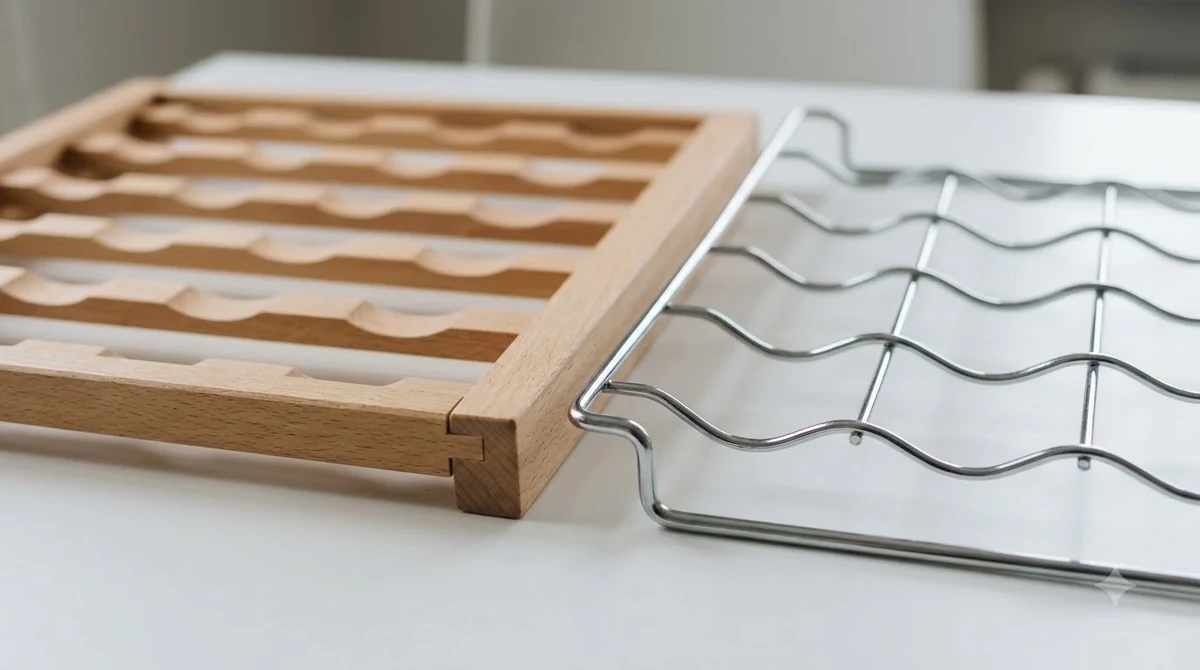
The manufacturer’s spec sheet identifies the unit as model 288 03 24 01 and lists one temperature zone, a 2.4-cubic-foot interior, compressor cooling, and a maximum of 24 Bordeaux bottles. The rack arrangement is more useful than a simple stack of identical shelves: Wine Enthusiast lists a wavy-wire rack, an upright bottle holder with wavy-wire shelving, a flat rack, and a bin. The upright section is designed to keep as many as four opened bottles standing rather than lying on their sides.
There is a useful distinction between this appliance’s set-point range and the temperature a bottle should be served at. A setting anywhere from 41°F to 64°F is available, but the cabinet has one zone, so every stored bottle shares that setting. The manual gives 115 volts and 1.2 amps as the electrical requirements and describes the cooler as freestanding only. Before planning a cabinet opening, note that the manufacturer recommends at least 2 inches of clearance on each side and 4 inches at the rear and top. The manufacturer’s model 288 03 24 01 manual is the right reference for setup and operating details.
Tip: Before ordering, mark out the 17-inch cabinet width plus at least 2 inches of clearance on both sides and 4 inches above and behind it; also confirm that the right-hinged door can swing fully open.
What Owners Like
The clearest reasons to like this cooler are its upright open-bottle space, compressor cooling, and compact footprint. One owner discussing the 24-bottle Wine Enthusiast with upright storage reported a 55°F reading within about one degree on a separate temperature sensor, while also wishing the cabinet held more bottles.
That owner comment is useful but should be treated as an individual report, not a guarantee that every unit will hold a perfectly fixed temperature in every room. Another buyer in the same discussion mentioned that some bottles were too long or wide to fit comfortably. Those observations match the manufacturer’s own warning that capacity is calculated with standard Bordeaux bottles, rather than every bottle shape sold by wineries. They also point to the central buying question: does the layout fit the bottles already in the collection?
The upright holder is a distinctive everyday convenience. A standard wine rack expects an opened bottle to lie horizontally, which is not always convenient once the cork has been removed or a sparkling-wine stopper is in place. Here, the upright area is intended to accommodate as many as four opened bottles. Crate & Barrel’s product listing also describes removable chrome-wire shelves and a bottom bin for oversized vessels, so the interior is not limited to one fixed arrangement.
Owners who want a readable control panel may also appreciate the blue LED display and electronic touch controls. The temperature can be adjusted in one-degree increments, and the panel locks automatically after five seconds of inactivity, according to the manual. The white interior LED can be switched off between uses. Those are modest conveniences rather than premium cellar features, but they make routine temperature changes and quick checks straightforward.
Common Complaints
The biggest limitation is the real-world bottle count: 24 is a maximum based on standard Bordeaux bottles, not a promise that every mixed collection will fit. The manufacturer’s manual says capacity can fall by 20% to 25% when up to half the collection uses non-standard Bordeaux-sized bottles, and by as much as 40% when most bottles are larger.
That warning matters for collectors who favor Burgundy, Pinot Noir, Champagne, or other wines in broad-shouldered or unusually long bottles. A cabinet can be nearly full before it reaches the advertised number if those bottles occupy more rack space. The upright holder also takes space that could otherwise be used for additional horizontal storage, although it adds a feature many compact fridges do not provide. A shopper with 20 bottles today and a steady stream of wide-format purchases should plan around a lower practical capacity rather than filling all 24 theoretical slots.
Placement is another constraint. This is not an undercounter or built-in unit: its vents are at the top and sides, and the manufacturer cautions against fitting it tightly into cabinetry. It is designed for an ambient room temperature of 61°F to 90°F, so an unheated garage, hot utility room, or sunlit patio is a poor location. The right-hinged door is not reversible, so check that it can open comfortably where the fridge will stand. A 17-inch-wide cabinet can be easy to fit, but its required ventilation space makes the full installation footprint larger.
Finally, compressor cooling does not mean complete silence. The manual says owners may hear refrigerant gurgling, slight vibration, thermostat clicks, and popping or crackling associated with the defrost cycle. Those sounds are described as normal operating noises, but they can be noticeable in a quiet studio or open-plan living room. If the fridge will sit beside a sofa or bed, the sound profile deserves as much attention as the exterior dimensions.
Who Should Buy and Who Should Skip
This cooler makes the most sense for someone with a small, mostly standard-bottle collection who wants one consistent storage temperature and an upright place for a few opened bottles. It is a practical fit for a household that keeps roughly a dozen to 18 bottles on hand, with some spare room for rotation, rather than a collector who expects to use all 24 positions with large-format or wide-bodied bottles.
A single-zone cabinet can be a sensible choice for storage because red, white, and sparkling wines can all be kept together at a stable cellar temperature. Wine Enthusiast’s storage guidance places general wine storage around 53°F to 57°F; a middle setting near 55°F is therefore a useful starting point for a mixed collection. Serving temperatures are different: the maker’s manual lists 45°F to 52°F for white wine and 60°F to 66°F for red wine, with sparkling wine at 40°F to 45°F. One cabinet cannot hold all three categories at their separate serving targets at the same time.
That makes the unit a stronger choice for storage than for a host who wants every bottle ready to pour immediately. A bottle of Sauvignon Blanc may need a colder finishing chill, while Cabernet Sauvignon may benefit from warming slightly after leaving the cooler. The 41°F minimum gives some flexibility for whites and sparkling wine, but the single zone forces a compromise whenever several wine styles are being served together. The same is true if you keep Prosecco ready for an aperitif: the cooler can chill the bottle, and the Hugo Spritz recipe is a natural use for a well-chilled sparkling wine, but the cabinet cannot maintain a separate red-wine setting at once.
Skip this model if you need a built-in appliance, a reversible door, or independent zones for reds and whites. It is also a weak fit for a fast-growing collection, a cellar built around Champagne bottles, or a room that regularly falls outside the stated 61°F to 90°F ambient range. Buyers who want dependable serving temperatures for several styles in one appliance should compare dual-zone designs before choosing a smaller single-zone cabinet.
How It Compares to Alternatives
The closest comparison is not simply another 24-bottle fridge: Wine Enthusiast also listed a separate 24-Bottle French Door Dual-Zone Compressor Wine Cooler, model 288 03 24 08. That design offers two independently controlled compartments and a wider, deeper cabinet, so the choice is mainly between a narrower single-zone layout with open-bottle storage and a larger dual-zone layout for serving different wine styles.
The 24-bottle single-zone model measures 30.5 inches high, 17 inches wide, and 17.75 inches deep. The French-door dual-zone model is listed at 31.4 inches high, 20 inches wide, and 19.3 inches deep, and its two sections can be set independently from 41°F to 64°F. That extra width and depth may be worthwhile for a household that regularly serves red and white wine at different temperatures, but it also requires more floor space. The dual-zone model’s divided doors let a user open one side without releasing all the cabinet’s cool air, according to its product description.
Wine Enthusiast’s product page also compares the single-zone unit with a 28-Bottle Wine Fridge with Compressor Cooler, identified by its label-view shelving. That is a potentially better direction for someone who values bottle display or wants a little more rated capacity, although the comparison listing does not provide enough detail to assume that it offers the same upright holder, dimensions, or warranty. Read the detailed specifications before treating a higher bottle count as a straightforward upgrade. For a broader look at compact and larger cabinets, compare the other wine fridge model reviews against the space and temperature features that matter most.
There is also a difference between choosing by capacity and choosing by use. If most bottles are stored for a few weeks before drinking, a simple single-zone cabinet may be all that is needed. If a collection includes both cellar bottles and wines kept at ready-to-serve temperatures, the extra control of a dual-zone cabinet is more useful than four additional Bordeaux bottle slots. The right comparison therefore starts with how many bottles are in the collection, the shapes of those bottles, and whether simultaneous service or longer-term storage is the primary job.
Frequently Asked Questions
The key questions for this 24-bottle model concern setup, loading, and routine upkeep. A few details in the manual are easy to miss but can help prevent avoidable installation and cleaning problems.
How long should the cooler stand before it is switched on?
After delivery, Wine Enthusiast says to leave the cabinet upright for approximately 24 hours before connecting it to power. Once plugged in, let it run for at least 30 minutes before making temperature adjustments. This settling period is intended to reduce the chance of a cooling-system problem after transport.
Does the display show the set temperature or the actual temperature?
The display briefly shows the selected set point while the controls are being adjusted. After about five seconds, it returns to showing the actual cellar temperature. That distinction helps explain why the number may change after the adjustment screen disappears.
How much weight can each shelf hold?
The manual gives a maximum shelf capacity of 25 pounds. It advises spreading bottles evenly rather than concentrating the load in one area, and says not to stack more than two rows of bottles per shelf. Do not pull out more than one rolling shelf at a time.
What is the recommended way to clean the interior?
Unplug the cooler before cleaning. The manual describes a mild solution made with 3 to 4 tablespoons of baking soda mixed into warm water, followed by a clean-water wipe and drying with a soft cloth. Avoid abrasive pads, ammonia, chlorine bleach, and harsh solvents.
How often should the door gasket be cleaned?
The manual recommends cleaning the door gasket every three months so it stays clean and pliable enough to seal properly. A poor seal can make the cabinet work harder and may contribute to temperature fluctuations. Inspect the gasket during routine cleaning rather than waiting for a visible cooling problem.
The Wine Enthusiast 24-bottle compressor cooler is a sensible small-collection option when its single temperature zone and Bordeaux-based capacity match the way the bottles are used. Measure the full ventilated footprint, count wider bottles honestly, and compare it with the dual-zone alternative before settling on a model.
More in Model Reviews
 Magic Chef 44 Bottle Wine Cooler Review for Flexible StorageUpdated Nov 21, 2026
 Whynter 164 Bottle Wine Cooler Review: Capacity, Features, and FitUpdated Nov 21, 2026
 Insignia NS WC16BK6 Review: Compact 16-Bottle Wine StorageUpdated Nov 21, 2026
 Wine Enthusiast Electric Blue Omega Review: Opening, Pouring, and Preserving Made EasierUpdated Nov 21, 2026
 Koolatron 20 Bottle Wine Cooler Review: Features, Fit, and PerformanceUpdated Nov 21, 2026
 NewAir AWC 330E Review for Home Wine StorageUpdated Nov 21, 2026