

We may earn a commission when you buy through links on this page, at no extra cost to you. Learn more.
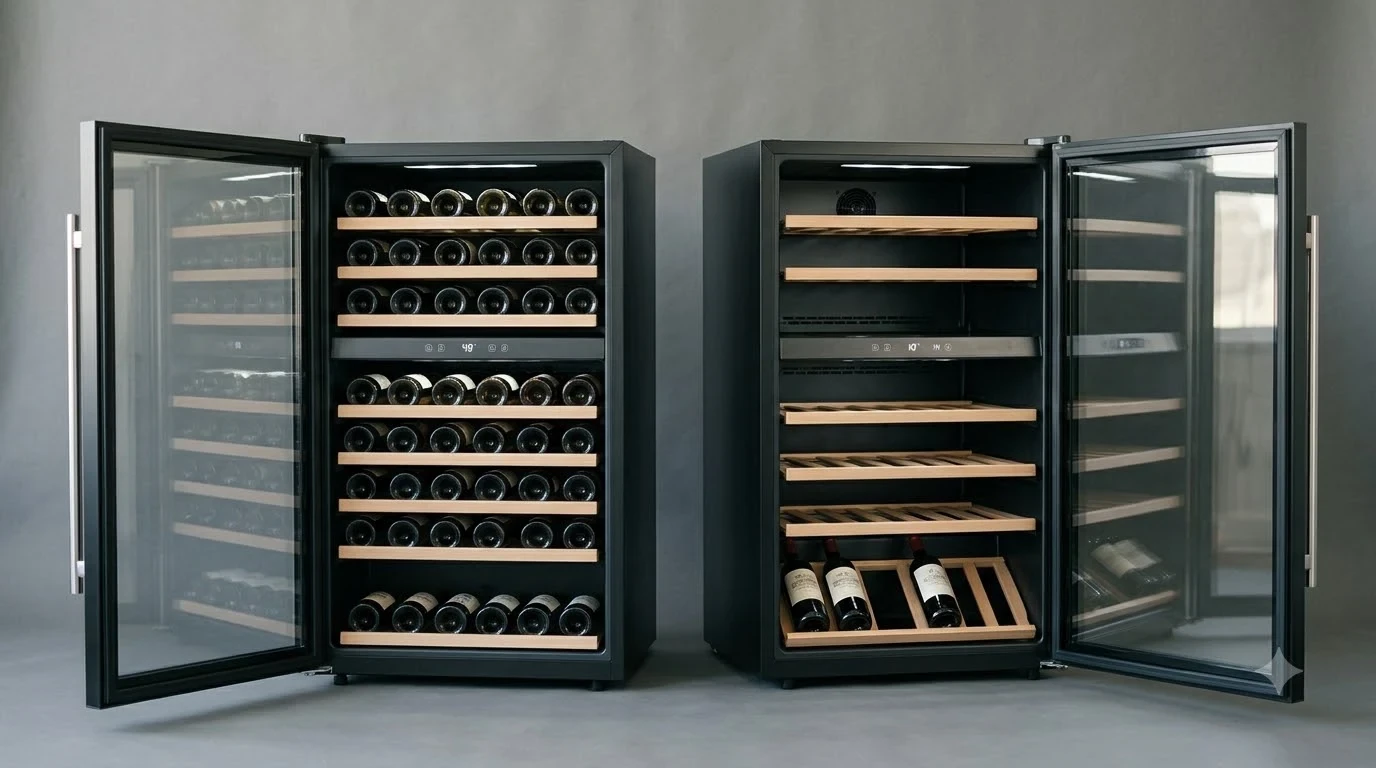
The kalamera 30 bottle wine fridge is a compact, single-zone wine refrigerator designed to store up to 30 standard wine bottles while keeping a home collection at a controlled temperature. Its appeal comes from its relatively narrow cabinet, digital temperature controls, glass door, and compressor-based cooling. However, buyers should pay attention to the exact model number because Kalamera sells multiple 30-bottle configurations with different dimensions, shelf arrangements, and installation requirements. It is a practical option for everyday wine storage, but its single-zone design and limitations with larger bottles deserve consideration before purchase.
A dedicated wine refrigerator can make a useful difference in a home bar, dining room, or kitchen. Instead of relying on a conventional refrigerator or leaving bottles exposed to changing room temperatures, a wine cooler provides a designated storage environment. The Kalamera 30-bottle range targets households that want more capacity than a small countertop cooler without committing to a full-size wine cabinet.
This review examines the KRC-30SZB and the closely related 30-bottle KMER1001 configuration, using manufacturer specifications, the operating manual, and retailer product information. Understanding which version is being considered is essential because similarly named appliances are not necessarily identical.
Specs and Key Features
The Kalamera 30-bottle wine refrigerator combines compressor cooling, electronic temperature adjustment, and a compact cabinet with a stated 30-bottle capacity. Its strongest practical feature is the ability to maintain one consistent temperature throughout the storage compartment rather than requiring a large dedicated wine cellar.
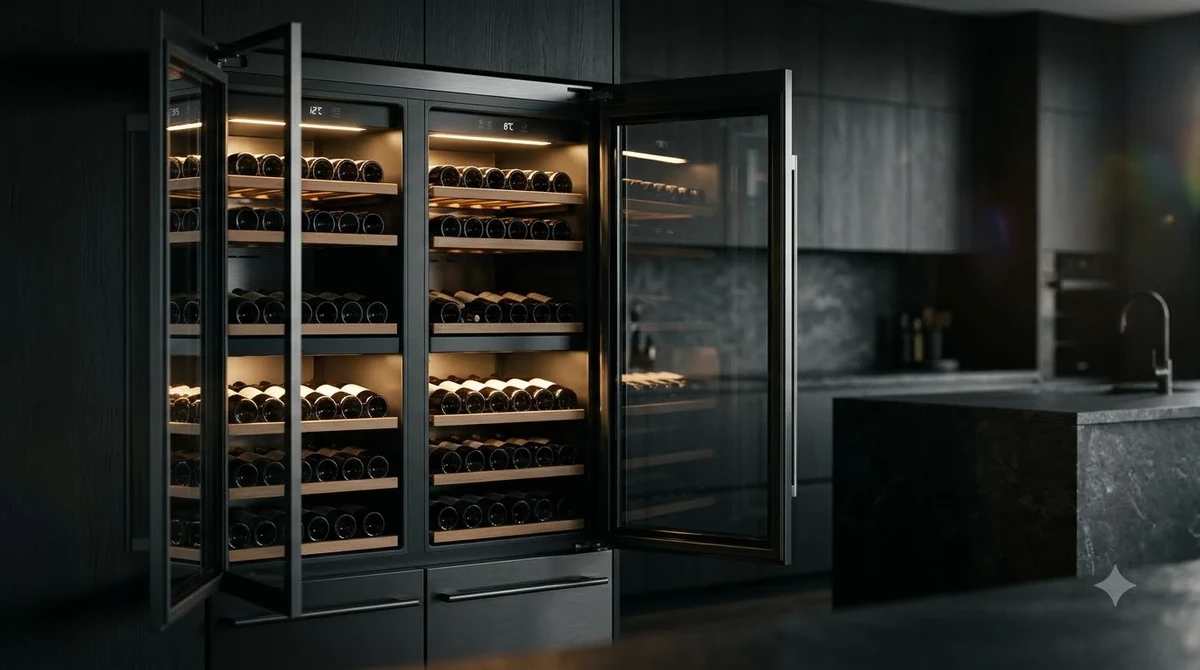
One important distinction is that the 30-bottle name covers more than one Kalamera configuration. The KRC-30SZB appears in the manufacturer’s operating manual, while the KMER1001 is identified separately in retailer listings. Another Kalamera product page advertises a 4.3-cubic-foot freestanding 30-bottle refrigerator with a different set of dimensions and specifications. These differences should not be overlooked when comparing listings.
For the KRC-30SZB, Kalamera’s manual specifies a 90-liter capacity, a single temperature-controlled compartment, and a compressor cooling system. The stated operating range is 40°F to 66°F, which offers flexibility for keeping different wines at a shared storage temperature. Its electronic controls adjust the temperature in one-degree increments, making small changes straightforward.
The KMER1001 has a similar overall footprint to the KRC-30SZB but is marketed as a built-in and freestanding refrigerator. Wayfair lists its front ventilation, six wooden shelves, reversible door, and double-pane glass construction as key features. Its temperature range is also listed as 40°F to 66°F.
| Specification | KRC-30SZB | KMER1001 listing |
|---|---|---|
| Stated bottle capacity | 30 bottles | 30 bottles |
| Interior volume | 90 liters | Not specified in the listing |
| Temperature zones | 1 | 1 |
| Temperature range | 40°F–66°F | 40°F–66°F |
| Width | 14.9 inches | 14.9 inches |
| Height | 33.9 inches | 33.9 inches |
| Depth | 22.4 inches | 24.4 inches overall |
| Electrical input | 110–120V | 110V |
| Rated power | 90W | Not specified |
| Rated current | 1.2A | 1.5A |
| Net weight | 72.8 lb. | 72.8 lb. |
| Shelf arrangement | Refer to model-specific manual | 6 wooden shelves |
| Door | Refer to model configuration | Reversible, double-pane glass |
The figures above come from the manufacturer’s KRC-30SZB manual and Wayfair’s KMER1001 listing. They should not be treated as interchangeable specifications for every Kalamera 30-bottle product. In particular, the separate freestanding model advertised on Kalamera’s store measures 19 inches wide and has a 41°F to 61°F temperature range, making model identification especially important.
The electronic controls are another useful feature. On the KRC-30SZB, pressing the up or down buttons changes the temperature by one degree. A separate light button operates the interior LED illumination, while the C/F button changes the displayed temperature scale.
These controls make the appliance relatively straightforward to operate without complicated programming. The LED lighting also provides visibility when selecting a bottle, although lighting is primarily a convenience feature rather than a substitute for good storage practices.
For further technical details, buyers can consult the Kalamera wine cooler instruction manual, which covers the KRC-30SZB alongside several other compressor refrigerator models.
Overall, the specifications make the Kalamera a reasonable candidate for a household collection that needs one shared storage temperature. Buyers looking for separate red and white wine compartments should consider a dual-zone alternative instead.
What Owners Like
Owner feedback for the KMER1001 emphasizes its appearance, compact dimensions, and relatively quiet operation. These qualities help explain its appeal as an appliance that can sit in a kitchen or entertainment area without looking like a commercial refrigeration unit.
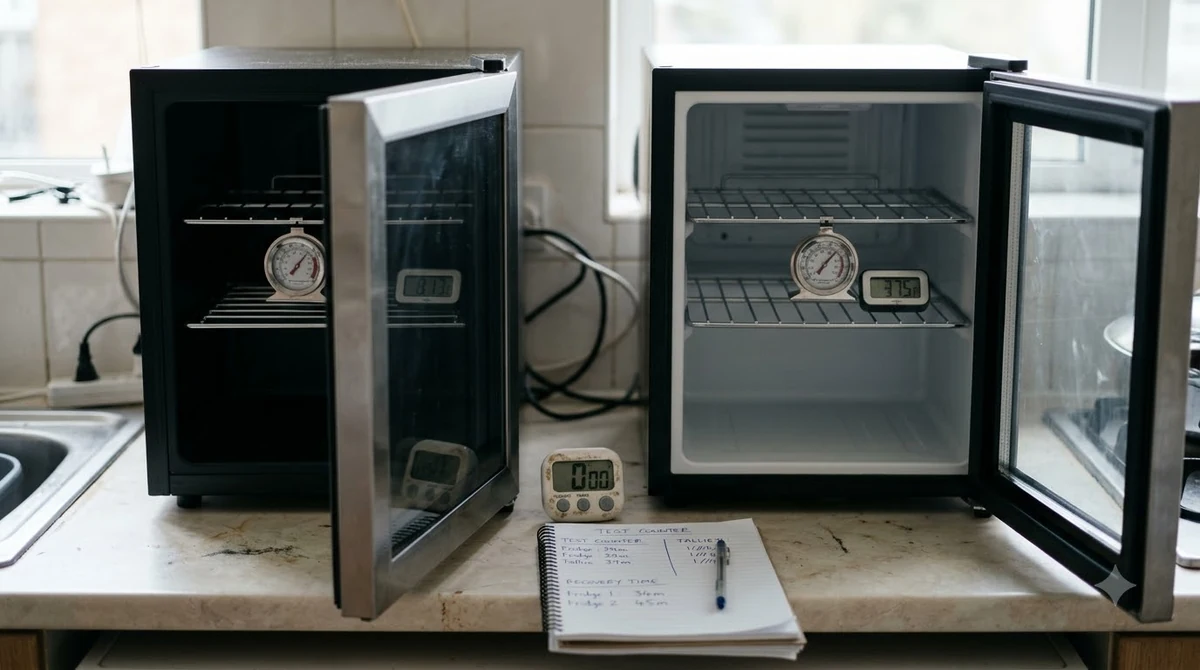
Wayfair’s customer-review summary identifies attractive styling and quiet operation as recurring positive themes. Customers also appreciate the compact footprint and the appliance’s ability to keep beverages at their selected temperature. These are useful observations for buyers who want a wine cooler that blends into an existing room rather than becoming its main feature.
The glass door is particularly relevant to the presentation of a collection. Being able to see stored bottles without opening the refrigerator makes selection easier and reduces the need to open the door repeatedly. The stainless-steel and black finish also suits many contemporary kitchen and home-bar arrangements.
The KMER1001 listing identifies a double-pane glass door, an interior light, and six wooden shelves. Wooden shelving gives the interior a more traditional wine-storage appearance than basic exposed metal racks. It also creates a visually consistent presentation when bottles are arranged by producer, grape variety, or occasion.
Another positive is the single-zone temperature arrangement. Although it limits simultaneous temperature customization, it makes daily management relatively simple. Owners do not need to decide which compartment should hold a particular bottle or balance different temperature settings between two sections.
For a collection centered on Cabernet Sauvignon, Merlot, Chardonnay, Sauvignon Blanc, and similar everyday wines, a single-zone appliance can be a sensible choice. Setting a suitable shared storage temperature and allowing individual bottles to reach their preferred serving temperature before opening is often more practical than attempting to serve every bottle directly from storage.
The cabinet dimensions are another advantage. A width of approximately 15 inches is considerably easier to accommodate than many wider wine cabinets. This can be particularly useful in a kitchen where a narrow opening is available beside existing cabinetry.
The reversible-door feature listed for the KMER1001 also offers some installation flexibility. A left-opening or right-opening arrangement can make a noticeable difference in a narrow kitchen aisle, especially when the cooler sits beside a wall or cabinet panel.
However, a reversible door does not mean installation is automatically simple. The appliance must be leveled, the hinge arrangement must be handled carefully, and the opening needs enough room for the door to swing without striking nearby furniture.
Buyers who value appearance and convenient everyday access may find these characteristics more important than advanced temperature programming. The Kalamera’s feature set is relatively straightforward, which is an advantage for households that want a dedicated wine cabinet without a complicated control system.
Common Complaints
The main concerns surrounding the Kalamera 30-bottle refrigerator involve its advertised capacity, shelf movement, and the practical limitations of a single-zone cabinet. These issues are important because a refrigerator can have good published specifications yet still prove inconvenient for a particular wine collection.
Wayfair’s customer-review summary specifically identifies bottle capacity as a potential disappointment. The advertised 30-bottle figure should be understood as a maximum based on standard Bordeaux-style bottles, not a guarantee that every combination of wine bottles will fit simultaneously.
Wine bottles are not uniform. A standard Bordeaux bottle has relatively straight sides and a predictable diameter, while many Burgundy bottles have broader shoulders and a different profile. Champagne bottles can be wider still, and some premium sparkling wines use particularly substantial glass.
These variations matter when bottles are stored on closely spaced shelves. A cooler that accommodates 30 conventional bottles may hold fewer when a collection includes wide Burgundy bottles, sparkling wine, or large-format bottles.
The six wooden shelves listed for the KMER1001 provide separate storage levels, but the actual usable capacity depends on bottle shape and shelf spacing. Buyers should avoid assuming that every shelf can accommodate every bottle style in the same arrangement.
Wayfair also identifies shelf movement as a concern in some customer feedback. Shelves that do not slide smoothly can make it harder to retrieve bottles from the rear of the cabinet. This is particularly relevant when the refrigerator is filled close to its advertised capacity.
Another limitation is the single-zone design. A single compartment cannot independently maintain one temperature for red wine and another for white wine. Someone who wants both categories ready to serve directly from the refrigerator may prefer a dual-zone cabinet.
The temperature range also deserves attention. The KRC-30SZB and KMER1001 are listed at 40°F to 66°F, while the separate freestanding Kalamera 30-bottle product is advertised at 41°F to 61°F. This difference reinforces why buyers should verify the model number rather than relying on a generic product title.
Noise is another consideration, even though Wayfair’s review summary identifies quiet operation as a positive. Compressor refrigerators make operational sounds, and the perceived volume depends on the room, floor surface, surrounding cabinets, and how level the appliance is.
A cooler positioned directly beside a dining table or in a quiet bedroom may be more noticeable than one installed in a kitchen with other appliances running. Buyers particularly sensitive to sound should consider the placement carefully.
Warranty coverage is another issue to investigate before ordering. Wayfair lists a one-year product warranty for the KMER1001 and does not list a labor warranty. This is a useful distinction because coverage for replacement parts does not necessarily mean that professional service or installation labor will be included.
Rather than assuming that every Kalamera 30-bottle listing has identical after-sales coverage, buyers should retain their purchase documents and confirm the applicable warranty terms for the exact product. The retailer’s return window and the manufacturer’s warranty are separate considerations.
Who Should Buy and Who Should Skip
The Kalamera 30-bottle refrigerator is most suitable for buyers who need a relatively narrow wine-storage appliance and are comfortable maintaining one temperature throughout the cabinet. It is less suitable for collections requiring separate serving temperatures or extensive storage for unusual bottle shapes.
Who should consider buying it
Homeowners with a growing collection of approximately 15 to 25 everyday bottles may find the stated 30-bottle capacity useful. Leaving some space available makes it easier to organize the collection and retrieve bottles without constantly rearranging shelves.
People who regularly purchase wines such as Pinot Noir, Cabernet Sauvignon, Chardonnay, and Riesling can also make good use of a single-zone cooler. These wines do not all need identical serving temperatures, but they can be stored together at a consistent, moderate temperature before being chilled or allowed to warm before service.
For example, a household that keeps everyday Sauvignon Blanc alongside bottles of Merlot and Pinot Noir may prefer to store everything in one place and adjust individual bottles before dinner.
The appliance can also suit a small home bar where a dedicated refrigerator is preferable to mixing wine with food and other household items. A glass-fronted cabinet makes it easier to keep track of the collection, while interior lighting helps identify bottles in a dimly lit room.
Buyers considering the KMER1001 for an under-counter position may also appreciate its listed front ventilation. That feature is important because a built-in appliance needs an appropriate airflow arrangement to release heat during operation.
Who should skip it
Collectors who regularly store large quantities of Champagne, wide Burgundy bottles, or large-format wines should be cautious. The advertised capacity is based on standard bottle dimensions, so an assortment of oversized bottles can reduce practical storage space.
Buyers who want separate red and white wine compartments should also look elsewhere. A single-zone refrigerator cannot independently maintain different temperatures in separate sections.
For instance, someone who wants white wine at approximately 48°F while keeping red wine closer to 60°F will need a dual-zone model or two separate storage appliances.
Long-term collectors with valuable bottles intended for extended aging should consider their broader storage requirements as well. Temperature consistency, vibration, light exposure, and the surrounding environment all matter. A compact home wine cooler is not automatically equivalent to a dedicated long-term wine cellar.
Finally, buyers with a particularly tight installation opening should avoid ordering before measuring the complete appliance. A cabinet that appears wide enough on paper may still lack sufficient clearance for the door, ventilation, electrical connection, or handle.
Tip: Before ordering, measure the opening’s width, height, and depth at several points. For the KMER1001, account for its listed 14.9-inch width, 33.9-inch height, and 24.4-inch overall depth, plus the retailer’s specified ventilation clearances and room for the door to open.
Wine storage habits should also influence the purchase decision. A person who primarily serves chilled whites and sparkling wines may benefit from a different temperature arrangement than someone who collects full-bodied reds.
For entertaining, the refrigerator can be a useful companion to a home cocktail setup. It can hold wine for occasions that also include an Aperol spritz recipe or a lighter sparkling drink. However, the appliance should be selected primarily for the bottle collection rather than assumed to be a general-purpose beverage refrigerator.
How It Compares to Alternatives
The Kalamera 30-bottle refrigerator occupies the middle ground between small wine coolers and larger wine cabinets. Its main distinction is its relatively narrow cabinet and single-zone arrangement, which prioritize everyday storage over specialized temperature management.
The manufacturer’s own range provides useful context. Kalamera’s operating manual identifies the 18-bottle KRC-18SZB, 30-bottle KRC-30SZB, 46-bottle KRC-46DZB, 54-bottle KRC-54SZB, and 157-bottle KRC-157DZB. These models illustrate how the company approaches different storage capacities and configurations.
The KRC-18SZB is the smaller option for households that keep a limited selection of wine. Its manual specifies a 70-liter capacity and a 40°F to 66°F temperature range. Someone who typically has fewer than a dozen bottles at home may not need a refrigerator intended for 30.
The KRC-46DZB offers a different approach because it is a dual-zone refrigerator. The manual specifies an upper compartment operating from 40°F to 50°F and a lower compartment operating from 50°F to 66°F. This arrangement makes it more appropriate for households that want to separate wines by temperature preference.
The KRC-54SZB offers a larger stated capacity while retaining a single-zone design. Its manual specifies a 40°F to 66°F operating range and a 150-liter capacity. It may suit a growing collection that needs more room without necessarily requiring separate temperature compartments.
At the other end of the range, the KRC-157DZB provides substantially more storage and two temperature zones. Its listed capacity is 450 liters, making it a different proposition from a compact kitchen refrigerator.
The important point is that a larger bottle count does not automatically mean a better purchase. Buyers should consider whether the extra space will be used, whether separate temperature zones are necessary, and whether the larger appliance can be accommodated comfortably.
| Model | Stated capacity | Zones | Temperature range |
|---|---|---|---|
| KRC-18SZB | 18 bottles | 1 | 40°F–66°F |
| KRC-30SZB | 30 bottles | 1 | 40°F–66°F |
| KRC-46DZB | 46 bottles | 2 | 40°F–50°F upper; 50°F–66°F lower |
| KRC-54SZB | 54 bottles | 1 | 40°F–66°F |
| KRC-157DZB | 157 bottles | 2 | 40°F–50°F upper; 50°F–66°F lower |
All five configurations are identified in Kalamera’s manufacturer manual. The comparison shows that the KRC-30SZB is intended for moderate home collections rather than extensive wine inventories.
Another comparison worth making is between the KRC-30SZB and the separately advertised 4.3-cubic-foot freestanding 30-bottle model. The latter has five sliding metal shelves, a 41°F to 61°F temperature range, and a listed width of 19 inches. Those differences can affect both placement and bottle organization.
In contrast, the KMER1001 listing describes a narrower 14.9-inch cabinet with six wooden shelves and front ventilation. This makes it particularly relevant to buyers considering an under-counter installation.
These distinctions matter more than a small difference in advertised capacity. A buyer with a 15-inch opening should not automatically select a 19-inch-wide freestanding model simply because the bottle count is identical.
For readers comparing additional appliances, the wine and beverage appliance reviews section can provide a broader starting point for evaluating storage capacity, installation, and features.
Overall, the KRC-30SZB makes the most sense for someone who wants a modest collection in one temperature-controlled compartment. The larger Kalamera models become more attractive when bottle counts grow, while the dual-zone alternatives are preferable for more specialized serving requirements.
Frequently Asked Questions
Does the Kalamera 30-bottle wine fridge have a memory function after a power outage?
The available KRC-30SZB manual describes the control panel and temperature adjustment but does not establish a universal battery-backed memory feature for every 30-bottle configuration. Buyers should confirm the restart behavior with the exact model documentation. It is sensible to monitor the cabinet after a power interruption rather than assume that every previous setting has been retained.
Can the Kalamera 30-bottle refrigerator be used in a garage?
Installation in a garage depends on the room’s ambient temperature and the refrigerator’s specified climate operating limits. The KRC-30SZB manual identifies climate classifications T, ST, N, and SN, but the actual suitability of an unheated or extremely hot garage requires checking the model’s operating conditions. A sheltered indoor location with stable surrounding temperatures is generally easier to manage.
Does the Kalamera 30-bottle cooler have an automatic defrost system?
Defrost arrangements are not identical across the different 30-bottle listings. Kalamera’s separate 4.3-cubic-foot freestanding model specifically identifies manual defrost, so buyers should not assume that every similarly named refrigerator is frost-free. The exact product manual provides the relevant maintenance instructions.
Can the wine cooler be transported while lying on its side?
Kalamera’s KRC-30SZB manual recommends allowing the appliance to stand upright for approximately two hours before connecting it to electricity. This instruction is intended to reduce the possibility of cooling-system problems following transportation. Keeping the refrigerator upright during delivery is the more straightforward approach whenever possible.
Does the Kalamera 30-bottle refrigerator include a child-resistant lock?
Wayfair identifies a safety lock on the KMER1001 configuration, while the manufacturer’s manual also lists keys among the spare parts for the KRC-30SZB family. Buyers should distinguish a physical door lock from electronic control-panel protection. These are separate functions and should not be assumed to be interchangeable.
The Kalamera 30-bottle wine refrigerator is a sensible candidate for households seeking compact, single-zone storage, especially when the correct configuration fits an existing kitchen or home-bar opening. Its strongest advantages are its straightforward temperature controls, glass-front presentation, and practical capacity for a moderate collection. Before ordering, verify the model number, ventilation requirements, usable bottle space, and warranty terms so the refrigerator matches the collection and installation location.
More in Model Reviews
 Magic Chef 44 Bottle Wine Cooler Review for Flexible StorageUpdated Nov 21, 2026
 Whynter 164 Bottle Wine Cooler Review: Capacity, Features, and FitUpdated Nov 21, 2026
 Insignia NS WC16BK6 Review: Compact 16-Bottle Wine StorageUpdated Nov 21, 2026
 Wine Enthusiast Electric Blue Omega Review: Opening, Pouring, and Preserving Made EasierUpdated Nov 21, 2026
 Koolatron 20 Bottle Wine Cooler Review: Features, Fit, and PerformanceUpdated Nov 21, 2026
 NewAir AWC 330E Review for Home Wine StorageUpdated Nov 21, 2026