

We may earn a commission when you buy through links on this page, at no extra cost to you. Learn more.
The haier 24 bottle wine fridge is a compact, compressor-cooled wine refrigerator designed to store up to 24 bottles with adjustable electronic temperature control. The Haier HVFE024BBB offers five storage racks, a tinted double-pane glass door, an LED temperature display, and a 43°F to 65°F adjustment range. Its straightforward design makes it interesting for casual wine drinkers, although its single temperature zone, discontinued retail status, and limited capacity make it less suitable for serious collectors.
Haier’s 24-bottle wine refrigerator belongs to an older generation of compact wine storage appliances. Its appeal comes from practical features rather than advanced cellar technology: a compressor cooling system, a relatively small footprint, chrome shelving, and controls intended to make storing red and white wines straightforward. The important distinction for prospective buyers is the exact model number. Haier produced several 24-bottle wine cellars with similar appearances but different controls and specifications, so the HVFE024BBB should not automatically be confused with the HVF024BBG or HVFM24BBB.
Specs and Key Features of the Haier HVFE024BBB
The HVFE024BBB is a freestanding, single-zone wine cooler with room for approximately 24 standard bottles. Its combination of compressor cooling, electronic controls, and five racks provides a practical arrangement for keeping a modest wine collection together.
According to the product specifications published by Best Buy, the refrigerator has a 2.8-cubic-foot-class compact design, a digital LED temperature display, and an adjustable operating range from 43°F to 65°F. The compressor cooling system is an important distinction because it separates this model from small wine cabinets that use thermoelectric cooling. Compressor systems are generally better suited to cooling wine in warmer surroundings, although actual performance still depends on ambient temperature, ventilation, door openings, and the condition of the appliance.
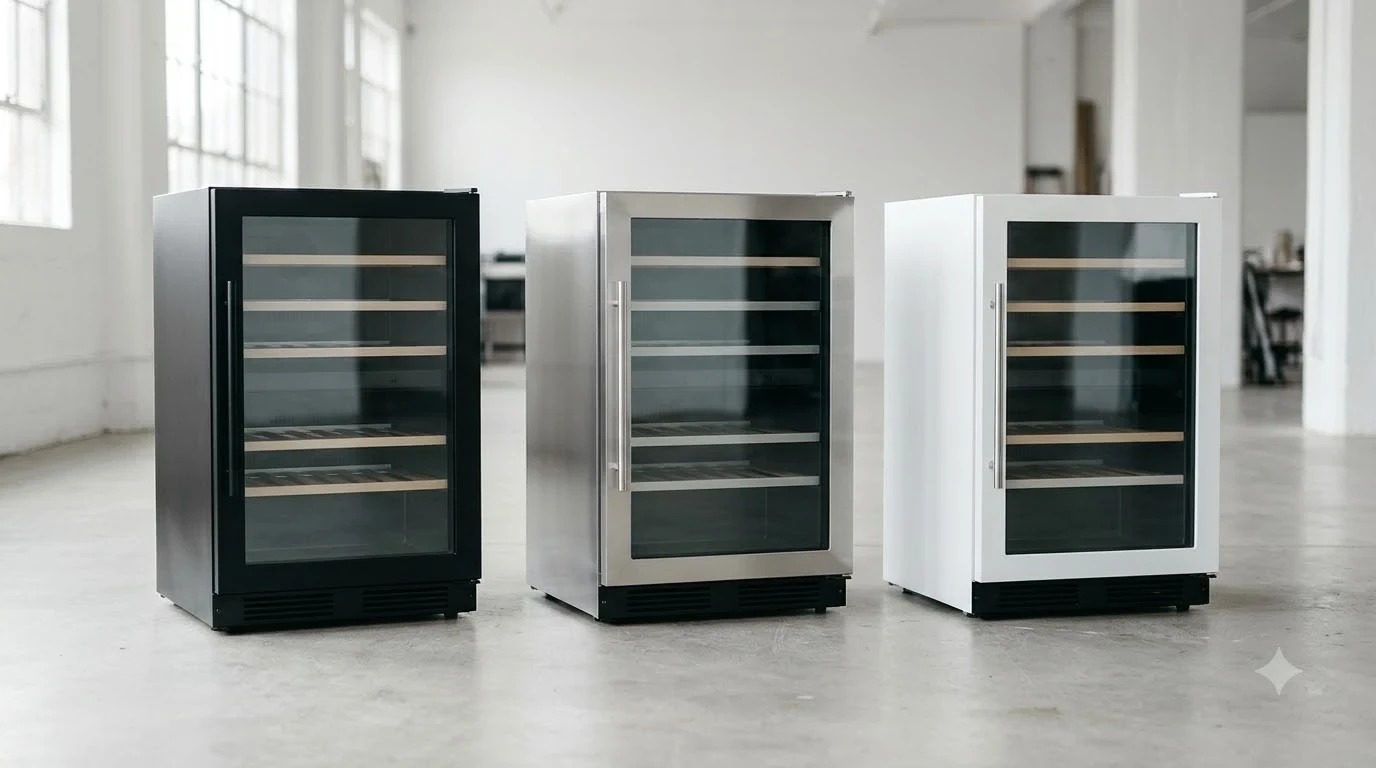
The exterior uses a black finish, a double-pane tinted glass door, and a recessed handle. The tinted glass gives the cabinet a more traditional wine-cellar appearance than a plain refrigerator door. The double-pane construction also provides an insulated barrier between the interior and surrounding room. Soft interior lighting makes it easier to identify bottles without having to remove shelves or turn on additional room lighting.
Five storage racks divide the interior into three full-depth positions and two half-depth positions. This arrangement provides flexibility, but it does not mean every bottle shape will fit equally well. Standard Bordeaux-style bottles are the easiest reference point for the advertised capacity. Wider Burgundy bottles, sparkling wine bottles, and unusually shaped containers can reduce the number that fit comfortably.
| Specification | Haier HVFE024BBB |
|---|---|
| Advertised capacity | 24 bottles |
| Cooling system | Compressor |
| Temperature zones | 1 |
| Temperature range | 43°F–65°F |
| Temperature controls | Electronic |
| Display | Digital LED |
| Storage racks | 5 |
| Door | Double-pane tinted glass |
| Height | 30 inches |
| Width | 19.9 inches |
| Depth | 23.4 inches |
| Approximate weight | 75 pounds |
| Electrical supply | 110V AC |
| Installation | Freestanding |
| Listed limited warranty | 1 year |
These figures come from the Best Buy listing for the HVFE024BBB rather than specifications for every Haier refrigerator advertised as a 24-bottle model. Genier’s Appliances also lists the same model, but its product page contains some conflicting catalog information about temperature zones. Best Buy explicitly identifies one compartment and one temperature zone, which is the more useful specification for understanding how the appliance operates. The single-zone configuration should guide purchasing decisions.
Another distinction concerns measurements. Best Buy lists a depth of 23.4 inches, while Genier’s lists 22.25 inches without the handle. Such differences can reflect measurement conventions, but buyers should allow additional room rather than planning an installation around the smallest published measurement. The model is freestanding, not a purpose-built built-in refrigerator.
For a closer look at the published product description and specifications, see the Best Buy Haier HVFE024BBB listing. It also identifies the important availability limitation: the refrigerator is no longer available in new condition through that retailer.
What Owners Like About the Design and Storage
The strongest selling points of the Haier 24-bottle refrigerator are its modest capacity, straightforward controls, and conventional wine-cellar appearance. For a household that keeps a rotating selection of everyday wines, these features can be more useful than sophisticated features intended for a much larger collection.
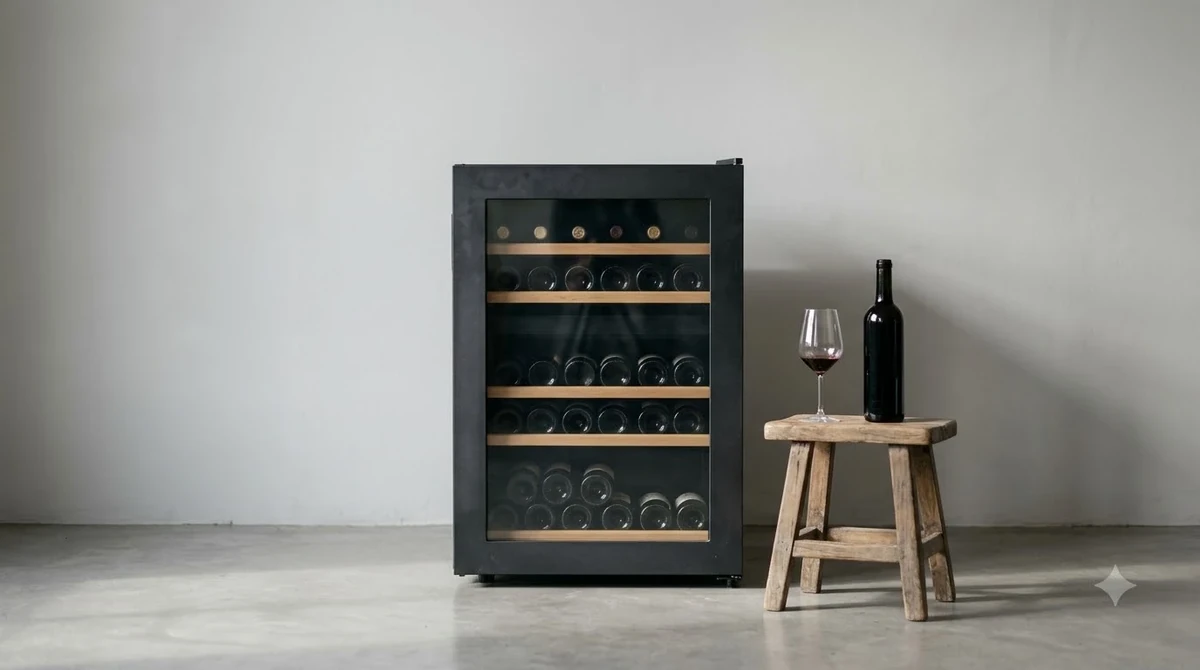
The 24-bottle capacity provides a reasonable starting point for someone who wants more organized storage than a kitchen refrigerator can provide. A collection might include several Cabernet Sauvignon and Merlot bottles, a few Pinot Noir selections, Sauvignon Blanc, Chardonnay, and sparkling wine. Keeping these bottles together makes it easier to organize drinking occasions and maintain a consistent storage environment.
The five-rack arrangement is another practical advantage. Three full-depth chrome racks provide the main bottle-storage positions, while two half-depth racks accommodate a more flexible arrangement. A shorter rack section can help organize bottles that do not need the same depth as conventional bottles. The arrangement also makes it easier to keep different wine styles separated without introducing complicated storage systems.
Electronic controls and an LED display are useful everyday conveniences. Instead of relying entirely on a mechanical dial with broad temperature markings, the owner can work with a displayed temperature setting. The automatic red and white wine settings also make basic operation less intimidating for someone who has never owned a wine refrigerator.
The compressor design is attractive for another reason. Wine storage appliances need to remove heat from an enclosed cabinet, and compressor cooling is a familiar refrigeration approach. The HVFE024BBB is therefore more recognizable in operation than some specialized thermoelectric wine cabinets. That does not establish a particular noise level or guarantee perfectly stable temperatures, but it provides a conventional cooling foundation.
The tinted glass door is an appealing visual feature. It allows the refrigerator to display a collection while giving the interior some protection from direct room light. Its black exterior and recessed handle are also relatively easy to coordinate with other kitchen or entertainment-room appliances.
There is an important qualification to the discussion of owner satisfaction. The Best Buy listing does not provide a substantial body of customer reviews for the HVFE024BBB, and Newegg’s related HVF024BBG listing also reports no customer reviews. Consequently, claims about long-term reliability, noise, and everyday satisfaction should not be presented as established owner consensus.
For buyers who want a broader collection of appliance reviews before deciding, the wine storage and appliance model reviews section offers a useful starting point for comparing different types of equipment and their intended uses.
Common Complaints and Important Limitations
The main disadvantages of this Haier wine cooler are its single temperature zone, limited advertised capacity, uncertain used-market condition, and lack of extensive model-specific owner feedback. These limitations matter more to a collector than the refrigerator’s basic appearance or simple controls.
The single-zone arrangement is the first major compromise. A single temperature setting applies to the storage compartment rather than allowing separate red and white wine temperatures. Someone who wants to keep Chardonnay ready for immediate serving while storing Cabernet Sauvignon at a different temperature cannot achieve that separation through independent zones.
It is possible to store both red and white wines in one cabinet. However, the owner needs to choose a compromise storage temperature and adjust serving temperatures separately when necessary. For example, a light-bodied Pinot Noir is generally served around 55°F to 60°F, while a full-bodied Cabernet Sauvignon is commonly served around 60°F to 65°F. Sauvignon Blanc generally benefits from a colder serving temperature of approximately 45°F to 50°F.
The second limitation is the 24-bottle capacity. The advertised figure is most useful as a planning estimate rather than an unconditional guarantee. Wine bottles are not standardized in width, shoulder shape, or overall length. A collection containing many Champagne, sparkling wine, or broad Burgundy bottles may not fit as neatly as a collection consisting mainly of standard Bordeaux bottles.
Temperature performance is another point requiring careful consideration. The advertised adjustment range does not establish how accurately the refrigerator holds every selected setting. A displayed number is not the same as independently verified temperature stability throughout the cabinet. Older appliances may also develop cooling problems as compressors, thermostats, door seals, or other components deteriorate.
There is some historical owner commentary about another Haier 24-bottle wine cellar, the HVDO24E. A published account describes a door-adjustment problem, fluctuating temperatures, and difficulty arranging 24 bottles. That account is not a review of the HVFE024BBB, so those observations should not be treated as confirmed defects in this particular model. They do, however, illustrate why inspecting an older wine refrigerator in operation is more useful than relying on its original capacity claim.
Availability is a practical drawback as well. Best Buy identifies the HVFE024BBB as no longer available in new condition. This means a prospective buyer may encounter used appliances, old inventory, or listings that use a similar model name without offering the exact same specifications.
Tip: Before buying a used Haier wine cooler, run it for several hours with a reliable independent thermometer inside. Check that the temperature moves toward the selected setting, that the door closes evenly, and that the compressor cycles normally. A working LED display alone does not prove that the refrigerator is cooling correctly.
Finally, the available product information does not provide enough independent evidence to recommend this model for demanding wine-aging conditions. Collectors planning to store expensive bottles for many years should prioritize verified temperature stability, dependable service support, appropriate humidity management, and protection against temperature fluctuations.
Who Should Buy the Haier 24-Bottle Wine Fridge and Who Should Skip It
The Haier HVFE024BBB makes the most sense for someone who wants a separate place for a small collection of bottles and is comfortable with a single-zone design. It is less attractive for buyers who need modern features, extensive service documentation, or precise separate storage conditions.
Who should consider it
A casual wine drinker with approximately 12 to 24 standard bottles is the most natural potential owner. The refrigerator provides dedicated storage without taking up the space required by a full-size wine cabinet. Someone who regularly buys a few bottles of wine for dinners, weekends, and occasional entertaining may appreciate the ability to keep a modest selection organized.
It can also suit a household that primarily stores one wine style at a time. Someone who mainly collects reds, for example, can select a suitable storage temperature and use the refrigerator for everyday bottles rather than maintaining separate temperature zones.
Another potential buyer is someone furnishing a small entertaining area. The black finish, tinted glass door, and interior lighting make the cabinet visually appropriate for a home bar or dining-room corner. Its approximately 30-inch height and 19.9-inch width are relatively manageable compared with larger wine cabinets, provided there is sufficient depth and ventilation space.
Who should skip it
Collectors with more than 24 bottles should consider a larger cabinet from the beginning. Buying a refrigerator that is already close to full leaves little room for new purchases, larger bottles, or bottles that need to remain undisturbed for extended periods.
Buyers who regularly drink both reds and whites at different temperatures should look for a dual-zone appliance. The HVFE024BBB has one temperature zone, so its convenience should not be confused with the flexibility of a two-zone refrigerator.
Serious collectors should also consider whether a compact older refrigerator provides enough control for their intended storage period. A single-zone cabinet without independently verified temperature stability is not an obvious choice for valuable bottles that need consistent conditions over several years.
Finally, anyone uncomfortable with purchasing used appliances should be cautious. A discontinued model can be inexpensive to acquire in some circumstances, but an aging compressor or unavailable replacement component can quickly make an apparently attractive purchase impractical.
How It Compares to Alternatives and Wine Storage Needs
The Haier 24-bottle wine cooler occupies a basic position in the compact wine-storage category. Its most useful comparison is not with a particular competing model but with the broader choices available to someone deciding between a single-zone cabinet, a dual-zone cabinet, and ordinary household refrigeration.
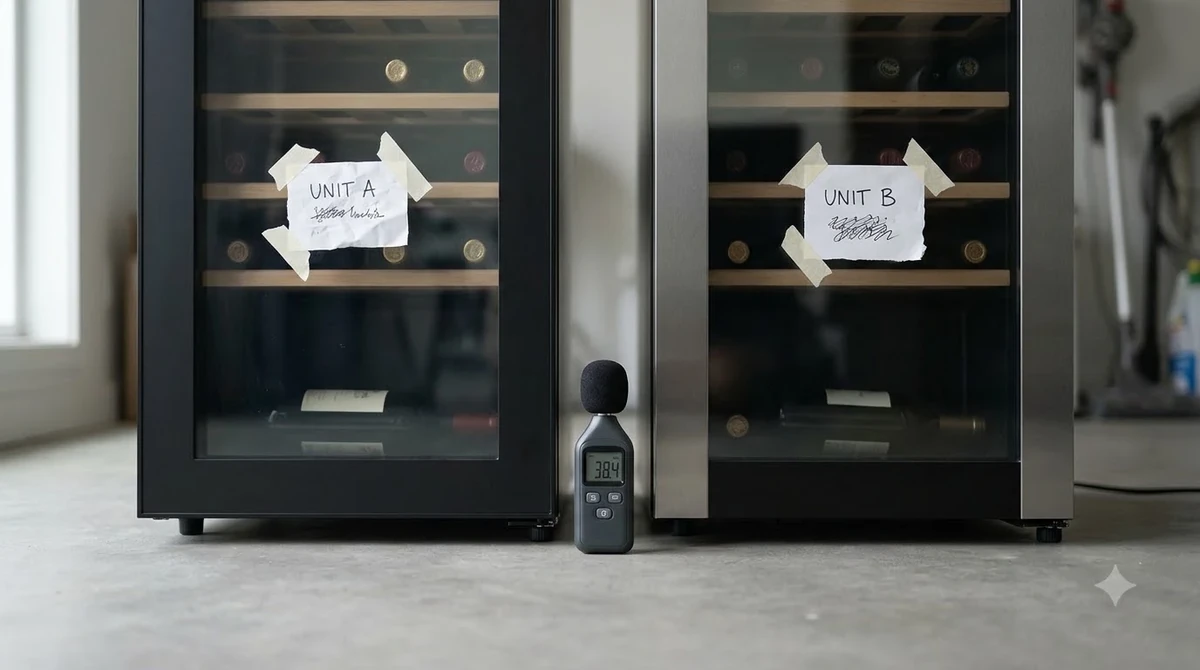
A single-zone wine refrigerator is generally the simpler option. It offers one consistent storage environment and usually has fewer temperature controls to manage. The HVFE024BBB follows this approach with its electronic thermostat and 43°F to 65°F adjustment range. Its design works best when the owner is happy to store different wines together and chill individual bottles to their serving temperatures before opening.
A dual-zone wine refrigerator provides more flexibility. Separate compartments or independently controlled sections allow the owner to maintain different temperatures for different wine styles. This is particularly useful for a household that keeps Champagne, Sauvignon Blanc, Chardonnay, Pinot Noir, and Cabernet Sauvignon available at the same time. The trade-off is that dual-zone appliances may have more complicated controls and less usable capacity in a similar exterior footprint.
Standard kitchen refrigerators offer another comparison. They can cool bottles for short periods, but their colder operating temperatures are not automatically suitable for keeping every wine style in long-term storage. They also share space with food, experience frequent door openings, and are not necessarily designed around bottle organization.
The HVFE024BBB’s advertised range gives it more flexibility than a basic food refrigerator for dedicated wine storage. However, its single-zone configuration means it cannot replace the separate serving-temperature arrangements that a more sophisticated wine cabinet provides.
Other Haier 24-bottle models should also be distinguished carefully. Newegg documents the HVF024BBG, which has three full-depth racks, two half-depth racks, an electronic thermostat, and a 45°F to 65°F listed temperature range. AJ Madison documents the HVFM24BBB, a different single-zone design with dial controls and dimensions of approximately 19 15/16 inches wide, 21 11/16 inches deep, and 30 17/32 inches high.
These model differences matter because a similar name does not guarantee identical controls, dimensions, or temperature settings. The AJ Madison product specifications are a useful example of why buyers should identify the complete model number before ordering parts or comparing used listings.
Food and wine pairing is another consideration when planning what to store. A cabinet that mainly holds reds might contain Cabernet Sauvignon for steak dinners, Merlot for roast chicken, and Pinot Noir for lighter dishes. White wine drinkers might prefer Chardonnay for creamy dishes and Sauvignon Blanc for salads or seafood. Someone who enjoys a simple aperitif can also keep sparkling wine available for an Aperol Spritz recipe occasion, although the refrigerator’s single storage setting is not necessarily the ideal final serving temperature for every bottle.
In practical terms, the Haier’s greatest strength is its simplicity. It does not attempt to offer a sophisticated wine-management system, but it provides a dedicated place for a modest collection. Whether that is enough depends on the number of bottles, the mix of wine styles, and the buyer’s expectations for temperature control.
Frequently Asked Questions
Can the Haier HVFE024BBB be used in a garage?
Genier’s Appliances lists an ambient operating range of approximately 60.8°F to 89.6°F for this model. A garage that regularly falls below or rises above that range may cause unsuitable operating conditions. A temperature-controlled indoor location is a safer choice than an unconditioned garage.
Does the Haier 24-bottle refrigerator protect wine from ultraviolet light?
The HVFE024BBB has a double-pane tinted glass door, but the available specifications do not establish a quantified ultraviolet-blocking rating. Tinted glass should not be treated as equivalent to a fully opaque wine-storage door. Avoid placing the refrigerator in direct sunlight or beside a window that receives strong afternoon exposure.
Can the refrigerator store opened bottles?
Yes, provided the bottles are properly resealed and stored upright when appropriate. However, the refrigerator is not a vacuum-preservation system and does not prevent oxidation. Most opened still wines are best consumed within approximately three to five days when refrigerated, depending on the wine and how well it is sealed.
Is the Haier HVFE024BBB suitable for Champagne bottles?
Some Champagne bottles are wider and heavier than standard Bordeaux bottles, so the advertised 24-bottle capacity may not apply to a collection dominated by sparkling wine. Measure the available rack spacing and interior depth before loading larger bottles. Avoid forcing a bottle into a rack position that does not support it securely.
What should be checked after moving a used Haier wine refrigerator?
Check the appliance’s transport instructions and allow the compressor system to settle before reconnecting power if the refrigerator was tilted or laid down. The required waiting period depends on how the unit was transported and the manufacturer’s instructions. Also inspect the power cord, door gasket, leveling feet, and cooling performance before loading the cabinet with wine.
The Haier HVFE024BBB remains an interesting compact wine-storage option for someone who values straightforward operation, five racks, and dedicated space for a modest collection. Its single temperature zone and discontinued retail availability are significant limitations, particularly for buyers seeking dependable long-term storage. Before purchasing one, verify the exact model number, inspect its cooling performance, and compare its condition with the advantages of a newer single-zone or dual-zone wine refrigerator.
More in Model Reviews
 Magic Chef 44 Bottle Wine Cooler Review for Flexible StorageUpdated Nov 21, 2026
 Whynter 164 Bottle Wine Cooler Review: Capacity, Features, and FitUpdated Nov 21, 2026
 Insignia NS WC16BK6 Review: Compact 16-Bottle Wine StorageUpdated Nov 21, 2026
 Wine Enthusiast Electric Blue Omega Review: Opening, Pouring, and Preserving Made EasierUpdated Nov 21, 2026
 Koolatron 20 Bottle Wine Cooler Review: Features, Fit, and PerformanceUpdated Nov 21, 2026
 NewAir AWC 330E Review for Home Wine StorageUpdated Nov 21, 2026