

We may earn a commission when you buy through links on this page, at no extra cost to you. Learn more.
A wine fridge thermometer helps verify that your wine cooler maintains a suitable storage temperature instead of relying entirely on its built-in display. A separate digital or analog thermometer can reveal temperature differences between shelves, unexpected fluctuations, and problems with the appliance’s thermostat. For the most meaningful measurement, consider a thermometer that can monitor liquid temperature inside a water-filled bottle rather than measuring only the surrounding air.
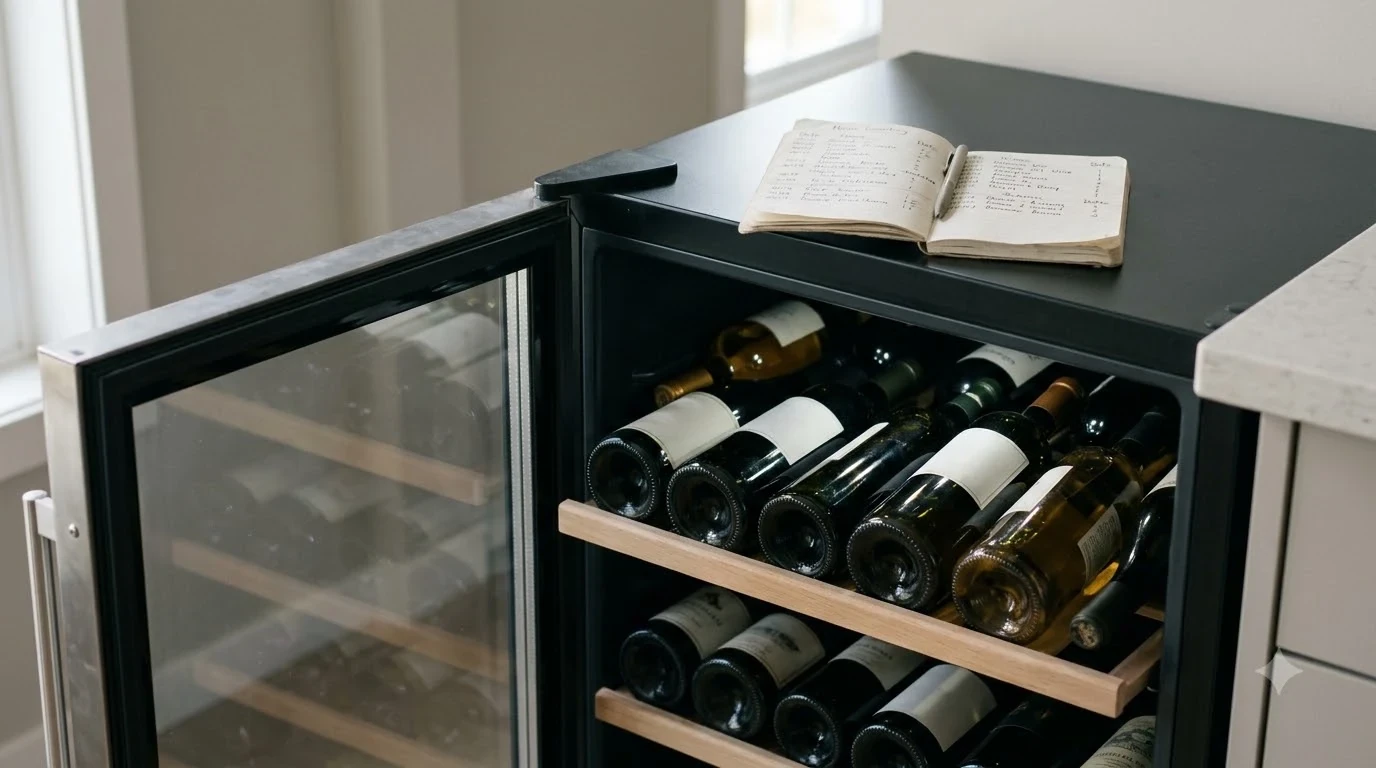
A wine refrigerator is designed to provide a more controlled environment than an ordinary kitchen refrigerator or an open storage shelf. However, the temperature selected on its control panel does not always match the temperature throughout the cabinet. Compressor cycles, room conditions, door openings, ventilation and bottle placement can all affect readings. A reliable thermometer gives wine owners an independent way to check those conditions and decide whether an adjustment is necessary.
Who This Is For
A separate thermometer is useful for anyone who wants to verify wine storage conditions, particularly owners of wine coolers with basic digital controls or no independent temperature indicator. It can also help identify differences between the upper, middle and lower shelves before those differences become a recurring storage concern.
Wine collectors with bottles intended for longer storage have a particularly good reason to monitor temperature. A stable environment around 55°F is a practical target for general wine storage, although individual serving temperatures vary. A separate instrument helps establish whether the cabinet is maintaining a consistent average rather than simply displaying the temperature selected by its thermostat.
Casual wine drinkers can benefit too. If a cooler stores Sauvignon Blanc, Chardonnay, Pinot Noir and Cabernet Sauvignon together, a thermometer helps establish whether its temperature is suitable for the intended use. It can also reveal whether a cooler is consistently warmer than expected during summer or after frequent door openings.
A thermometer is especially useful in these situations:
- New wine fridge owners: Verify the cabinet’s performance after installation rather than assuming its factory settings are correct.
- Owners of older appliances: Look for temperature changes that might indicate a thermostat, seal or cooling-system problem.
- Collectors: Monitor long-term storage conditions and identify unusual fluctuations.
- Dual-zone cooler owners: Check whether the upper and lower compartments maintain their intended temperature ranges.
- People storing different wine styles: Confirm that the cooler is appropriate for both storage and serving purposes.
Not everyone needs an expensive monitoring system. A straightforward refrigerator thermometer may be sufficient for a small cooler holding bottles intended for relatively short-term consumption. More advanced instruments make sense when continuous monitoring, remote readings or temperature history are important.
Before purchasing additional equipment, consider whether you actually need a wine fridge. If you already have a suitable cooler, a separate thermometer is a relatively inexpensive way to understand how effectively it maintains the intended environment.
Key Factors to Compare
The best thermometer for a wine fridge is one that provides dependable readings, fits the available shelf space and measures the temperature that matters for your storage needs. Accuracy, sensor placement, display visibility and minimum/maximum recording are more useful considerations than decorative features.
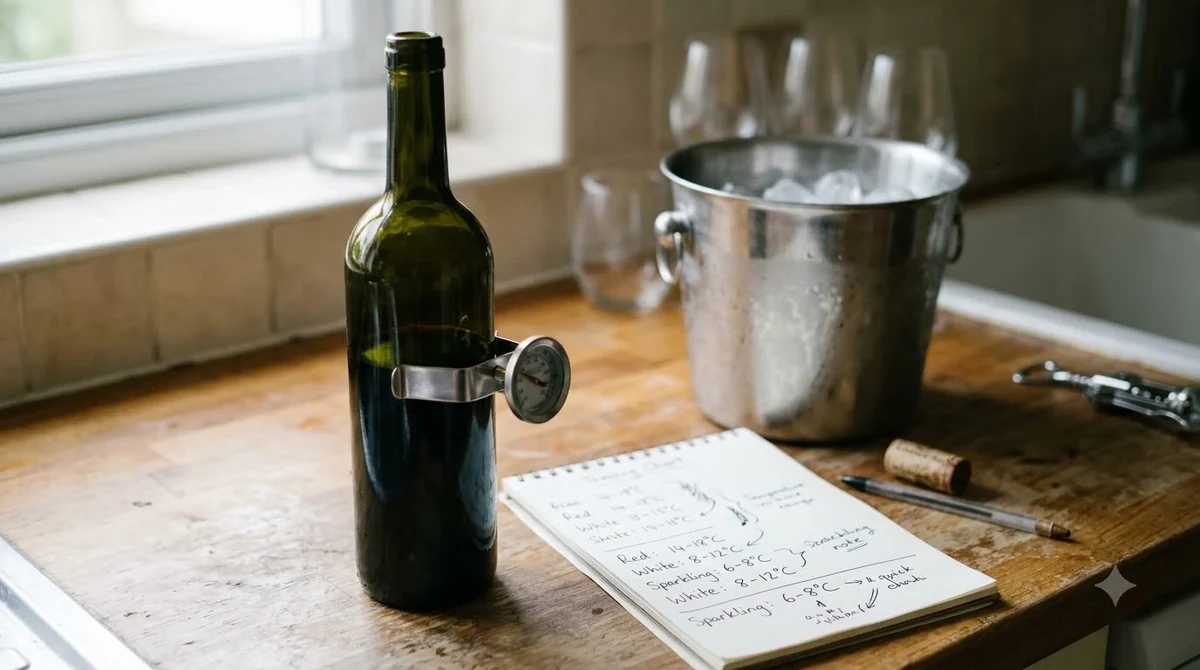
Start by deciding whether you need to measure cabinet air or approximate the temperature of the wine itself. These are different measurements, and understanding that distinction prevents unnecessary thermostat adjustments.
| Feature | What to look for | Why it matters |
|---|---|---|
| Temperature range | Approximately 32°F to 80°F or wider | Covers common wine storage and serving conditions |
| Accuracy | Manufacturer-stated accuracy around ±1°F to ±2°F | Helps identify meaningful temperature differences |
| Display | Clear Fahrenheit and Celsius readings | Makes readings easier to compare with appliance settings |
| Recording | Minimum and maximum temperature memory | Reveals fluctuations between inspections |
| Sensor design | Internal sensor or remote wired probe | Allows flexible placement inside the cooler |
| Measurement type | Air or liquid temperature | Determines what the displayed number actually represents |
| Additional monitoring | Optional relative humidity measurement | Provides more information about storage conditions |
| Power | Replaceable battery or suitable passive design | Supports convenient long-term monitoring |
Accuracy and measurement range
Accuracy should be one of the first specifications to examine. A thermometer advertised as accurate within ±1°F offers a more useful reference than a device that displays several decimal places without stating its measurement tolerance. Display precision and actual accuracy are not the same thing.
For example, if a wine fridge thermometer reads 55°F with a stated accuracy of ±2°F, the actual measured temperature could reasonably fall between 53°F and 57°F. That is generally more informative than a display showing 55.3°F without a published accuracy specification.
A range covering approximately 32°F to 80°F is sufficient for most household wine storage applications. A wider range can be helpful if the instrument will also be used to monitor room temperatures or other refrigeration appliances.
Air temperature versus liquid temperature
An ordinary refrigerator thermometer measures the air surrounding its sensor. A bottle probe or submersible thermometer measures liquid temperature, which more closely represents the conditions experienced by the wine inside a bottle.
Avintage explains that its wine cellar display measures cabinet air rather than the wine itself. Its guidance also notes that liquid temperature changes approximately ten times less than air temperature because liquid has greater thermal inertia. This explains why a short-lived change on the display does not necessarily mean the wine has experienced the same temperature change.
Display and monitoring features
A large display is useful when the thermometer sits behind bottles or on a middle shelf. A remote sensor can be particularly convenient because the display can remain outside the cabinet while the probe measures conditions inside.
Minimum and maximum memory is another worthwhile feature. Instead of checking the temperature at one convenient moment, owners can review the lowest and highest readings recorded between inspections. Some advanced devices also offer alarms, wireless connections and smartphone notifications, although these extras are not essential for every collection.
Tip: Prioritize a clearly stated accuracy specification and a suitable sensor over a complicated app. A simple thermometer with dependable readings is more useful than an advanced device that does not measure the correct location.
Step-by-Step: How to Check Your Wine Fridge Temperature
The most reliable approach is to let the appliance stabilize, position the thermometer correctly and compare readings over an extended period. One quick measurement immediately after opening the door is not enough to establish normal operating conditions.
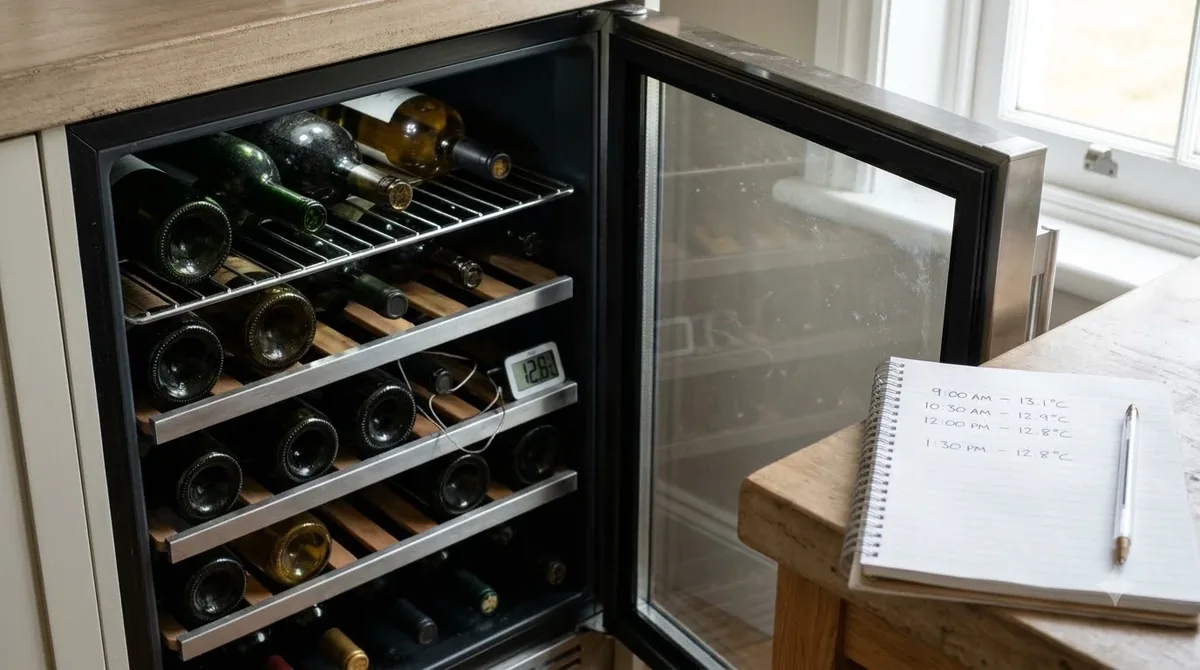
- Choose an appropriate thermometer. Select a refrigerator thermometer with a readable display and a suitable temperature range. If you want to approximate the temperature of the wine, use a liquid-compatible probe or a submersible thermometer designed for the purpose.
- Allow the cooler to stabilize. A newly installed appliance should have time to reach its operating temperature before measurements begin. The H.Koenig AGE6WV manual recommends running its cooler for 24 hours before adding wine. Follow the stabilization instructions for your own appliance.
- Position the thermometer correctly. For a general cabinet-air reading, place the thermometer on the middle shelf where it can be read easily. Avoid placing it directly against a cooling surface or in front of a ventilation outlet.
- Keep the door closed. Opening the door repeatedly introduces warmer room air and can temporarily change the thermometer reading. Leave the appliance closed during the measurement period.
- Wait for a meaningful reading. Allow an ordinary thermometer several hours or overnight to settle. For a liquid-temperature measurement, Avintage recommends leaving a submersible thermometer in a water-filled glass bottle for 24 hours.
- Compare the independent reading with the display. Record the temperature shown by the separate thermometer and compare it with the wine cooler’s digital setting. Remember that one instrument may measure air while the other is measuring liquid.
- Record fluctuations. Check the minimum and maximum readings if the thermometer offers that feature. Avintage recommends monitoring approximately once an hour over 24 hours when investigating temperature or humidity variations.
- Adjust the appliance gradually if necessary. If the independent measurement consistently differs from the desired storage temperature, make a small thermostat adjustment according to the manufacturer’s instructions. Allow the cabinet to stabilize again before evaluating the result.
This process is more useful than repeatedly changing the thermostat in response to every temporary reading. A compressor-operated wine fridge naturally cycles between cooling and resting periods, and its air temperature may change more quickly than the liquid inside the bottles.
Testing a bottle-temperature probe
A bottle-temperature setup is particularly helpful when the cooler’s display and a separate air thermometer appear to disagree. Vinothéque describes a system that uses a bottle probe to relay liquid-temperature information to the thermostat rather than measuring the surrounding air. Its liquid thermometer installation instructions explain how to establish this type of measurement.
The installation instructions call for filling an empty wine bottle with room-temperature water, inserting the probe securely and positioning the bottle in a level rack space. This arrangement creates a useful reference for the thermal conditions inside a typical bottle. Avoid pulling on the probe cable because a disconnected sensor can produce inaccurate readings.
For an ordinary household cooler without a dedicated bottle probe, a suitable submersible thermometer in a water-filled bottle provides a practical alternative. The water should remain undisturbed during the measurement period so that the reading reflects the bottle’s gradual temperature adjustment.
Types of Wine Fridge Thermometers Explained
Wine fridge thermometers are available in several designs, ranging from simple analog instruments to wireless monitoring systems. The right type depends on whether you want an inexpensive temperature check, ongoing records or a measurement that more closely represents the wine itself.
Digital refrigerator thermometers
Digital thermometers are a convenient choice for most household wine coolers. They typically show the current temperature on a small LCD screen, and some models include minimum/maximum memory or a humidity reading.
Their main advantage is readability. Fahrenheit and Celsius displays make it easy to compare measurements with appliance controls and storage recommendations. A compact digital unit can sit on a shelf without taking up much room, although it should not obstruct bottle placement or airflow.
Choose a digital model with a clearly stated accuracy specification. A memory function is particularly useful if you want to identify overnight changes or temperature differences that occur when the room becomes warmer.
Analog dial thermometers
Analog thermometers use a physical dial rather than an electronic screen. They are straightforward, do not require batteries and can remain inside the cabinet for continuous visual reference.
Their disadvantages include smaller markings and potentially less convenient readings when the instrument is positioned behind bottles. Some inexpensive dial models also provide limited accuracy information, making it difficult to determine how closely the displayed temperature reflects actual conditions.
An analog instrument can still be useful as a basic secondary reference. Look for a clear scale, a sturdy housing and a design intended for refrigerator temperatures.
Digital thermometers with remote probes
A remote-probe thermometer separates the sensor from its display. The sensor remains inside the wine fridge, while the main unit can sit outside the cabinet or on a nearby counter.
This arrangement is useful for built-in coolers, deep cabinets and appliances where opening the door to read a thermometer would be inconvenient. It can also make it easier to compare conditions between different shelf positions by moving the sensor while keeping the display accessible.
Check the probe cable length and the manufacturer’s instructions before purchasing. The cable must not interfere with the door seal or become pinched when the door closes. A damaged or poorly positioned cable can undermine the reliability of the readings.
Wireless and smart thermometers
Wireless thermometers transmit readings to an external display, receiver or smartphone. Depending on the product, they may provide temperature history, high- and low-temperature notifications, and remote monitoring.
These features can be helpful for a larger collection or a cooler installed in a basement, pantry or utility room. They also reduce the need to open the door simply to inspect the current reading.
However, wireless connectivity is not a substitute for measurement accuracy. Check the sensor’s stated tolerance, transmission range, battery life and compatibility with the receiving device before choosing a smart system.
Combination thermometers and hygrometers
A thermo-hygrometer measures both temperature and relative humidity. This is useful because wine storage involves more than temperature alone, particularly when bottles have natural cork closures and are intended for extended storage.
Avintage identifies 50% to 75% relative humidity as an average target for a wine cellar. Its guidance also recommends electronic minimum/maximum hygrometers with remote displays when investigating humidity variations. A combination device is therefore a practical choice for owners who want to monitor both measurements using one instrument.
Common Mistakes When Using a Wine Fridge Thermometer
Even a dependable thermometer can produce misleading information if it is placed incorrectly or interpreted without considering the appliance’s operation. The most common mistakes involve comparing different types of measurements, reacting to temporary fluctuations and overlooking the room surrounding the cooler.
Confusing the thermostat setting with actual temperature
A thermostat setting is the target selected by the owner, not necessarily a direct measurement of the temperature experienced by every bottle. For example, a cooler set to 55°F might display a different instantaneous air temperature while its compressor is running or resting.
This does not automatically indicate a malfunction. Compare independent measurements over an appropriate period before deciding that the appliance requires adjustment.
Placing the thermometer in the wrong location
Putting a thermometer directly against the rear cooling panel, next to a fan or close to a door can produce readings that do not represent the general storage environment. A thermometer exposed to a concentrated stream of cold air may show a lower temperature than the surrounding bottles experience.
The middle shelf is a sensible starting point for a general air-temperature check. If the cooler has separate zones, monitor each compartment independently rather than assuming that one reading represents the entire appliance.
Reacting to every temperature change
Compressor cycling can produce short-term fluctuations, particularly in the air surrounding the sensor. Avintage explains that these changes may have little immediate effect on the liquid temperature because wine has greater thermal inertia than air.
Repeatedly lowering and raising the thermostat in response to individual readings can make it harder to understand the appliance’s normal behavior. Use a consistent measurement period and look for persistent differences instead.
Ignoring the surrounding room
Wine coolers depend on their operating environment. A unit positioned beside an oven, radiator or sunny window may struggle to maintain its selected temperature, especially during warm weather.
The Whynter WC-201TD manual recommends an installation environment between 70°F and 78°F and warns that surrounding conditions can affect cooling performance. Its guidance also recommends avoiding extreme surrounding temperatures. Always follow the ventilation and clearance requirements for the particular appliance.
Assuming more decimal places mean better accuracy
A digital display showing 54.8°F may appear more sophisticated than one displaying 55°F, but the extra decimal place does not prove that the instrument is more accurate. Look for the manufacturer’s stated tolerance and measurement specifications.
Similarly, a wireless thermometer with multiple alerts is not necessarily better than a basic instrument with a dependable sensor. The measurement itself should determine the purchasing decision.
Care and Storage Tips for Reliable Monitoring
Keeping a thermometer in good condition is straightforward, but placement, battery maintenance and periodic comparisons all matter. A dependable monitoring routine also makes it easier to distinguish ordinary compressor cycling from a genuine cooling problem.
Keep the sensor properly positioned
Place an ordinary air thermometer on a stable shelf away from direct contact with cold surfaces. Avoid blocking ventilation openings or positioning the sensor where bottles might knock it over when the door opens.
For remote probes, route cables carefully and keep them away from hinges and door seals. If the appliance uses a bottle probe, secure it according to the manufacturer’s instructions and avoid pulling on its cable.
Check batteries and sensor condition
Digital thermometers depend on functioning batteries. Replace them when the display becomes faint, readings become inconsistent or the manufacturer indicates that battery replacement is due. After changing batteries, allow the sensor to settle before relying on a new reading.
Clean the thermometer housing with a soft, slightly damp cloth when necessary. Avoid soaking electronic components or using harsh cleaning products. A thermometer stored in a damp wine cooler should have a housing suitable for that environment.
Understand appropriate wine storage temperatures
For long-term storage, a steady temperature near 55°F is a widely used household target. Consistency is generally more important than constantly switching between temperatures intended for different wine styles.
Serving temperatures are different from long-term storage temperatures. A wine fridge thermometer helps confirm the cabinet environment, while the following ranges provide useful serving references:
- Sparkling wines: 40°F to 50°F.
- Light whites and rosé: 45°F to 50°F.
- Full-bodied whites: 50°F to 55°F.
- Light reds: 55°F to 60°F.
- Full-bodied reds: 60°F to 65°F.
- Sweet whites: 43°F to 50°F.
These ranges help explain why a single-zone wine cooler may not serve every bottle at its ideal drinking temperature. For long-term storage, maintaining a consistent environment is generally more practical than trying to match the serving temperature of every wine simultaneously.
Monitor humidity as well as temperature
Humidity is a separate measurement from temperature, so a thermometer alone cannot establish the complete storage environment. A combination thermo-hygrometer provides both readings and can help identify unusually dry or humid conditions.
Avintage recommends an average humidity range of 50% to 75% for wine cellars. Excessively high humidity can affect labels, while persistently low humidity may contribute to cork drying over extended storage periods. Avoid making major humidity adjustments based on a single reading.
Keep a simple monitoring record
Recording temperatures helps establish a baseline for normal operation. Write down the appliance setting, independent thermometer reading, date and approximate room conditions. For a dual-zone appliance, record the upper and lower compartments separately.
A useful monitoring schedule might include an initial 24-hour check after installation, periodic weekly observations and additional checks during unusually hot weather. If the appliance has minimum/maximum memory, use it to identify changes that happen between inspections.
If readings remain substantially outside the intended range, inspect the door seal, ventilation openings and surrounding installation conditions. Persistent problems may require the manufacturer’s service department or a qualified refrigeration technician rather than further thermostat adjustments.
It is also useful to consider wine fridge energy efficiency when evaluating an appliance that runs continuously or struggles to maintain its temperature. Poor ventilation, unsuitable room conditions and damaged door seals can affect both cooling performance and electricity consumption.
Before purchasing or upgrading a wine cooler, it can also help to consider how much a wine fridge costs and whether its features justify the additional expense. A dependable thermometer is a relatively simple way to make better use of an appliance you already own.
Frequently Asked Questions
Can I use a regular refrigerator thermometer in a wine fridge?
Yes. A refrigerator thermometer designed for low-temperature environments can generally be used in a wine cooler. Choose a model with a suitable measurement range and stated accuracy, and avoid placing it directly against the cooling panel.
How often should I replace a wine fridge thermometer?
There is no universal replacement interval for all thermometer designs. Replace an instrument if its display fails, its sensor becomes damaged or it produces readings that cannot be reconciled with a reliable reference thermometer. Battery-powered models also need periodic battery replacement.
Can a wine fridge thermometer detect a refrigerant leak?
No. A thermometer can identify abnormal cooling performance, but it cannot confirm a refrigerant leak or identify its location. If the appliance cannot maintain its temperature despite correct installation and settings, arrange a professional inspection.
Should I keep a thermometer inside a dual-zone wine fridge?
Ideally, monitor both compartments independently because the upper and lower zones can have different temperature settings and operating conditions. A remote-probe instrument with separate sensors can simplify this process. Record each zone’s reading rather than treating one compartment as representative of the entire cabinet.
Can a thermometer help identify a failing wine fridge door seal?
It can help identify a possible temperature-control problem, but it cannot diagnose the seal itself. A damaged gasket may allow warm air to enter and increase cooling demand. Inspect the seal for visible gaps, deformation and obstructions if the temperature repeatedly rises beyond the expected range.
A wine fridge thermometer is a practical addition to almost any wine cooler, especially when independent measurements are more important than relying on the built-in display alone. For most households, a clear digital model with reliable accuracy and minimum/maximum memory provides a sensible starting point. If you store bottles for extended periods, consider a bottle-temperature probe and a separate humidity monitor to gain a more complete picture of your wine storage conditions.
More in Wine Buying Guides
 Cheap Red Blend: How to Find a Flavorful Bottle for LessUpdated Nov 20, 2026
 Pinot Grigio Gift: How to Choose a Bottle They’ll EnjoyUpdated Nov 20, 2026
 Best White Wine at Total Wine for Every MealUpdated Nov 20, 2026
 Wine Fridge Replacement Shelves: Find the Right FitUpdated Nov 20, 2026
 Best Sparkling Wine Under 20: Find Bubbles Worth BuyingUpdated Nov 20, 2026
 Best Wine For Birthday Celebrations With Perfect Party PairingsUpdated Nov 20, 2026