

We may earn a commission when you buy through links on this page, at no extra cost to you. Learn more.
The KitchenAid wine opener is a practical choice for wine drinkers who want a dependable manual corkscrew with a comfortable grip and straightforward operation. KitchenAid offers different manual corkscrew designs, including a stainless-steel winged opener and a heavy-duty soft-grip model. Neither should be confused with a rechargeable electric wine opener. The right choice depends on your preferred opening method, hand comfort, storage needs, and the types of corks you encounter.
A good wine opener should make opening a bottle simple rather than turn it into a frustrating task. KitchenAid’s wine-opening accessories appeal to buyers who appreciate familiar kitchen-tool styling and practical construction. However, the different designs have distinct advantages, and customer feedback suggests that performance can vary. This review examines the available styles, construction, owner experiences, limitations, and alternatives to help you make an informed purchase.
Specs and Key Features
The KitchenAid wine opener category includes manual tools rather than one universal electric model. Two designs worth comparing are the stainless-steel winged corkscrew and the heavy-duty corkscrew with a soft-grip handle. Both are intended for traditional wine bottles sealed with removable corks, but their construction and handling characteristics differ.

The winged design uses a central spiral and two rising arms to provide leverage. As the spiral enters the cork, the arms rise; pressing them downward helps extract the cork. This familiar mechanism makes the opener relatively easy to understand, even for someone who rarely opens wine. The stainless-steel appearance also suits a traditional kitchen or home bar.
Canadian Tire describes its stainless-steel KitchenAid model as a metal winged corkscrew with a helix-style screw, bottle opener, and dishwasher-safe construction. Its listed dimensions are 10 inches long, 3 inches wide, and 1.5 inches high, making it a full-size drawer accessory rather than a compact travel tool. You can review the KitchenAid stainless-steel winged corkscrew specifications and customer feedback for additional product details.
The heavy-duty version takes a different approach. Walmart describes its construction as cast material with a matte-textured ABS body and a soft-grip handle. Its manual operation avoids the need for batteries, charging cables, or a charging dock. The emphasis is on grip, control, and straightforward cork removal rather than powered convenience.
| Feature | Stainless-Steel Winged | Heavy-Duty Soft-Grip |
|---|---|---|
| Operating method | Manual winged corkscrew | Manual winged corkscrew |
| Main construction | Metal design | Cast construction |
| Handle design | Two lifting wings | Soft-grip handle |
| Body finish | Stainless-steel appearance | Matte-textured ABS |
| Power source | None | None |
| Charging requirement | Not required | Not required |
| Dishwasher suitability | Listed as dishwasher-safe | Listed as dishwasher-safe |
| Primary advantage | Traditional leverage mechanism | Comfort-oriented grip |
| Potential limitation | Spiral alignment and mechanism quality matter | Manual operation still requires positioning |
These distinctions matter more than the brand name alone. A stainless-steel finish does not automatically mean that every moving component is stainless steel, while a soft-grip handle does not guarantee that the spiral will suit every cork. Buyers should compare the complete design instead of judging an opener by its appearance.
Another important distinction is the difference between an electric opener and a manual corkscrew. Electric products generally have a motorized spiral, powered extraction, a release control, and sometimes a foil cutter. Those features should not be attributed to the KitchenAid manual designs discussed here.
What Owners Like About KitchenAid Wine Openers
Owner feedback points to three appealing qualities: straightforward operation, comfortable handling, and attractive kitchen-tool styling. The strongest reason to consider a KitchenAid corkscrew is its practical manual design rather than an expectation of sophisticated electronic features.

The stainless-steel winged corkscrew receives positive feedback from customers who appreciate having a familiar opener available for everyday bottles. Canadian Tire’s customer feedback includes a purchaser describing the product as easy to use and long-lasting. Another positive review calls it a solid corkscrew, reflecting the appeal of a conventional opening mechanism that does not require much explanation.
Ease of use is particularly relevant for occasional wine drinkers. Someone opening one bottle during a weekend dinner may prefer a manual tool that stays in a kitchen drawer rather than maintaining an electric device. There is no charging schedule, battery indicator, or electrical connection to manage.
The heavy-duty model has a different advantage. Its soft-grip handle is intended to improve comfort and control during operation. This can be appealing when a user prefers a broader gripping surface rather than narrow metal arms. The matte-textured body also provides a less reflective appearance than polished stainless steel.
Practical everyday operation
Manual corkscrews are generally easy to keep ready for use. They do not need to be charged before a dinner party, and they can be stored with other bar tools. A simple opening routine also makes them suitable for households where different people take turns serving wine.
The winged design is especially familiar. Once the spiral is centered and inserted correctly, the rising arms provide a visible indication of how much leverage is available. Users can operate the mechanism without learning a sequence of electronic controls.
Styling for a home bar
KitchenAid’s recognizable kitchen-accessory aesthetic may appeal to buyers who want their wine tools to look coordinated with other countertop equipment. The stainless-steel winged model has a traditional appearance, while the heavy-duty version offers a darker, more understated finish.
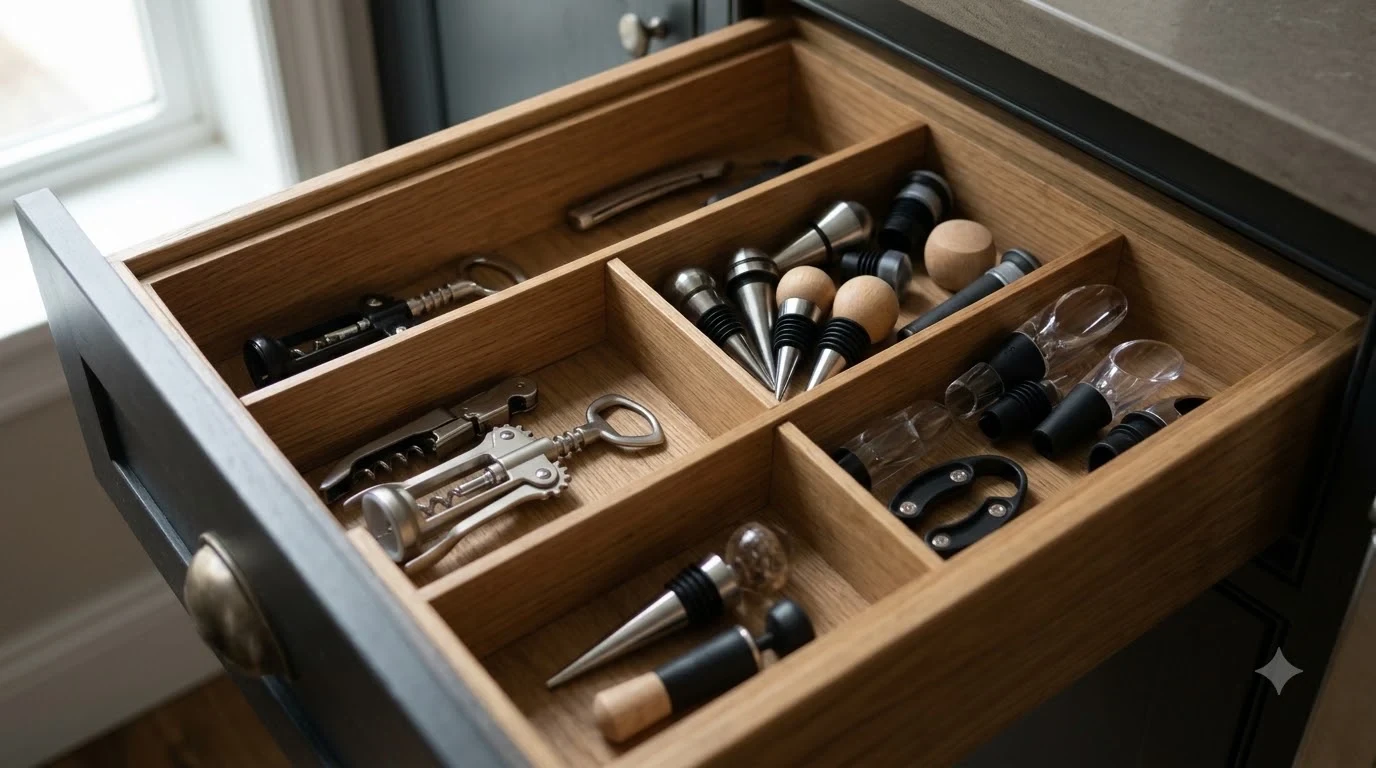
Both styles can fit into a home entertaining setup. A manual corkscrew is also relatively easy to keep in a drawer, organizer, or small accessory tray. For someone assembling a collection of practical wine accessories, a dedicated opener is a useful starting point alongside a stopper and a pourer.
There is also a practical reason to avoid overcomplicating the purchase. A wine opener performs one primary task: extracting a cork without damaging it or making the bottle difficult to handle. A well-designed manual tool can satisfy that requirement without additional electronics or accessories.
For a more complete serving setup, a wine opener and preserver set combines the opening task with equipment for handling unfinished bottles. That option may be more useful for households that regularly save wine for another evening.
Common Complaints and Limitations
The main concerns involve the quality of the corkscrew mechanism, the fit between the spiral and cork, and the effort required during extraction. KitchenAid branding does not eliminate the possibility of mechanical problems, so it is important to consider negative owner feedback alongside positive comments.
Canadian Tire’s customer reviews include complaints about a loose screw mechanism and a cork-piercing point that one purchaser considered too dull. These issues can make it difficult to insert the spiral cleanly and may increase the effort needed to remove a cork. Other reviewers reported returning the product because they were dissatisfied with its performance.
These experiences do not establish that every unit has the same problem. They do, however, identify the parts that deserve attention when evaluating a winged corkscrew. The spiral should remain aligned with the bottle opening, and its point should enter the cork without excessive force.
Spiral alignment can affect performance
A corkscrew works best when its spiral enters the center of the cork. If the opener is tilted, the spiral may travel toward the side instead of following a straight path. This can make extraction harder and increase the chance of breaking or crumbling an older cork.
A loose mechanism creates another possible difficulty. The spiral needs to remain stable while the user turns the opener. If it shifts or feels poorly connected to the handle, the opening process may become less predictable.
For a winged model, inspect the movement of both arms. They should move consistently rather than feel excessively loose or uneven. The central spiral should also appear properly aligned with the body of the opener.
Manual effort remains necessary
Even a comfortable manual corkscrew requires the user to position the tool and apply force. The heavy-duty soft-grip version may improve handling, but it is not an automatic extraction device. Anyone looking for a one-button opening experience should consider an electric alternative instead.
Another limitation concerns cork condition. Old natural corks can become fragile, especially after extended bottle storage. A conventional spiral may cause pieces to break away if the cork is already deteriorating. The issue is not exclusive to KitchenAid; it is a general limitation of traditional corkscrews.
Synthetic corks can also behave differently from natural cork. Their material may be firmer or more slippery, affecting how easily a spiral enters and grips. An opener that works comfortably with ordinary natural corks may not perform identically with every synthetic closure.
Tip: Keep the bottle upright on a stable surface, position the corkscrew over the center of the cork, and turn slowly. Avoid forcing a spiral that begins to enter at an angle. Correct alignment can reduce unnecessary stress on both the cork and the opener.
Finally, cleaning and maintenance should not be overlooked. Wine residue, dust, and small cork fragments can collect around moving components. Removing debris after use helps keep the mechanism easier to operate. Both KitchenAid styles discussed here are listed as dishwasher-safe by their respective retailer product descriptions, although buyers should follow the care instructions supplied with their particular model.
Who Should Buy and Who Should Skip
A KitchenAid manual wine opener makes the most sense for someone who values a straightforward opening mechanism, wants to avoid charging requirements, and prefers a conventional kitchen accessory. The choice between the winged and soft-grip designs depends mainly on how the user likes to hold and operate a corkscrew.
The stainless-steel winged version is a sensible option for people familiar with traditional lever-style openers. Its two-arm mechanism is easy to understand, and it provides visible leverage during cork extraction. Buyers who like classic wine accessories may also appreciate its appearance.
The heavy-duty soft-grip version is worth considering for people who prioritize handle comfort. Its cast construction and matte-textured ABS body provide a different feel from the stainless-steel winged design. The soft-grip feature may be particularly appealing to someone who finds narrow handles uncomfortable.
Good reasons to choose KitchenAid
- You prefer a manual corkscrew over an electric opener.
- You want an accessory that does not require batteries or charging.
- You usually open standard wine bottles with conventional cork closures.
- You appreciate familiar lever-style operation.
- You want a practical opener for a kitchen drawer or home bar.
- You prefer the soft-grip handling offered by the heavy-duty design.
Occasional wine drinkers may find the manual approach especially convenient. There is no need to check a battery before opening a bottle for dinner, and the opener can remain stored for long periods without a charging routine.
Reasons to consider another design
A KitchenAid manual corkscrew may not be the right choice for everyone. People who frequently open several bottles at parties, for example, may prefer an electric opener that reduces repetitive manual effort. Users who have difficulty gripping or turning small objects may also benefit from a different opening mechanism.
Collectors who regularly open older bottles should consider a specialized two-prong opener or an appropriate wine-opening tool for fragile corks. These tools use a different extraction approach and may be more suitable when a cork is particularly delicate.
There is also a difference between a basic opener and a complete wine-serving station. A buyer who wants a foil cutter, pourer, stopper, and storage stand should compare bundled accessories rather than purchasing a standalone corkscrew without considering the rest of the setup.
For a compact alternative that can be carried away from home, a wine bottle opener keychain may be convenient. It serves a different purpose from a full-size corkscrew, but it can make sense for occasional travel or outdoor entertaining.
How It Compares to Alternatives
The KitchenAid winged and soft-grip corkscrews occupy the traditional manual-opener category. Their alternatives include other manual designs and electric openers, each with different advantages in comfort, speed, portability, and control.
A useful comparison starts with the opening mechanism. Winged corkscrews use two arms to provide leverage, while other manual designs rely on a handle, lever, or additional supporting mechanism. Electric openers replace much of the user’s physical effort with a motor.
Winged corkscrew versus waiter’s corkscrew
A waiter’s corkscrew is a compact tool commonly used by restaurant professionals. It generally includes a folding spiral, a small foil-cutting blade, and a lever that rests against the bottle neck. Its compact shape makes it easy to carry in a pocket or apron.
The KitchenAid winged opener is usually more intuitive for people who prefer visible leverage. The rising arms show how the extraction mechanism works, and the user does not need to position a folding lever against the bottle lip.
However, a waiter’s corkscrew offers greater portability. It is a practical choice for people who want a small opener in a picnic bag or travel kit. Its compact size also makes it suitable for a drawer with limited space.
Manual versus electric wine opener
An electric wine opener is designed to reduce the physical work involved in extracting a cork. Many models use a powered spiral and separate controls for extraction and cork release. Some include a charging base or USB charging connection, along with a foil cutter.
The trade-off is that electric models require battery management and have additional components that can eventually need attention. A manual KitchenAid corkscrew avoids those requirements, although it still depends on the user’s grip and technique.
Electric opening may be more convenient for households that open several bottles during gatherings. A manual model may be preferable for occasional use, simple storage, and buyers who do not want another rechargeable appliance in the kitchen.
KitchenAid styles compared with other options
The following comparison summarizes the practical differences between the main opening categories. These are general design characteristics rather than claims that every model from every manufacturer performs identically.
| Opener type | Main advantage | Main limitation | Best use |
|---|---|---|---|
| KitchenAid winged | Visible leverage and familiar operation | Mechanism quality matters | Everyday home use |
| KitchenAid soft-grip | Comfort-oriented handling | Still requires manual effort | Regular manual opening |
| Waiter’s corkscrew | Compact and portable | Requires practiced technique | Travel and dining service |
| Electric opener | Motorized cork extraction | Requires charging or batteries | Frequent bottle opening |
| Lever corkscrew | Mechanical assistance | Usually larger to store | Home entertaining |
For most households, the best design is the one that feels comfortable and works reliably with the corks commonly found in their wine collection. There is little reason to purchase an electric model if a simple manual tool already meets the household’s needs.
Likewise, buyers should not assume that a more elaborate mechanism is automatically better. A basic opener with a well-aligned spiral can be more useful than a complicated device with uncomfortable controls or unreliable operation.
Building a coordinated wine station
A wine opener is only one part of a practical entertaining setup. A foil cutter, bottle stopper, pourer, and suitable glassware can make serving wine more organized. The opener should be easy to reach, while smaller accessories should have a dedicated place to prevent them from becoming misplaced.
A bar cart offers a convenient place to keep frequently used wine tools together. A compact tray can separate the corkscrew from smaller accessories, while a nearby bottle stopper makes it easier to store unfinished wine after dinner.
Buyers comparing more kitchen and wine accessories can also browse Accessory Brands for additional equipment ideas. The important point is to build a setup around actual serving habits rather than accumulating tools that rarely get used.
Frequently Asked Questions
These answers cover practical details that can help clarify the purchase decision, including cork compatibility, opening technique, and the differences between common bottle closures.
Can a KitchenAid wine opener open sparkling wine bottles?
No conventional corkscrew should be used to extract a sparkling wine cork. Sparkling bottles are designed to be opened by carefully controlling the cork and wire cage because internal pressure can propel the cork unexpectedly. Keep a hand over the cork while removing the cage and gently twist the bottle rather than inserting a spiral.
Does a KitchenAid corkscrew work with screw-cap wine bottles?
No corkscrew is needed for a standard screw-cap bottle. These closures use threaded caps that turn off rather than corks that require extraction. A manual wine opener is intended for bottles with removable cork-style closures.
Can a KitchenAid wine opener remove a broken cork?
A traditional corkscrew may sometimes grip the remaining portion of a broken cork, but success depends on how much material remains and whether it is stable. If the cork is badly fragmented, a two-prong cork puller may be a more appropriate tool. Avoid pushing loose cork fragments into the bottle if the wine can be transferred carefully through a suitable strainer.
Should wine bottles be opened before serving to let them breathe?
Not every wine benefits from extended exposure to air. Some young, full-bodied reds may benefit from approximately 30 to 60 minutes of decanting, while delicate older wines can lose their aromas more quickly. The decision depends on the wine’s structure, age, and serving style rather than the type of corkscrew used.
How should a wine corkscrew be stored between uses?
Store the opener in a dry drawer or accessory organizer, away from moisture and loose objects that could damage its spiral. Keep any sharp foil-cutting component protected and out of children’s reach. A dedicated compartment also makes it easier to locate the tool before serving guests.
The KitchenAid wine opener range is worth considering if you prefer a practical manual corkscrew with familiar operation and kitchen-friendly styling. The stainless-steel winged design suits traditional corkscrew users, while the heavy-duty soft-grip version offers an alternative focused on handling comfort. Compare the mechanism, grip, and owner feedback before choosing, and select the style that best fits the way wine is opened in your home.
More in Wine Accessories
 Vinglace Wine Tumbler Review: A Glass-Lined Choice for Better SippingUpdated Nov 20, 2026
 ZWILLING Electric Wine Opener Review: Features and DrawbacksUpdated Nov 20, 2026
 Vinturi Electric Wine Opener Review for Easy UncorkingUpdated Nov 20, 2026
 Vinabon Wine Aerator Review for Easier, Cleaner Wine ServingUpdated Nov 20, 2026
 Vacu Vin Electric Wine Opener Review: Easy Cork Removal for Home Wine LoversUpdated Nov 20, 2026
 Rabbit Wine Accessories for Easier Home Wine ServiceUpdated Nov 20, 2026