

We may earn a commission when you buy through links on this page, at no extra cost to you. Learn more.
The oster cordless wine opener is a convenient electric corkscrew for home wine drinkers who want to remove traditional corks with minimal manual effort. Its rechargeable design, one-button operation, soft-grip handle, and included foil cutter make opening bottles straightforward. However, charging requirements, occasional cork-removal problems, and long-term battery reliability are important considerations before choosing one. The Oster 4207 and 4208 models also differ in their included accessories, so identifying the correct version matters.
Opening a bottle of wine should be a simple part of serving dinner or entertaining guests. A traditional waiter’s corkscrew is inexpensive and compact, but it requires some hand strength and practice. An electric opener offers a more convenient alternative, particularly for people who regularly open several bottles or prefer a powered mechanism.
Oster has produced several versions of its electric wine opener, including the 4207 and 4208 models and newer silver cordless versions. Their shared approach combines a motorized corkscrew with a rechargeable base, while certain packages add a stainless-steel wine chiller. This review examines the design, operating instructions, owner feedback, limitations, and practical considerations that help determine whether an Oster opener belongs in a home wine setup.
Specs and Key Features
The Oster electric wine opener focuses on straightforward cork removal rather than complicated controls or multiple operating modes. Its main features are cordless operation, a rechargeable base, a two-direction switch, and a separate foil cutter.
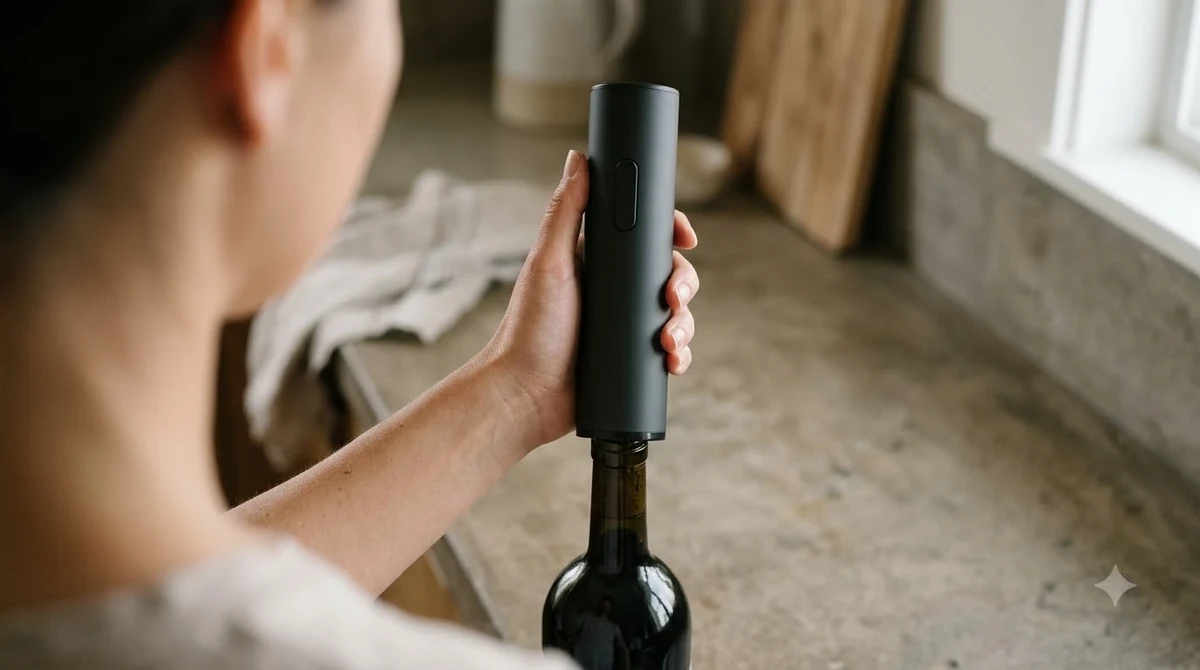
One important distinction is the model number. The older Oster 4207 is the standard electric opener, while the 4208 adds a wine chiller. Oster’s newer Silver Electric Wine Opener with Chiller is identified as model 004208-FFP-000. Specifications and battery-capacity claims can differ between product generations, so figures from one version should not automatically be applied to another.
Oster’s official 4207 and 4208 instruction manual provides the operating sequence, charging requirements, cork compatibility warnings, and safety information for the older models.
| Specification | Oster 4207 / 4208 | Newer Silver Chiller Version |
|---|---|---|
| Operation | Cordless electric | Cordless electric |
| Charging method | Rechargeable stand | Rechargeable base |
| Initial charging | At least 8 hours recommended | Follow supplied manual |
| Full charging time | Approximately 6–8 hours | Not specified on product page |
| Advertised capacity | Approximately 40 bottles | Up to 30 bottles |
| Controls | Two-direction switch | Electric push-button operation |
| Handle | Soft-grip design | Ergonomic soft grip |
| Foil cutter | Included | Included |
| Wine chiller | 4208 only | Included |
| Newer model dimensions | Not specified here | 5.51 × 5.32 × 14.96 inches |
| Newer model warranty | See applicable model documentation | 3-year limited warranty |
The differences in advertised bottle capacity deserve attention. Oster’s older instruction manual estimates approximately 40 openings after a full charge, while its newer chiller product page advertises up to 30. These are manufacturer figures for different product documentation, not a guarantee that every opener will achieve the same number of openings under all conditions.
The charging base is an important part of the design. Rather than relying on a disposable battery, the opener uses a rechargeable arrangement and returns to a dedicated stand between uses. This provides a convenient storage location and keeps the device available for the next bottle. However, it also means that the charging stand, power adapter, and electrical connection need to remain accessible.
The soft-grip exterior provides a more secure surface to hold while the motor operates. This matters because the opener needs to remain upright over the bottle. A comfortable grip helps users maintain that position without squeezing the housing excessively.
The 4208 package offers an additional accessory for serving wine. Its double-walled stainless-steel chiller provides a separate place to keep a bottle cool during a meal. It is a useful addition for people who regularly serve chilled Sauvignon Blanc, Riesling, sparkling wine, or rosé.
For a broader look at household wine accessories and their practical differences, see these Model reviews.
What Owners Like
Ease of use is the strongest recurring advantage in owner feedback about Oster’s cordless electric wine openers. The powered mechanism eliminates the twisting and pulling required by a traditional corkscrew, while the charging base and included foil cutter make the complete opening process relatively convenient.
Oster’s published owner feedback for its silver electric wine opener includes positive comments about ease of use and long-term convenience. Some owners describe using their openers for years, while others appreciate the straightforward operation and compact charging arrangement. These observations are useful indicators of the product’s appeal, although they should not be interpreted as a guarantee of long-term performance.
The simple switch arrangement is another practical advantage. There is no complicated menu, speed adjustment, or learning process. The lower portion of the switch operates the cork-removal mechanism, while the upper portion reverses the motor to release the extracted cork.
Convenience during dinner parties
Electric operation becomes especially useful when several guests are sharing wine. Instead of repeatedly working a manual corkscrew, the host can remove the foil, position the opener, and let the motor extract the cork. This reduces the amount of physical effort required when opening multiple bottles throughout an evening.
For example, a dinner featuring Chardonnay with roasted chicken followed by a glass of Pinot Noir can involve more than one bottle. A powered opener makes the transition between bottles easier, especially when the host is also preparing food and serving guests.
The accessory arrangement also helps keep the opening process organized. The foil cutter is supplied with the older 4207 and 4208 packages, so there is no need to search for a separate cutting tool every time a bottle is opened. The charging stand provides a consistent location for storing the opener between uses.
Less manual effort
A manual corkscrew requires the user to position a spiral, turn it into the cork, and apply controlled pulling force. The Oster replaces much of this work with a powered mechanism. Users who find traditional corkscrews uncomfortable or difficult to control may appreciate that difference.
The soft-grip handle also helps provide a comfortable holding surface. Although the motor does the mechanical work, users still need to stabilize the opener. Its ergonomic shape supports that process and makes it easier to maintain a vertical position during extraction.
For people who enjoy entertaining, the opener can become part of a practical serving station alongside wine glasses, a decanter, and a bottle chiller. It is particularly convenient when the wine selection includes several traditional cork-finished bottles rather than screw-cap wines.
The Oster 4208 version makes this arrangement more complete by adding a stainless-steel chiller. Someone serving an Aperol Spritz recipe alongside chilled wine can also appreciate having a dedicated place to keep a wine bottle cool during the same gathering.
Common Complaints
The main concerns surrounding Oster electric wine openers involve battery reliability, corks becoming stuck, and inconsistent performance with certain cork materials. These issues do not affect every unit, but they are important enough to consider before purchasing an older model or relying on one as the only corkscrew in the kitchen.
Oster’s own owner feedback for its newer silver electric wine opener includes reports of charging failures and declining battery performance. Some owners describe units that worked well initially but stopped maintaining a charge after extended use. Other comments mention corks becoming stuck inside the mechanism.
Battery and charging problems
A rechargeable wine opener depends on two connected components: the battery inside the device and the charging base that transfers power. If either develops a problem, the opener may become inconvenient or unusable.
Some owners report that their openers initially performed well but eventually stopped maintaining a charge. Others describe charging problems even though the motor itself had previously worked. These reports highlight an important distinction between initial performance and long-term reliability.
The rechargeable design also creates a limitation that does not exist with a basic manual corkscrew. A manual model can remain available whenever needed, while an electric opener may require several hours of charging before it is ready for extended use.
Stuck corks and broken corks
Another concern is the possibility of a cork becoming trapped in the corkscrew mechanism. This can interrupt the opening process and leave the opener temporarily unusable. Some owners also report problems when dealing with natural corks.
Oster’s instruction manual specifically warns that a small percentage of plastic, synthetic, and undersized corks may cause operating problems. It recommends manual removal when the mechanism cannot handle those corks properly.
These limitations mean that an electric opener should not be treated as universally compatible with every closure. Cork condition, alignment, and the way the opener is positioned all affect the result.
Size and storage requirements
The opener is not particularly compact compared with a traditional waiter’s corkscrew. The newer silver chiller package measures 5.51 inches long, 5.32 inches wide, and 14.96 inches tall. Its charging stand also needs a suitable countertop location and access to a power outlet.
This is manageable in a kitchen with an appliance station or dedicated wine area. It may be less convenient in a small apartment where countertop space is limited. The newer chiller package also adds another item to store.
Owners should therefore consider the entire charging setup rather than judging the opener by its handheld body alone. A convenient electric mechanism is useful, but only if there is a practical place to keep it charged and accessible.
Who Should Buy and Who Should Skip
The Oster cordless opener is most suitable for households that value simple electric operation and regularly open traditional cork-finished wine bottles. It is less suitable for buyers who want a completely maintenance-free tool, a compact travel accessory, or a device that handles every cork type without difficulty.
Good fit for regular home wine drinkers
People who open wine several times a week may appreciate the convenience of a rechargeable electric corkscrew. Its one-switch operation makes it straightforward to use, and the charging base provides a dedicated storage location.
It is also a reasonable option for someone who has difficulty operating a manual corkscrew. Instead of applying repeated twisting and pulling force, the user only needs to hold the device correctly and operate the appropriate switch.
Hosts who serve several bottles during dinner parties may also benefit from the advertised battery capacity. The older manual specifies approximately 40 openings on a full charge, while the newer chiller version advertises up to 30. Either figure represents the manufacturer’s stated capacity rather than a guaranteed result.
Suitable for gift buyers
The Oster 4208 package has an advantage as a gift because it combines an electric wine opener, foil cutter, and stainless-steel wine chiller. This gives the recipient more than a single-purpose corkscrew.
It may be appropriate for someone furnishing a new kitchen, setting up a home wine corner, or regularly hosting meals. The silver appearance and matching accessories also create a coordinated presentation.
For a gift intended for someone who primarily enjoys sparkling cocktails, an electric wine opener may be less useful than other serving accessories. A bottle opener cannot replace the glassware, fresh citrus, or sparkling wine required for a Hugo Spritz recipe.
Who should consider another option
People who open wine only occasionally may find a manual corkscrew more practical. A good waiter’s corkscrew requires no charging, occupies very little space, and is easy to keep in a kitchen drawer.
Frequent travelers should also consider a smaller manual option. The Oster’s charging base and power adapter make it better suited to a stationary home setup than a compact travel kit.
Finally, buyers who prioritize repairability should pay attention to the rechargeable battery arrangement. The older instruction manual explains that the opener and charging unit have no user-serviceable parts. Anyone who prefers replaceable batteries and easily repaired appliances may find that limitation frustrating.
How It Compares to Alternatives
The Oster cordless opener occupies a middle ground between a basic manual corkscrew and a more accessory-focused electric wine-opening set. Its main advantage is convenient powered operation, while its main disadvantages are dependence on charging and potential mechanical reliability issues.
Comparing the different Oster configurations is especially useful because the 4207 and 4208 share much of their opening mechanism but do not offer identical packages. The 4208 adds a dedicated wine chiller, while the standard 4207 focuses on the opening process itself.
Oster’s Silver Electric Wine Opener with Chiller product specifications provide the manufacturer’s details for the newer accessory package, including its advertised capacity, included components, dimensions, and warranty.
Oster 4207 versus Oster 4208
The Oster 4207 is the simpler choice for someone who wants an electric corkscrew without an additional serving accessory. It includes the rechargeable base and foil cutter, making it suitable for everyday kitchen use.
The 4208 adds the stainless-steel wine chiller. This makes it more appealing to people who frequently serve white wine, rosé, or sparkling wine at the table. The chiller is a useful extra, but it does not change the basic cork-removal process.
Both models require suitable charging and correct positioning over the bottle. Their shared limitations around certain synthetic and undersized corks also mean that choosing the chiller package does not automatically improve cork compatibility.
Electric versus manual corkscrews
A manual waiter’s corkscrew remains a practical alternative for people who value portability and simplicity. It does not require a battery, charging stand, or dedicated counter space. It also gives the user direct control over how the spiral enters and exits the cork.
The trade-off is physical effort. Removing a firmly fitted cork with a manual tool requires more coordination and pulling force. An electric Oster opener reduces that work, but it introduces a motor and battery that can eventually require attention or replacement.
For households that regularly open wine and have sufficient counter space, the electric approach can be more convenient. For occasional drinkers or people who want a dependable backup tool, a manual corkscrew remains a sensible choice.
Choosing between convenience and long-term simplicity
The most important comparison is not simply which device opens a bottle faster. It is how much convenience the user gains relative to the additional maintenance requirements.
An electric opener makes sense when its battery remains charged, its mechanism operates correctly, and the household regularly benefits from reduced manual effort. A manual opener is more appealing when minimal storage, straightforward operation, and freedom from charging are the main priorities.
For a wine enthusiast who wants both options available, keeping a manual corkscrew in a kitchen drawer alongside the Oster is a practical arrangement. This provides a backup when the electric mechanism encounters a difficult cork or needs charging.
Setup, Operation, and Maintenance
Correct positioning and regular charging make a meaningful difference to the everyday experience of using an Oster electric wine opener. Following the manufacturer’s operating sequence also helps reduce the possibility of misalignment, trapped corks, and unnecessary strain on the mechanism.
The older Oster instruction manual recommends charging the opener for at least eight hours before first use. Subsequent full charging takes approximately 6 to 8 hours. The newer Silver Chiller version has separate product specifications, so its applicable instructions should take priority.
Opening a bottle correctly
- Charge the opener. Place the device securely in its charging base and connect the supplied adapter. Allow the initial charging period recommended in the applicable instruction manual.
- Remove the foil. Use the supplied foil cutter to remove the capsule covering the top of the bottle. Expose the cork before positioning the opener.
- Position the device. Place the opener directly over the bottle opening. Keep it upright and aligned with the bottle rather than holding it at an angle.
- Extract the cork. Hold the opener firmly and press the lower part of the switch. The motor turns the corkscrew clockwise and gradually draws the cork out.
- Release the cork. Lift the opener away from the bottle and press the upper part of the switch. The mechanism reverses to release the cork from the spiral.
- Return the opener to its base. Place the device back in its charging stand after use to protect the mechanism and keep it ready for the next bottle.
The process is straightforward, but alignment is important. If the opener is tilted, the corkscrew may enter the cork unevenly. That can make extraction more difficult and increase the possibility of damaging the cork.
Charging and storage
Keeping the charging base in a stable location helps prevent connection problems. The opener needs to sit firmly in the stand so that the charging contacts engage properly. If the device does not appear to charge, check its seating and the adapter connection before assuming that the battery has failed.
A consistent storage routine also makes the opener easier to use. Returning it to the stand after opening a bottle reduces the chance of misplacing it and keeps the mechanism protected between uses.
However, the charging base should be kept away from water, excessive moisture, and areas where it could be knocked onto the floor. The manufacturer specifies indoor household use and warns against immersing the appliance or charging unit in liquid.
Tip: Keep a manual corkscrew in the same kitchen drawer as your wine accessories. If the Oster battery is depleted or a synthetic cork becomes difficult to remove, the manual tool provides a practical backup without interrupting dinner service.
Cleaning and troubleshooting
Always switch the appliance off and disconnect the charging equipment before cleaning. The opener should be handled carefully because its corkscrew spiral is sharp. Avoid touching or adjusting the moving mechanism while it is operating.
Never immerse the opener or charging base in water. Cleaning should be limited to the exterior surfaces using an appropriate method that does not allow moisture to enter the electrical components. The chiller, if included, should be maintained according to its own care instructions.
If a cork becomes stuck, switch off the opener before attempting to remove it. Avoid forcing the mechanism or pulling aggressively on the cork. Oster’s product support information recommends carefully repositioning a trapped cork and using the appropriate switch operation to release it. If the mechanism remains stuck or the battery will not charge, contacting Oster support is preferable to opening the housing or attempting an internal repair.
For additional cooking and entertaining ideas, the opener can be part of a larger home serving setup. A bottle of Chardonnay or Pinot Noir can accompany a chicken Marsala recipe, while the 4208 chiller provides a convenient place to keep a second bottle cool.
Frequently Asked Questions
Can the Oster cordless wine opener be used with champagne bottles?
No electric corkscrew should be used to remove the pressure-secured closure of a sparkling wine bottle. Champagne and other traditional sparkling wines require careful manual handling because internal pressure can propel the cork unexpectedly. The Oster is designed for conventional cork-finished still wine bottles, not for extracting pressurized sparkling wine closures.
Does the Oster opener work with screw-cap wine bottles?
No corkscrew mechanism is necessary for a screw-cap bottle. Remove the screw cap manually by turning it counterclockwise. The Oster is intended for bottles with removable cork closures, so using its motor on a screw cap provides no practical benefit.
Can an Oster electric opener remove a broken cork?
A partially broken cork may be difficult to extract because the spiral needs a stable surface to grip. If a cork breaks or becomes lodged inside the bottle, stop using the motor rather than repeatedly activating it. A suitable manual corkscrew or two-pronged cork remover may be more appropriate, depending on the condition of the remaining cork.
Why does the Oster charging indicator remain red?
Oster’s product support information for its Silver Electric Wine Opener with Chiller explains that the indicator on top of that particular opener remains red rather than changing color when charging is complete. The indicator therefore should not be interpreted as a conventional red-to-green charging-status system. Refer to the instructions for the specific model when checking its charging condition.
Can the Oster electric wine opener be carried in checked luggage?
Travelers should check the airline’s current battery and electronic-device rules before packing a rechargeable appliance. Battery type, capacity, and whether the battery is removable can affect transportation requirements. The charging base and adapter also add extra bulk compared with a compact manual corkscrew.
The Oster cordless wine opener is a convenient choice for households that regularly open traditional cork-finished wines and prefer electric operation to manual twisting and pulling. Its soft-grip design, charging stand, and included foil cutter make everyday bottle opening straightforward, while the 4208 package adds a useful wine chiller. However, potential battery deterioration, occasional stuck corks, and limited compatibility with certain closures mean that buyers should weigh convenience against long-term reliability before choosing one.
More in Model Reviews
 Magic Chef 44 Bottle Wine Cooler Review for Flexible StorageUpdated Nov 21, 2026
 Whynter 164 Bottle Wine Cooler Review: Capacity, Features, and FitUpdated Nov 21, 2026
 Insignia NS WC16BK6 Review: Compact 16-Bottle Wine StorageUpdated Nov 21, 2026
 Wine Enthusiast Electric Blue Omega Review: Opening, Pouring, and Preserving Made EasierUpdated Nov 21, 2026
 Koolatron 20 Bottle Wine Cooler Review: Features, Fit, and PerformanceUpdated Nov 21, 2026
 NewAir AWC 330E Review for Home Wine StorageUpdated Nov 21, 2026