

We may earn a commission when you buy through links on this page, at no extra cost to you. Learn more.
The cuisinart wine chiller is best understood as a compact, eight-bottle wine cellar for steady storage and serving-temperature control, not a rapid bottle chiller. The Private Reserve CWC-800CEN offers one temperature zone from 39°F to 68°F, touchscreen controls, and thermoelectric cooling. It suits a small household that wants a dedicated place for a handful of reds and whites, but its single-zone design, ventilation needs, and bottle spacing call for realistic expectations.
In this review, “Cuisinart wine chiller” refers to the Private Reserve CWC-800CEN, the countertop-style model Cuisinart lists as an eight-bottle wine cellar. The distinction matters: it is an appliance for holding bottles at a chosen cabinet temperature, not a bucket that rapidly cools one bottle before dinner. The key decision is whether its modest capacity and compact footprint match the way you buy, store, and serve wine.
Specs and Key Features
The CWC-800CEN combines an eight-bottle layout with a broad 39°F-to-68°F setting range in a compact cabinet. Its thermoelectric system, touchscreen controls, and three contoured chrome racks make it a small storage appliance rather than a simple serving accessory.

Cuisinart lists the model as a single cabinet with touchscreen adjustment for temperature and interior light. The company describes its cooling system as thermoelectric, a design that avoids the compressor found in many larger refrigerators and is intended to run with less noise and energy use. The temperature range gives the owner room to choose a cooler setting for whites or a warmer one for reds, but it does not create separate zones: all bottles share the same controlled space. The cabinet measures 10.5 inches long, 17.5 inches wide, and 17.25 inches high, making a countertop or open bar shelf a realistic placement. It is not designed to be sealed into a tight niche because the installation instructions require airflow around it. Black housing, stainless-steel trim, a triple-pane window, soft interior lighting, and adjustable feet complete the design.
| Specification | Cuisinart Private Reserve CWC-800CEN |
|---|---|
| Rated capacity | 8 bottles |
| Temperature adjustment | 39°F–68°F |
| Cooling system | Thermoelectric |
| Temperature zones | 1 shared cabinet setting |
| Racks | 3 contoured chrome racks |
| Bottle formats stated by Cuisinart | 750 ml and 1,500 ml |
| Dimensions | 10.5″L × 17.5″W × 17.25″H |
| Viewing window | Triple-pane |
| Controls and lighting | Touchscreen, LED temperature display, soft interior light |
| Warranty listed by Cuisinart | 3-year limited warranty |
Those published figures do not guarantee that every combination of eight bottles will fit equally well. Although Cuisinart designs the racks for 750 ml and 1,500 ml bottles, bottle shoulders and widths vary: a broad Champagne or rounded Burgundy bottle can take more room than a standard Bordeaux bottle.
Tip: Before choosing a permanent spot, measure the cabinet opening and leave the ventilation gap required by the instruction booklet. Also check the widest bottles in your regular rotation; nominal eight-bottle capacity is not the same as a guarantee that eight unusually wide bottles will fit together.
For exact model details, compare the listing with Cuisinart’s CWC-800CEN product specifications. The company page is the appropriate reference for the model code, dimensions, rack design, temperature range, and warranty language.
What Owners Like
Owner feedback most often points to the compact footprint, straightforward temperature adjustment, and low operating noise. Those qualities make sense for a small home bar where an eight-bottle cabinet can stay within reach without the visual bulk of a floor-standing refrigerator.
Several Best Buy customers describe the appliance as a good fit for a counter or a small household. One owner said the eight-bottle capacity was the right size for keeping Chardonnay cool and then allowing Cabernet Sauvignon to warm after removal; another appreciated being able to use one setting for a red-wine collection. These comments illustrate the model’s best use: a limited number of bottles that can share one cabinet temperature, with final serving temperature adjusted after the bottle comes out. That distinction matters because storage temperature and serving temperature are related but not identical goals. The cellar keeps bottles ready for the household’s routine; a brief rest on the counter can fine-tune the glass before pouring.
Quiet operation is another recurring positive. Owners describe the unit as unobtrusive or nearly silent, and the thermoelectric design supports that appeal for kitchens, dining areas, and home offices where compressor noise would be distracting. This should be read as a general pattern in the comments rather than a promise of absolute silence: a cooling appliance still has moving parts and may cycle as it maintains its set point.
The appearance also earns favorable comments. The black exterior, glass front, chrome racks, and soft interior light display bottles without a large freestanding cooler taking over the room. The LED display and exterior touchscreen let owners change the setting without opening the door; for a household with a short rotation of everyday wines and a few bottles for guests, this compact layout can be more useful than extra capacity. It remains a convenience appliance, not a dedicated long-term aging cellar.
Common Complaints
The main compromise is the single temperature zone: the CWC-800CEN cannot hold reds and whites at two independently selected temperatures at the same time. It also needs breathing room and a reasonably cool location, and some owners report that bottle fit is less generous than the capacity figure suggests.
First, the 39°F-to-68°F range is a choice of one setting, not a pair of settings. A household that wants Sauvignon Blanc near 45°F to 50°F and Cabernet Sauvignon near 60°F to 65°F cannot hold both conditions inside this cabinet. You can choose a middle cellar-style setting, store a main category, or let bottles adjust after removal, but that is a compromise rather than dual-zone control.
Second, thermoelectric cooling depends on the surrounding room and adequate airflow. The CWC-800CEN instruction booklet warns that an ambient temperature of 80°F or higher can make it difficult to chill adequately on the white-wine setting, and says the first cooling cycle can take up to 24 hours. It calls for at least 2 inches of open space on both sides and behind the cabinet, plus a level surface; a hot garage, sunny kitchen corner, or tight cabinet can therefore undermine cooling performance. This is not a detail to solve after installation: a space that looks ideal in a kitchen layout may become too warm once the oven, dishwasher, or afternoon sun raises the surrounding temperature. Check the spot at the warmest part of the day before deciding that it will be a reliable wine-storage location.
Third, the stated eight-bottle capacity may be difficult to reach with wide bottles. Best Buy owners mention removing a rack for wider-than-normal bottles and describe the wire shelves as tight for some shapes. Noise reports also vary: some owners call the unit very quiet, while another noticed the rear fan switching on and off. For troubleshooting, the CWC-800CEN instruction booklet also points to high room temperature, blocked vents, frequent door openings, and the time needed for newly added wine to cool. Persistent failure to hold temperature deserves a call to Cuisinart support.
Who Should Buy and Who Should Skip
The Cuisinart is a sensible match for a small household that wants eight-bottle storage, a simple digital setting, and a countertop-friendly footprint. It is less suitable for a collector who needs multiple zones, consistently cold temperatures in a hot room, or flexible shelving for a wide range of bottle shapes.
Buyers who mainly drink one category at home can make good use of the shared temperature control. A household that often opens Chardonnay, Sauvignon Blanc, rosé, or sparkling wine can choose a cooler setting; one that mostly drinks Merlot, Pinot Noir, or Cabernet Sauvignon can choose a warmer one. The broad adjustment range supports either pattern, but the single cabinet means all bottles stored together share the same setting.
It can also suit drinkers who prefer reds slightly cooler than a warm living room allows. A standard kitchen refrigerator can make red wine too cold, while a controlled cabinet offers a middle option; the bottle can then warm briefly after removal. This works well for casual meals where a bottle is opened over an hour or two rather than decanted well ahead of time. Light reds such as Pinot Noir generally need less warmth than a structured Cabernet Sauvignon, so the same setting will not be perfect for every style. A household that wants to move easily between those preferences may be happier with separate zones or a larger appliance.
Skip this model if you regularly store whites, sparkling wines, and reds at different target temperatures; a dual-zone cabinet is the more direct solution. It is also a poor fit for a room that stays near or above 80°F, a location without the required 2-inch side and rear clearance, or a collection dominated by wide bottles. Serious collectors should note that Cuisinart lists temperature control and a viewing window, but not active humidity management, a lock, or UV-protective glass. Forbes Vetted likewise presents it as a compact countertop option rather than a feature-rich cellar for a valuable collection.
How It Compares to Alternatives
The CWC-800CEN occupies the small, single-zone end of the wine-cooler category. Compared with larger models, it gives up capacity and separate temperature compartments in exchange for a shorter cabinet that can sit on a counter or bar surface.
For buyers who want more than eight bottles or separate temperature zones, Forbes Vetted names larger options including the Wine Enthusiast Classic 70, a dual-zone cellar for a substantially larger collection, and the GE 31-bottle wine and beverage cooler for a larger single-zone layout. Those appliances suit shoppers who can give up more floor or counter space in exchange for greater capacity, multiple temperature settings, or extra storage features. A dual-zone layout is particularly useful when a household routinely keeps both whites and reds ready to pour, because the separate compartments let each group sit at its own target rather than forcing one compromise. A larger single-zone cabinet, by contrast, expands the bottle count but keeps the one-setting limitation.
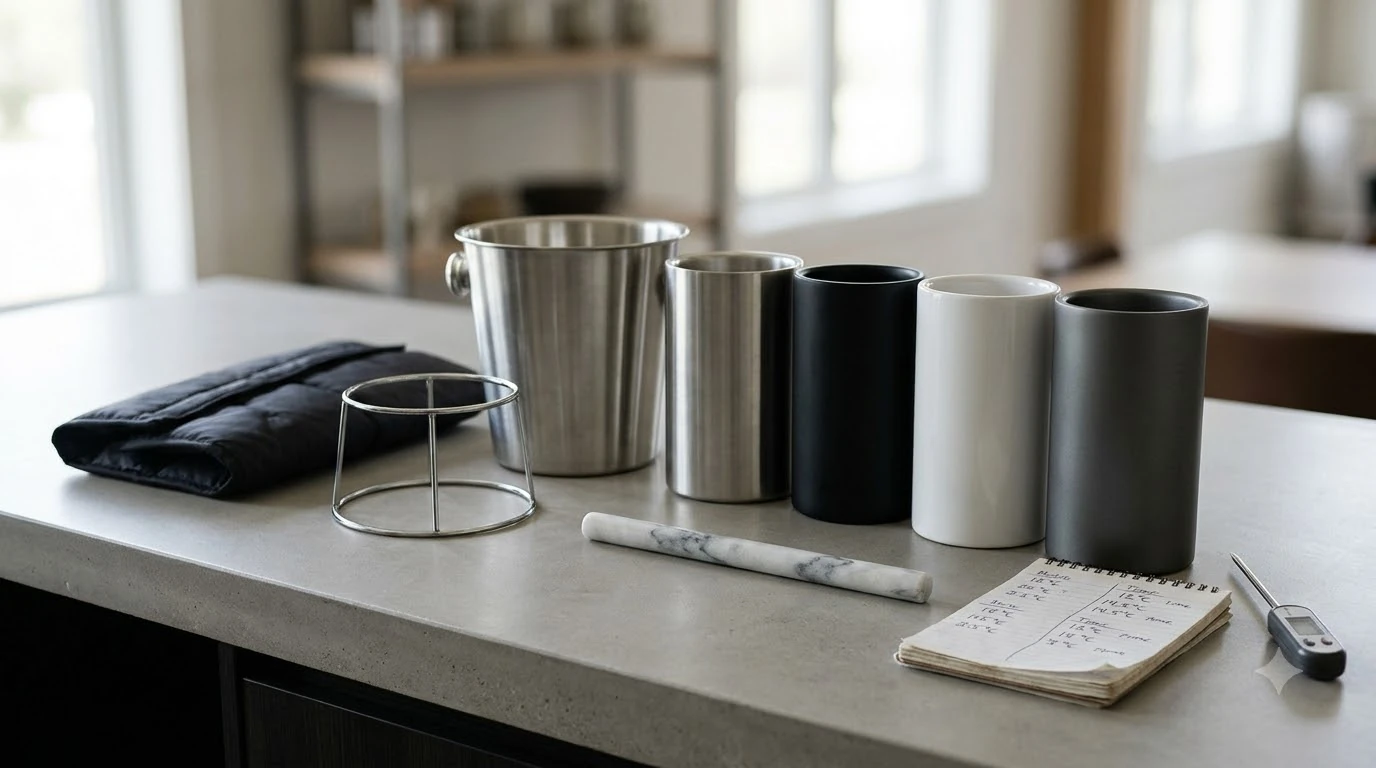
The word “chiller” can also describe different tools. The Cuisinart is a powered storage cabinet, while an instant wine chiller is intended to cool a bottle on demand and a marble wine chiller helps a pre-chilled bottle stay cool at the table. These accessories solve different problems, not the same eight-bottle storage job; shoppers comparing powered storage can also review the site’s electric wine chiller category and the broader Accessory Brands index.
The Cuisinart’s strongest advantage remains the balance of size and features. Its 8-bottle capacity, 39°F-to-68°F range, and thermoelectric system suit a modest rotation and buyers who value quiet operation. Its weakest points are equally clear: one temperature for all bottles, dependence on room conditions, and racks that may be tight for wide bottles. A larger dual-zone alternative takes more space, but it solves the temperature-splitting problem that this model cannot.
Frequently Asked Questions
These answers cover practical details that often come up after comparing the CWC-800CEN’s headline specifications with its day-to-day use. They focus on fit, maintenance, and small operating questions that are easy to overlook before setting up the cabinet.
Can the CWC-800CEN hold an opened bottle with a stopper?
One Best Buy owner specifically reported that the cabinet was deep enough for an opened bottle fitted with a vacuum stopper. That is useful owner feedback, but it does not guarantee clearance for every stopper shape or bottle length.
Can the interior light be switched off?
Yes. Best Buy owner feedback describes the interior light as something that can be left on or turned off, so the display lighting does not have to remain on continuously.
Does Cuisinart list replacement parts for this cellar?
Cuisinart’s product page lists a rack and a water tray among the parts and accessories for the Private Reserve wine cellar. That is helpful for owners looking for a named replacement component instead of assuming the shelves and tray are permanently unavailable.
Is condensation always a sign that the cooler is failing?
No. The instruction booklet says moisture on the interior or exterior can be normal during periods of high humidity. It also identifies frequent or prolonged door openings and a poor door-gasket seal as other things to inspect if moisture keeps appearing.
Can the cabinet run frequently on hot or humid days?
The instruction booklet says frequent operation can be normal when the appliance is maintaining its temperature during hot and humid conditions. If the room is also near 80°F or warmer, however, the unit may have trouble reaching its coolest setting, so ventilation and room placement remain important.
The Cuisinart Private Reserve CWC-800CEN is a practical small wine cabinet when eight-bottle capacity, one shared temperature, and quiet thermoelectric operation match your routine. Its value depends on giving it the required airflow and choosing bottles that fit the racks, rather than expecting a dual-zone cellar or rapid bottle chiller. For a compact home bar with a modest wine rotation, it is a reasonable option; for a varied collection or a hot installation space, compare larger or dual-zone designs first.
More in Wine Accessories
 Coravin Vs Vacu Vin: Choose the Right Wine Saver for Your BottlesUpdated Nov 21, 2026
 Zwilling Wine Stopper Review: Preserve Open Bottles LongerUpdated Nov 21, 2026
 Wine Enthusiast Wine Preserver Review: Features, Benefits and LimitationsUpdated Nov 21, 2026
 Wine Enthusiast Wine Stopper: An Easier Way to Reseal Open BottlesUpdated Nov 21, 2026
 Vintorio Wine Opener: Two-Step Cork RemovalUpdated Nov 21, 2026
 Zwilling Wine Aerator Review: Aerate, Pour, and Seal With One ToolUpdated Nov 21, 2026