

We may earn a commission when you buy through links on this page, at no extra cost to you. Learn more.
The Houdini corkscrew is a practical manual wine opener for everyday bottle opening, with a stable bottle-clamping design, a non-stick spiral, and two lifting arms that help extract corks with relatively little effort. The Houdini Winged Corkscrew is particularly suitable for beginners who prefer a familiar twisting mechanism over a complicated lever system. Its dishwasher-safe construction and straightforward operation are attractive advantages, although the absence of an included foil cutter and occasional cork splintering are worth considering before buying.
Choosing a wine opener should be about more than appearance. A useful corkscrew needs to grip the bottle securely, enter the cork cleanly, and remove it without requiring excessive force or leaving fragments behind. Houdini offers several wine-opening accessories, including winged, lever, and electric designs. This review focuses on the manual Houdini Winged Corkscrew, examining its specifications, operation, reported performance, limitations, and suitability for different wine drinkers.
Specs and Key Features
The Houdini Winged Corkscrew is a compact manual opener built around a familiar two-arm mechanism. Its main distinction is a bottle-clamping design intended to keep the spiral centered over the cork while the user turns the handle.

According to Target’s Houdini Winged Corkscrew product specifications, the opener measures 1.06 inches long, 7.87 inches high, and 3.35 inches wide. Its listed weight is 0.67 pounds, making it substantial enough to handle comfortably without being an especially large piece of bar equipment. The combination of ABS plastic, zinc, iron, and steel gives the opener a mixture of lightweight body construction and metal operating components.
| Specification | Houdini Winged Corkscrew |
|---|---|
| Product type | Manual winged corkscrew |
| Length | 1.06 inches |
| Height | 7.87 inches |
| Width | 3.35 inches |
| Weight | 0.67 pounds |
| Materials | ABS, zinc, iron, and steel |
| Power source | Manual |
| Battery requirement | None |
| Spiral | Non-stick design |
| Additional function | Top-mounted bottle opener |
| Cleaning | Dishwasher-safe according to Target |
| Warranty | Five years according to Directions for Me |
One of the most useful design elements is the clamp that fits around the bottle neck. Instead of requiring the user to hold a separate opener in position while trying to maintain a straight angle, the mechanism helps stabilize the tool during insertion. This can make the first step more manageable for someone who has limited experience with winged corkscrews.
The non-stick spiral is another important feature. A corkscrew worm should penetrate the cork without tearing it apart unnecessarily. Houdini’s product description specifically identifies the spiral as a feature intended to reduce crumbling. However, that design objective does not mean every cork will remain completely intact, particularly if the cork is old, dry, or damaged.
The opener also has a bottle-opening function at the top. This gives it another practical use around the kitchen or bar, although it remains primarily a wine accessory. Its manual construction means there is no charging base, motor, or battery compartment to maintain.
It is important to distinguish this model from other products sold under the Houdini name. The Houdini Electric Corkscrew, for example, uses four AA batteries and a powered extraction mechanism. Those specifications do not apply to the winged model reviewed here.
What Owners Like
The Houdini Winged Corkscrew’s strongest appeal is its straightforward operating method. It combines a familiar twisting motion with lifting arms, giving beginners a relatively simple way to remove standard wine corks without mastering a professional waiter’s corkscrew.

In its comparison of wine openers, Shop TODAY evaluates the Houdini Wing Corkscrew as a beginner-friendly manual option. Its evaluation gave the opener 4 out of 5 for efficiency and 4 out of 5 for ease of use. Those results suggest that the design can work well for everyday opening, although they should be understood as editorial evaluation scores rather than a guarantee of identical performance in every household.
One detail highlighted in the Shop TODAY evaluation is that the arms naturally sit slightly raised. This helps users avoid accidentally holding the wings down while turning the central handle. That positioning matters because a common beginner mistake with winged openers is interfering with the arms before the spiral has reached the correct depth.
A more stable opening position
The bottle-clamping feature is particularly helpful when opening a bottle on a kitchen counter or dining table. Once the tool is properly positioned, the clamp helps keep the spiral aligned with the cork. A straight entry is important because an angled spiral can create unnecessary resistance and increase the chance of damaging the cork.
This feature also makes the opener easier to control than a basic winged corkscrew that simply rests on top of the bottle. The user still needs to hold the bottle securely, but the clamping mechanism reduces the amount of adjustment required during the twisting stage.
No electrical components to maintain
Another advantage is the absence of batteries or charging requirements. A manual opener can remain in a kitchen drawer for extended periods without losing its ability to operate because a battery has discharged. It also avoids the noise and motor-related maintenance associated with electric alternatives.
For people who open a bottle occasionally rather than several bottles every evening, this simplicity can be more valuable than a powered mechanism. There is no need to remember a charging schedule, locate a cable, or replace batteries before hosting a dinner.
Convenient cleaning
Target identifies the winged model as dishwasher-safe, which is convenient compared with accessories that require exclusively manual cleaning. The ability to clean an opener without complicated disassembly is useful in a household where wine accessories are used regularly.
Nevertheless, dishwasher-safe construction should not be confused with permission to soak every moving mechanism indefinitely. Removing visible cork residue and following the care instructions associated with the particular model remain sensible practices.
For readers comparing different opening mechanisms, our guide to the best Rabbit corkscrew provides another useful starting point. Rabbit-style lever designs offer a different approach for people who prioritize mechanical leverage over the traditional two-wing action.
Common Complaints
The Houdini Winged Corkscrew has several practical limitations, especially for people who expect a complete wine-opening kit or consistently perfect cork extraction. Its straightforward design is appealing, but it does not eliminate the difficulties associated with damaged corks or incorrect technique.
The clearest limitation identified by Shop TODAY is the absence of an included foil cutter. This means users need a separate foil-cutting tool or another suitable method for removing the capsule before opening a bottle. For someone assembling a complete wine accessory collection, that additional requirement is worth considering.
Cork splintering is still possible
Although Houdini describes the spiral as non-stick and designed to reduce cork crumbling, Shop TODAY observed mild splintering during its evaluation. The report also noted that no cork pieces entered the bottle during that evaluation.
This distinction matters. A non-stick coating can improve how a spiral moves through a cork, but it cannot restore the structure of a cork that has already become brittle. Older bottles, dry storage conditions, and corks with existing cracks can all make extraction more difficult.
For valuable aged bottles, a two-pronged wine opener or an appropriate specialized tool may be a better choice than a conventional winged design. Those accessories can offer a different approach when the cork is fragile and needs careful handling.
The wings require enough clearance
Winged corkscrews need vertical and horizontal space for their arms to rise. In a crowded bar cabinet or underneath a low kitchen shelf, the raised wings can make opening a bottle less convenient.
The Houdini’s listed height of 7.87 inches provides a useful indication of its overall size, but the operating position requires additional room above the bottle. Buyers who plan to use an opener inside a compact storage area should consider this before choosing a permanent location.
Technique still matters
The clamping feature does not make the tool completely automatic. The user must center the spiral, turn the handle in the correct direction, and push both wings down once they are upright. If the spiral enters at an angle or the bottle moves during extraction, the opening process can become less controlled.
People who dislike twisting movements may also prefer an electric or lever-style opener. The Houdini Winged Corkscrew reduces some of the difficulty of manual opening, but it does not remove the physical steps involved.
Tip: Remove the foil or capsule before positioning the Houdini Winged Corkscrew. Center the spiral directly over the cork, keep the bottle steady, and allow both wings to rise fully before pushing them down. This helps maintain alignment and reduces unnecessary stress on the cork.
Who Should Buy and Who Should Skip
The Houdini Winged Corkscrew makes the most sense for casual wine drinkers who want a reusable manual opener with a familiar operating mechanism. Its bottle-clamping feature, dishwasher-safe designation, and lack of batteries make it a practical option for an everyday kitchen or home bar.
It is particularly suitable for people who open conventional cork-finished bottles from regions such as Bordeaux, Burgundy, Napa Valley, and Tuscany. These bottles commonly use traditional cork closures, making a standard corkscrew a useful accessory for regular wine service.
Good choice for beginners
First-time wine opener buyers may appreciate the raised-arm mechanism because it provides a visible indication of how the extraction process works. Instead of relying entirely on a small hinged lever or learning the coordinated movements of a waiter’s corkscrew, beginners can use the two wings to generate the lifting motion.
The instructions also follow a clear sequence. Position the opener, turn the handle clockwise, allow the wings to rise, and push them down. This makes it easier to understand the process and repeat it consistently after a few uses.
Useful for casual entertaining
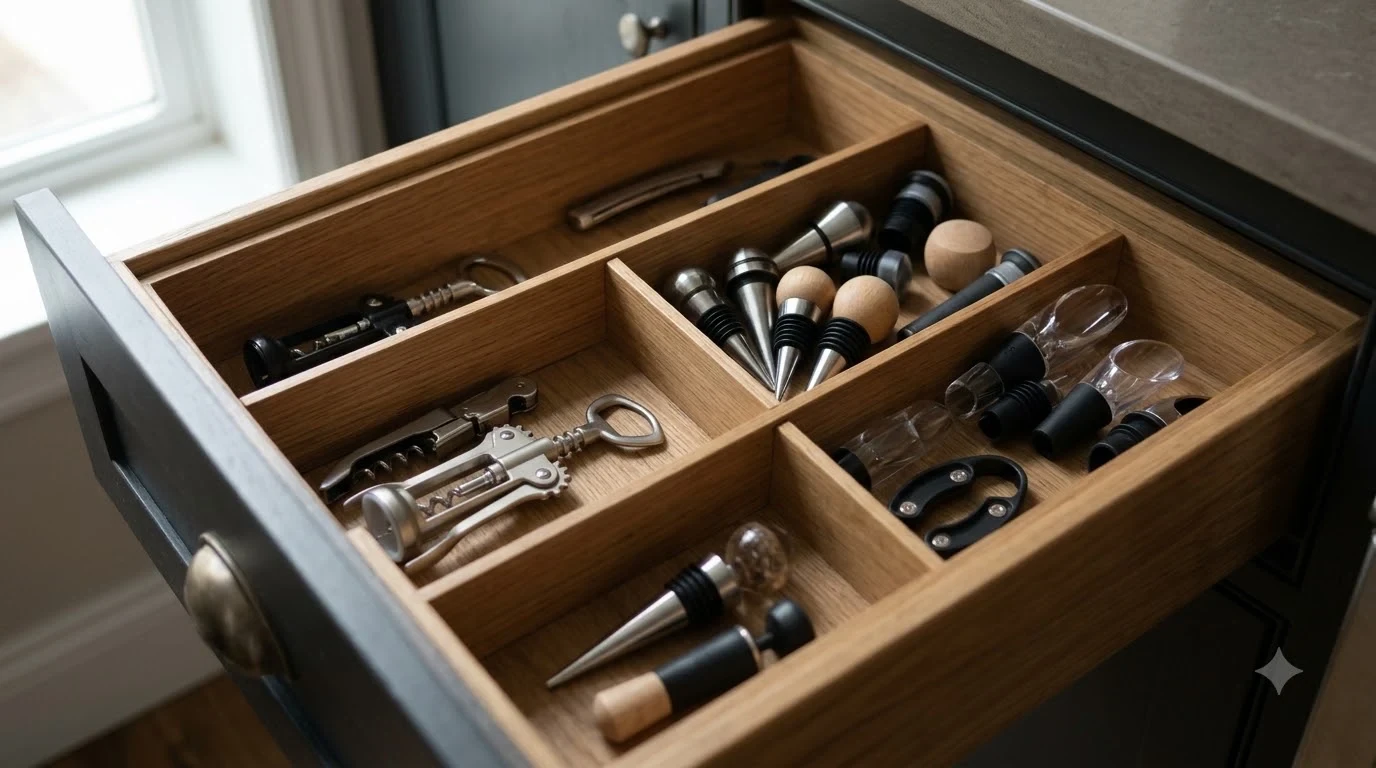
For a home bar that serves wine at occasional dinners, the Houdini can be a sensible addition. It does not need to be charged before guests arrive, and it can be stored alongside bottle stoppers, wine glasses, and serving accessories.
It also makes sense for people who prefer mechanical simplicity. A manual opener has fewer electrical components to worry about, and its operation is not dependent on a particular battery type or charging connection.
A dedicated bar cart can provide a convenient place to keep the opener, a foil cutter, and other serving essentials. Keeping these items together makes preparing a bottle easier when hosting guests.
Who should look elsewhere
Frequent wine drinkers who regularly open multiple bottles may prefer a lever-style opener. These models use a different mechanical arrangement and can reduce the repeated wrist movement involved in a winged design.
People who often open older bottles should also consider a specialized opener intended for fragile corks. A conventional spiral can place pressure on a weakened cork, even when it has a non-stick coating.
Finally, anyone expecting an all-in-one kit should remember that the winged model does not include a foil cutter according to Shop TODAY. Buyers who want the entire opening process handled with minimal effort may find a separate electric opener more appropriate.
How It Compares to Alternatives
The Houdini Winged Corkscrew competes with several established wine-opening styles rather than just one specific product. Its main advantage is the combination of a familiar two-wing mechanism and a bottle-clamping design, while alternative styles prioritize leverage, compactness, or powered operation.
Shop TODAY’s wine opener comparison includes winged, waiter-style, lever, and electric approaches. Those categories help explain where the Houdini belongs and why the right choice depends on how frequently someone opens wine and how much physical involvement they prefer.
Houdini winged versus a waiter-style corkscrew
A waiter’s corkscrew is a compact folding accessory with a spiral, foil-cutting blade, and hinged bottle-support lever. Its small size makes it convenient for restaurant service, travel, and storage in a kitchen drawer.
The Houdini is larger, with two raised arms that perform the lifting action. Beginners may find the winged mechanism easier to understand because the movement is visible, while experienced users often appreciate the compactness and portability of a waiter’s opener.
Another difference is that a double-hinged waiter’s corkscrew can provide two stages of leverage. This arrangement helps users extract longer corks without requiring one uninterrupted pulling movement.
Houdini winged versus lever corkscrews
Lever corkscrews use a larger handle and a mechanical action to drive the spiral into the cork and extract it. The user generally operates a lever rather than turning a central handle until two wings rise.
The Houdini Winged Corkscrew is therefore a more traditional choice. A lever opener can be preferable for someone who opens wine frequently and wants to reduce the amount of twisting involved, although lever models may take up more storage space.
Shop TODAY’s comparison also identifies the OXO Steel Vertical Lever Corkscrew as a manual alternative. Its review describes a mechanism that uses downward and upward handle movements to insert and extract the cork, rather than the winged action used by Houdini.
Houdini winged versus electric openers
Electric openers are designed for people who want powered cork extraction. Liquor.com describes the Houdini Electric Corkscrew as a battery-operated model that uses a down button to extract the cork and an up button to release it from the spiral.
That product uses four AA batteries and has a stainless steel construction. These features make it substantially different from the manual winged model, which does not require batteries.
Electric designs can be convenient during parties or for people who find manual opening difficult. However, the motor introduces another component that can require troubleshooting, and the opener may become unusable if its batteries run out.
Comparison at a glance
| Opener style | Main operating method | Best suited to |
|---|---|---|
| Houdini winged | Twisting handle and pushing two wings down | Casual home use and beginners |
| Waiter’s corkscrew | Manual spiral and hinged leverage | Travel and compact storage |
| Lever corkscrew | Mechanical handle movement | Frequent bottle opening |
| Electric corkscrew | Powered spiral extraction | Convenience and reduced manual effort |
There is no single winner for every household. Someone who opens a bottle on weekends may find the Houdini perfectly adequate, while someone serving wine regularly may value the speed and leverage of another design.
Readers interested in comparing different manual mechanisms can also explore our Rabbit corkscrew reviews. For a broader look at wine-serving equipment, the Accessory Brands section offers additional context when assembling a practical collection.
Frequently Asked Questions
These additional details help clarify how the Houdini Winged Corkscrew fits into a wider collection of wine accessories. They also address practical questions about compatibility, construction, and long-term ownership.
Does the Houdini Winged Corkscrew work with synthetic corks?
The standard spiral design is intended for extracting bottle corks, including many synthetic closures, but the available winged-model specifications do not provide a separate compatibility guarantee for every synthetic material. Synthetic corks can differ in density and surface friction, so extraction resistance may vary. Keeping the spiral centered and maintaining a steady bottle position helps during operation.
Can the Houdini corkscrew open bottles other than wine bottles?
The top of the Houdini Winged Corkscrew also functions as a bottle opener, providing a second use for bottles with conventional crown caps. This is separate from its cork-extraction mechanism. It should not be confused with a universal opener for screw-cap wine bottles, which do not require a corkscrew.
Is the Houdini Winged Corkscrew suitable for restaurant service?
It can serve occasional tableside bottle openings, but its relatively large winged construction is less compact than the folding waiter’s corkscrew commonly carried by restaurant staff. Professional servers may prefer a double-hinged opener because it fits easily into an apron pocket. The Houdini is more naturally suited to a stationary home bar or kitchen.
Does the Houdini corkscrew need replacement parts?
Spirals are wear components on corkscrews and may eventually need replacement if their coating or threading becomes damaged. The Rabbit and Houdini instruction document specifically discusses spiral replacement after repeated use. Availability of a replacement spiral for a particular winged model should be confirmed with the manufacturer rather than assumed from instructions for another model.
Where is the Houdini Winged Corkscrew manufactured?
Directions for Me lists the country of manufacture for the winged model as China and identifies RABBIT as its manufacturer. This is a product-specific detail rather than a statement about every accessory sold under the Houdini name. Different Houdini models can have different materials, manufacturing details, and product specifications.
The Houdini Winged Corkscrew is a sensible choice for wine drinkers who want a straightforward manual opener with a stabilizing clamp and an easy-to-understand two-arm mechanism. Its main compromises are the missing foil cutter and the possibility of cork splintering, so buyers should consider their opening habits before choosing it. For occasional bottles and a practical home bar, its simple operation makes it a useful everyday accessory.
More in Wine Accessories
 Vinglace Wine Tumbler Review: A Glass-Lined Choice for Better SippingUpdated Nov 20, 2026
 ZWILLING Electric Wine Opener Review: Features and DrawbacksUpdated Nov 20, 2026
 Vinturi Electric Wine Opener Review for Easy UncorkingUpdated Nov 20, 2026
 Vinabon Wine Aerator Review for Easier, Cleaner Wine ServingUpdated Nov 20, 2026
 Vacu Vin Electric Wine Opener Review: Easy Cork Removal for Home Wine LoversUpdated Nov 20, 2026
 Rabbit Wine Accessories for Easier Home Wine ServiceUpdated Nov 20, 2026