

We may earn a commission when you buy through links on this page, at no extra cost to you. Learn more.
How to choose a wine fridge depends on your collection size, preferred storage temperature, cooling system, and available installation space. For most home wine drinkers, a single-zone refrigerator set near 55°F provides dependable storage for red, white, rosé, and sparkling wines. If you regularly serve different wine styles and want bottles ready at different temperatures, a dual-zone model offers more flexibility. The best choice is a refrigerator that maintains stable conditions and fits the bottles you actually own.
A dedicated wine refrigerator can make a meaningful difference if your home lacks a consistently cool, dark place to keep bottles. Unlike an ordinary kitchen refrigerator, a wine fridge is designed around wine storage, with appropriate temperature settings, bottle racks, and features that help limit exposure to light and temperature fluctuations. However, capacity and appearance alone should not determine your purchase. Understanding how you plan to store and serve wine will help you choose an appliance that performs well over time.
1. Decide How Many Wine Bottles You Need to Store
Start by estimating the number of bottles you expect to keep in the refrigerator, rather than buying according to the largest collection you might eventually own. A compact unit can work for occasional wine drinkers, while regular collectors benefit from additional storage space and room for different bottle shapes.
Wine refrigerator capacities are generally advertised using standard 750 ml Bordeaux-style bottles. This measurement can be misleading if your collection includes wide Burgundy bottles, Champagne, sparkling wine, or larger formats. These bottles take up more shelf space and can reduce the refrigerator’s practical capacity.
For example, a refrigerator advertised for 30 bottles might not accommodate 30 bottles if most of your collection consists of wide sparkling wine bottles. The same problem occurs when fixed shelves leave insufficient clearance for bottles with unusually long necks or broad shoulders.
Choose capacity based on your buying habits
Think about how frequently you purchase wine and how long you normally keep it. Someone who buys four or five bottles at a time and drinks them within a few months has different storage requirements from someone who regularly purchases cases and saves bottles for special occasions.
Consider these approximate capacity categories when comparing refrigerators:
- 6–12 bottles: Suitable for occasional drinkers, small apartments, and limited kitchen space.
- 12–24 bottles: A practical option for households that keep several wine styles available throughout the week.
- 25–50 bottles: Useful for regular wine enthusiasts who maintain a varied selection.
- 50–100 bottles: Better suited to growing collections and households that frequently purchase wine by the case.
- 100–200 bottles: Designed for substantial home collections that require dedicated storage space.
These are planning categories rather than universal appliance classifications. Actual capacity depends on shelf spacing, bottle dimensions, and refrigerator design. A 24-bottle refrigerator with individual sliding racks may offer easier access than a larger model that relies on tightly stacked bottles.
It is sensible to leave some room for future purchases, but excessive unused capacity is not automatically beneficial. A much larger refrigerator takes up more floor or cabinet space and may consume more electricity than necessary.
Before buying, count your current bottles, consider how many you expect to add, and account for the bottle shapes you purchase most frequently. This simple exercise provides a more realistic capacity target than relying on the manufacturer’s headline number alone.
2. Choose Between Single-Zone and Dual-Zone Cooling
A single-zone wine fridge maintains one general temperature throughout its storage compartment, making it a straightforward option for long-term storage. A dual-zone model provides two separately controlled temperature areas, which is particularly useful if you regularly serve red and white wines.
For long-term storage, approximately 55°F is a practical target for a mixed wine collection. Red, white, rosé, and sparkling wines can all be stored at this temperature, even though their ideal serving temperatures differ.
A single-zone refrigerator is often the better choice for someone who primarily wants to preserve bottles rather than serve them directly from the appliance. It also avoids the need to divide a limited collection between separate compartments.
When a single-zone refrigerator makes sense
Choose a single-zone model if you collect wine for future enjoyment, purchase mostly one style, or prefer a simple storage arrangement. Setting the entire refrigerator near 55°F provides a consistent environment without requiring separate temperature adjustments.
This arrangement also works well for collectors who buy both red and white wine but do not mind chilling or warming bottles before serving. A white wine can spend some additional time in a kitchen refrigerator before dinner, while a light red can warm slightly after being removed from storage.
When a dual-zone refrigerator is useful
A dual-zone refrigerator is more convenient for households that regularly drink different wine styles and want them close to serving temperature. For example, one compartment can hold full-bodied reds around 60–65°F while another keeps light whites and rosé around 45–50°F.
Some appliances place the warmer compartment above the cooler compartment, while others use side-by-side sections. The arrangement varies, so examine the actual compartment layout instead of assuming that every dual-zone refrigerator works the same way.
Also consider how many bottles each zone can hold. A refrigerator with two zones may advertise an attractive total capacity but offer relatively little usable space in either individual section.
Dual-zone cooling is not automatically better for every household. If you rarely drink chilled white wine or sparkling wine, the additional compartment may provide little practical benefit. A reliable single-zone refrigerator may be a more sensible purchase.
3. Understand Wine Storage and Serving Temperatures
Temperature control is one of the most important features of a wine refrigerator because prolonged heat and repeated temperature fluctuations can damage wine. A stable storage temperature near 55°F is suitable for a broad range of wine styles, while serving temperatures vary according to body, sweetness, and style.

It is important not to confuse a wine’s storage temperature with the temperature at which it should be poured. A bottle stored at 55°F may need additional chilling before serving, while a full-bodied red might benefit from a little time outside the refrigerator.
The following reference shows how to plan storage and serving temperatures using the typical ranges for different wine styles.
| Wine style | Typical storage temperature | Serving temperature |
|---|---|---|
| Sparkling wine | 55°F | 40–50°F |
| Light white wine | 55°F | 45–50°F |
| Rosé | 55°F | 45–50°F |
| Full-bodied white wine | 55°F | 50–55°F |
| Light-bodied red wine | 55°F | 55–60°F |
| Full-bodied red wine | 55°F | 60–65°F |
| Sweet white wine | 55°F | 43–50°F |
For example, a Sauvignon Blanc generally benefits from serving temperatures between 45°F and 50°F, while a Cabernet Sauvignon is usually better served between 60°F and 65°F. A bottle of Champagne can be stored near 55°F but should be chilled further before pouring.
Temperature stability is more important than repeatedly changing the refrigerator setting to match individual bottles. A unit that maintains its selected temperature consistently is preferable to one that frequently fluctuates between warm and cold conditions.
Look for accurate temperature controls
Digital temperature controls make it easier to set and monitor the refrigerator. They are particularly helpful when you want to maintain a specific storage temperature without opening the door repeatedly.
Pay attention to the appliance’s actual operating range. Some wine refrigerators cannot reach sufficiently cool temperatures for serving sparkling wine, while others may not maintain a sufficiently warm setting for a dedicated storage environment.
Also consider temperature distribution inside the cabinet. In some single-compartment refrigerators, colder air settles toward the bottom, creating differences between upper and lower shelves. This may be acceptable for general storage, but a more uniform interior is preferable when consistency matters.
Tip: For a mixed collection intended primarily for storage, start with approximately 55°F rather than trying to assign every grape variety a separate storage temperature. Use additional chilling or warming shortly before serving.
4. Compare Compressor and Thermoelectric Cooling Systems
Wine refrigerators commonly use either compressor-based or thermoelectric cooling. Both systems can be suitable for home wine storage, but they differ in cooling strength, operating noise, vibration, and performance in warm rooms.
Your choice should depend on the appliance’s location, the number of bottles you intend to store, and the temperature conditions in your home.
Compressor wine refrigerators
Compressor cooling works similarly to the system used in a conventional refrigerator. A refrigerant circulates through the cooling components to remove heat from the cabinet and maintain the selected temperature.
The main advantage is cooling performance. Compressor refrigerators generally handle larger capacities and warmer surrounding environments better than small thermoelectric models. They are often the more practical choice for a household that needs substantial storage or lives in a warm climate.
The disadvantages include operating noise, mechanical vibration, and potentially greater energy consumption. However, these drawbacks vary between appliances, and compressor technology is not automatically unsuitable for wine storage.
Thermoelectric wine refrigerators
Thermoelectric models use an electronic cooling system rather than a conventional compressor. They are commonly found in smaller appliances intended for relatively quiet indoor environments.
Because they have fewer moving mechanical components, thermoelectric refrigerators generally operate quietly and produce less vibration from their cooling mechanism. This can make them attractive for placement in a living room, dining area, or home office.
However, their cooling capacity is more limited. Thermoelectric units typically struggle to maintain sufficiently low temperatures when the surrounding room becomes hot. They also tend to be better suited to smaller collections than large-capacity compressor refrigerators.
In a warm kitchen or an area without reliable air conditioning, a compressor model is usually the safer choice. For a small collection in a consistently cool room, a thermoelectric appliance may offer adequate performance.
Which cooling system should you prioritize?
Do not select a refrigerator solely because its product description advertises low vibration or quiet operation. Its ability to maintain a stable internal temperature under your home’s actual conditions is more important.
It is also useful to distinguish between vibration reduction and complete vibration elimination. Fans, compressors, and other operating components can all create some movement. Well-designed shelves and vibration-reducing mounting systems can help limit transmission to stored bottles.
The discussion of vibration and wine quality is not entirely settled. The practical approach is to select a well-built refrigerator, avoid unnecessary movement, and prioritize reliable cooling over marketing claims about a particular technology.
For an additional comparison of the technical features involved, CHOICE’s wine refrigerator buying guide discusses cooling systems, temperature zones, humidity, and bottle storage considerations.
5. Check Humidity, UV Protection, and Bottle Shelving
A good wine refrigerator should do more than cool bottles. It should also provide practical protection against excessive light exposure, unsuitable humidity, and unnecessary handling. These features become particularly important when storing cork-sealed bottles for extended periods.
Humidity control and cork preservation
Humidity affects the condition of natural cork closures. If the surrounding air becomes excessively dry over a long period, corks can lose moisture and potentially shrink, increasing the risk of unwanted air exchange.
Many wine refrigerators include a humidity-management feature or a small water reservoir. Some systems require occasional refilling, while others rely on the refrigerator’s internal design to maintain a more suitable environment.
A relative humidity level around 60–70% is a useful reference for cork-sealed wine storage. However, not every home wine refrigerator includes precise humidity controls, and the feature may be less important for collections dominated by screw-cap bottles.
Excessive humidity is not desirable either. Persistent moisture can encourage mold growth on labels, packaging, and interior surfaces. A balanced environment is preferable to simply maximizing humidity.
UV-protected doors and interior lighting
Light exposure can contribute to premature wine deterioration. Ultraviolet radiation is particularly undesirable, which is why many wine bottles use dark glass to provide additional protection.
If your refrigerator will sit in a bright kitchen or near a window, look for UV-protected glass or a solid door. Double- or triple-pane construction may also provide additional insulation, depending on the appliance design.
Interior LED lighting is another useful feature because it helps you identify bottles without leaving the door open for extended periods. Choose lighting that can be switched off or kept dim when the refrigerator is not in use.
Evaluate the shelving system
Shelves determine how easily you can retrieve bottles and how efficiently the refrigerator uses its interior space. Sliding wooden racks are popular because they provide convenient access and can reduce direct contact between bottles and metal shelving.
Look for shelves that move smoothly and include stops to prevent them from sliding completely out. A shelf that becomes unstable when fully extended can make retrieving a bottle unnecessarily difficult.
Adjustable shelving is especially valuable if you regularly buy Champagne, Burgundy, or other bottles that differ from the standard Bordeaux shape. A removable shelf can also create room for larger formats or unusually tall bottles.
Individual bottle compartments make organization easier, but bulk stacking can increase total capacity. Decide whether convenient access or maximum bottle storage is more important for your collection.
Additional features worth considering include a door lock, reversible door hinges, a digital temperature display, and an interior light. These features do not replace reliable cooling, but they can make everyday use more convenient.
6. Measure Your Installation Space and Check Ventilation
Before purchasing a wine refrigerator, decide exactly where it will be installed and whether the appliance is designed for that location. Freestanding and built-in refrigerators have different ventilation requirements, and confusing the two can lead to cooling problems.
Freestanding wine refrigerators
Freestanding models are designed to operate independently rather than being enclosed inside kitchen cabinetry. Depending on their construction, they may release warm air through rear or side vents.
These appliances need sufficient clearance around their ventilation areas. Placing a freestanding refrigerator inside a tight cabinet can restrict airflow, cause excessive heat buildup, and make it harder for the cooling system to maintain its target temperature.
They are useful for utility rooms, dining spaces, home bars, and other locations where an independent appliance is practical. Their portability also makes them easier to relocate if your home layout changes.
Built-in and under-counter wine refrigerators
Built-in models are designed for installation within cabinetry or underneath kitchen counters. They generally use front ventilation, allowing warm air to escape through the designated front grille.
This makes them a better choice for fitted kitchens, kitchen islands, and custom home bars. Their dimensions are particularly important because an appliance that is slightly too wide or tall may not fit the available opening.
Measure the installation space in at least three dimensions: width, height, and depth. Remember to account for the door swing, handle projection, power outlet, and any clearance requirements specified by the manufacturer.
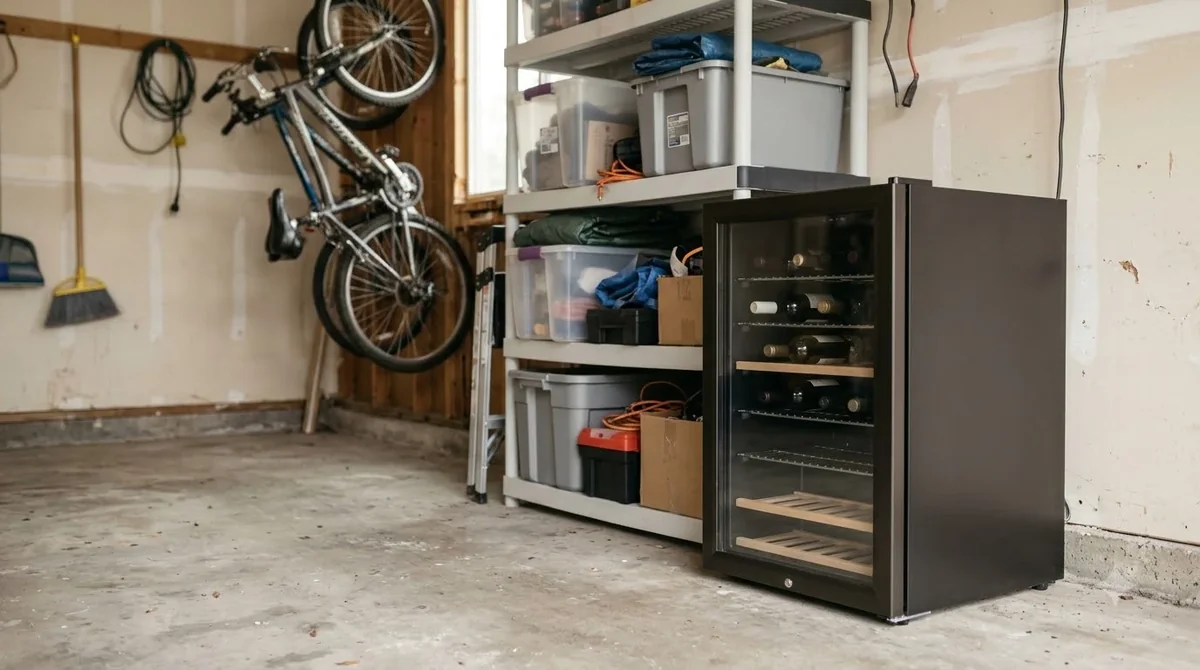
Also consider the surrounding environment. A refrigerator placed beside an oven, radiator, or sunny window may have to work harder to maintain its internal temperature. An enclosed garage or attic can present similar problems because temperatures may change considerably throughout the day.
Noise, accessibility, and everyday use
If the refrigerator will be installed near a living room or bedroom, noise should be part of your decision. Compare published operating noise specifications and consider whether the appliance will be running in a space where a continuous hum could become distracting.
Door orientation also matters. A reversible door can help when the refrigerator must fit into a narrow kitchen layout. Make sure you can open it comfortably and pull out the shelves without hitting nearby cabinets or furniture.
For more details about the differences between installation styles and appliance features, Abt’s wine refrigerator buying guide explains freestanding and built-in designs, cooling zones, capacity, and other useful specifications.
When planning your storage space, remember that the refrigerator should make it easier to access and organize your wine, not create another inconvenient household appliance.
7. Match the Refrigerator to Your Wine Storage Routine
The best wine fridge is not necessarily the largest or most expensive model. It is the appliance that suits your drinking habits, storage duration, collection size, and available space while maintaining reliable conditions.
Before making a purchase, compare the specifications that affect daily use rather than concentrating on appearance or advertised capacity alone.
Choose according to how you drink wine
If you purchase a few bottles each month and generally drink them soon afterward, a compact single-zone model may be sufficient. It can keep a small selection organized and provide a stable environment without taking up excessive room.
If your collection includes several styles and you frequently entertain guests, a dual-zone refrigerator may offer more convenience. Keeping sparkling wine and Sauvignon Blanc in a cooler section while maintaining a warmer area for Cabernet Sauvignon can reduce preparation time before serving.
Collectors who plan to hold bottles for several years should place greater emphasis on temperature consistency, suitable humidity, UV protection, and storage capacity. A refrigerator intended mainly for serving convenience may not offer the same features as a dedicated wine storage cabinet.
Think about long-term storage
Wine storage is not simply a matter of making bottles cold. Stable conditions help limit premature aging and preserve the character of wines intended for future enjoyment.
Keep bottles on their sides when using traditional cork closures so the cork remains in contact with the wine. Store the refrigerator near 55°F for general collection storage, avoid direct sunlight, and minimize unnecessary movement.
Not every wine benefits from years of aging. Many everyday whites, rosés, and light-bodied reds are intended for relatively early consumption. A wine refrigerator helps maintain suitable conditions, but it cannot make every bottle improve indefinitely.
If aging is a central reason for purchasing an appliance, consider whether its temperature stability and construction are appropriate for extended storage. The article can you age wine in a wine fridge explains the conditions that matter when keeping bottles for longer periods.
Make a practical pre-purchase checklist
Use the following checklist to compare shortlisted appliances. A model that satisfies the essential requirements is generally a better choice than one that offers numerous decorative features but falls short on cooling performance.
- Does the refrigerator have enough usable capacity for your collection?
- Can it accommodate Champagne and other wide bottles?
- Does its temperature range cover your intended storage requirements?
- Would a single-zone or dual-zone design be more useful?
- Is the cooling system suitable for the room’s typical temperature?
- Does the appliance offer suitable humidity management for cork-sealed bottles?
- Are the doors and shelves designed to reduce light exposure and make access convenient?
- Is the unit freestanding or built-in, and does your installation space support that design?
- Are ventilation, door clearance, noise, and electricity requirements acceptable?
- Does the refrigerator leave enough room for future additions to your collection?
It is also helpful to consider what happens if the refrigerator loses power or develops a cooling problem. An appliance with a clear temperature display and a visible warning system makes it easier to identify potential issues before they affect your collection.
For smaller collections, there may be no need to purchase a dedicated refrigerator immediately. A cool, dark storage area with relatively stable temperatures can be an alternative. The article how to store wine without a wine fridge covers practical options for households without dedicated wine storage equipment.
For additional wine fundamentals, including storage and serving practices, explore the site’s Wine Q&A resource.
Frequently Asked Questions
Can I put an ordinary kitchen refrigerator to use for long-term wine storage?
An ordinary kitchen refrigerator is generally colder than the approximately 55°F target used for general wine storage. Its frequent door openings can also create changing internal conditions. It can still be useful for temporarily chilling bottles before serving, but a dedicated wine refrigerator is more suitable for maintaining a collection over extended periods.
Should wine bottles always be stored horizontally in a wine fridge?
Horizontal storage is particularly useful for bottles sealed with natural cork because it keeps the cork in contact with the wine. Screw-cap bottles do not require this arrangement for cork-moisture reasons. Some wine refrigerators include upright display positions, which are useful for bottles intended for relatively short-term storage or presentation.
How long can an unopened bottle remain inside a wine refrigerator?
There is no single storage duration that applies to every wine. Many everyday wines are best enjoyed within a few years of release, while suitable age-worthy wines can develop over considerably longer periods. The grape variety, winemaking style, vintage, closure, and storage conditions all influence how long a bottle remains suitable for drinking.
Does opening the wine fridge door damage the wine?
Occasional door openings are a normal part of using a wine refrigerator and do not automatically damage the bottles. The concern is repeated or prolonged exposure that makes the appliance work harder to restore its internal temperature. Keeping bottles organized and closing the door promptly helps reduce unnecessary temperature changes.
Can I store wine glasses and other beverages in a wine refrigerator?
Some models include dedicated compartments or adjustable shelves for accessories, but available space depends on the appliance design. Ordinary beverage cans and other drinks may also fit if the shelving accommodates them. However, mixing food and strongly scented items with wine is best avoided because unwanted odors can affect the storage environment, particularly in appliances with limited ventilation.
Choosing the right wine refrigerator starts with understanding your collection, preferred storage conditions, and available installation space. For most households, a reliable single-zone model maintained near 55°F is an effective starting point, while frequent entertainers may benefit from dual-zone cooling. Prioritize stable temperatures, appropriate bottle capacity, good shelving, and suitable ventilation to keep your wine organized and ready for future enjoyment.
More in Wine Basics
 What Is The Best Wine For Mimosas? Choose Bubbly That Balances Orange JuiceUpdated Nov 20, 2026
 Which Prosecco Is Best for Your Taste and OccasionUpdated Nov 20, 2026
 Which Wine Is Best For Health? Understand the Risks and BenefitsUpdated Nov 20, 2026
 Which Champagne Is Best for Your Taste and OccasionUpdated Nov 20, 2026
 What To Put In A Wine Gift Basket For A Thoughtful, Memorable GiftUpdated Nov 20, 2026
 What Is the Best Wine for Mulled Wine? Choose a Smooth, Fruity RedUpdated Nov 20, 2026