

We may earn a commission when you buy through links on this page, at no extra cost to you. Learn more.
Grenache is most likely from Aragón in northeastern Spain, where it is known as Garnacha—the clearest answer to where is grenache from. From that Iberian home, the grape spread across the western Mediterranean and became closely associated with southern France, especially the Rhône and Roussillon. Its origin is sometimes debated because Sardinia has a long-standing Cannonau tradition, but genetic and botanical evidence points more strongly to Spain.
Grenache is now planted far beyond its original range, from Priorat and Châteauneuf-du-Pape to Australia and California. Knowing where it began helps explain why the same grape can produce juicy, fruit-forward reds, structured blends, pale rosés, and sweet fortified wines.
Grenache Began in Aragón, Northeastern Spain
The strongest case places Grenache’s birthplace in Aragón, the inland region of northeastern Spain. The grape is called Garnacha in Spanish, and its ability to ripen in a warm, dry Mediterranean climate helps explain its long association with this part of the Iberian Peninsula.
Aragón is more than a point on a map: it is a broad inland region with a range of vineyard settings, including the wine areas of Cariñena, Campo de Borja, and Calatayud. These districts remain important reference points for Garnacha today. Their wines show why it is useful to look beyond Grenache’s French reputation: in Spain, the grape can stand on its own as a varietal red rather than serving only as a blending partner.
The exact moment the variety first appeared is not known. An origin history published by Garnacha-Grenache.com describes botanical evidence from Aragón and reports seeds and leaves carbon-dated to 153 BCE, while identifying 1513 as the first known written reference to Garnacha. Those dates are evidence of a long history, not proof that the grape was domesticated in a specific year. Grapevines were cultivated and moved for generations before written records consistently named individual varieties.
The Spanish name is a useful clue on a label: Garnacha from Aragón is the same red grape that a French bottle calls Grenache. Cannonau is its local name in Sardinia, which helps explain why its origin story can look different across wine traditions.
How Garnacha Spread Across the Mediterranean
Grenache moved beyond Aragón as people, trade, and political rule connected the western Mediterranean. The grape became established in southern France and on Mediterranean islands, where different languages and local wine traditions gave it different names and uses.
During the 14th and 15th centuries, the Crown of Aragón expanded across parts of the Mediterranean. The historical route is often used to explain Garnacha’s movement toward Roussillon and southern France, Sardinia, parts of Italy, and Greece. The Pyrenees did not prevent the grape from crossing into what is now France; instead, the neighboring regions developed a shared viticultural history. The French name Grenache became the best-known international form, while Garnacha remained the everyday name in Spain.
In southern France, the grape found a role in blends that needed ripe fruit, body, and alcohol. VinePair describes Grenache’s rise in the southern Rhône as a response to winemakers seeking a variety that could round out blends. Châteauneuf-du-Pape became the best-known example. The appellation’s rules developed over time: VinePair recounts an early list of 10 varieties, a list of 13 when the AOC rules were established in 1936, and a later expansion to 18 permitted varieties.
This history separates birthplace from fame: Aragón is the likeliest origin, while the southern Rhône gave Grenache a global identity through wines such as Châteauneuf-du-Pape. Its French success did not erase its Spanish roots; it gave the variety a second major home.
Why Sardinia Is Part of the Origin Debate
Sardinia has a serious claim in the Grenache story because the island has cultivated the grape for centuries under the name Cannonau. The historical record is not simple, but modern genetic comparisons give Spain the stronger case as the original home.
Sardinia was under the rule of Aragón from 1297 to 1713, a long period during which vines and other crops could move between the Iberian Peninsula and the island. WSET’s analysis of Grenache’s origins notes that Garnacha and related names appear in both Spain and Sardinia in sixteenth-century documents. That leaves room for competing local histories: Sardinian growers can point to a deep Cannonau tradition, while Spanish regions can point to wider genetic diversity among their old Garnacha vines.
WSET summarizes three genetic clues that favor Spain. Spanish vineyards contain the major color forms and the downy-leafed form of the variety; Spanish populations show greater clonal diversity; and the grape groups genetically with old Spanish varieties such as Airén and Verdejo rather than with Sardinian varieties. WSET also notes a remaining gap: researchers have not established a parent-offspring relationship with another grape variety. The evidence therefore supports Spain strongly without making every historical detail certain.
For wine drinkers, the distinction is practical as well as historical. A Sardinian bottle labeled Cannonau is not a different grape from Grenache simply because the name changes. The island’s versions often make the variety the central feature of the wine, while French examples are frequently associated with appellation blends. Comparing Garnacha, Grenache, and Cannonau side by side is a useful way to see how climate, local practice, and winemaking shape a shared variety.
Spain’s Main Garnacha Regions Today
Spain remains the grape’s historical heartland, with important plantings in Aragón, Catalonia, Navarra, and Rioja. The label’s region can tell you whether to expect a concentrated single-variety red, an ageworthy blend, or a fresh rosé.
In Aragón, Cariñena, Campo de Borja, and Calatayud are key names to recognize. Garnacha is often bottled on its own in these districts, allowing the grape’s red-fruit character and the vineyard site to take the lead. Producers may work with old vines, lower yields, and careful extraction to make wines with more depth than the simple, easy-drinking style many people associate with the variety. The region’s hot, dry conditions also suit a grape that can ripen through a long growing season.
Catalonia offers a different point of reference in Priorat. There, Garnacha is a major component of serious red wines, often grown alongside Carignan on steep slopes and varied soils. Wine Enthusiast identifies Priorat as one of Spain’s leading regions for ageworthy Garnacha-based wines. In Navarra, Garnacha is used for both still reds and rosé, so the same region can provide a lighter, earlier-drinking style as well as a more substantial red.
Rioja gives Garnacha another role. Rather than always appearing alone, it is commonly blended with Tempranillo, where it can contribute ripe fruit and weight. That contrasts with Aragón’s single-variety bottlings and makes the label especially useful. For a direct look at Spanish wine geography, browse our guide to Wine by Type and compare Garnacha-based reds with other regional styles. The grape’s range is a reminder that a variety does not dictate one fixed flavor; place and blending choices matter.
Southern France Made Grenache Famous
Southern France is the grape’s most internationally recognized home, particularly the southern Rhône, Languedoc, and Roussillon. Grenache can be the leading red grape in a blend, a contributor to rosé, or the base for a sweet fortified wine.
In Châteauneuf-du-Pape, Grenache is the most common permitted variety and often leads the blend. Its ripe berry flavors and generous texture work alongside grapes such as Syrah and Mourvèdre. The broader southern Rhône also uses Grenache in appellations such as Gigondas and Vacqueyras, while the wines of Tavel and Lirac show how the grape can contribute to rosé. For readers comparing related Rhône varieties, our explanation of where is Syrah from clarifies the other major partner in many GSM blends.
Farther west, Languedoc and Roussillon have extensive Grenache plantings. In these Mediterranean areas, producers may blend it with Carignan, Cinsault, Syrah, and Mourvèdre. Roussillon also uses Grenache for dry still wines and for vins doux naturels, a category of naturally sweet fortified wines that includes Banyuls and Rivesaltes. This range is important: Grenache is not limited to dry red table wine, even though that is the style most commonly associated with the name.
Provence is another major region for Grenache, especially in pale rosé. The grape’s relatively thin skins make it useful for wines that emphasize red-fruit aromas without deep color or heavy tannin. Across the south of France, the local result depends on the appellation, the blend, and the winemaker’s choices. A Châteauneuf-du-Pape red and a Provence rosé may share Grenache as a central grape while offering very different weight, color, and structure.
Grenache Around the World and What It Tastes Like
Grenache spread well beyond Europe because it performs in warm, dry growing regions and can be made in several styles. France and Spain remain central to its identity, but Australia, the United States, and Sardinia have developed distinctive versions of their own.
In Australia, the Barossa Valley and McLaren Vale are important Grenache areas, with old-vine plantings that give the grape a strong local following. Decanter reports Barossa plantings dating to the 1840s. Australian examples may be bottled as single-variety reds or used in GSM blends with Shiraz and Mourvèdre. In the United States, Grenache appears in California, including Paso Robles and the Central Coast, as well as Washington State. These wines can show a balance of ripe fruit and savory notes, depending on the site and picking decisions.
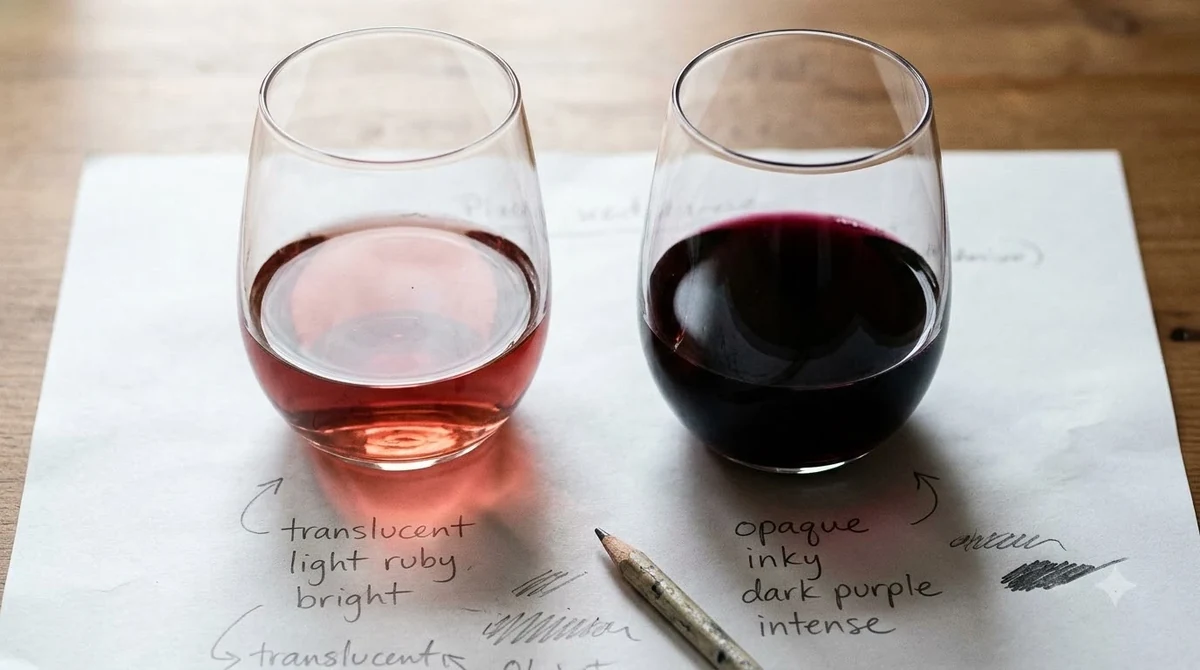
Grenache is typically medium- to full-bodied, with strawberry, raspberry, red cherry, and white-pepper notes. Dried herbs, licorice, and orange peel can appear, especially in more complex examples. The grape’s thin skins often lead to a paler color than people expect from a full-bodied red, and its tannins are generally softer than those in Cabernet Sauvignon. Warm growing conditions and a long ripening season can produce grapes with high sugar levels, which helps explain why finished wines can have relatively high alcohol.
Climate and winemaking set the style: a lighter Garnacha emphasizes fresh red fruit, while a warm-climate red can feel richer and more warming. In blends, Syrah adds darker fruit, color, and firmer structure, while Mourvèdre can add savory depth. Compare this with where is Merlot from and where is Port from to see how grape origin and wine style differ.
Choosing, Serving, and Pairing Grenache
Choose a Grenache by the style you want, not by the grape name alone. A young Spanish Garnacha, a southern Rhône blend, and a Sardinian Cannonau can share red-fruit flavors but differ in body, oak, alcohol, and savory character.
For a fresh, uncomplicated red, look for a straightforward Garnacha from Aragón or a lighter-framed Grenache from a cooler site. For more structure, consider Priorat, Châteauneuf-du-Pape, or a serious Barossa bottling. A GSM blend is a good option if you like Grenache’s fruit but want more dark-fruit depth and firmer structure from Syrah and Mourvèdre. For rosé, Navarra and Provence are useful regional signposts. Roussillon is the place to explore if you are interested in Grenache-based sweet fortified wines.
Serve a lighter Grenache at about 55–60°F and a fuller, more concentrated red at about 60–65°F. Slightly cool temperatures help keep ripe fruit lively and prevent alcohol from seeming too pronounced. Use a standard 5-ounce pour, and remember that a 750-milliliter bottle provides about five such glasses. Young, full-bodied reds can benefit from 30–60 minutes in a decanter, especially when they feel tight after opening.
| Wine style or context | Useful number | What it tells you |
|---|---|---|
| Grenache in Châteauneuf-du-Pape | 18 permitted varieties | Grenache is the leading variety within a broad appellation blend. |
| Châteauneuf-du-Pape AOC rules | 1936 | The AOC rules formalized a list of 13 varieties. |
| Serving a lighter red | 55–60°F | A cooler pour keeps fresh red-fruit styles lively. |
| Serving a fuller red | 60–65°F | A slightly warmer pour suits more concentrated examples. |
| Standard wine bottle | 750 ml | At 5 ounces per pour, one bottle yields about five glasses. |
Grenache pairs naturally with grilled lamb, roast pork, sausages, burgers, and flame-cooked vegetables. Its fruit suits browned or smoky flavors, while salt and fat soften tannin. A structured Grenache can work well with lamb shoulder or charcuterie, but high alcohol can make very hot chili dishes seem hotter.
Tip: When choosing between two bottles, use the region as your first clue: Aragón for varietal Garnacha, the southern Rhône for Grenache-led blends, Priorat for concentrated Spanish reds, and Provence for Grenache-based rosé.
Frequently Asked Questions
Grenache raises practical questions about its color forms, vineyard training, and cellar handling. The answers below add a few details that help distinguish the grape from the wines and regions that use it.
Is Grenache Blanc the same grape as red Grenache?
Grenache Blanc is the white-berried mutation known in Spain as Garnacha Blanca. WSET also identifies Garnacha Roja, a pinkish-gray form, and Garnacha Peluda, which has downy leaf undersides. These forms share the same DNA profile as Garnacha Tinta, the best-known red version.
Why are some Grenache vines trained as bush vines?
Garnacha has strong wood and an upright growth habit, traits that suit bush-vine training in hot, dry, windy vineyards. WSET notes that drought-resistant rootstocks can further improve its ability to cope with dry conditions. The training system is a vineyard choice, not a different grape variety.
Is Grenache vulnerable to spring frost?
Yes. Grenache buds early, which can expose young shoots to spring frost in regions where cold weather returns after budbreak. It can also suffer from coulure, a problem with flowering and fruit set that can reduce the crop.
Why do winemakers handle Grenache carefully in the cellar?
WSET describes Garnacha as particularly prone to oxidation and loss of its naturally light color. Careful oxygen management, including limiting unnecessary racking, helps protect freshness and color. The source also notes that new oak is relatively unusual because its strong flavors can mask the grape’s fruit.
When is International Grenache Day?
It is celebrated on the third Friday of September, a date chosen because Grenache is being harvested across much of the Northern Hemisphere. The first celebration followed a Grenache symposium held in the Rhône Valley in 2010, attended by more than 250 producers.
Grenache most likely began as Garnacha in Aragón, but its journey across the Mediterranean made it one of the most adaptable grapes in the wine world. Explore it by region—from Spanish Garnacha to Rhône Grenache and Sardinian Cannonau—and you will see how one variety can tell several different stories.
More in Wine Types & Grapes
 What Does Mourvèdre Taste Like? Flavor Profile, Regions, and PairingsUpdated Nov 20, 2026
 What Does Marsanne Taste Like? Flavors, Styles, and Food PairingsUpdated Nov 20, 2026
 What Does Malvasia Taste Like? Styles, Flavors, and Food PairingsUpdated Nov 20, 2026
 What Does Grenache Blanc Taste Like? Flavor Profile, Styles, and PairingsUpdated Nov 20, 2026
 What Does Garnacha Taste Like? Key Flavors, Styles, and Pairing TipsUpdated Nov 20, 2026
 What Does Fruit Wine Taste Like? A Complete Flavor and Style BreakdownUpdated Nov 20, 2026