

We may earn a commission when you buy through links on this page, at no extra cost to you. Learn more.
Perrier Jouet wine means Champagne from the house founded in 1811 in Épernay, best known for its flagship Grand Brut and the prestige Belle Epoque bottle decorated with white anemones. The house built its reputation on Chardonnay from chalky vineyards and a dry, floral style that suits both celebrations and dinner tables. Most buyers start with the non-vintage Grand Brut, then move to the vintage Belle Epoque or the pink Blason Rosé. This guide covers the history, each bottle, serving and storage, and the foods that match.
Walk into a good restaurant and the most recognizable Champagne on the list is often the one with the white flowers. That bottle is the centerpiece of the brand, but the house offers more than a single showpiece. The sections below look at where the house came from, what goes into each bottle, and how to get the most from it at home.
Perrier Jouet Wine Starts With a Champagne House Founded in 1811
The house dates to 1811, when a married couple combined a love of nature with a Champagne business in Épernay. Their early choices still shape how the brand thinks about vineyards, vintages and dryness.
The house was founded by Pierre-Nicolas Perrier and Rose-Adélaïde Jouët, who married in 1810 and began producing Champagne the following year. According to the house’s own history page, she came from a cultured Norman merchant family, while he was a skilled vintner and botanist. That pairing of commercial ambition and interest in nature still defines how the brand describes itself, and it explains why art and botany appear so often in its marketing and its venues.
Their son Charles Perrier took over the business, and the family kept a focus on creative freedom and an unusual eye for the natural world. The house also has a record of firsts. VinePair notes that Perrier-Jouët was among the first Champagne houses to regularly stamp its corks with the vintage date, a practice that tied each bottle to one harvest and its weather. VinePair also credits the house with sharply reducing residual sugar in the 1830s, which helped set the stage for the drier Champagne most people drink today.
Royal patronage followed. VinePair reports that Queen Victoria granted the house a Royal Warrant in 1861. The founders were drawn to the Cramant and Avize areas of the Épernay region, where chalky soils shape the house’s Chardonnay. Readers comparing how large houses build their identities can also look at laurent perrier wine, which offers a useful parallel when you weigh one house’s style against another’s.
Grand Brut Is the House Style in One Bottle
Grand Brut is the flagship non-vintage bottling, and it shows the house style without relying on a single exceptional harvest. It blends the three classic Champagne grapes, with Chardonnay making up about a fifth of the mix.
Champagne falls into two broad camps. Vintage wines come from a single harvest the house judges exceptional, while non-vintage wines blend several years to hold a steady profile. Wine.com’s Champagne overview describes non-vintage cuvées as produced every year from a blend of several years, and Grand Brut follows that logic. That consistency is why the bottle works as a reference point for the rest of the range.
VinePair’s guide calls Grand Brut the flagship style of the house. The blend uses Chardonnay, Pinot Noir and Pinot Meunier, and Chardonnay makes up about 20 percent of it. VinePair links the wine’s floral, delicate character to the chalky terroir that the house prizes. Chef de caves Hervé Deschamps has described the house’s aroma as the “floral nuances of Chardonnay,” a phrase that fits this bottle well.
What the red grapes add
Pinot Noir and Pinot Meunier are the red-skinned grapes in the blend. Wine.com describes Pinot Noir as the element that adds structure and longevity, while Pinot Meunier brings body and supple red-fruit flavors. Those two grapes give the Grand Brut more weight on the palate than a Chardonnay-only Champagne, and they are the reason it pairs with a wider range of foods than a light blanc de blancs.
Belle Epoque: The Vintage Icon Behind the Anemone Bottle
Belle Epoque is the prestige vintage cuvée and the reason most people recognize the bottle. The design dates to 1902, the lost magnums were rediscovered in 1964, and the cuvée was released under its current name in 1969.
In 1902, Octave Gallice commissioned Émile Gallé to design a bottle decorated with Japanese anemones, and the motif became the emblem of the house. The producer’s history page links the design to the Art Nouveau love of natural forms, which is why the bottle still reads as decorative art. VinePair notes that the decorated bottles were too expensive to mass-produce, so only a handful of magnums were made and then cellared.
Those magnums stayed in the cellar for about 60 years before cellar master André Baveret rediscovered them in 1964. VinePair reports that they were re-released in 1969 under the name Belle Epoque Cuvée. The house later reopened Maison Belle Epoque, a late 19th century residence, as an Art Nouveau venue in 1991, with more than 200 pieces of furniture, glassware, lamps and sculptures by masters such as Gallé, Majorelle and Guimard. The same design language that appears on the bottle fills the rooms of that house.
To see how the cuvée performs in a specific year, the 2014 vintage is a useful case. Its blend is 50 percent Chardonnay, 45 percent Pinot Noir and 5 percent Pinot Meunier. Chardonnay comes from the Cramant and Avize Grands Crus, and Pinot Noir from the Montagne de Reims Grand Cru. The wine spent six years on lees and received a dosage of 8 grams per liter, which places it in the brut range.
| Specification | Belle Epoque 2014 |
|---|---|
| Blend | 50% Chardonnay, 45% Pinot Noir, 5% Pinot Meunier |
| Chardonnay source | Cramant and Avize Grands Crus |
| Pinot Noir source | Montagne de Reims Grand Cru |
| Time on lees | 6 years |
| Dosage | 8 g/L |
| Alcohol | 12.5% |
| Serving temperature | 9 to 10°C (48 to 50°F) |
| Professional scores | 94 (Wine Spectator), 94 (James Suckling), 94 (Jeb Dunnuck), 93 (Decanter) |
Critics responded well to that vintage. Wine.com’s listing shows Wine Spectator, James Suckling and Jeb Dunnuck each awarding 94 points, with Decanter at 93. Scores are only one signal, though, and whether the wine suits your table depends on how you plan to serve it.
Blason Rosé and the Pink Side of the Range
Blason Rosé is the house’s pink Champagne and a way to bring the house style to a table that calls for rosé. It is a Champagne A.O.C. wine at 12.5% alcohol, sold in 750 ml bottles.
Wine.com’s Champagne overview notes that rosé is often made by blending red and white wine together. Blason Rosé sits within the Champagne appellation, so its bubbles come from the same second fermentation in the bottle as the rest of the house’s range. Natalie MacLean’s review page lists the wine at 12.5% alcohol and 750 ml, which puts it in line with the Grand Brut and Belle Epoque bottles.
Rosé Champagne shows more red fruit than its white counterparts, and it serves the same purpose at the table. Serve it in the same 40 to 50°F range used for other sparkling wines, and pour the same 5-ounce glass. If you want a reference point from another Champagne house’s pink bottling, Laurent Perrier rose tasting notes offer a useful comparison.
Where the rosé fits at the table
Rosé Champagne handles a wider menu than most white sparkling wines because its red-fruit notes can stretch to dishes with more color, such as roast chicken, salmon with a light sauce and cured meats. It also works with a fruit-forward salad, where the wine’s acidity keeps the dressing from feeling heavy. At 12.5% alcohol it stays light enough for an early-evening glass, so it can work as an aperitif as well as a food companion.
How to Serve and Store Perrier Jouet Wine
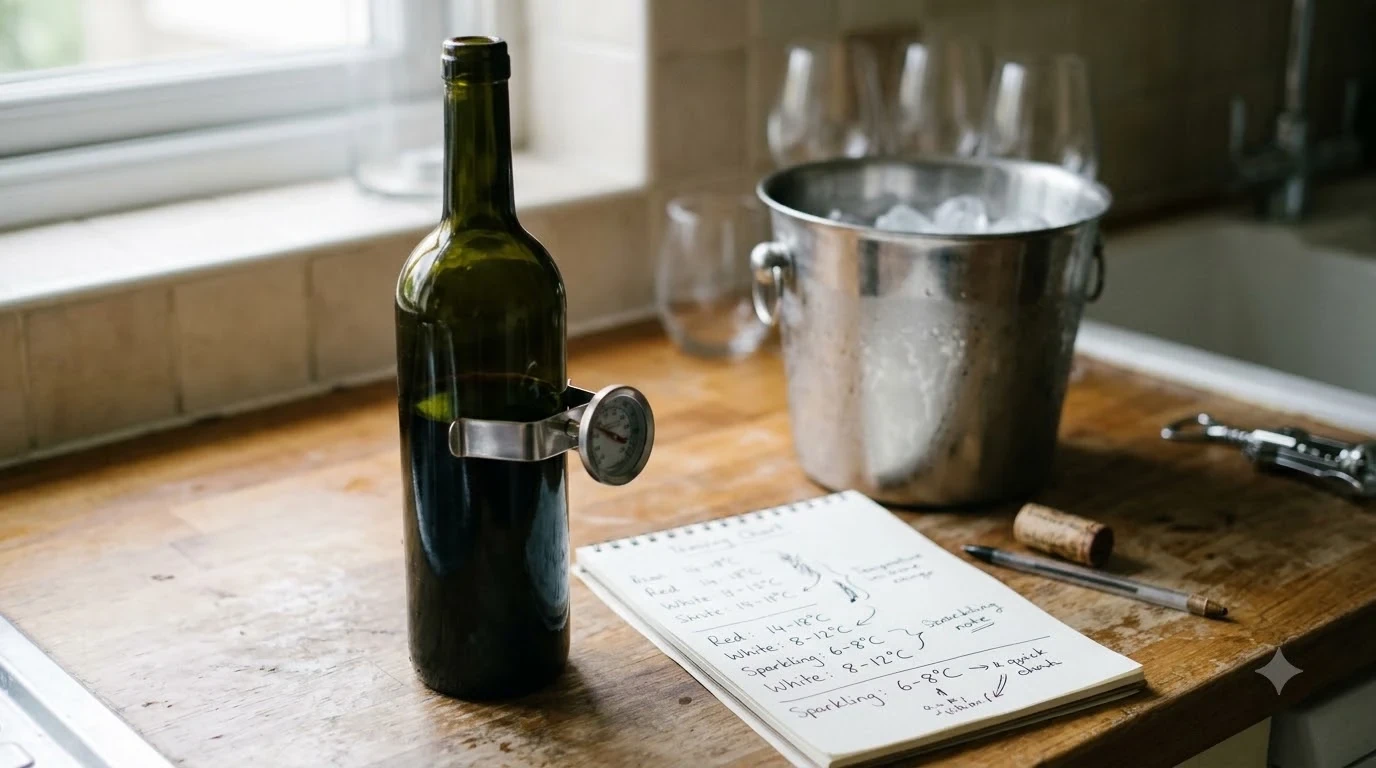
Serve Perrier Jouet wine between 40 and 50°F, with Belle Epoque best around 48 to 50°F. Store unopened bottles on their side near 55°F, and finish any opened sparkling wine within a few days.
The Grape to Glass review of the 2014 Belle Epoque recommends serving it at 9 to 10°C, which works out to 48 to 50°F, in an aromatic wine glass. That sits inside the wider sparkling range of 40 to 50°F, so the same guidance applies to the Grand Brut and Blason Rosé. Chill the bottle gently rather than dropping it into the freezer, because very cold wine dulls its aromas and makes the fruit harder to pick out.
Pour size, yield and glassware
Pour about 5 ounces per glass, which gives roughly five glasses from a 750 ml bottle. An aromatic white-wine glass suits the house style because it concentrates the floral and citrus notes that the Chardonnay provides. A flute works for celebrations, but a wider glass lets you smell the wine properly, and the Chardonnay character shows up most clearly in the nose.
Storage matters just as much. Keep unopened bottles on their side in a cool, stable spot near 55°F, away from heat and light. Once opened, sparkling wine stays fresh for roughly 1 to 3 days when refrigerated. Use a sealed stopper and finish the bottle early, because the bubbles fade quickly after the first pour.
| Item | Typical number |
|---|---|
| Sparkling serving range | 40 to 50°F |
| Belle Epoque serving (Grape to Glass review) | 9 to 10°C (48 to 50°F) |
| Pour size | 5 oz |
| Glasses per 750 ml bottle | About 5 |
| Opened sparkling wine, refrigerated | 1 to 3 days |
| Storage for unopened bottles | Near 55°F, on their side |
Tip: Chill the bottle until it reaches 48 to 50°F, pour five ounces per glass, and reseal the rest with a sparkling wine stopper. If you are hosting, plan on one bottle for every five guests as a starting point.
Food Pairings That Suit Perrier Jouet Wine
Perrier Jouet wine pairs best with fresh seafood, lighter poultry and savory courses, where its acidity and chalky minerality lift the food. The general rule is that a wine should be at least as acidic as the dish, and Champagne meets that standard with most seafood.
Grape to Glass suggests oysters, scallops, calamari, stuffed crab and grilled whole fish on herb risotto, all of which suit the wine’s bright acidity and mineral finish. Chicken with an apple salad is another reliable match, because the apple and the wine’s freshness echo each other. Fried or buttery seafood also works, since the bubbles cut through richness and clean the palate between bites.
Sweet desserts need more care. Wine should be at least as sweet as the dessert, and the Belle Epoque is a dry Brut, so a sweet dessert will make it taste thin. Grape to Glass lists a peach tart with grilled peaches as a pairing, but a sweeter sparkling wine will serve that course better. Save the Belle Epoque for the savory courses and let dessert take a richer, sweeter bottle.
Spicy food needs a different approach. Alcohol and tannin intensify chili heat, and a 12.5% sparkling wine can feel hotter alongside a curry or a chili-heavy dish. Pick milder preparations, or pour the Grand Brut with dishes that carry acid and herbs rather than heavy heat. For a broader look at how sparkling wine fits into different categories, the Wine Brands section of this site covers the wider landscape.
Frequently Asked Questions
The questions below cover taste, blend, vintage status, cellaring and serving occasions that the main sections do not address in detail.
What does Perrier Jouet wine taste like?
Wine.com’s winemaker notes for the 2014 Belle Epoque describe aromas of vine peach and poached pear, with linden and hawthorn blossom. The finish is described as long and plush, and the wine balances ripe fruit with freshness and tension.
Why does Pinot Meunier matter in the blend?
Wines with a larger share of Pinot Meunier are ready to drink earlier, while Pinot Noir contributes to longevity, according to Wine.com. That means the 5 percent Meunier in Belle Epoque has less influence on how long the wine ages than the Pinot Noir does.
Is Belle Epoque a vintage Champagne?
Yes. Wine.com explains that a vintage Champagne comes from one superior harvest, makes up only about 5 percent of total production, and is produced about three times in a decade. That scarcity is part of why Belle Epoque is usually opened for special occasions rather than everyday drinking.
Can Perrier Jouet wine be cellared?
A Grape to Glass reviewer judged the 2014 Belle Epoque to be drinking well at the time, with room to hold for another five to six years. That gives buyers a rough benchmark for how long a recent vintage can rest in a cool cellar, though actual storage conditions matter a great deal.
Is Perrier Jouet wine served as an aperitif?
Yes. Grape to Glass describes the 2014 Belle Epoque as a wine that works well as an aperitif, and it also suggests serving it with food. A dry, lively Champagne before dinner gives guests a clean, fresh start and leads naturally into the first courses.
Perrier Jouet wine is easiest to choose once you match the bottle to the occasion: the Grand Brut for everyday use, Belle Epoque for a celebration or a special gift, and Blason Rosé when you want a pink option for the table. Serve each one within the 40 to 50°F range, and pair it with fresh seafood or savory dishes. Once you know the house style, comparing other producers becomes much easier.
More in Wine Brands
 Underwood Wine Price: Compare Bottles, Cans, and Pack SizesUpdated Nov 21, 2026
 Zenato Wine Price: Compare Styles and Choose the Right BottleUpdated Nov 21, 2026
 Zuccardi Wine Price: Compare Bottles and Find the Right RangeUpdated Nov 21, 2026
 Yellow Tail Moscato Review: Taste, Sweetness and Serving TipsUpdated Nov 21, 2026
 Wolf Blass Yellow Label Review: Choose Your Best StyleUpdated Nov 21, 2026
 Wolffer Estate Rose Review: Choose the Right Bottle for Your TableUpdated Nov 21, 2026