

We may earn a commission when you buy through links on this page, at no extra cost to you. Learn more.
The most practical way to improve wine fridge energy efficiency is to choose a right-sized model, compare its annual kilowatt-hour rating, and install it where heat and blocked airflow will not force longer cooling cycles. A wine refrigerator runs year-round, so a modest difference in electricity use can add up over several years. The best choice balances power consumption with stable storage temperatures, useful capacity, and the ventilation space required by the design.
A low annual kWh figure is a useful starting point, but it is not the whole decision. Cabinet size, room temperature, door construction, cooling technology, and how often the door opens all affect the work the appliance must do. The practical goal is to hold wine at a steady, suitable temperature without making the cooling system fight its surroundings.
How to Compare a Wine Fridge’s Energy Use
The clearest comparison is the model’s stated annual electricity use in kilowatt-hours (kWh), followed by its capacity and installation requirements. Compare units of similar size and format, because a compact countertop cooler and a tall cabinet for a large collection are not equivalent appliances.
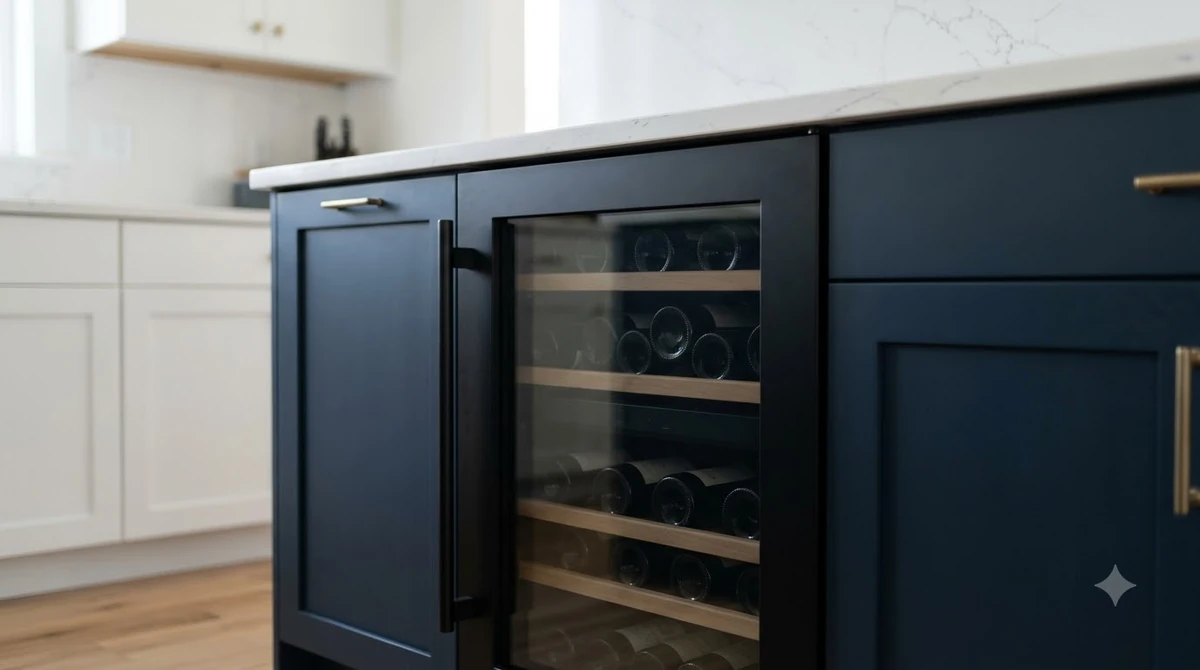
Look for an annual kWh figure in the product specifications, owner documentation, or a standardized energy label where one is provided. Divide that figure by 12 for a rough monthly average, or by 365 for a daily average. Treat it as a comparison tool, not a promise that every home will use exactly that amount: room temperature, setpoint, ventilation, door openings, and loading patterns all affect real-world consumption. A cabinet installed in a warm kitchen may use more than the same model in a cool basement because it has to remove heat more often. Multiply annual kWh by the electricity rate on your utility bill to estimate running expense, then use the same rate when comparing two models so the comparison stays consistent.
The examples below show how annual ratings translate into use over time. They are arithmetic examples, not claims about any specific brand or bottle capacity; five-year totals assume the same annual use each year. The 150 kWh example, for instance, averages 12.5 kWh a month and reaches 750 kWh over five years. That gives you a straightforward way to compare the long-term electricity demand of two similarly sized cabinets before considering other features.
| Stated annual use | Monthly average | Five-year use | Daily average |
|---|---|---|---|
| 100 kWh | 8.3 kWh | 500 kWh | 0.27 kWh |
| 150 kWh | 12.5 kWh | 750 kWh | 0.41 kWh |
| 200 kWh | 16.7 kWh | 1,000 kWh | 0.55 kWh |
| 250 kWh | 20.8 kWh | 1,250 kWh | 0.68 kWh |
| 300 kWh | 25.0 kWh | 1,500 kWh | 0.82 kWh |
Read energy-label claims carefully. ENERGY STAR lists built-in coolers at 30% below applicable federal minimums, freestanding compact coolers at 20% below, and freestanding coolers at 10% below. But its criteria also say wine refrigerators that do not meet the program’s defined electric refrigerator or refrigerator-freezer categories are not eligible. Not every product sold as a wine fridge automatically qualifies, so confirm the exact model and category in the ENERGY STAR refrigerator and cooler criteria rather than relying on a general marketing claim.
Cooling Technology and Compressor Workload
Compressor and thermoelectric systems behave differently, but the technology name alone does not tell you which wine fridge will use less electricity. Compare annual kWh ratings and operating limits first, then choose a system that can hold the target temperature in the room where you plan to use it.
A compressor-based wine refrigerator moves refrigerant through a cooling circuit, much like a household refrigerator. Wine Enthusiast describes compressor models as efficient and capable of stronger cooling, while noting that they can be slightly louder and need ventilation space. This can make a compressor unit practical for a larger cabinet or a warm room, provided the exhaust side has enough room to release heat.
Thermoelectric models are often valued for quiet operation, but their cooling ability depends more heavily on ambient conditions. They may struggle in a particularly warm room and generally cannot cool as far as compressor-based models. A small, well-matched thermoelectric cabinet may suit a moderate room; a larger collection or warmer setting may call for a compressor. Neither system is an automatic energy winner. For example, a 55°F storage target in an 80°F room means the appliance must maintain a 25-degree difference from its surroundings; heat entering through poor clearance or repeated door openings adds to that workload. Compare the stated kWh use, capacity, ambient operating range, and clearance requirements. Wine Enthusiast explains these distinctions in its wine refrigerator placement and buying guide.
Placement, Ventilation, and Room Temperature
Where the wine fridge stands has a direct effect on its workload: choose a shaded, temperate location with the manufacturer-required air clearance. An oven, dishwasher, sunny window, or poorly ventilated cabinet can create extra heat that the wine fridge must continually remove.
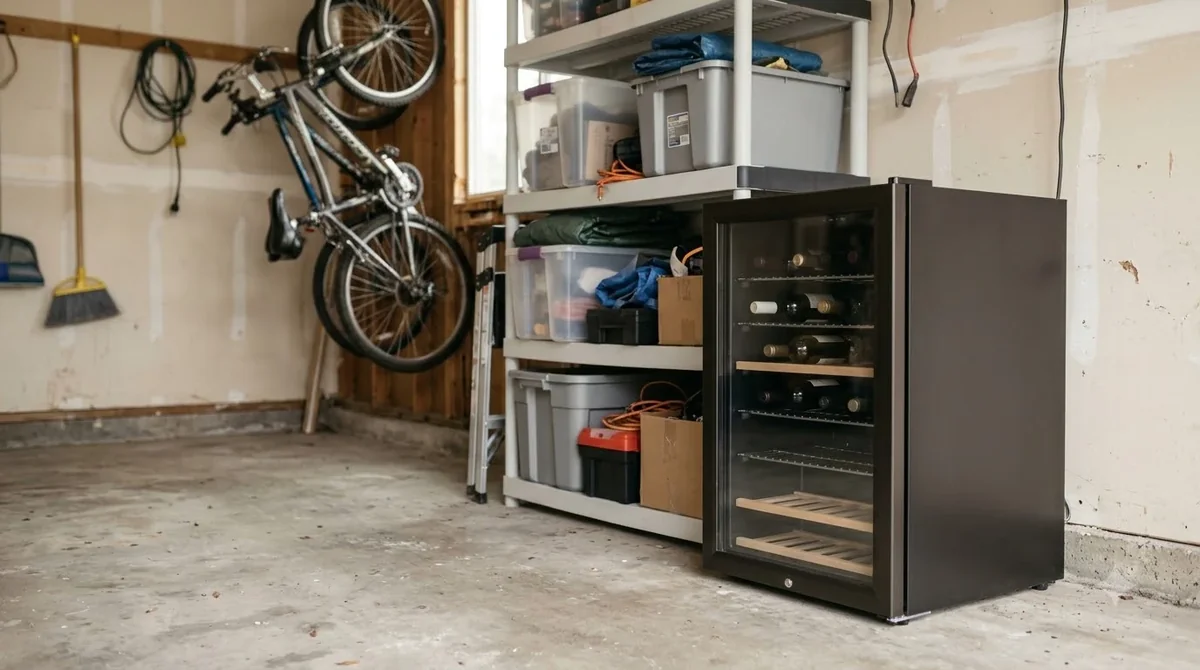
Wine Enthusiast advises keeping a wine refrigerator away from heat-producing kitchen appliances and allowing a few inches of space around many freestanding units. Front-venting built-in models are different because they release heat through the front grille. These are general pointers, not universal measurements: follow the installation diagram for the exact model, since vent locations and clearance rules vary.
Do not push a freestanding unit tightly against a wall or surround it with storage boxes. Keep the intake and exhaust areas open, and preserve any specified side, rear, or top clearance after installation. A built-in model and a freestanding model should not be swapped casually; blocking the designed air path can trap heat and make the cooling system run longer. Before sliding a unit into an opening, check the manual for the grille location and the minimum clearance on every side. Also make sure the nearby wall, cabinet trim, or a closed pantry door will not obstruct the exhaust after installation.
Ambient temperature matters as much as clearance. A garage may become very hot in summer and cold in winter, and some wine refrigerators are not designed for those swings. A basement or interior room is often more stable. Before installing a unit in a garage, enclosed porch, or unconditioned room, compare the space’s seasonal temperatures with the manufacturer’s operating range; shade cannot compensate for conditions beyond that range.
Temperature Settings That Protect Wine Without Wasting Power
For general long-term wine storage, aim for a steady cabinet temperature near 55°F rather than setting the fridge colder than necessary. Stable storage is more useful than frequently changing the thermostat to match the serving temperature of each bottle.
Wine storage benefits from consistency. About 55°F is a practical target for a mixed collection intended for storage. The cabinet does not need to hold red wine at its serving temperature or chill every white to its ideal pouring temperature; those adjustments can be made shortly before serving.
Very cold settings increase the temperature difference between the cabinet and the room, giving the cooling system more work to do. A storage setting should not be confused with a serving setting: a bottle can be brought to its preferred drinking temperature shortly before it is poured, rather than keeping the entire cabinet colder year-round. A single-zone fridge is usually adequate when most bottles will be stored at a common cellar temperature. Dual-zone models offer separate targets, useful when one section holds ready-to-serve bottles and another is for longer-term storage; choose that feature because you need two conditions, not simply because it appears on a feature list. See what a dual-zone wine fridge is for more on the layout.
Capacity, Cabinet Design, and Features
The most efficient purchase is a wine fridge that fits the collection you actually plan to store, with enough room for normal bottle shapes and airflow. An oversized cabinet can consume more electricity than a smaller one, while a unit that is too small may lead to overpacking or early replacement.
Manufacturers usually state capacity using standard 750 ml Bordeaux-shaped bottles. Wide Burgundy bottles, sparkling-wine bottles, and larger formats can reduce usable capacity, especially when shelves are close together. A nominal 40-bottle capacity may be lower in practice if a collection includes Champagne bottles or broad-shouldered formats, so look for adjustable shelves and a layout that matches the bottles you own. Consider the mix of wines you buy rather than relying on the headline bottle count, and measure the opening, appliance depth, door swing, handle projection, plug location, and ventilation clearance before ordering.
Look for a well-sealing door, stable shelves, accessible controls, and a clearly documented installation method. A front-venting built-in model is designed for an under-counter opening; many freestanding models release heat through the rear or sides. Consider whether a dedicated cabinet is necessary at all: a naturally cool, stable cupboard may work for a small group of bottles consumed soon, while a wine fridge can be useful for a larger collection or a home with seasonal heat. The guide do I need a wine fridge helps frame that decision, and Buying Basics covers broader selection considerations.
Maintenance and Everyday Habits
Simple habits help a wine fridge maintain its setpoint without unnecessary cycling: keep the door closed, protect the seal, and leave the designed air path unobstructed. Periodic checks are usually more useful than constantly changing the temperature controls.
Inspect the door gasket around all four sides for cracks, flattened sections, dirt, or corners that do not sit flush. Clean it gently according to the manual and replace it if it no longer closes securely. Limit long door openings by choosing a bottle before opening the cabinet, and do not leave the door open as a display while entertaining.
Keep vents and any user-accessible condenser area free of dust if the manufacturer describes a safe cleaning method. ENERGY STAR’s refrigerator guidance also recommends air circulation behind a cooler, airtight door seals, and minimizing door-open time. Do not remove a grille or reach into a powered appliance unless the manual describes that maintenance step. When loading bottles, avoid blocking an internal fan or cold-air outlet; a large restock of room-temperature bottles can create a temporary cooling load. Leave a little room around the manufacturer’s designated vents, and do not store loose items on top of an appliance if they can block a top-mounted exhaust. Keep the cabinet level as well, so the door and gasket align as designed.
Tip: Set the cabinet near 55°F, close the door promptly, and check the gasket and ventilation path during routine cleaning. Those three steps address common sources of avoidable cooling work while maintaining stable storage.
If the unit runs nearly continuously, first check the room temperature, clearance, door seal, and setpoint. A hot room or blocked exhaust can explain long run times, but persistent trouble may indicate a fault. If the cabinet cannot maintain its target within the manufacturer’s stated operating conditions, contact an authorized service provider rather than repeatedly lowering the setting.
Frequently Asked Questions
The right setup depends on the room, the collection, and the appliance’s design. These answers address practical questions that can remain after comparing annual kWh figures and an approximately 55°F storage setting.
Does a wine fridge use less electricity when it is full?
Bottles can buffer short-term temperature changes because liquid warms and cools more slowly than air in an empty cabinet. That does not mean shelves should be packed tightly or an internal fan blocked; preserve the airflow paths and follow the rack layout in the owner’s manual.
Can I use a wine fridge to store food?
A wine cabinet is designed around wine-storage temperatures, not the colder conditions used for a household food refrigerator. ENERGY STAR recommends 35°F to 38°F for household refrigerators, while a wine-storage setting near 55°F is much warmer. Use a food refrigerator for perishable food rather than treating a wine cooler as a second kitchen fridge.
Is a glass door always less energy efficient than a solid door?
Not necessarily. Performance depends on the door’s construction, insulation, seals, and the cabinet as a whole, so the material alone is not enough to rank two models. Compare annual kWh use and look for well-fitted seals rather than assuming every glass-front unit consumes more electricity.
Should I switch off a wine fridge when I go on vacation?
For wine intended to remain in storage, switching the cabinet off for an extended trip exposes bottles to room-temperature changes. A thermostat-controlled unit is designed to cycle as needed, so leaving it at a steady storage setting is generally more appropriate than repeatedly powering it down. For an empty cabinet, follow the manufacturer’s shutdown and cleaning instructions.
How cold should sparkling wine be before serving?
Sparkling wine is generally best served at 40°F to 50°F. Keep the storage cabinet near its steady storage setting and chill individual bottles shortly before serving instead of lowering the temperature for the entire collection.
For a lower-energy wine storage setup, start with a cabinet whose annual kWh rating suits its capacity, then give it the temperature and ventilation conditions specified by its manufacturer. A correctly sized unit kept near a stable 55°F, away from heat sources and with a sound door seal, can protect your collection without making the cooling system work harder than necessary.
More in Wine Buying Guides
 Cheap Red Blend: How to Find a Flavorful Bottle for LessUpdated Nov 20, 2026
 Pinot Grigio Gift: How to Choose a Bottle They’ll EnjoyUpdated Nov 20, 2026
 Best White Wine at Total Wine for Every MealUpdated Nov 20, 2026
 Wine Fridge Replacement Shelves: Find the Right FitUpdated Nov 20, 2026
 Best Sparkling Wine Under 20: Find Bubbles Worth BuyingUpdated Nov 20, 2026
 Best Wine For Birthday Celebrations With Perfect Party PairingsUpdated Nov 20, 2026