

We may earn a commission when you buy through links on this page, at no extra cost to you. Learn more.
A wine fridge clicking noise is often normal because the thermostat, compressor, or electrical controls switch during the cooling cycle. Occasional clicks when the refrigerator starts or stops cooling generally do not indicate a failure. However, repeated clicking without cooling, loud electrical snapping, or clicking accompanied by unusual heat can indicate a problem with the compressor relay, fan, or control system.
A wine refrigerator needs to cycle its cooling components to maintain a stable storage temperature. These operating changes can produce clicking, humming, and other sounds that are noticeable in a quiet kitchen, dining room, or home bar. The important distinction is whether the sound follows a normal cooling pattern or continues while the appliance struggles to operate.
Understanding where the sound comes from, how frequently it occurs, and whether the interior temperature remains stable can help you decide what to check. Several simple installation and maintenance issues can also make an otherwise healthy wine fridge sound louder than expected.
1. Normal Compressor and Thermostat Clicking During Cooling Cycles
A wine fridge commonly clicks when its thermostat or electronic controls switch the compressor on and off. Occasional clicking followed by a low humming sound is generally normal, particularly when the appliance is maintaining its selected temperature.
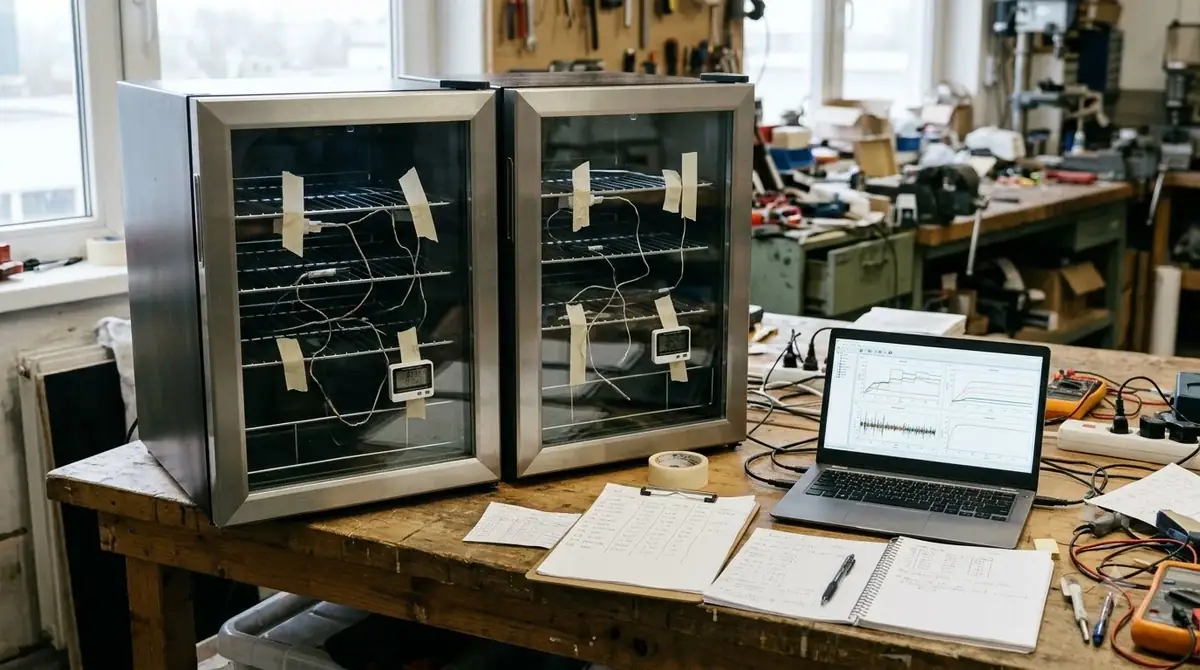
The compressor is responsible for circulating refrigerant through the cooling system. When the interior reaches the target temperature, the cooling demand decreases and the compressor may stop. As the temperature gradually rises, the thermostat signals the cooling system to operate again. This sequence can produce an audible click each time the operating state changes.
Miele’s wine refrigerator operating instructions specifically identify thermostat switching as the cause of normal clicking. Its guidance also distinguishes compressor humming, fan whirring, and refrigerant gurgling as ordinary operating sounds. For additional manufacturer guidance, see Miele’s explanation of normal refrigerator and wine unit noises.
The sound may be easier to notice when the refrigerator is installed in a quiet room or close to a hard kitchen cabinet. Countertops, tile floors, and surrounding furniture can reflect operating sounds, making ordinary mechanical activity seem louder.
Pay attention to what happens immediately after the click. A click followed by a steady compressor hum is usually consistent with a cooling cycle. A click followed by silence may simply mean the appliance has reached its temperature setting and is waiting for another cooling cycle.
What normal clicking sounds like
Normal operating clicks are generally brief rather than continuous. They may occur when the refrigerator begins cooling, stops cooling, or changes the operating state of an electronic component. The frequency varies according to the appliance design, temperature setting, room conditions, and how often the door is opened.
Other ordinary operating sounds can accompany the clicking. A low hum usually comes from the compressor, while a soft whirring sound can indicate that a circulation or cooling fan is running. Gurgling and bubbling may also occur as refrigerant moves through the pipes.
These sounds should be considered together rather than treated as separate evidence of mechanical failure. A wine refrigerator that clicks occasionally, maintains its temperature, and otherwise operates consistently is less concerning than one that clicks repeatedly without producing cold air.
2. Faulty Compressor Relays, Start Components, and Electrical Controls
Repeated clicking without successful compressor operation can indicate an electrical starting problem. A faulty compressor start relay, overload protector, or control component may prevent the cooling system from starting and maintaining normal operation.
The compressor requires electrical power to begin operating. In some wine refrigerators, a start relay helps provide the electrical connection needed for the compressor to start. An overload protector helps interrupt operation if the compressor becomes excessively hot or draws abnormal current.
If a starting component fails, the refrigerator may produce a click as the control system attempts to start the compressor. The compressor may fail to run, or it may start briefly before stopping again. This can create a repeating pattern of clicking and short humming sounds.
However, the sound alone cannot establish that the relay is defective. Similar symptoms can result from a compressor problem, an electrical supply issue, a temperature sensor fault, or a control board malfunction. A qualified technician must test the relevant components to identify the actual cause.
Signs that the starting system needs attention
Several symptoms make an electrical or compressor-related problem more likely:
- The refrigerator clicks repeatedly but never develops a steady compressor hum.
- The compressor attempts to start but stops almost immediately.
- The interior temperature rises even though the display indicates an active cooling setting.
- The refrigerator repeatedly starts and stops without maintaining a consistent temperature.
- A new clicking pattern appears alongside unusual buzzing, overheating, or an electrical smell.
Repeated clicking accompanied by poor cooling deserves more attention than an occasional operating click. A compressor that cannot start properly may fail to maintain the storage temperature needed to protect a wine collection.
Do not open the electrical compartment or attempt to replace a relay while the appliance is connected to power. Refrigeration components can involve hazardous electrical connections, and compressor testing requires appropriate equipment. If the refrigerator repeatedly attempts to start without success, arrange professional diagnosis rather than repeatedly resetting the appliance.
Why compressor protection matters
A compressor overload protector is designed to interrupt operation under certain abnormal conditions. If the compressor becomes too hot, the protective device may disconnect it. A clicking sound can occur when the protection system changes state.
Restricted ventilation, unusually high room temperatures, or a failing compressor can contribute to excessive operating temperatures. These conditions should be investigated rather than assuming that the protective device itself is defective.
If the appliance becomes unusually hot, produces a burning smell, or makes rapid electrical snapping sounds, disconnect power if it is safe to do so and seek qualified service. Do not continue operating a refrigerator that shows signs of electrical damage.
3. Loose Shelves, Bottles, Fans, and Cabinet Vibrations
Some wine fridge clicking and rattling noises are caused by vibration rather than the cooling system itself. Loose shelves, touching bottles, fan housings, and an uneven cabinet can create repeated sounds as the appliance operates.
A wine refrigerator contains several components that can move slightly during normal operation. Compressor vibration and fan movement can transfer through the cabinet, shelves, and surrounding furniture. When two objects touch, even a relatively small vibration can produce an audible clicking or tapping sound.
Start with the simplest possible explanation: the bottles. Wine bottles stored too close together may knock against each other when the compressor starts or the cooling fan operates. Separate neighboring bottles slightly, especially around the shelf edges and metal supports.
Next, inspect the removable shelves and drawers. A shelf that is not fully seated can move against its support when the refrigerator vibrates. Remove and reinstall loose components according to the manufacturer’s instructions. Check that bottles are not resting against the interior walls or door.
Miele specifically identifies unstable shelves, drawers, and touching bottles as potential causes of rattling and clinking. The manufacturer also recommends correcting appliance alignment when vibration becomes noticeable.
Check the cooling fan
A cooling fan moves air through certain wine refrigerator designs. If its mounting bracket, guard, or surrounding panel is loose, ordinary fan movement may produce a repetitive tapping or clicking noise.
Dust and debris around accessible ventilation openings can also interfere with airflow. In some models, an obstructed fan blade or damaged fan bearing may create unusual operating sounds. A fan that produces a grinding, scraping, or repeated knocking noise should be inspected.
Never insert tools or fingers through a ventilation opening to investigate a moving fan. Disconnect power before performing any cleaning permitted by the owner’s manual. Internal fan assemblies and electrical connections should be handled by a qualified technician.
Level the refrigerator
An uneven installation can make a normal operating vibration sound like a mechanical fault. Place a spirit level on an appropriate flat surface of the cabinet and check whether the refrigerator sits evenly. Adjust the leveling feet as directed by the manufacturer.
Also check whether the refrigerator touches a neighboring cabinet, wall, or appliance. Even a small contact point can transmit vibration into surrounding surfaces. Leave the installation clearances specified in the owner’s manual, particularly around the ventilation openings.
Tip: Before arranging a repair appointment, remove loose bottles, reseat removable shelves, and check the cabinet’s level position. These simple checks can eliminate several common sources of clicking and rattling without disturbing the refrigeration system.
4. Restricted Ventilation, Heat, and Frequent Compressor Cycling
A wine fridge that clicks more frequently than usual may be responding to excessive heat or restricted airflow. Poor ventilation can make the compressor operate longer, cycle more often, or struggle to maintain the selected temperature.
Compressor wine refrigerators release heat through their ventilation system. Depending on the design, the condenser and associated components may need unobstructed airflow at the rear, sides, or front of the cabinet. Blocking these openings can reduce cooling efficiency.
Installation requirements differ between freestanding and built-in models. Vinotemp explains that its freestanding wine coolers with rear exhaust require at least 6 inches of clearance behind the appliance. Built-in models with front exhaust are designed for a different installation arrangement.
These measurements should not be applied automatically to every wine refrigerator. A unit designed for built-in installation may have different clearance requirements from a freestanding model. Follow the exact ventilation specifications for the appliance rather than relying on a general measurement.
Room temperature and compressor activity
Room temperature can influence how frequently a compressor operates. A wine refrigerator installed in a hot kitchen, enclosed cabinet, or sun-exposed room may have difficulty releasing heat efficiently. The compressor can consequently run for longer periods.
Vinotemp identifies higher-than-normal room temperatures as one possible reason for frequent on-and-off operation. It also identifies a door that does not close properly and an incorrectly set temperature control as potential contributors.
Check whether the refrigerator has adequate space around its ventilation openings. Remove objects stored directly against the exhaust grille, and make sure curtains, boxes, or nearby furniture do not obstruct airflow.
Do not place a freestanding wine fridge inside an enclosed cabinet unless the manufacturer specifically permits that installation. A unit with rear exhaust may require substantial clearance to release heat safely.
Door seals and temperature settings
A damaged or dirty door gasket can allow warm air to enter the cabinet. The refrigerator then has to work harder to maintain its target temperature, potentially increasing compressor operating time.
Inspect the gasket for visible dirt, cracks, gaps, or areas that have become detached. Clean it using the method recommended in the owner’s manual. Also confirm that bottles or incorrectly positioned shelves are not preventing the door from closing completely.
The temperature setting matters as well. An unnecessarily low setting can increase cooling demand, especially when the surrounding room is warm. For general long-term wine storage, approximately 55 degrees Fahrenheit is a commonly recommended target.
5. How to Diagnose a Clicking Wine Fridge Step by Step
The most useful troubleshooting approach is to compare the sound with the refrigerator’s cooling performance. Start with external checks, observe the operating pattern, and distinguish normal cycling from repeated unsuccessful starting attempts.
Before investigating, note whether the clicking occurs once, several times in succession, or continuously. Record whether the compressor starts humming afterward and whether the interior temperature remains stable. This information can help narrow down the cause.
A practical troubleshooting sequence
- Identify the sound. Listen for a single click, repeated clicking, tapping, buzzing, or clicking accompanied by a low hum.
- Check the temperature display. Confirm that the refrigerator is set to an appropriate storage temperature and look for warning indicators.
- Inspect the cabinet position. Make sure the refrigerator is stable, level, and not touching another appliance or furniture.
- Check bottles and shelves. Separate touching bottles and reseat removable shelves or drawers.
- Inspect ventilation. Remove obstructions from accessible air openings and confirm that installation clearances meet the manufacturer’s requirements.
- Inspect the door. Make sure the door closes fully and the gasket is clean and properly positioned.
- Monitor cooling performance. Observe whether the compressor starts and whether the interior temperature moves toward its setpoint.
- Arrange service if necessary. Repeated unsuccessful starting attempts, electrical smells, overheating, or deteriorating cooling performance warrant professional attention.
Do not repeatedly unplug and reconnect a compressor refrigerator to force it to restart. Compressor systems may need a waiting period before restarting, and the appropriate delay depends on the model. Some manufacturers specify a restart delay to protect the compressor after a power interruption.
When cleaning or inspecting accessible areas, follow the owner’s manual. Vinotemp specifically recommends unplugging its wine coolers before cleaning to reduce the risk of electrical shock. Avoid removing protective panels or accessing internal wiring during routine troubleshooting.
Common clicking patterns and their likely explanations
| Sound pattern | Possible cause | Recommended action |
|---|---|---|
| One occasional click | Thermostat or control switching | Monitor normal cooling |
| Click followed by humming | Compressor starting | Check whether cooling is maintained |
| Repeated clicks without humming | Starting relay or compressor problem | Arrange professional diagnosis |
| Clicking with shelf vibration | Loose shelf or bottle contact | Reseat and separate items |
| Clicking with fan noise | Fan vibration or obstruction | Inspect accessible ventilation areas |
| Clicking with poor cooling | Cooling or electrical system fault | Check settings and request service |
| Rapid electrical snapping | Possible electrical fault | Disconnect power if safe and seek service |
| Popping after temperature changes | Interior material expansion | Monitor if cooling remains normal |
This table is a diagnostic starting point, not a definitive component test. Different wine refrigerator designs use different compressors, fans, relays, and electronic controls. A sound that appears similar between two models may have a different underlying cause.
For broader appliance symptoms, the wine fridge making noise troubleshooting guide can help distinguish clicking from humming, buzzing, rattling, and other operating sounds. The Wine Fridge Troubleshooting resources can also help identify related storage and maintenance concerns.
6. When to Repair or Replace a Clicking Wine Refrigerator
A clicking wine refrigerator does not automatically need replacement. If the sound comes from normal thermostat switching, bottle contact, or a loose shelf, correcting the installation or storage arrangement may be sufficient.
Mechanical and electrical problems require a different approach. A refrigerator that clicks repeatedly without cooling, experiences frequent unsuccessful compressor starts, or develops abnormal electrical noises should be evaluated by an appliance technician.
The technician can inspect the compressor starting components, overload protection, fan motor, temperature sensors, wiring, and control board. Appropriate electrical testing can determine whether a replaceable component has failed or whether the compressor or sealed refrigeration system needs further investigation.
When professional repair is appropriate
Arrange a service inspection when any of the following symptoms occur:
- Repeated clicking continues without the compressor starting successfully.
- The refrigerator cannot maintain its selected temperature.
- The compressor becomes unusually hot or repeatedly stops shortly after starting.
- The cooling fan makes grinding, scraping, or persistent knocking sounds.
- The control display shows a persistent error or temperature alarm.
- There is a burning smell, visible electrical damage, or abnormal electrical buzzing.
For a refrigerator that is still cooling normally but produces a new or louder clicking sound, record the sound pattern and monitor the temperature. A technician can use that information to decide whether an inspection is necessary.
Before requesting service, locate the model and serial number, usually found on an identification label inside or behind the appliance. Keep the purchase information and any warranty documentation available. These details help the service provider identify compatible components and determine the applicable warranty process.
Brand-specific repair considerations
Wine refrigerators do not all use the same cooling systems or replacement parts. Some have compressor-based refrigeration, while others use thermoelectric cooling. Their operating sounds, ventilation requirements, and repair procedures can differ significantly.
For an Allavino refrigerator, a clicking sound accompanied by poor cooling should be investigated alongside the temperature setting, ventilation, door seal, and compressor operation. The Allavino wine fridge not cooling troubleshooting resource is useful when temperature problems occur at the same time as unusual noise.
If the issue appears to involve a faulty electrical component, fan, or refrigeration assembly, the Allavino wine fridge repair resource provides a more relevant starting point for model-specific repair considerations.
When comparing repair and replacement, consider the appliance’s age, overall condition, warranty coverage, availability of replacement parts, and the nature of the fault. A minor fan or electrical component issue may be repairable, whereas a major sealed-system failure can require a more extensive decision.
Protecting the wine collection should also be part of the decision. If the refrigerator cannot maintain a stable storage temperature, transfer valuable bottles to another suitable storage location while the appliance is being assessed.
Frequently Asked Questions
Can a wine fridge make clicking noises even when the door is closed?
Yes. The thermostat and cooling controls operate independently of the door position, so normal compressor cycling can produce clicking while the door remains closed. Some models also operate internal circulation fans and electronic components that produce occasional sounds during ordinary operation.
Does a wine fridge need to stand upright after transportation?
Some manufacturers specify an upright settling period before connecting a transported wine cooler to electricity. Vinotemp recommends allowing its newly delivered coolers to stand upright for 24 hours before plugging them in. Follow the transportation and installation instructions for the specific model.
Can a thermoelectric wine cooler make clicking noises?
Yes, although thermoelectric models have different operating components from compressor refrigerators. Their cooling systems use solid-state thermoelectric modules and fans rather than conventional compressor refrigeration. A clicking sound may therefore originate from a fan, electrical control, or vibrating cabinet component.
Can power fluctuations cause a wine refrigerator to click repeatedly?
Yes. An unstable electrical supply or an interrupted connection can affect compressor starting and electronic controls. If other appliances also show signs of electrical interruption, have the outlet and household circuit evaluated by a qualified electrician rather than attempting internal refrigerator wiring repairs.
Should wine bottles be removed before a refrigerator repair appointment?
Not necessarily for every inspection, but a technician may need access to shelves, interior panels, or ventilation areas. Follow the service provider’s preparation instructions and remove bottles when requested. For a repair involving an extended shutdown, arrange suitable temporary wine storage before the appointment.
An occasional wine fridge clicking noise is often part of normal thermostat and compressor operation, but repeated clicking without effective cooling deserves attention. Start by checking the bottles, shelves, leveling, ventilation, and door seal before considering an internal component fault. If the sound is accompanied by electrical warning signs or a rising interior temperature, arrange professional service to protect both the appliance and the wine stored inside.
More in Storage & Fridge Care
 How Long Can You Store Wine in a Wine Fridge? Protect Bottle QualityUpdated Nov 20, 2026
 Can You Store Beer in a Wine Fridge? Keep Both Drinks FreshUpdated Nov 20, 2026
 Is It Worth Repairing a Wine Fridge? Spot the Cheap Fixes Before You ReplaceUpdated Nov 20, 2026
 Wine Fridge Condensation: Identify Causes and Fix Moisture ProblemsUpdated Nov 20, 2026
 Wine Fridge Too Cold: Protect Your Wine and Fix the TemperatureUpdated Nov 20, 2026
 How to Reset Wine Fridge: Restore Cooling and SettingsUpdated Nov 20, 2026