

We may earn a commission when you buy through links on this page, at no extra cost to you. Learn more.
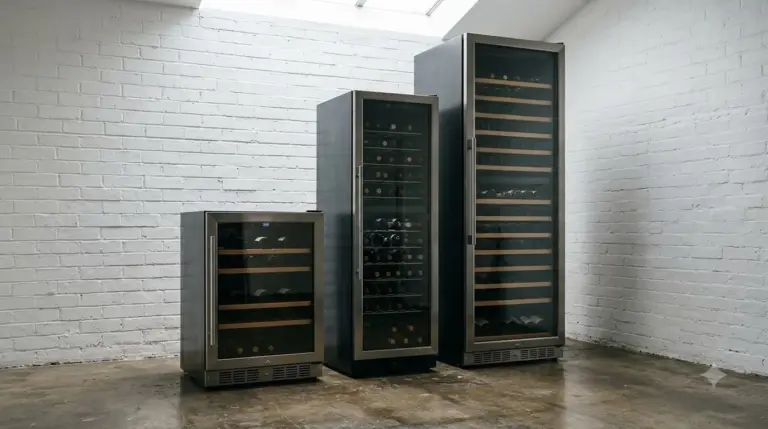
The best freestanding wine fridge for most homes is a mid-sized dual-zone compressor cabinet holding 28 to 50 bottles, as it holds both reds and whites at ready-to-pour temperatures without requiring cabinetry modifications. If your collection leans heavily toward long-term aging, a tall single-zone cellar cabinet offers steadier climate control, while apartment dwellers often prefer narrow-footprint or countertop models. Entertainers who host regularly can also look to combo beverage centers that chill canned drinks alongside standard 750 mL bottles.
Unlike built-in units that vent through a front toe-kick, freestanding coolers release heat from the back and sides, letting you plug them in anywhere with a standard outlet and a few inches of breathing room. Choosing the right category comes down to how many bottles you keep on hand, whether you drink mostly one style or mix reds and whites, and how much floor space you can spare.
Quick Comparison
Each freestanding category balances bottle capacity, temperature flexibility, and physical footprint differently depending on how you buy and drink wine.
| Fridge Type | Typical Capacity | Temperature Zones | Cooling System | Best Placement |
|---|---|---|---|---|
| Mid-Size Dual-Zone Cabinet | 28–50 bottles | Dual (41°F–64°F) | Compressor | Dining room, pantry, open kitchen corner |
| Compact Countertop Cooler | 6–18 bottles | Single zone | Thermoelectric or small compressor | Kitchen counter, home bar, studio apartment |
| Tall Collector Cellar | 80–300 bottles | Single or dual zone | Heavy-duty compressor | Basement, garage, dedicated wine wall |
| Wine & Beverage Combo | 15–30 bottles + 50–100 cans | Dual zone (down to 39°F) | Compressor | Game room, patio lounge, family kitchen |
| Slim Narrow-Width Unit | 18–34 bottles | Single or dual zone | Compressor | Tight hallway alcoves, galley kitchens |
Best for Mixed Red and White Collections: Mid-Size Dual-Zone Cabinets
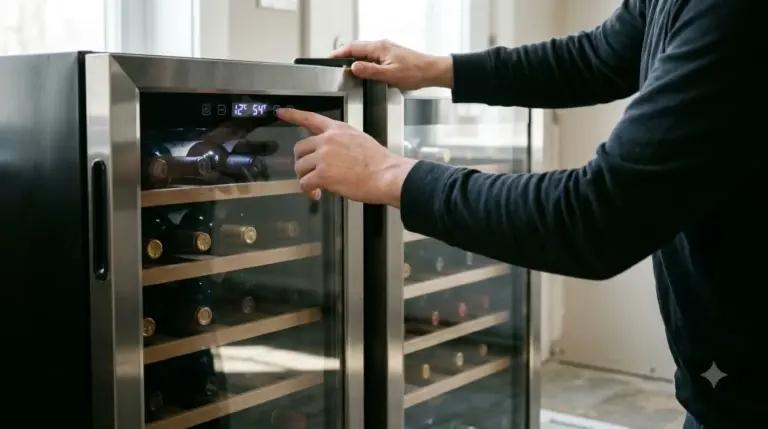
Mid-size dual-zone cabinets divide the interior into two independently controlled compartments, allowing you to store crisp whites and sparkling wines at 41°F to 50°F while keeping reds at 55°F to 64°F. They hit a practical middle ground in capacity, accommodating two to four cases without dominating a room.
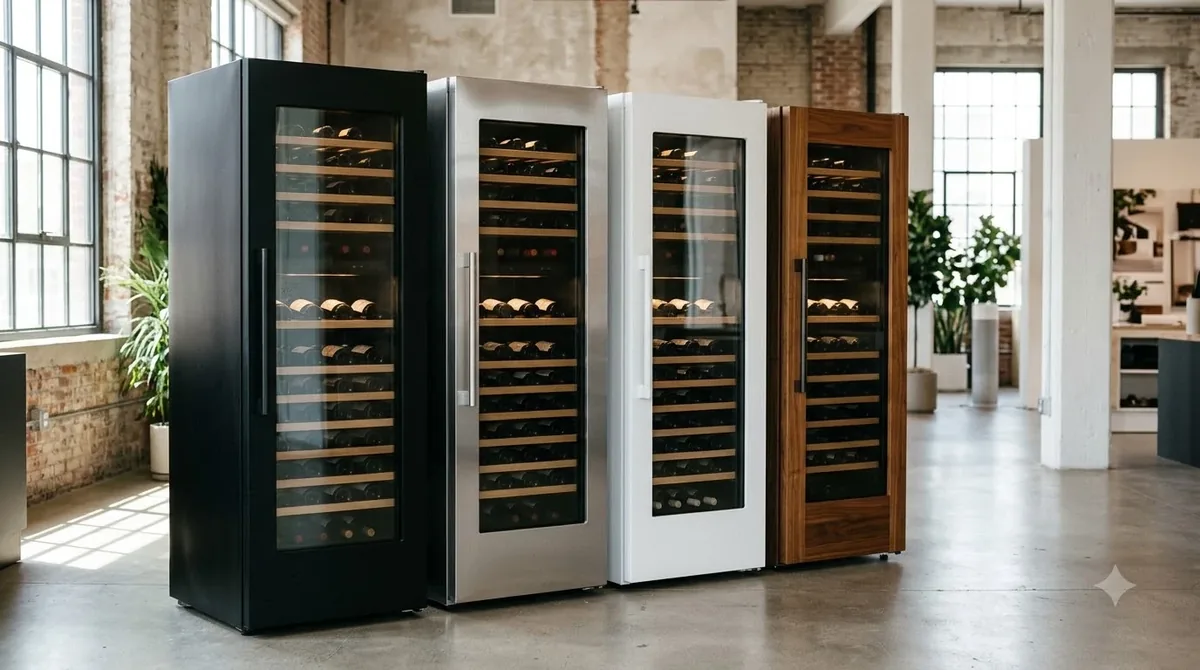
Why it stands out: Reviewers at Wine Enthusiast highlight 32-bottle dual-zone compressor units as top all-around performers because electronic touch controls let you set distinct serving climates—or match both zones to the same temperature if your buying habits shift. Compressor cooling holds steady even when room temperatures fluctuate during summer or winter, outperforming thermoelectric alternatives in warmer kitchens.
Keep in mind: Stated bottle counts always assume standard slim Bordeaux-style 750 mL bottles; wider Pinot Noir, Champagne, or Burgundy bottles reduce usable capacity by roughly 15 to 25 percent unless shelves are removable. Best for households that open different styles throughout the week and want every bottle ready to pour without waiting for an ice bucket.

- Capacity
- 179 bottles
- Zones
- Dual: 40-55°F / 55-65°F
- Cooling
- Compressor
- Install
- Easy install, 4 wheels
Two temperature zones let a mixed collection live together: the cooler upper zone runs 40 to 55 °F and the warmer lower zone 55 to 65 °F. The 24-inch cabinet holds up to 179 standard Bordeaux bottles on wood and wire shelves. A compressor, temperature memory after a power loss, a safety lock, and blue protective light round out the features.
Pros & ConsView
- Two zones for mixed red and white storage
- Holds up to 179 Bordeaux bottles
- Temperature memory and safety lock
- One door opens both zones at once
- 24 inch width needs wide floor space
Best for Small Spaces and Renters: Compact Countertop Coolers
Compact countertop coolers hold between 6 and 18 bottles in a footprint roughly the size of a microwave, making them easy to move when you relocate. If you are working with tight square footage, browsing dedicated guides to a mini wine fridge or a small wine fridge will help you match exact exterior dimensions to your counter clearance.
Why it stands out: These units eliminate the temptation to store wine in a standard kitchen refrigerator, where low humidity dries out natural corks and food odors like garlic or onions can seep into the bottle over time. Smaller models run quietly on desks, sideboards, or pantry shelves, giving casual drinkers an immediate upgrade over a warm kitchen rack.
Keep in mind: Many entry-level countertop units rely on thermoelectric cooling, which works silently with zero vibration but struggles to cool more than 20°F below ambient room temperature. If your apartment routinely hits 78°F or higher, look for a compact model equipped with a miniature compressor rather than a thermoelectric chip. Best for renters, studio apartments, and drinkers who buy a few bottles at a time for near-term enjoyment.

- Capacity
- 1.3 cu ft
- Storage
- Wine bottles or cans
- Door
- Reversible, glass
- Defrost
- Manual
Reds and whites can share this 1.3 cubic foot cooler, which stores either type on horizontal racking, and it also takes canned beer and beverages. The reinforced glass door has an airtight seal, the door swing is reversible, and two front legs level the cabinet. At 35.8 pounds and about 16.5 inches deep, it fits a counter or sideboard.
Pros & ConsView
- Stores red, white or canned drinks
- Reversible glass door with airtight seal
- Two front legs level the cabinet
- Manual defrost needs periodic attention
- A single shelf limits stacking layouts
Best for Serious Aging and Large Cellars: Tall Collector Cabinets
Tall freestanding cellar cabinets stand 48 to 72 inches high and hold anywhere from 80 to 300 bottles, recreating the dark, vibration-dampened conditions of a traditional underground cellar. Most feature single-zone cooling calibrated around 55°F, the universal benchmark for long-term wine maturation.
Why it stands out: According to Wine Folly, protecting wine for more than a year requires steady temperatures, proper humidity, and darkness to shield bottles from ultraviolet rays that degrade flavor compounds. Full-height freestanding cellars pair UV-tinted double- or triple-pane glass doors with smooth-gliding wooden racks that prevent friction from tearing delicate paper labels as you inventory your collection.
Keep in mind: Fully loaded, a 150- to 300-bottle cabinet can weigh well over 500 pounds, so place it on a level, reinforced floor away from direct sunlight and heat-producing appliances. You will also need to leave at least three to five inches of clearance behind and beside the cabinet so the condenser coils can dissipate heat efficiently. Best for collectors building multi-year verticals or buying by the case.

- Capacity
- 100 bottles
- Zone
- Single temperature
- Cooling
- Compressor, fan-forced
- Shelves
- 12 wooden slide-out
For collectors holding bottles over the long term, one precisely held temperature is the point here. The 100-bottle cabinet pairs a compressor with fan-forced circulation, an activated carbon filter, and a double-pane UV-protected glass door that keeps light off labels and corks. Twelve removable beechwood shelves hold bottles steady, and a cylinder lock plus touchscreen controls complete it.
Pros & ConsView
- UV-protected double-pane glass door
- Even fan-forced cooling with carbon filter
- Key lock and touchscreen control
- Single zone cannot store reds and whites apart
- Large cabinet needs dedicated floor space
Best for Entertaining and Mixed Drinks: Wine and Beverage Combo Centers
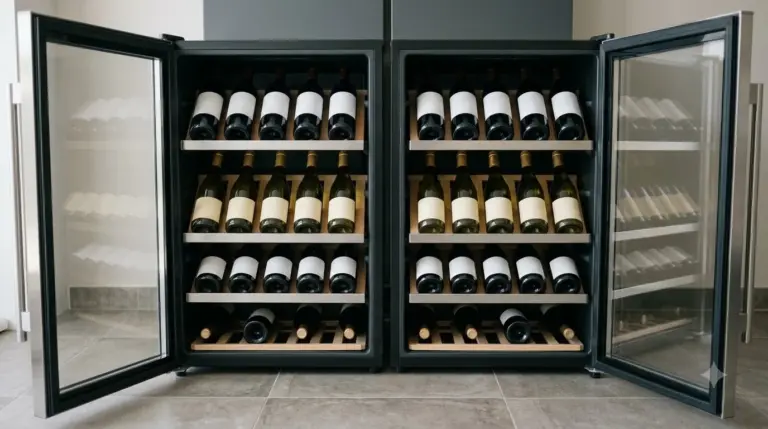
Wine and beverage combo centers pair traditional scalloped wine racks with flat wire or glass shelves designed for 12-ounce cans, holding roughly 15 to 30 bottles alongside 50 to 100 sodas, seltzers, or craft beers. Most use dual-zone layouts where the beverage side drops as low as 39°F while the wine side stays comfortably above 41°F.
Why it stands out: Consolidating party drinks into one freestanding cabinet frees up substantial shelf space in your primary kitchen refrigerator during holidays and weekend gatherings. Top-mounted amber or soft white LED lighting makes labels easy to scan in dimly lit dining rooms or basements without generating heat inside the chamber.
Keep in mind: Single-door combo units split space vertically, which means wide Champagne bottles or magnums can be tricky to fit unless the middle divider or racks adjust easily. Best for families and frequent hosts who want one self-serve station for both adult vintages and canned refreshments.

- Capacity
- 18 bottles, 88 cans
- Zones
- L 35-50°F, R 41-64°F
- Cooling
- Compressor, auto defrost
- Install
- Built-in or freestanding
Part wine cellar, part drink station: the left zone runs 35 to 50 °F and the right zone 41 to 64 °F, each controlled independently. It holds up to 18 Bordeaux bottles and 88 cans. A touch screen, temperature memory, automatic defrost every six hours, and an odor-reducing carbon filter keep upkeep low. It fits under a counter or stands alone.
Pros & ConsView
- Holds 18 bottles plus 88 cans
- Independent controls for each zone
- Fits under a counter or stands alone
- Only 18 bottles, not a serious collection
- Two doors need clearance to open
Best for Tight Alcoves and Narrow Corners: Slim-Profile Tower Coolers
Slim-profile tower coolers measure between 10 and 15 inches wide while extending upward to hold 18 to 34 bottles in single- or double-column rows. Their tall, narrow silhouette slips into awkward gaps next to a refrigerator, beside a china hutch, or at the end of a kitchen counter.
Why it stands out: Instead of sacrificing bottle count to save width, slim towers build vertically, giving you genuine compressor performance in spots too narrow for standard 20- to 24-inch cabinets. Many include reversible door hinges so you can switch the swing direction to avoid bumping adjacent walls or appliances.
Keep in mind: Narrow shelves typically store bottles neck-out or in single-file rows, which makes reaching bottles at the very back slightly slower than in wider cabinets with full-extension wooden racks. Check the door swing radius before ordering so the gasket clears nearby trim cleanly. Best for urban condos, galley kitchens, and unused wall niches.
How to Choose
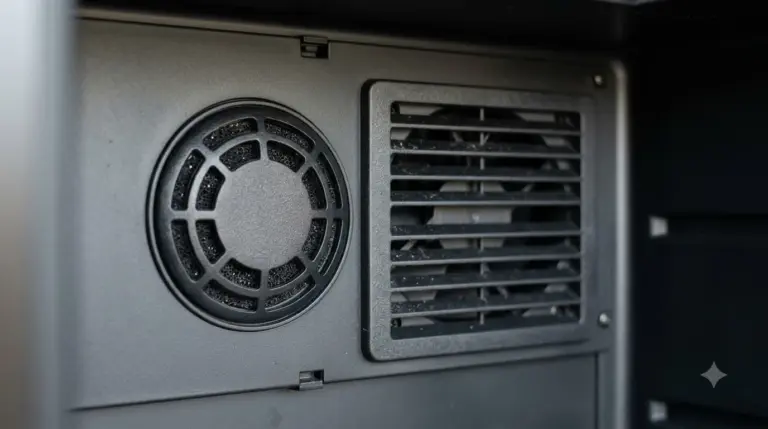
Before ordering any freestanding cabinet, measure the exact spot where it will live and add three to five inches to the width, depth, and height. Unlike front-venting undercounter models, freestanding coolers expel warm air through rear or side grilles; pushing them flush against drywall or boxing them inside cabinetry traps heat, forcing the compressor to run nonstop and shortening its lifespan. You can compare installation clearances across categories in our by type overview.
Next, check the cooling mechanism and shelving layout against the bottles you actually buy. Compressor units cool faster, recover quickly after the door opens, and handle warm rooms reliably, whereas thermoelectric models suit small, climate-controlled spaces where silence matters most. Look for UV-resistant tinted glass, an interior temperature display you can read without opening the door, and removable or adjustable racks if you drink Pinot Noir, Rhône blends, or sparkling wine housed in wider-shouldered glass. If you regularly keep half-finished bottles on hand, check our guide on how long does wine last after opening—and consider a cabinet that offers upright storage space so recorked bottles do not leak through horizontal racks.
Tip: Buy for the collection you expect to own two years from now rather than the bottles sitting on your counter today—most wine drinkers fill their first cooler faster than anticipated, and a unit running at 75 to 85 percent capacity maintains more stable internal temperatures than a nearly empty one.
Frequently Asked Questions
Can you put a freestanding wine fridge under a counter?
No, you should not slide a standard freestanding wine fridge into a tight undercounter cutout. Freestanding models vent heat from the back and sides, so enclosing them restricts airflow, causes overheating, and voids most manufacturer warranties. Only units specifically rated as built-in or front-venting belong beneath cabinetry.
What temperature should I set my freestanding wine fridge to?
For long-term storage of mixed wines in a single-zone fridge, 55°F is the gold standard because it balances aging speed with cork elasticity. If you have a dual-zone cabinet set for immediate serving, keep whites and sparkling wines between 41°F and 50°F and reds between 55°F and 64°F.
Are compressor wine fridges loud?
Modern compressor wine fridges typically operate between 38 and 43 decibels, which is quieter than a standard kitchen refrigerator or average dishwasher. You will hear a soft hum when the compressor cycles on and off, though rubber vibration dampeners keep bottles from rattling inside.
How long should I wait before plugging in a new wine fridge?
Leave a newly delivered compressor wine fridge upright and unplugged for at least 24 hours before turning it on. Shipping often tilts the cabinet, allowing compressor oil to flow into the refrigerant lines; waiting lets the oil settle back into the compressor so the cooling system starts safely.
Matching your freestanding wine fridge to your room layout, bottle shapes, and drinking habits ensures every pour tastes the way the winemaker intended. Measure your ventilation clearance carefully, prioritize steady compressor cooling for anything larger than a countertop unit, and leave yourself a little extra rack space to grow into.
More in Wine Fridges by Type
 Best White Wine Fridge for Reliable Chilling and StorageUpdated Nov 20, 2026
 Best Smart Wine Fridge for Steady Temperatures and Remote ChecksUpdated Nov 18, 2026
 Best Black Under Counter Wine Fridge Options for Kitchens and IslandsUpdated Nov 18, 2026
 Best Black Slim Wine Fridge for Narrow Gaps and Dark KitchensUpdated Nov 18, 2026
 Best Built In Dual Zone Wine Fridge Options by Kitchen LayoutUpdated Nov 18, 2026
 Best Slim Built in Wine Cooler: 5 Space-Saving Styles for Tight KitchensUpdated Nov 18, 2026