

We may earn a commission when you buy through links on this page, at no extra cost to you. Learn more.
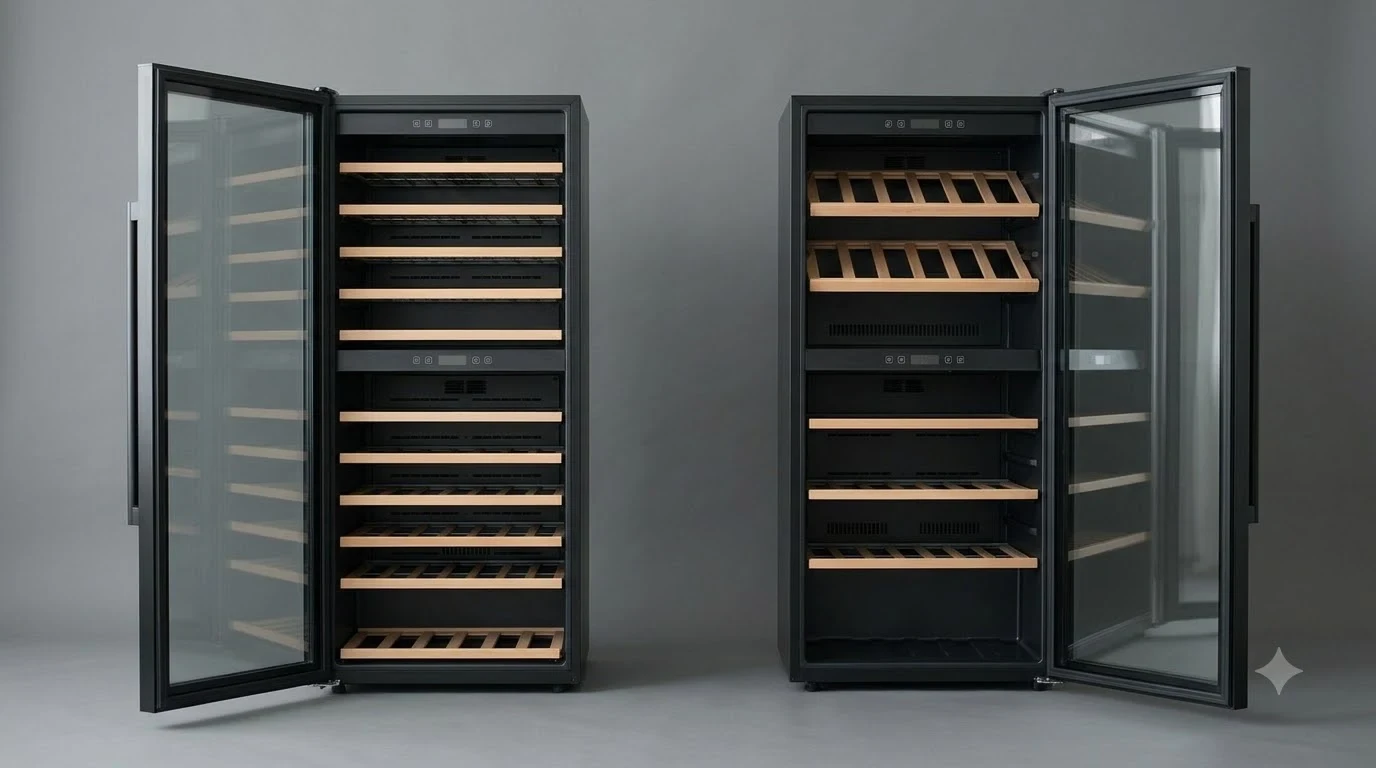
The wine enthusiast 32 bottle wine fridge is a good choice for home wine drinkers who want separate temperature settings for reds and whites without dedicating an entire room to wine storage. Its Dual Zone MAX design offers a 41°F to 64°F adjustment range, compressor cooling, and space for up to 32 standard Bordeaux bottles. However, its freestanding installation, fixed door orientation, and limitations with wider bottles make it important to check your available space and collection before buying.
A dedicated wine refrigerator can make everyday wine storage easier, particularly when a collection includes Cabernet Sauvignon, Pinot Noir, Chardonnay, Sauvignon Blanc, sparkling wine, and rosé. Keeping these bottles together in a regular kitchen refrigerator is not ideal because household refrigerators generally run colder than the temperatures needed for longer-term wine storage. A purpose-built cooler provides more suitable temperature control while keeping bottles organized and protected from ordinary kitchen conditions.
The Wine Enthusiast 32-Bottle Dual Zone MAX Compressor Wine Cooler occupies an appealing middle ground between small countertop wine cabinets and larger collection-focused refrigerators. Its separate compartments, compact vertical footprint, and mirrored glass door make it a practical option for a home bar, dining area, or dedicated storage corner. The important question is whether its capacity, cooling arrangement, and construction match the way you actually buy and serve wine.
Specs and Key Features
The Wine Enthusiast 32-Bottle Dual Zone MAX combines compressor refrigeration, two adjustable temperature zones, and a relatively narrow cabinet. Its specifications make it particularly interesting for households that regularly keep both red and white wine available.
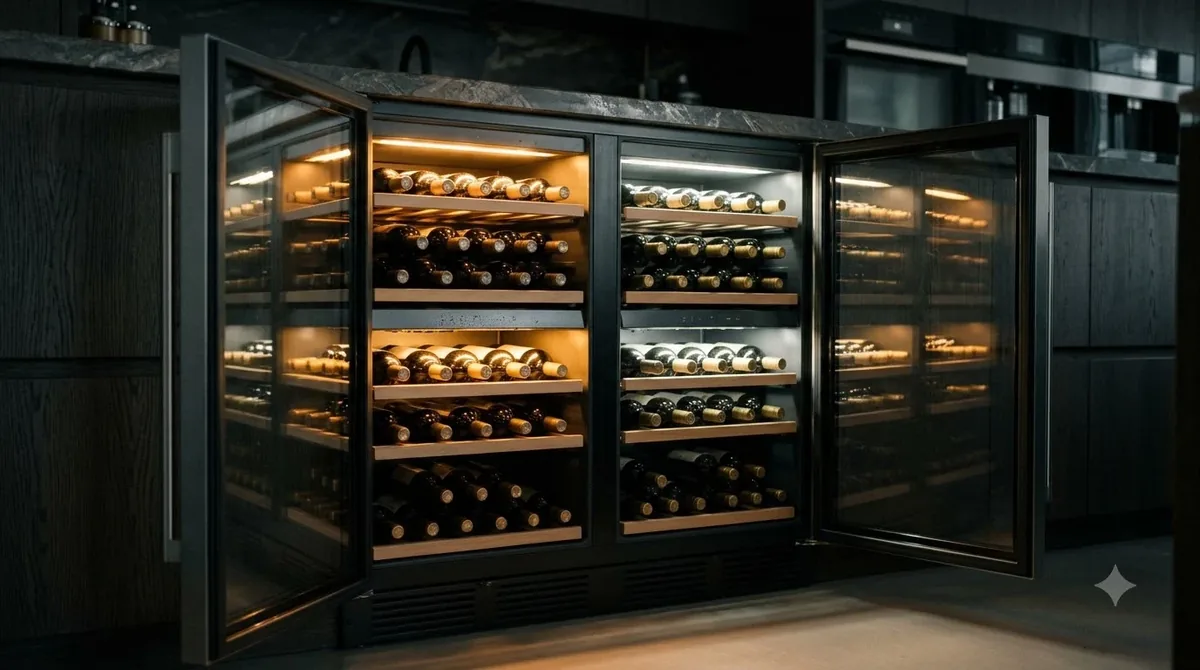
The manufacturer’s product specification identifies the refrigerator as model 288 03 32 03. It provides 3.2 cubic feet of usable volume and a maximum capacity of 32 standard Bordeaux bottles. The two compartments can be adjusted independently between 41°F and 64°F, allowing different wines to remain at different temperatures without requiring two appliances.
The six storage components consist of five wavy chrome-wire racks and one fixed bin. This arrangement is designed around conventional wine bottles, with the fixed lower storage area providing another option for organizing bottles. The white LED interior light and blue LED temperature display make it easier to see the contents and monitor the selected settings.
| Specification | Wine Enthusiast 32-Bottle MAX |
|---|---|
| Manufacturer model | 288 03 32 03 |
| Maximum capacity | 32 standard Bordeaux bottles |
| Usable volume | 3.2 cubic feet |
| Temperature zones | 2 independent zones |
| Temperature range | 41°F–64°F per zone |
| Cooling system | Compressor |
| Height | 33⅜ inches |
| Width | 19½ inches |
| Depth | 17 inches |
| Net weight | Approximately 60 pounds |
| Storage components | 5 wavy racks and 1 fixed bin |
| Door | Dual-pane mirrored glass |
| Door orientation | Right hinge, not reversible |
| Lighting | White LED |
| Controls | Electronic touch controls |
| Sound rating | 40 dB(A) |
| Electrical requirements | 115V, 60Hz, 1.2 amps |
| Warranty | 1 year parts and labor; 3 years sealed system |
| Installation | Freestanding only |
These figures come from the manufacturer’s product specification sheet rather than estimates based on retailer descriptions. The complete Wine Enthusiast 32-Bottle MAX specifications are particularly useful when checking the physical measurements, electrical requirements, rack configuration, and warranty before ordering.
One detail deserves special attention: the 32-bottle figure assumes standard Bordeaux-shaped bottles. It is not a promise that 32 bottles of every wine style will fit comfortably. Wider Burgundy bottles, sparkling bottles, and unusually shaped wine containers can make the practical capacity considerably smaller. The layout is most useful for collections dominated by conventional 750 ml bottles.
The compressor cooling system is another important feature. Unlike a basic beverage cabinet designed primarily for occasional chilling, this appliance is intended to maintain wine-friendly temperatures. The manufacturer specifies an ambient operating range of 61°F to 90°F, making the intended installation environment an important consideration.
The door also deserves attention when planning the installation. Its mirrored dual-pane glass gives the refrigerator a more finished appearance than an opaque utility cabinet, while the integrated handle keeps the front relatively uncluttered. However, the right-side hinge cannot be reversed, so the direction of the opening should be considered before choosing a location.
What Owners Like
The strongest reasons to consider this refrigerator are its separate temperature controls, practical capacity, and straightforward appearance. These features address several common frustrations with smaller wine coolers that have limited space or only one shared temperature setting.
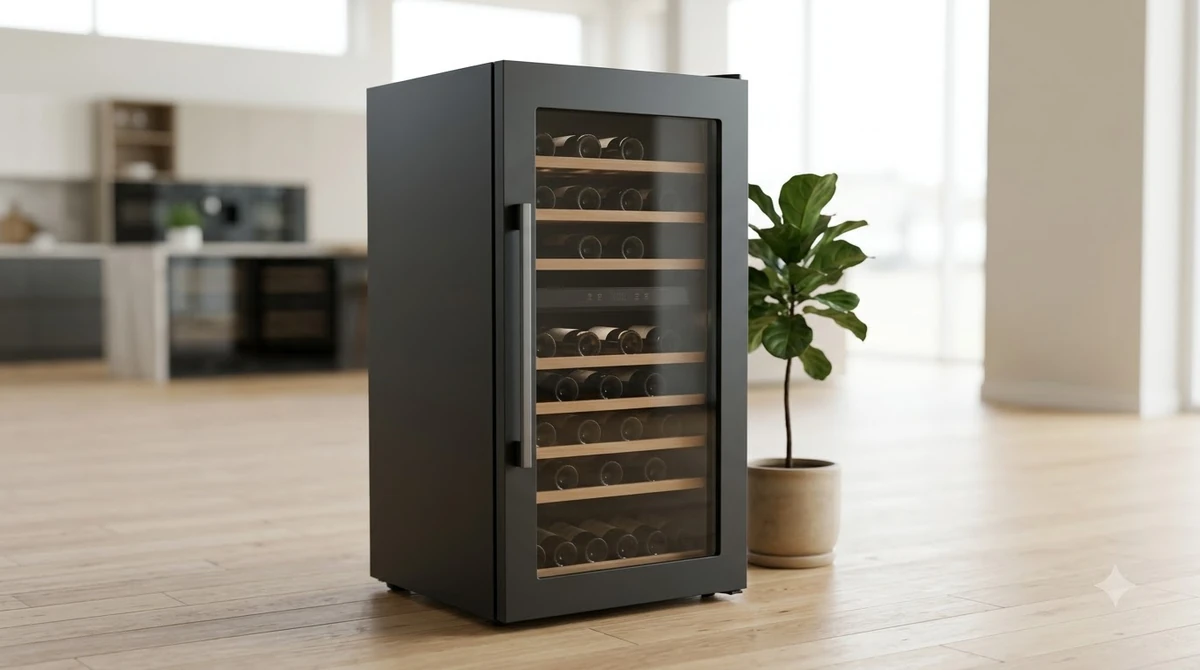
Dual-zone operation is particularly useful for households that regularly drink different wine styles. A red wine collection containing Merlot, Cabernet Sauvignon, and Pinot Noir has different serving requirements from a collection of Chardonnay, Riesling, Sauvignon Blanc, and rosé. With two temperature settings, bottles can be organized according to their intended use instead of being stored together at one compromise temperature.
For example, a household could set one compartment to approximately 55°F for longer-term storage and use the other at approximately 48°F for whites and rosé that will be served relatively soon. Another arrangement is to keep lighter reds around 58°F and whites around 48°F. The useful feature is not that these are mandatory settings, but that the appliance provides enough flexibility to accommodate different preferences.
Another advantage is that both zones can be set to the same temperature. This makes the refrigerator useful even for someone whose collection changes over time. A person who initially buys mostly Chardonnay and Sauvignon Blanc might eventually develop an interest in Italian reds, Bordeaux blends, or sparkling wines without needing to replace the appliance immediately.
The capacity is also sensible for a small home collection. Thirty-two standard bottles represent a meaningful improvement over an eight- or twelve-bottle countertop cooler, but the cabinet remains considerably smaller than a large wine cellar. It can accommodate bottles purchased for upcoming dinners, weekend entertaining, and a modest selection of wines saved for special occasions.
Owner feedback for the related Wine Enthusiast 272 03 32 refrigerator on Best Buy provides additional context about the brand’s compact dual-zone format. Reviewers frequently mention temperature control and quiet operation as positives. Some describe being able to maintain separate temperatures for red and white wine without making the appliance intrusive in a home office or living area.
Those reports should be treated as supporting feedback about the related model, not as a guarantee of identical performance from every 288 03 32 03 unit. Nevertheless, they illustrate why buyers are attracted to this style of refrigerator: it offers useful wine storage features without the dimensions of a dedicated cellar.
The visual design is another advantage. A black cabinet with a mirrored glass door can fit naturally into a modern kitchen, dining room, or home bar. The blue display adds a visible control interface, while the white interior light helps identify bottles without requiring the door to remain open for extended periods.
The compressor design also makes the refrigerator more appropriate for people who want a dedicated cooling appliance rather than a decorative wine cabinet. Temperature control is the primary consideration when storing a collection, and the combination of two adjustable zones and compressor refrigeration provides a useful foundation for that purpose.
For households that enjoy serving wine alongside dinner, the storage arrangement can make entertaining more convenient. A bottle of Chardonnay can be ready for a seafood meal while Cabernet Sauvignon remains in the other compartment for a later dinner. Someone preparing a chicken marsala recipe can also keep the wines intended for cooking and serving organized without moving bottles between several household refrigerators.
For casual entertaining, a chilled bottle of sparkling wine can also be useful for cocktails. A Aperol Spritz recipe is one example of a drink that benefits from having sparkling wine ready to serve. Keeping a few bottles available in a dedicated cooler makes it easier to prepare drinks without having to chill each bottle at the last minute.
Common Complaints and Limitations
The main compromises are the standard-bottle capacity assumption, the fixed door hinge, and the possibility of noticeable operating noise. The refrigerator offers useful features, but its compact design requires some compromises that buyers should understand.
The first limitation is bottle compatibility. The stated 32-bottle capacity is based on standard Bordeaux bottles, which have a relatively familiar shape and diameter. Burgundy bottles generally have broader shoulders and a different profile, while Champagne bottles are wider and often more difficult to fit into closely spaced wine racks.
That difference matters if a collection includes substantial quantities of sparkling wine, large-format bottles, or wines from producers that use unusually shaped glass. A refrigerator that comfortably holds a full load of Bordeaux bottles may hold considerably fewer mixed bottles. Buyers should therefore think about the actual dimensions of their collection rather than treating the advertised capacity as a guaranteed everyday loading figure.
The curved wire shelving is another potential compromise. The design is intended to cradle conventional wine bottles, but its shape can make unusual bottle arrangements less convenient. Some reviewers of the related 272 03 32 model have specifically mentioned difficulty fitting wider red wines and sparkling bottles. Removing a rack may create more room, but doing so reduces the number of bottles that can be stored in the cabinet.
The second concern is the door hinge. The manufacturer lists a right-side hinge and confirms that the door is not reversible. This limits installation flexibility, particularly in narrow rooms where the door must open toward a specific side to avoid a wall, countertop, or adjacent cabinet.
Best Buy feedback for the related 272 03 32 model also includes reports of damaged hinge components and concerns about hinge sturdiness. Other customers describe receiving units that worked well and remained quiet. These mixed reports do not establish a defect rate for the newer specification, but they make delivery inspection and careful handling sensible precautions.
Noise is another factor to consider. The manufacturer lists a sound rating of 40 dB(A), while Serious Eats describes the appliance as fairly quiet but noisier than some competing wine refrigerators. Compressor cooling involves operating sounds, including humming and periodic cycling. Those sounds may be unimportant in a kitchen but more noticeable in a bedroom or particularly quiet living space.
It is also important not to confuse a stated sound rating with a guarantee that every installation will sound identical. The surrounding room, floor surface, cabinet positioning, and leveling can affect how sound is perceived. A refrigerator placed against another surface may transmit vibration differently from one standing securely on a level floor.
The freestanding-only installation requirement is a further restriction. Although its width and depth might make it appear suitable for an under-counter opening, the manufacturer specifies ventilation requirements. It should not be treated as a built-in refrigerator or enclosed inside cabinetry without the required airflow.
Finally, the warranty is relatively straightforward but limited in duration. The manufacturer’s specification provides one year of parts-and-labor coverage and three years for the sealed system. Buyers who expect extended protection for every electronic component, the display, door hardware, and other parts should review the complete warranty conditions before purchasing.
Who Should Buy and Who Should Skip
This refrigerator makes the most sense for someone with a small to medium home collection who wants separate temperatures for different wine styles. It is less suitable for serious collectors who need extensive bottle capacity, flexible installation, or dedicated storage for many oversized bottles.
Consider buying it if you:
- Keep both red and white wines at home and want independent temperature settings.
- Usually purchase standard 750 ml Bordeaux-shaped bottles.
- Want space for a collection of approximately 20 to 32 conventional bottles.
- Have a suitable freestanding location with sufficient ventilation.
- Prefer a vertical refrigerator that does not occupy an entire wall.
- Want a dedicated wine appliance rather than using the kitchen refrigerator.
- Enjoy entertaining and want bottles organized according to serving temperature.
The refrigerator is particularly attractive for people who purchase wine regularly but do not necessarily keep dozens of bottles for long-term aging. Its dual-zone arrangement can separate everyday whites from reds intended for dinner, while the interior light and display make routine access straightforward.
It also suits households where wine preferences are varied. One person might prefer Sauvignon Blanc and sparkling wine, while another regularly chooses Merlot, Syrah, or Cabernet Sauvignon. Separate compartments make it easier to maintain different temperatures without creating an elaborate storage system.
Skip it if you:
- Need a true built-in refrigerator for a kitchen cabinet opening.
- Have a large collection of Champagne or wide Burgundy bottles.
- Need room for significantly more than 32 standard bottles.
- Require a reversible door because of your room layout.
- Expect completely silent operation in a bedroom or quiet study.
- Need extensive storage for large-format wine bottles.
- Want an appliance with a longer comprehensive parts warranty.
Serious collectors should also consider how frequently they buy new wine. A refrigerator filled to its stated maximum capacity leaves little flexibility for additional purchases or bottles with unusual dimensions. Someone who routinely buys cases of wine may find that a larger wine cellar provides better long-term value, even if it requires more installation space.
Another important distinction is the difference between wine storage and wine service. A dual-zone refrigerator can perform both roles for a small collection, but not every bottle needs to be kept at its ideal drinking temperature continuously. Many wines benefit from being stored around 55°F to 57°F, with adjustments made shortly before serving.
For example, a full-bodied Cabernet Sauvignon can be stored at cellar temperature and brought slightly warmer before serving. A Sauvignon Blanc or dry Riesling can be chilled more thoroughly for a refreshing serving temperature. This approach allows the refrigerator to function as a storage appliance rather than simply a beverage chiller.
If the household mostly drinks one style of wine, a single-zone refrigerator could be a more straightforward alternative. Paying attention to actual drinking habits is more useful than choosing a dual-zone design simply because it offers more controls.
How It Compares to Alternatives
The Wine Enthusiast 32-Bottle MAX is positioned between compact single-zone wine refrigerators and larger, more expensive wine storage appliances. Its main selling point is the combination of dual-zone temperature control and a relatively small freestanding footprint.
One useful comparison is the Ivation 12-Bottle Freestanding Wine Refrigerator featured in Serious Eats’ wine-fridge evaluation. That model provides a smaller single-zone storage option, making it more appropriate for someone who buys a few bottles at a time. Its reduced capacity is easier to accommodate in a small apartment, but it cannot offer the same two-compartment temperature flexibility.
For households that primarily store one type of wine, a smaller single-zone cooler can be sufficient. Someone who mainly drinks Sauvignon Blanc, for instance, may not need separate temperature controls. However, a household that regularly serves both Chardonnay and Cabernet Sauvignon is more likely to appreciate the Wine Enthusiast’s separate compartments.
Another comparison is the Cuisinart Private Reserve 8-Bottle Wine Cellar, also included in the Serious Eats evaluation. This compact appliance is designed for very limited storage and countertop use. It is a different type of solution, intended for people who want only a few bottles readily available rather than a larger collection with separate temperature requirements.
At the other end of the range, Serious Eats also discusses the GE 31-Bottle or 109-Can Wine and Beverage Cooler. That appliance offers a different storage emphasis, combining wine and beverage capacity in a single-zone configuration. It may make more sense for households that want to store assorted drinks alongside wine, whereas the Wine Enthusiast model focuses specifically on separate wine temperatures.
The important comparison is therefore not simply how many bottles each refrigerator holds. Buyers should consider the number of zones, bottle compatibility, physical dimensions, cooling system, ventilation requirements, and whether the appliance is intended for wine alone or a mixture of beverages.
Tip: Measure the refrigerator’s full installation area before comparing models. The Wine Enthusiast specification gives a cabinet depth of 17 inches, but the installation also needs ventilation space. Serious Eats recommends approximately four inches of clearance at the back and top for the reviewed model, so a tight cabinet opening should not be assumed to work.
Serious Eats’ evaluation of 12 wine refrigerators is useful additional reading because it considers factors beyond advertised capacity, including usability, noise, shelf design, and temperature adjustment. Its wine refrigerator comparison and buying recommendations provide context for deciding whether a dual-zone cabinet is more appropriate than a smaller or larger alternative.
For a household that wants one appliance to handle a modest collection of reds and whites, the Wine Enthusiast has a convincing feature combination. However, people with unusually shaped bottles or demanding installation requirements should compare the physical rack arrangement and ventilation specifications before making a decision.
Buyers comparing different capacities and configurations can also browse our wine refrigerator model reviews to see how other appliances approach bottle storage, temperature control, and installation requirements.
Setup, Temperature Settings, and Everyday Use
Proper installation and sensible temperature settings are important for getting the most from this refrigerator. The compressor, ventilation arrangement, and bottle racks all work best when the appliance is installed according to the manufacturer’s instructions.
The first step is to choose a stable, level location. The refrigerator weighs approximately 60 pounds, so the floor or supporting surface must be suitable for that load. Allow room for the door to open fully, particularly if the refrigerator will stand beside a wall or another appliance.
Wine Enthusiast recommends allowing its 32-bottle wine refrigerator to remain upright for approximately 24 hours before connecting it to electricity. This waiting period helps reduce the possibility of cooling-system problems associated with transportation. After connecting the appliance, the manual recommends allowing it to operate for at least 30 minutes before making temperature adjustments.
The manual also recommends distributing bottles evenly throughout the cabinet. This prevents excessive weight from being concentrated in one area and helps keep bottles from touching the back of the refrigerator or the lower cabinet step. Only one sliding shelf should be pulled out at a time.
Temperature selection should reflect the wines being stored and whether the goal is longer-term storage or near-term serving. A setting around 55°F is a practical starting point for general wine storage. A separate compartment can be set colder for bottles that are likely to be consumed soon.
The following settings are useful starting points for common wine styles:
- Cabernet Sauvignon and Syrah: Approximately 60°F to 65°F for serving, depending on style and preference.
- Merlot: Approximately 58°F to 62°F for serving.
- Pinot Noir: Approximately 55°F to 60°F for serving.
- Chardonnay: Approximately 50°F to 55°F for serving.
- Sauvignon Blanc and Riesling: Approximately 45°F to 50°F for serving.
- Rosé: Approximately 45°F to 50°F for serving.
- Sparkling wine: Approximately 40°F to 50°F for serving.
These are serving guidelines rather than instructions to store every wine permanently at its drinking temperature. A cellar-style setting around 55°F is suitable for many bottles, with a colder setting reserved for wines that will be consumed soon.
The two-zone controls make it possible to create a practical arrangement without constantly changing settings. One compartment can hold bottles intended for longer storage, while the other contains wines that are nearly ready to serve. This is especially convenient when hosting a dinner with different wine pairings.
Cleaning and organization also matter. Avoid overloading shelves, forcing bottles into narrow spaces, or leaving the door open unnecessarily. When rearranging the collection, pay attention to bottle shoulders and labels so that they do not catch on adjacent racks.
For households that regularly serve sparkling wine, it may be useful to reserve a specific area for those bottles. Their wider bodies can make them harder to fit in standard wine racks, so organizing them separately helps avoid repeatedly rearranging the entire collection.
For a different sparkling-wine serving idea, the Hugo Spritz recipe offers another reason to keep chilled sparkling wine available for entertaining. Having suitable bottles ready in the refrigerator can simplify preparation when guests arrive.
Finally, remember that a wine refrigerator is not a substitute for a suitable installation environment. The manufacturer’s recommended ambient temperature range is 61°F to 90°F. A hot garage or poorly ventilated enclosure may not provide the conditions intended for the appliance.
Frequently Asked Questions
Does the Wine Enthusiast 32-Bottle MAX have a child lock?
The operating manual describes a control-panel locking function that is activated by pressing and holding the zone-select control. This is intended to prevent accidental changes to the temperature settings. It should not be confused with a physical door lock that provides security against unauthorized access.
Can the refrigerator store opened wine bottles?
The refrigerator is designed primarily for conventional horizontal wine-bottle storage. Open bottles with corks or wine stoppers may not fit securely in the same position as unopened bottles. A separately designated upright storage area or another refrigerator may be more convenient for bottles that have already been opened.
Does the Wine Enthusiast 32-Bottle MAX have automatic defrost?
The available manufacturer specification sheet does not identify an automatic-defrost feature. Buyers should therefore consult the documentation for the exact model before assuming that defrosting and maintenance are fully automated. Any ice accumulation or maintenance issue should be handled according to the appliance’s instructions.
Can the LED temperature display show Celsius?
The operating manual for the Wine Enthusiast 32-bottle dual-zone line describes a control-panel function that switches the display between Celsius and Fahrenheit. It is activated by holding the light control for approximately two seconds. This can be useful for households accustomed to temperature readings in Celsius.
Does the refrigerator have an alarm if the door stays open?
The manufacturer’s specification sheet does not list an audible open-door alarm among the standard features. Buyers who consider this function essential should confirm its availability for the exact model before purchasing. Closing the door securely after removing bottles remains an important part of maintaining consistent storage conditions.
The Wine Enthusiast 32-Bottle Dual Zone MAX is a practical option for wine drinkers who want a dedicated refrigerator with separate temperature settings, compressor cooling, and room for a modest collection. Its biggest advantages are its flexible two-zone layout and manageable freestanding footprint, while bottle compatibility, hinge orientation, and ventilation requirements deserve careful consideration. If your collection consists mainly of standard wine bottles and you have a suitable installation location, it is a compelling model to compare with other compact wine refrigerators before choosing your next storage appliance.
More in Model Reviews
 Magic Chef 44 Bottle Wine Cooler Review for Flexible StorageUpdated Nov 21, 2026
 Whynter 164 Bottle Wine Cooler Review: Capacity, Features, and FitUpdated Nov 21, 2026
 Insignia NS WC16BK6 Review: Compact 16-Bottle Wine StorageUpdated Nov 21, 2026
 Wine Enthusiast Electric Blue Omega Review: Opening, Pouring, and Preserving Made EasierUpdated Nov 21, 2026
 Koolatron 20 Bottle Wine Cooler Review: Features, Fit, and PerformanceUpdated Nov 21, 2026
 NewAir AWC 330E Review for Home Wine StorageUpdated Nov 21, 2026