

We may earn a commission when you buy through links on this page, at no extra cost to you. Learn more.
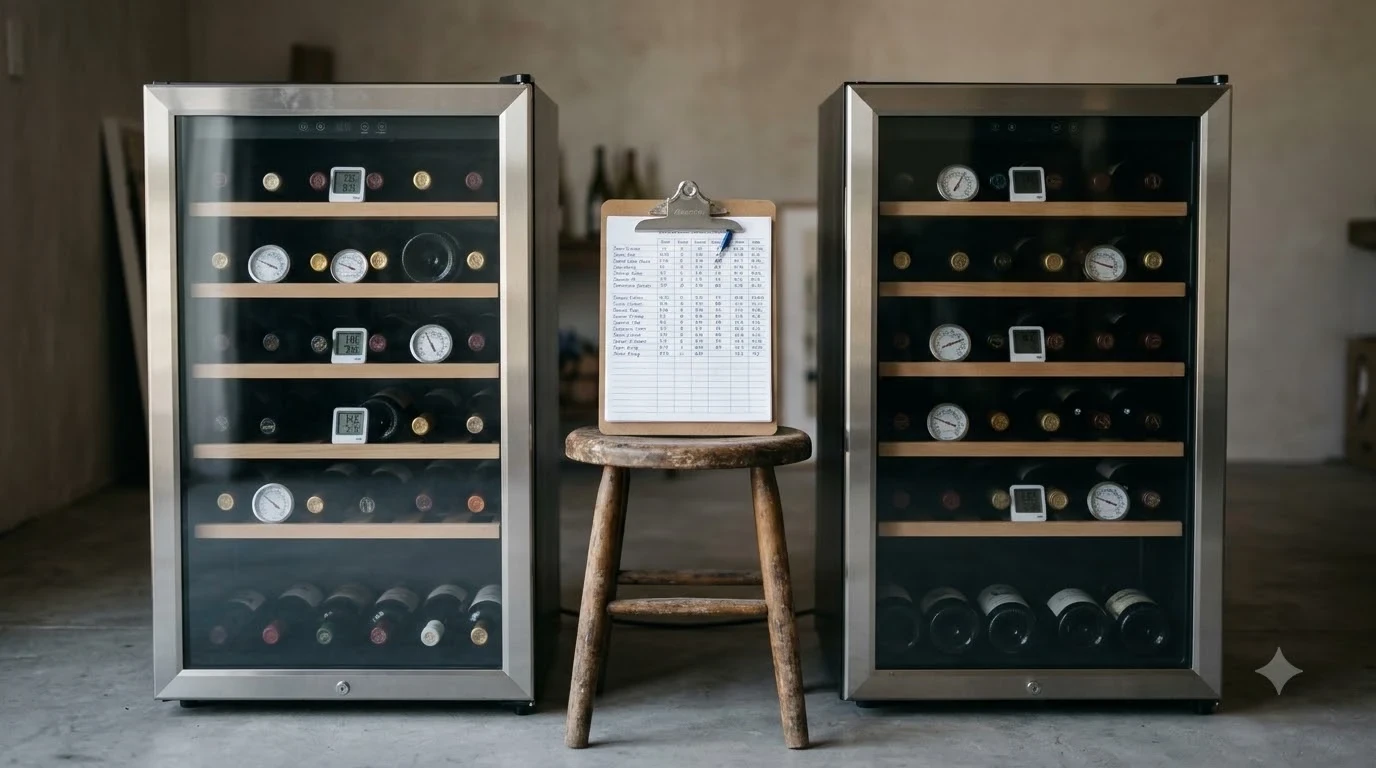
The wine enthusiast 18 bottle wine fridge is a compact, freestanding compressor cooler designed to store up to 18 standard Bordeaux bottles at adjustable temperatures between 41°F and 64°F. Its narrow 13.75-inch width, electronic temperature controls, and six storage racks make it an appealing option for smaller wine collections. However, its single-zone design, bottle-size restrictions, and ventilation requirements are important considerations before buying.
A dedicated wine refrigerator can make a meaningful difference for anyone who wants a more organized collection and dependable serving temperatures without dedicating an entire room to wine storage. Wine Enthusiast offers this model as a space-conscious alternative to larger cabinets, combining compressor cooling with a glass-front design. This review examines its specifications, practical advantages, limitations, installation requirements, and the types of wine drinkers most likely to appreciate it.
Specs and Key Features
The Wine Enthusiast 18-Bottle Compressor Wine Cooler, model 288 03 18 01, is a single-zone refrigerator with a maximum advertised capacity of 18 standard Bordeaux bottles. Its compressor cooling system, digital controls, and compact cabinet distinguish it from many smaller thermoelectric wine refrigerators.
The manufacturer’s product listing provides the core specifications, including its temperature range, electrical requirements, shelf configuration, and warranty. These details matter because a wine refrigerator needs to fit both the available room and the physical dimensions of the bottles being stored.
| Specification | Manufacturer-listed detail |
|---|---|
| Model number | 288 03 18 01 |
| Maximum capacity | 18 standard Bordeaux bottles |
| Temperature range | 41°F–64°F |
| Cooling system | Compressor |
| Temperature zones | 1 |
| Interior volume | 1.8 cubic feet |
| Height | 30.5 inches |
| Width | 13.75 inches |
| Depth | 17.75 inches, excluding handle |
| Storage racks | 6 |
| Noise rating | 40 dB |
| Rated power | 95 watts |
| Electrical requirement | 115V / 60Hz |
| Refrigerant | R600a |
| Warranty | 1 year parts and labor; 3 years sealed system |
| Installation | Freestanding only |
One important distinction is that the advertised 18-bottle capacity assumes standard Bordeaux-shaped bottles. Wider Champagne bottles, Burgundy bottles, and unusually long Riesling bottles can reduce the number of bottles that fit comfortably. The manufacturer specifically identifies a 13.75-inch European Riesling bottle as too deep for the standard rack arrangement.
The six racks combine wavy wire, fixed, and display-style storage. This arrangement provides separate positions for organizing bottles and displaying a favorite selection. The chrome wire construction also makes it easier to identify bottle labels than in a cabinet with completely enclosed shelving.
The exterior features a full-glass door with black trim, a top-mounted LED interior light, electronic touch controls, and a blue temperature display. The glass provides visibility into the collection, although the manufacturer does not list UV protection as a feature. Buyers who prioritize light protection should consider the placement of the refrigerator and avoid exposing it to direct sunlight.
The official product specifications and warranty information are available on the Wine Enthusiast 18-Bottle Compressor Wine Cooler product page.
What Owners and Buyers May Appreciate
The strongest advantages of this refrigerator are its narrow footprint, compressor-based cooling, and straightforward storage arrangement. These features make it a practical candidate for someone who wants a dedicated wine cabinet without purchasing a much larger appliance.

Compressor cooling for more consistent temperatures
The compressor system is one of the most important features. Unlike many thermoelectric wine coolers, which depend heavily on the surrounding room temperature, compressor models are designed to maintain cooling across a broader range of ambient conditions.
This matters in an American home where indoor temperatures can change between seasons. A kitchen that reaches the upper 70s during summer presents a different cooling challenge from a basement that remains relatively cool throughout the year. Compressor technology generally offers more cooling capability in these situations.
Wine Enthusiast specifies an operating ambient temperature range of 61°F to 90°F for this model. That range provides useful flexibility for ordinary indoor locations, although the refrigerator still needs sufficient ventilation and should not be placed beside a heat-producing appliance.
A compact footprint
At 13.75 inches wide, this cooler occupies relatively little horizontal space. Its narrow cabinet can be useful in an apartment, dining room, home bar, or smaller kitchen where a conventional wine refrigerator might be difficult to accommodate.
The 30.5-inch listed height also makes the appliance easier to consider alongside other compact household equipment. However, the product page contains another dimension entry of 32.75 inches high and 19 inches deep. This discrepancy deserves attention when measuring a restricted installation area. Planning around the larger published measurements is the safer approach.
Simple temperature controls
The electronic touch controls and blue LED display provide a straightforward way to adjust and monitor the refrigerator. Users can select a temperature within the 41°F to 64°F range rather than relying on a basic low, medium, or high cooling switch.
This flexibility is useful for households that keep several types of wine but prefer one general storage temperature. A collection of everyday Chardonnay, Pinot Noir, Cabernet Sauvignon, and sparkling wine can be organized inside the same cabinet, even though their ideal serving temperatures differ.
Useful display and storage features
The glass door and interior LED lighting make the collection visible without requiring the door to remain open while someone searches for a bottle. The six-rack layout also offers a more organized arrangement than a simple stack of bottles on a refrigerator shelf.
The 40 dB manufacturer-listed noise rating provides a useful reference when comparing appliances. Actual sound perception depends on room acoustics, installation, and compressor cycling, so a refrigerator with this rating should not automatically be considered completely silent.
Common Complaints and Limitations
The most significant compromises involve bottle compatibility, single-zone storage, installation flexibility, and the limited space available inside a narrow cabinet. These are practical limitations rather than minor cosmetic details, especially for collectors who regularly purchase different wine styles.
The 18-bottle capacity is not universal
The advertised capacity is based on standard Bordeaux bottles, which have a relatively consistent shape and diameter. Other bottle styles can occupy more room, preventing the refrigerator from reaching its advertised maximum capacity.
Champagne bottles often have wider shoulders and thicker glass. Burgundy bottles can also have a broader profile than traditional Bordeaux bottles. European Riesling bottles present another challenge because their longer dimensions can exceed the available rack depth.
For a collection consisting mainly of conventional Cabernet Sauvignon, Merlot, and Bordeaux-style blends, the storage arrangement is more straightforward. A mixed collection containing Champagne, Burgundy, and long Riesling bottles requires more careful planning.
One temperature zone limits flexibility
This particular model has one temperature zone, meaning the cabinet operates around a shared temperature setting. It cannot independently maintain a cooler compartment for white wines and a warmer compartment for red wines.
That distinction is important because wine serving temperatures vary considerably. Light-bodied reds such as Pinot Noir are generally served around 55°F to 60°F, while fuller-bodied reds such as Cabernet Sauvignon are typically served around 60°F to 65°F. Light whites and rosé are generally served around 45°F to 50°F.
A single-zone refrigerator can store all these wines, but it cannot simultaneously provide each category with its ideal serving temperature. Collectors who frequently serve both chilled whites and room-temperature reds may prefer a genuine dual-zone appliance.
Freestanding installation only
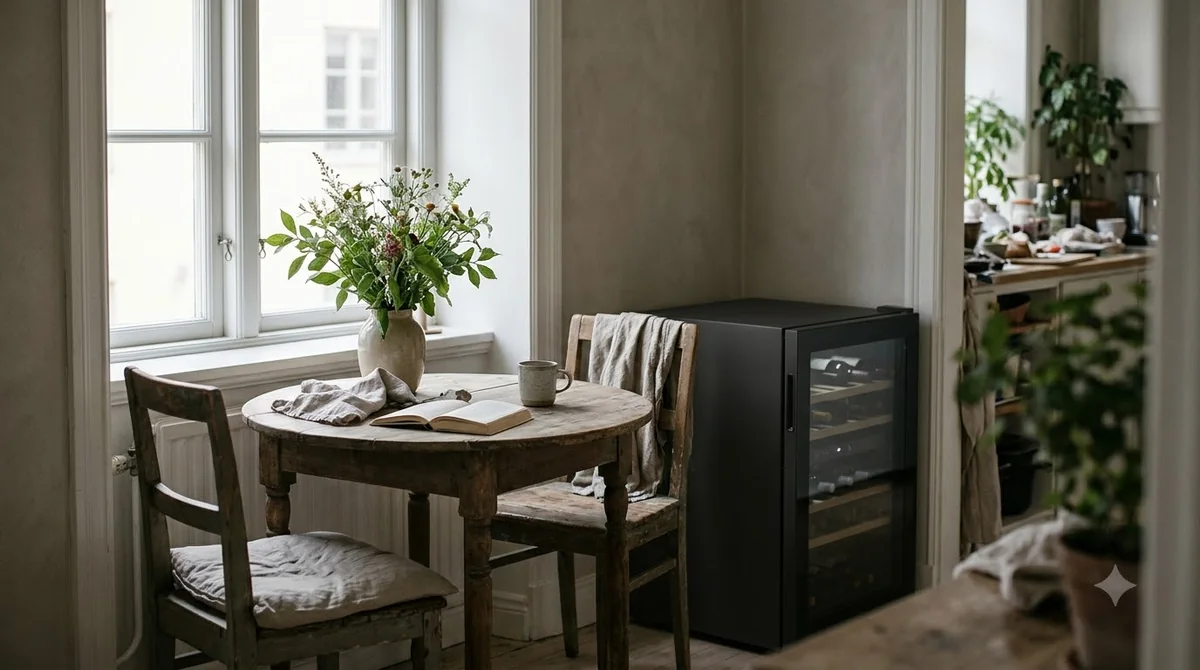
The manufacturer explicitly identifies this appliance as freestanding. It is not designed as a built-in wine refrigerator, and placing it inside a tightly enclosed kitchen cabinet can restrict the airflow needed to release heat.
The specified installation clearance is at least 2 inches on both sides and 4 inches behind and above the refrigerator. These requirements can make a narrow kitchen alcove less suitable than it initially appears.
Door and lighting considerations
The full-glass door provides an attractive presentation, but the manufacturer’s specification does not identify UV protection. This is a consideration for buyers planning to store valuable bottles for extended periods in a bright room.
The door is also listed as non-reversible. Its opening direction therefore needs to work with the surrounding furniture and available walking space. A refrigerator placed next to a wall or countertop should have enough clearance for convenient access to the racks.
Warranty coverage is divided
The manufacturer lists one year of parts and labor coverage and three years of sealed-system coverage. This is useful information, but buyers should understand that these are separate warranty periods.
The longer coverage applies to the sealed cooling system rather than every component in the refrigerator. Electronic controls, door components, and other parts should not automatically be assumed to receive the same three-year protection. Keeping the purchase documentation and following the manufacturer’s installation instructions are sensible steps for warranty support.
Who Should Buy and Who Should Skip It
The Wine Enthusiast 18-bottle compressor refrigerator is best suited to someone with a modest wine collection who wants temperature-controlled storage in a relatively narrow freestanding cabinet. It is less appropriate for collectors who need separate temperature zones, built-in installation, or generous capacity for oversized bottles.
Good fit for smaller collections
Someone who typically keeps 8 to 18 standard bottles at home may find the capacity appropriate. The cabinet provides dedicated storage without requiring the floor space of a larger wine cellar.
It is also worth considering for people who purchase wine regularly but do not maintain a large inventory. A small collection of California Cabernet Sauvignon, Oregon Pinot Noir, Washington Merlot, and French Chardonnay can be arranged without needing a full-size storage cabinet.
Suitable for home bars and entertaining areas
The glass door and interior lighting make the appliance visually appropriate for a home bar or dining area. Guests can see the available selection, while the narrow footprint helps preserve room for glassware, cocktail equipment, and other entertaining essentials.
For cocktail enthusiasts, a separate refrigerator can also help organize sparkling wine and aperitif bottles. An Aperol Spritz recipe, for example, uses sparkling wine as a central ingredient. However, the wine refrigerator should be viewed as wine storage rather than a substitute for a dedicated beverage refrigerator.
Less suitable for serious collectors
Someone with a collection of 40 or more bottles will probably outgrow this appliance quickly. The 18-bottle maximum leaves little room for additional purchases, and the limited internal volume makes it difficult to organize a large assortment by region, vintage, or grape variety.
Collectors who regularly buy Burgundy, Champagne, or longer Riesling bottles should also think carefully about usable capacity. A nominal 18-bottle refrigerator can become considerably less practical when its shelves must accommodate a variety of bottle shapes.
Not for under-counter installations
Buyers looking for a refrigerator that fits flush beneath kitchen counters should skip this model. Its freestanding design and required ventilation clearances make it unsuitable for enclosed cabinetry.
A front-vented, built-in wine refrigerator is a better option for that application. Installation type should be established before comparing appearance or advertised bottle capacity because an incorrectly installed appliance may struggle to release heat.
Tip: Measure the intended location before ordering. Allow for the larger published height and depth figures, then add at least 2 inches of side clearance and 4 inches above and behind the refrigerator. Also measure your tallest and widest wine bottles rather than assuming every bottle will fit like a standard Bordeaux.
How It Compares to Alternatives
The Wine Enthusiast 18-bottle refrigerator occupies a useful middle ground between very small countertop coolers and larger freestanding wine cabinets. Its main distinction is compressor cooling combined with a narrow cabinet and a single temperature zone.
There are several alternatives worth considering, depending on whether storage flexibility, capacity, or installation requirements matter most. The appropriate comparison is not simply the number of bottles advertised; cooling technology and practical bottle compatibility also influence long-term satisfaction.
Single-zone versus dual-zone storage
A single-zone refrigerator is straightforward to operate because the entire collection shares one temperature setting. This arrangement is appropriate for someone who stores wine for general preservation and takes individual bottles out before serving.
A dual-zone refrigerator provides separate temperature settings for two compartments. This arrangement is more convenient for households that regularly serve Sauvignon Blanc, Chardonnay, and sparkling wine alongside Cabernet Sauvignon and Syrah.
Wine Enthusiast also documents a separate 18-bottle dual-zone model, numbered 288 03 18 03. It should not be confused with the single-zone 288 03 18 01 reviewed here. The manufacturer provides different model numbers and operating instructions for these configurations.
Compressor versus thermoelectric cooling
Thermoelectric refrigerators are often attractive to buyers who prioritize low operating noise and simple construction. However, their cooling ability is more dependent on the surrounding room temperature.
Compressor refrigerators generally provide stronger cooling performance and are less affected by warmer indoor conditions. This makes the Wine Enthusiast model a reasonable consideration for a home where summer temperatures rise above comfortable cellar conditions.
The trade-off is that compressor units can produce audible operating sounds. Buyers who plan to place the refrigerator beside a bed or in a particularly quiet office should consider this factor alongside the published 40 dB rating.
Small versus larger wine refrigerators
A larger freestanding refrigerator offers more room for bottle rotation and future purchases. However, it also requires additional floor space and may be unnecessarily large for someone who keeps only a dozen or so bottles.
The 18-bottle cabinet makes more sense when the available space is restricted and the collection is relatively stable. A larger cabinet becomes more appealing when wine purchases are frequent or the collection includes multiple cases intended for longer storage.
Choosing the right storage arrangement
The best alternative depends on the actual collection rather than a general preference for more features. Someone who primarily buys Bordeaux-style bottles may be satisfied with a compact single-zone refrigerator, while a Champagne enthusiast may benefit from a cabinet with more generous shelf spacing.
For additional appliance comparisons, the Brand x Capacity model reviews section provides another starting point for evaluating different wine storage options.
Installation, Operation, and Maintenance
Proper installation is particularly important for a freestanding compressor refrigerator because the cooling system needs room to release heat. The Wine Enthusiast manual also provides initial setup and loading instructions that help avoid unnecessary operating problems.
Choose an appropriate location
Place the refrigerator on a hard, level surface away from direct sunlight, heating appliances, and other significant heat sources. The manufacturer’s specified ambient operating range is 61°F to 90°F, so an unheated garage or an exposed outdoor location is not an appropriate choice.
Maintain the required ventilation clearances around the cabinet. Avoid pushing the appliance directly against a wall or surrounding it with decorative panels that obstruct airflow.
Allow the refrigerator to settle after transportation
The manufacturer’s user manual instructs users to leave the refrigerator upright for approximately 24 hours before connecting it to power following transportation. This allows the cooling system to settle after handling and reduces the possibility of operating problems.
After connecting the refrigerator, allow it to operate for at least 30 minutes before making temperature adjustments. The cabinet may also require additional time to reach its selected temperature, particularly when it is first loaded with several bottles.
Load bottles carefully
Distribute bottles evenly throughout the available storage space instead of concentrating the entire collection on one shelf. The manual recommends avoiding contact between bottles and the back of the cabinet or the lower interior step.
Only pull out one rolling shelf at a time when accessing bottles. The manual also specifies a maximum weight capacity of 25 pounds per shelf for the models covered by its instructions. Removing shelves to create extra space may be possible, but it can change the organization and usable capacity.
Choose a practical temperature
A single-zone refrigerator is most convenient when the owner selects one general storage temperature rather than trying to match every serving recommendation simultaneously. A setting around 55°F is a practical reference point for a mixed collection, provided the wine is removed and allowed to reach its preferred serving temperature when necessary.
For serving, light whites and rosé generally work well around 45°F to 50°F, full-bodied whites around 50°F to 55°F, and light reds around 55°F to 60°F. Fuller reds are generally served around 60°F to 65°F.
For example, a Pinot Noir can benefit from a short period outside the refrigerator before serving, while a Chardonnay may be ready closer to its chilled storage temperature. A separate serving routine makes a single-zone refrigerator more versatile.
Keep the interior clean
Unplug the refrigerator before cleaning or performing maintenance. Clean interior surfaces with a soft cloth and an appropriate mild cleaning solution, avoiding abrasive materials that could damage the interior finish or door components.
Keep the door seal clean and inspect it periodically for dirt or damage. A properly closing door helps the refrigerator maintain its selected temperature without unnecessary cooling cycles.
Regularly check the space around the ventilation openings as well. Dust accumulation and obstructed airflow can interfere with normal heat release, particularly when the appliance is positioned in a room with limited circulation.
Frequently Asked Questions
Is the Wine Enthusiast 18-bottle refrigerator suitable for long-term wine aging?
It can provide dedicated temperature-controlled storage, but it does not offer every feature associated with a specialized long-term wine cellar. The manufacturer does not list humidity control or UV protection for this model. Collectors aging expensive bottles over many years may prefer a purpose-built cellar with additional environmental controls.
Does the refrigerator have a door lock?
The manufacturer’s specification listing for model 288 03 18 01 identifies the door as having no lock-and-key feature. Buyers who need restricted access should consider this before choosing the appliance. The door is also listed as non-reversible, so its opening direction cannot be changed to suit every room layout.
Can the refrigerator store wine bottles horizontally?
Its wire-rack arrangement is designed to hold bottles horizontally for organized storage. Horizontal positioning keeps the cork in contact with the wine in traditionally cork-sealed bottles. Bottle placement should remain secure, and shelves should not be overloaded or unevenly weighted.
Does the refrigerator require a special electrical outlet?
The manufacturer specifies a standard 115V, 60Hz electrical supply and a NEMA 5-15P plug. The manual calls for a properly grounded electrical outlet and advises against removing the grounding connection. An appropriate dedicated outlet location is preferable to relying on an extension cord.
Can the refrigerator store opened wine bottles?
It can accommodate suitable bottles of opened wine if they fit securely on the racks, preferably with an appropriate closure. However, refrigeration does not stop oxidation completely. Sparkling wine generally keeps for approximately 1 to 3 days after opening, while most still wines keep around 3 to 5 days when properly resealed and refrigerated.
The Wine Enthusiast 18-bottle compressor refrigerator is a practical option for smaller collections that need dedicated, adjustable-temperature storage in a narrow freestanding cabinet. Its compressor cooling, digital controls, and organized shelving are appealing, but the single-zone arrangement and bottle-size limitations deserve careful consideration. Measure the installation area, evaluate the shapes of the bottles being stored, and compare single-zone and dual-zone requirements before deciding whether this model is the right addition to a home wine collection.
More in Model Reviews
 Magic Chef 44 Bottle Wine Cooler Review for Flexible StorageUpdated Nov 21, 2026
 Whynter 164 Bottle Wine Cooler Review: Capacity, Features, and FitUpdated Nov 21, 2026
 Insignia NS WC16BK6 Review: Compact 16-Bottle Wine StorageUpdated Nov 21, 2026
 Wine Enthusiast Electric Blue Omega Review: Opening, Pouring, and Preserving Made EasierUpdated Nov 21, 2026
 Koolatron 20 Bottle Wine Cooler Review: Features, Fit, and PerformanceUpdated Nov 21, 2026
 NewAir AWC 330E Review for Home Wine StorageUpdated Nov 21, 2026