

We may earn a commission when you buy through links on this page, at no extra cost to you. Learn more.
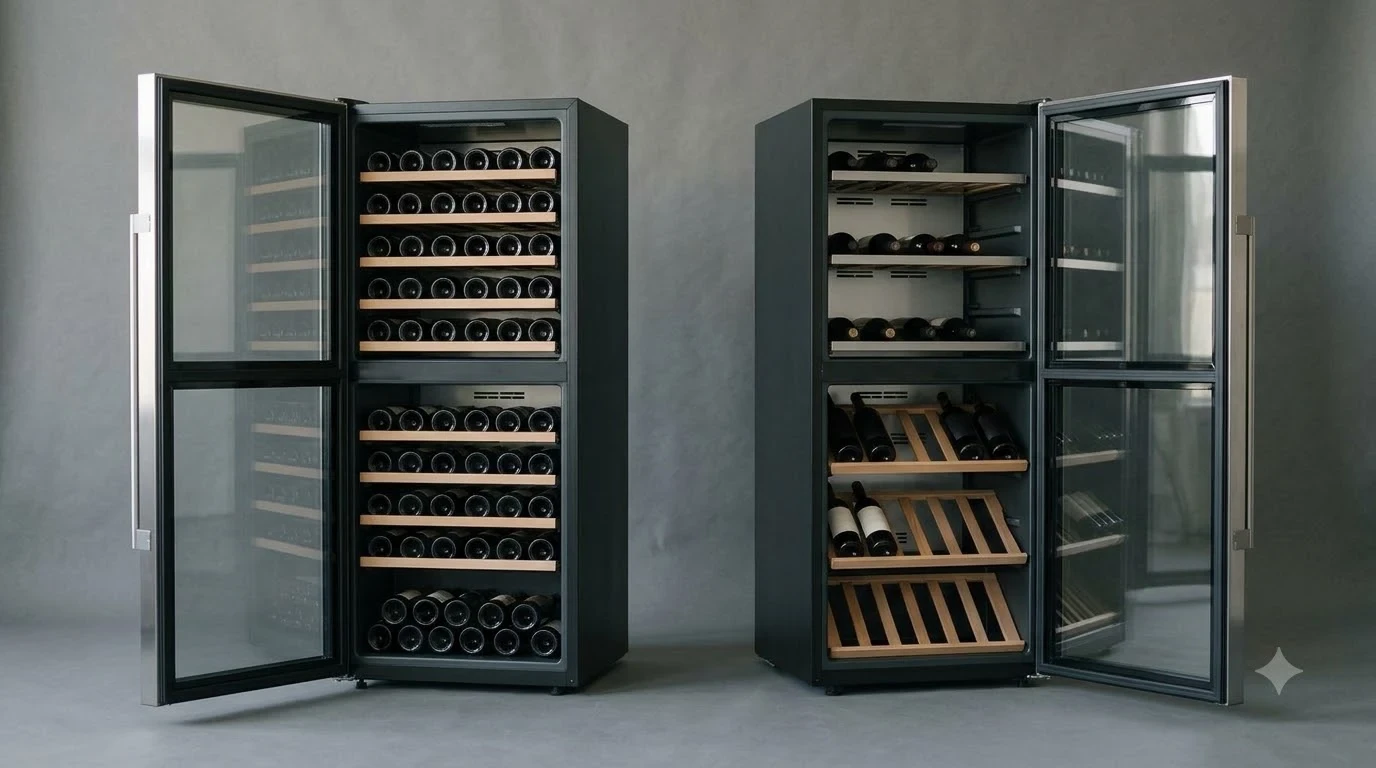
The Whynter dual zone wine fridge, specifically the BWR-462DZ, is a practical 46-bottle compressor refrigerator for households that want separate storage temperatures for red and white wines. Its 24-inch cabinet, front ventilation, five removable wood-faced shelves and independently controlled compartments make it a useful option for an undercounter installation or a freestanding home bar. However, its one-year limited warranty, relatively modest upper-zone capacity and installation requirements deserve consideration before purchasing.
The Whynter BWR-462DZ targets wine drinkers who have outgrown a small countertop cooler but do not need a full-height wine cabinet. Its advertised 46-bottle capacity provides room for everyday drinking wines, sparkling bottles and selections intended for longer storage. The important distinction is that this is a dual-zone refrigerator with different temperature ranges, not simply a single-temperature cabinet with two shelves. Understanding those ranges, the physical dimensions and the practical storage limitations will help determine whether it belongs in your kitchen.
Specifications and Key Features
The BWR-462DZ combines a 24-inch-class cabinet with compressor cooling, two independently controlled zones and a 46-bottle advertised capacity. Its feature set emphasizes flexible installation, straightforward temperature adjustment and a glass-door presentation rather than advanced connected controls.
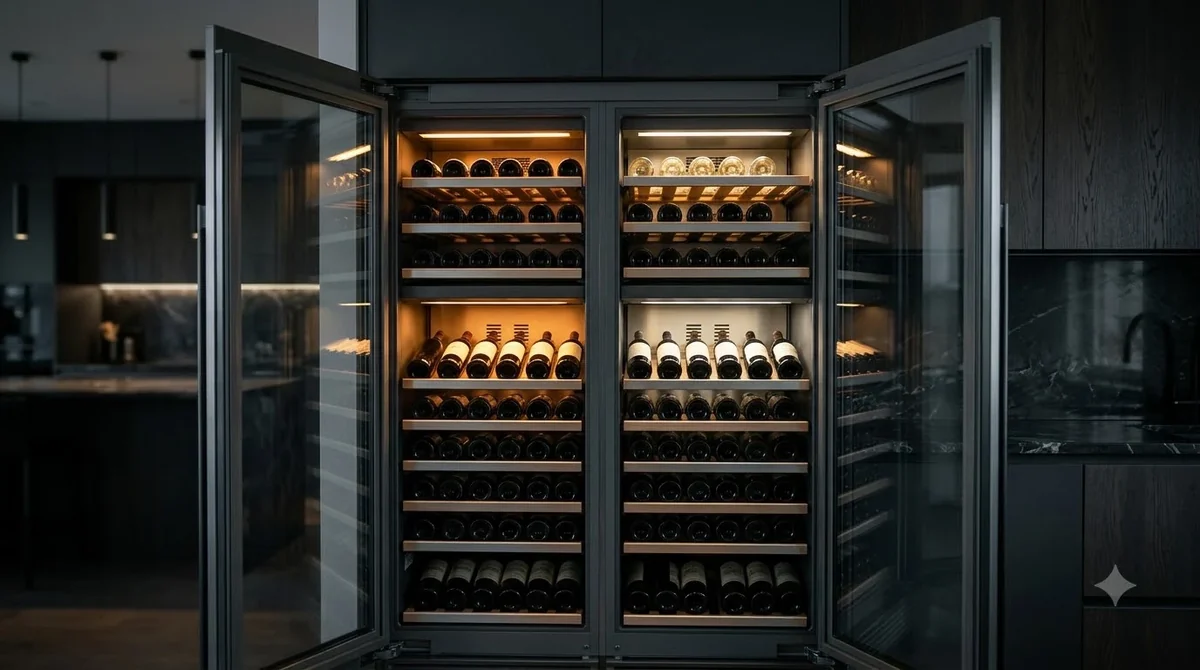
Whynter divides the cabinet into an upper compartment holding up to 16 standard bottles and a lower compartment holding up to 30. The arrangement is useful for separating wines that need different serving temperatures. For example, the upper compartment can accommodate Sauvignon Blanc, Riesling and sparkling wine, while the lower compartment provides warmer storage for Pinot Noir, Merlot and other reds.
The compressor cooling system is an important part of the specification. Unlike thermoelectric wine coolers, which depend heavily on surrounding room temperatures, compressor systems are generally more suitable for maintaining refrigerated conditions in ordinary kitchen environments. The BWR-462DZ also uses fan-assisted air circulation to distribute cooling throughout the cabinet.
The manufacturer’s specifications identify a noise rating below 38 dB. That is a useful published benchmark for an appliance intended for kitchen or entertainment-area installation, although the actual sound in a particular room can depend on flooring, cabinet construction, ventilation and compressor cycling.
| Specification | Whynter BWR-462DZ |
|---|---|
| Advertised capacity | 46 standard 750 ml bottles |
| Upper compartment | 16 bottles |
| Lower compartment | 30 bottles |
| Storage volume | 5.1 cubic feet |
| Cooling system | Compressor |
| Upper temperature range | 40°F–55°F |
| Lower temperature range | 50°F–65°F |
| Dimensions | 32.5 H × 23.5 W × 22.5 D inches |
| Depth with handle | 24.25 inches |
| Shelving | Five removable wood-faced roller shelves |
| Installation | Built-in or freestanding |
| Published noise rating | Below 38 dB |
| Maximum power consumption | 100 watts |
| Electrical requirement | 115V / 60Hz |
| Refrigerant | R600a |
| Door | Reversible, stainless steel trim and glass |
| Warranty | One-year limited warranty |
One specification deserves particular attention. The manufacturer’s product listing gives the upper zone a 40°F–55°F range and the lower zone a 50°F–65°F range. The instruction manual, however, describes operating control limits of 41°F–50°F for the upper compartment and 50°F–72°F for the lower compartment. These published documents do not agree completely. Buyers should obtain confirmation of the applicable operating range for their particular BWR-462DZ version rather than assume every listing describes identical control limits.
Other features include a reversible door, security lock and key, temperature memory, open-door warning and malfunction alarm. The double-pane glass door provides an additional layer between the collection and the surrounding room, while soft white LED lighting makes bottle labels easier to see. These are practical features for a refrigerator that may occupy a visible position in a kitchen or entertainment space.
For the complete manufacturer’s specification, consult the Whynter BWR-462DZ product specifications before selecting an installation location.
What Owners Like About the Refrigerator
Available owner feedback highlights the refrigerator’s appearance, shelving and relatively quiet operation. The comments are encouraging, but the limited number of published reviews means they should be treated as individual experiences rather than proof of long-term reliability.
The Home Depot review page contains three customer reviews. One verified purchaser described the replacement unit as excellent after the first delivery arrived damaged. Another reviewer praised the wood shelving, overall appearance and quiet operation, describing the appliance as a successful addition to a newly constructed kitchen island.
The wood-faced shelves are one of the more attractive details of the design. Metal shelving can look industrial, while wooden shelf fronts provide a more traditional wine-cellar appearance. The sliding construction also makes it easier to retrieve bottles without removing several neighboring bottles from the cabinet.
The stainless steel trim and glass door help the refrigerator fit into contemporary kitchen designs. Its black cabinet creates a relatively understated appearance, while the curved handle provides a more substantial visual feature than a recessed plastic grip.
Capacity is another potential advantage. Forty-six standard bottles offer meaningful storage without requiring a tall, full-height appliance. A household that buys mixed cases, keeps several bottles of Champagne or Prosecco available and maintains a modest selection of red wines may find the arrangement especially convenient.
Separate temperature controls also offer a practical benefit. White wine generally needs cooler serving conditions than full-bodied red wine. Keeping Sauvignon Blanc at approximately 48°F and Merlot around 60°F can make both bottles more convenient to serve without repeatedly adjusting a single compartment.
The reversible door is another useful feature for kitchen planning. Depending on the location of nearby cabinets, an alternative hinge orientation can make loading and retrieving bottles considerably easier. The lock can also help prevent casual access to a collection in a shared household.
There is an important qualification to the owner feedback: three reviews are not enough to establish a dependable failure rate, compressor lifespan or consistency across manufacturing batches. Buyers should distinguish attractive early impressions from evidence of performance over several years.
Common Complaints and Limitations
The most important concerns are the limited warranty, modest review sample, installation dimensions and differences between published temperature specifications. None automatically disqualifies the BWR-462DZ, but each affects the ownership decision.
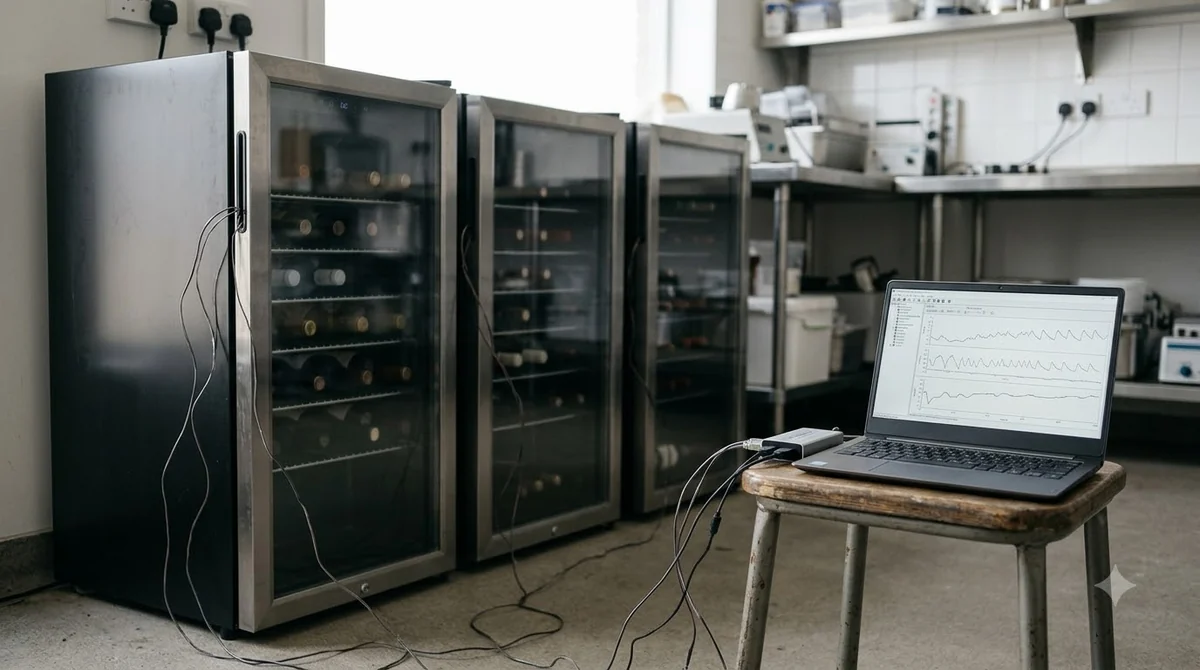
The one-year limited warranty is relatively short for an appliance that may remain in a kitchen for many years. A wine refrigerator is expected to operate continuously, so compressor problems, control failures and temperature inconsistencies can become expensive concerns after the initial coverage expires.
Compare the warranty terms with those of competing refrigerators before making a final decision. Also investigate whether the retailer offers a clearly documented extended protection plan, what it covers and whether service requires transporting the appliance. A longer warranty is only useful if the repair and replacement conditions are practical.
The next concern is the limited amount of owner feedback. The three reviews listed by Home Depot contain positive comments, but they do not provide enough detail to establish consistent cooling performance, long-term compressor durability or customer-service satisfaction. There is also a delivery-related complaint involving damage to the original unit.
That delivery experience makes inspection particularly important. The appliance weighs approximately 121 pounds according to the manufacturer, so it is not a small package that can easily be moved or replaced. Buyers should arrange appropriate delivery assistance and inspect the cabinet, glass, door alignment and packaging before accepting the refrigerator.
The temperature specification discrepancy is another issue. The manufacturer’s product page advertises an upper range of 40°F–55°F and a lower range of 50°F–65°F, while the manual describes different limits. This matters to anyone who wants to maintain particular temperatures rather than simply keep red and white wines in separate compartments.
Capacity also requires realistic expectations. The advertised 46-bottle figure assumes standard wine bottles arranged according to the manufacturer’s storage configuration. Wide Champagne bottles, Burgundy shapes and some specialty bottles can reduce usable space. A collection containing many larger-format bottles may not approach the advertised number.
The 16-bottle upper compartment is particularly important. A household that drinks more white wine than red may find the distribution inconvenient because the larger lower compartment is assigned to the warmer temperature zone. The two compartments cannot simply be treated as interchangeable storage areas.
Finally, the BWR-462DZ is a compressor refrigerator. Even with a published noise rating below 38 dB, it should not be assumed to operate in complete silence. Compressor cycling and ventilation fans produce operating sounds, and an uneven floor or poorly fitted surrounding cabinetry can introduce additional vibration.
Tip: Before ordering, request written confirmation of the temperature-control ranges for your exact BWR-462DZ model revision. Also photograph the appliance immediately after delivery so that visible shipping damage can be documented before installation.
Who Should Buy the Whynter BWR-462DZ and Who Should Skip It
This refrigerator makes the most sense for wine drinkers with a moderate collection, a suitable 24-inch installation area and a genuine need for two temperature zones. It is less suitable for households that prioritize extensive long-term storage, unusually large bottles or lengthy warranty coverage.
Good candidates for this refrigerator
Homeowners planning a kitchen renovation may appreciate the front-venting design and undercounter installation option. The refrigerator can occupy a dedicated opening beneath a counter without requiring the same type of rear ventilation arrangement used by many freestanding-only appliances. The actual cabinet opening and installation clearances still need to follow the model’s manual.
It is also a reasonable configuration for people who regularly drink both red and white wines. For example, a collection containing Sauvignon Blanc, Chardonnay, Pinot Noir and Cabernet Sauvignon benefits from separate temperature environments. The cooler upper section can accommodate the whites, while the lower compartment offers warmer conditions for reds.
Frequent entertainers may appreciate the glass door, lighting and lock. Keeping sparkling wine chilled in the upper compartment and several bottles of red wine in the lower compartment makes it easier to prepare for a dinner gathering without using a separate refrigerator.
People who want a visible wine display rather than concealed storage may also like the wood-faced shelves and stainless steel trim. The design looks more like a dedicated wine appliance than an ordinary beverage refrigerator.
Who should consider another option
Large collectors should consider a larger-capacity refrigerator. Forty-six bottles can disappear quickly when a household buys wine by the case, collects different vintages or reserves bottles for special occasions. The advertised capacity also leaves little room for irregularly shaped bottles.
Buyers who want one consistent temperature throughout the entire collection may prefer a single-zone wine refrigerator. Dual-zone storage is useful for different serving temperatures, but it is not necessarily the ideal configuration for long-term aging when the primary objective is keeping the collection at a consistent cellar temperature.
People with limited kitchen clearance should also be cautious. The refrigerator is approximately 23.5 inches wide, but its depth increases to 24.25 inches with the handle. Measuring only the cabinet opening without accounting for the door, handle and ventilation requirements can produce an expensive installation problem.
Finally, anyone who considers a lengthy manufacturer’s warranty essential should compare alternatives before buying. Whynter’s published one-year limited warranty is an important limitation for a continuously operating appliance.
How It Compares to Other Whynter Wine Refrigerators
The BWR-462DZ is not the only dual-zone option in Whynter’s range. The smaller BWR-281DZ offers a narrower installation footprint, while larger models such as the BWR-0922DZ provide more capacity for collectors who need additional storage.
The BWR-281DZ is particularly relevant because it addresses a common kitchen-planning problem: finding a dual-zone refrigerator that fits a narrower opening. According to Whynter, it holds 28 standard bottles, with 10 in the upper compartment and 18 in the lower compartment. Its width is 15 inches rather than the BWR-462DZ’s 23.5 inches.
That smaller footprint comes with reduced storage. A 28-bottle refrigerator may be adequate for a casual wine drinker, but it offers less flexibility for people who purchase mixed cases or keep several varieties ready for entertaining.
The BWR-281DZ also uses compressor cooling, removable wood-faced shelves and separate temperature controls. Its published temperature ranges are 40°F–55°F for the upper zone and 50°F–65°F for the lower zone. The manufacturer lists its noise rating below 42 dB, compared with below 38 dB for the BWR-462DZ.
For significantly larger collections, the BWR-0922DZ is another model to investigate. Whynter advertises 92 standard bottle capacity, divided between upper and lower compartments. Its substantially greater capacity is more appropriate for collectors who maintain a larger selection, although the taller cabinet requires a different installation plan.
The following comparison summarizes the principal differences using the manufacturer’s published specifications.
| Feature | BWR-281DZ | BWR-462DZ | BWR-0922DZ |
|---|---|---|---|
| Bottle capacity | 28 | 46 | 92 |
| Upper compartment | 10 bottles | 16 bottles | 40 bottles* |
| Lower compartment | 18 bottles | 30 bottles | 52 bottles |
| Width | 15 inches | 23.5 inches | 23.5 inches |
| Cooling | Compressor | Compressor | Compressor |
| Temperature range | 40°F–55°F / 50°F–65°F | 40°F–55°F / 50°F–65°F | 40°F–65°F |
| Installation | Built-in / freestanding | Built-in / freestanding | Built-in / freestanding |
*Whynter lists an alternative upper-compartment arrangement for the BWR-0922DZ, with capacity changing to 30 bottles when its display shelf is used.
For a compact kitchen, the BWR-281DZ is the more practical choice. For a typical household collection that needs separate storage for whites and reds, the BWR-462DZ offers a useful middle ground. For a collector with several cases of wine, the BWR-0922DZ provides considerably more room.
These models also illustrate why capacity should not be the only selection criterion. Cabinet width, usable shelf arrangement, temperature range and installation clearance can matter more than the headline bottle count. Buyers comparing other manufacturers can also browse our wine refrigerator model reviews for additional appliance comparisons.
Installation, Temperature Settings and Everyday Care
Correct installation is essential for consistent cooling and convenient access. The BWR-462DZ is designed for built-in or freestanding placement, but its front ventilation, electrical requirements and surrounding temperature conditions must be considered before the cabinet is installed.
Measure the installation area
Start with the manufacturer’s dimensions: 32.5 inches high, 23.5 inches wide and 22.5 inches deep. Allow for the additional handle depth of 24.25 inches and consider how far the door will extend when opened.
For undercounter installation, verify that the surrounding cabinets do not block the front ventilation grille. Avoid assuming that the refrigerator can be pushed into any opening measuring approximately 24 inches wide. The actual installation clearance requirements should come from the instruction manual and the specifications for the particular unit.
The appliance should stand on a stable, level surface. A refrigerator that is not properly leveled can produce unwanted vibration and may prevent the door from closing correctly. Leave sufficient room to access the electrical connection and remove the appliance for servicing if necessary.
Choose sensible temperatures
The upper compartment is designed for cooler storage, making it suitable for white wine, rosé and sparkling bottles. A setting around 45°F to 48°F works well for many everyday whites, while sparkling wine generally benefits from serving temperatures around 40°F to 50°F.
The lower compartment accommodates warmer storage. Pinot Noir and other lighter reds are generally enjoyable around 55°F to 60°F, while fuller-bodied reds such as Cabernet Sauvignon can be served around 60°F to 65°F.
Remember that storage temperature and serving temperature are not always identical. A wine kept in a refrigerator may need a short period outside the cabinet before serving, depending on its style and intended presentation.
Use the controls correctly
The instruction manual describes separate upper and lower controls. The initial preset temperatures are 43°F for the upper zone and 54°F for the lower zone. Each zone can be adjusted in one-degree increments using its respective up and down buttons.
The display normally shows the current internal temperature. When an adjustment is made, the selected setting flashes before the display returns to showing the cabinet temperature. This distinction is useful because the displayed temperature is not necessarily the same as the newly selected target immediately after an adjustment.
After installation, allow the refrigerator time to reach stable operating conditions before loading the entire collection. Adding dozens of bottles immediately can make it harder to assess whether the cabinet is maintaining the selected settings.
Maintain airflow and cleanliness
Do not cover the shelves with foil, liners or other materials that restrict circulation. The cooling system depends on moving air throughout the cabinet, and blocked airflow can interfere with temperature consistency.
Clean the interior periodically using appropriate nonabrasive cleaning materials. Remove bottles carefully before cleaning shelves, and avoid harsh chemicals or flammable cleaning fluids. Unplug the appliance before performing maintenance as directed by the manufacturer.
The manual also specifies a three-to-five-minute waiting period before restarting the appliance after unplugging or a power interruption. Following that instruction helps avoid unnecessary problems with compressor startup.
For serving, the two-zone arrangement can support a versatile collection. A bottle of Chardonnay can remain in the cooler section, while Merlot occupies the warmer compartment. For a dinner featuring chicken Marsala, a medium-bodied red such as Merlot or Pinot Noir offers a useful pairing direction.
Frequently Asked Questions
Does the Whynter BWR-462DZ have a humidity-control system?
Whynter’s published specification does not list an active humidity-control system or humidity tray for this model. This is different from some dedicated wine-storage cabinets designed with additional humidity management. Owners should therefore avoid treating the appliance as a complete substitute for a purpose-built wine cellar when storing valuable bottles for extended periods.
Can the refrigerator be connected to a standard household outlet?
The manufacturer specifies a 115V, 60Hz electrical supply and a grounded three-prong connection. The instruction manual recommends a dedicated circuit and advises against extension cords or grounding adapters. Electrical installation should follow applicable local requirements.
Does the glass door protect wine from all ultraviolet light?
The BWR-462DZ uses double-pane glass that Whynter describes as providing UV isolation. However, the published product information does not establish complete ultraviolet blocking across every wavelength. Buyers storing particularly light-sensitive bottles should continue to consider the location and amount of direct sunlight reaching the appliance.
How long should the refrigerator remain upright after transportation?
The appropriate waiting period depends on how the refrigerator was transported and positioned. The manufacturer’s installation instructions should be consulted before plugging it in, especially if the cabinet was tilted during delivery. Do not assume that a general waiting period from another refrigerator manufacturer automatically applies to this model.
Does the refrigerator have a Sabbath mode?
Yes. The BWR-462DZ includes a Sabbath mode that disables the displays, interior lighting and audible alarms while normal cooling continues. The manual explains that holding the Power and Light controls together for at least five seconds activates the setting. It automatically exits after 96 hours.
The Whynter BWR-462DZ is a compelling option for households seeking a reasonably sized, built-in-capable dual-zone wine refrigerator with compressor cooling and attractive shelving. Its 46-bottle capacity, separate controls and front ventilation make it particularly useful for mixed wine collections, although the one-year warranty, limited owner feedback and conflicting published temperature ranges deserve careful attention. Confirm the specifications and installation requirements for the exact model before purchasing, then choose it if its compartment layout matches the way you actually buy, store and serve wine.
More in Model Reviews
 Magic Chef 44 Bottle Wine Cooler Review for Flexible StorageUpdated Nov 21, 2026
 Whynter 164 Bottle Wine Cooler Review: Capacity, Features, and FitUpdated Nov 21, 2026
 Insignia NS WC16BK6 Review: Compact 16-Bottle Wine StorageUpdated Nov 21, 2026
 Wine Enthusiast Electric Blue Omega Review: Opening, Pouring, and Preserving Made EasierUpdated Nov 21, 2026
 Koolatron 20 Bottle Wine Cooler Review: Features, Fit, and PerformanceUpdated Nov 21, 2026
 NewAir AWC 330E Review for Home Wine StorageUpdated Nov 21, 2026