

We may earn a commission when you buy through links on this page, at no extra cost to you. Learn more.
The whynter 100 bottle wine fridge, model BWR-1002SD, is a large-capacity, single-zone compressor refrigerator designed for collectors who want built-in or freestanding storage for up to 100 standard wine bottles. It offers an adjustable 40°F to 65°F temperature range, removable wooden shelves, a reversible glass door, and front ventilation. Its biggest limitations are the single temperature zone, the reduced practical capacity when storing wider bottles, and the relatively short one-year limited warranty.
The Whynter BWR-1002SD occupies an interesting position between compact undercounter wine coolers and larger dedicated wine-storage cabinets. Its 24-inch-wide footprint makes it worth considering for a kitchen renovation, home bar, or dining-room storage area, while its advertised 100-bottle capacity appeals to collectors who have outgrown smaller refrigerators. However, the advertised capacity and dual-zone marketing language deserve closer examination before making a purchase. The distinction between the manufacturer’s specifications and the practical storage experience can make a significant difference to whether this refrigerator suits your collection.
Specs and Key Features: What the BWR-1002SD Actually Offers
The BWR-1002SD combines compressor cooling, single-zone temperature control, and a front-vented cabinet in a 24-inch format. Its headline specifications include a 100-bottle maximum capacity, a 40°F to 65°F operating range, and a stainless steel-trimmed glass door.
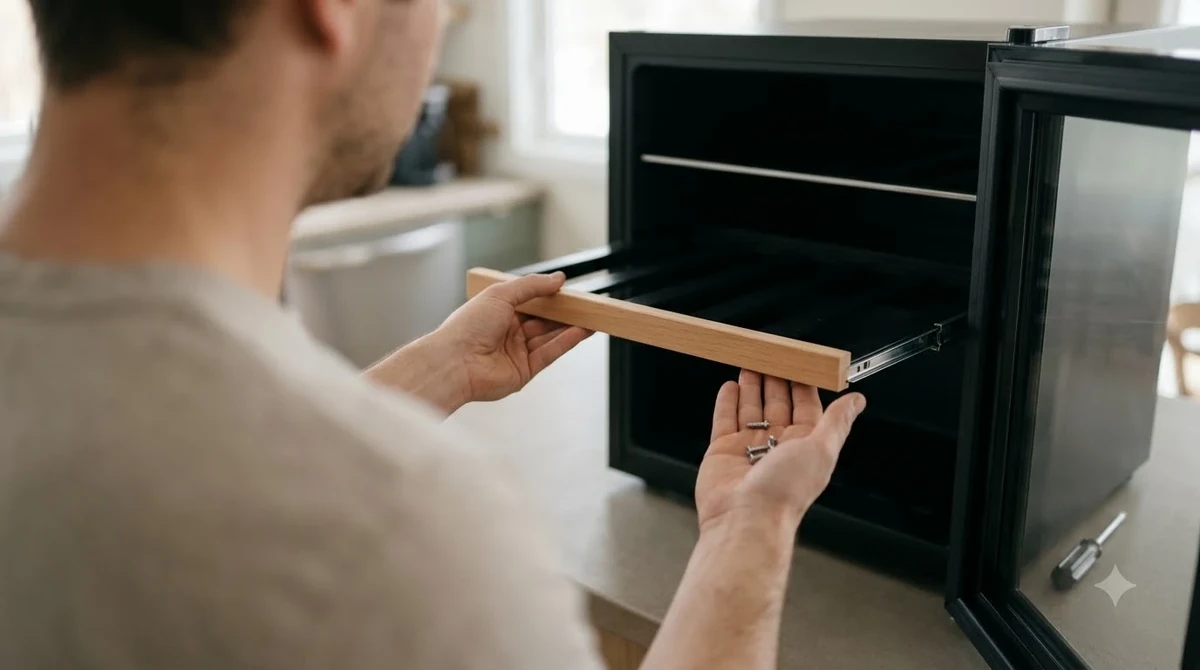
One important detail is that Whynter’s product page contains conflicting promotional language. Its description mentions dual-zone functionality, but the actual specification section identifies the BWR-1002SD as a single-zone refrigerator. The manufacturer’s instruction manual also describes it as a single-zone model. Buyers should therefore treat it as a one-temperature-zone appliance rather than expect independent red and white wine settings.
The cooling system uses a compressor and internal fan-forced circulation. This arrangement is intended to distribute cool air throughout the cabinet rather than relying exclusively on passive cooling. The double-pane glass door provides additional UV isolation, and nine soft-white LED bulbs illuminate the interior without relying on conventional bright lighting.
| Specification | Whynter BWR-1002SD |
|---|---|
| Model | BWR-1002SD |
| Maximum capacity | 100 standard 750 ml bottles |
| Capacity with display configuration | 90 bottles |
| Cabinet volume | 9.7 cubic feet |
| Temperature zones | 1 |
| Temperature range | 40°F–65°F |
| Cooling system | Compressor |
| Dimensions | 55 H x 23.5 W x 22.25 D inches |
| Depth with handle | 24 inches |
| Net weight | 159 pounds |
| Electrical requirement | 115V / 60Hz / 2.0A |
| Maximum power rating | 120 watts |
| Noise level | Below 39 dBA |
| Shelving | 12 removable wooden shelves and display shelf |
| Door | Reversible, double-pane glass |
| Security | Cylinder lock and two keys |
| Warranty | One-year limited warranty |
The storage arrangement is particularly important. Whynter describes a layout with different shelf capacities: the top shelf accommodates up to 16 bottles in one configuration, while several middle shelves accommodate eight bottles each. Other positions accommodate six bottles. Using the inclined display arrangement reduces the advertised maximum capacity to 90 bottles.
The exterior is finished with a stainless steel-trimmed glass door, a curved handle, and a dark cabinet. The overall appearance is suited to contemporary kitchens and home bars. Its reversible door also gives installers more flexibility when planning the refrigerator’s position alongside cabinetry or other appliances.
For electrical planning, the unit operates on a standard 115V, 60Hz supply and has a maximum power rating of 120 watts. Whynter lists R600a as its refrigerant. These specifications are useful when checking whether the planned installation area has an appropriate electrical connection.
The full specifications are available on the official Whynter BWR-1002SD product page, which is the appropriate reference for checking model-specific dimensions and features before ordering.
What Owners Like: Appearance, Quiet Operation, and Temperature Control
Owner feedback generally highlights the refrigerator’s attractive appearance, generous cabinet size, and ability to maintain a consistent storage temperature. Its relatively quiet operation and reversible door are also useful features for a kitchen or entertainment space.
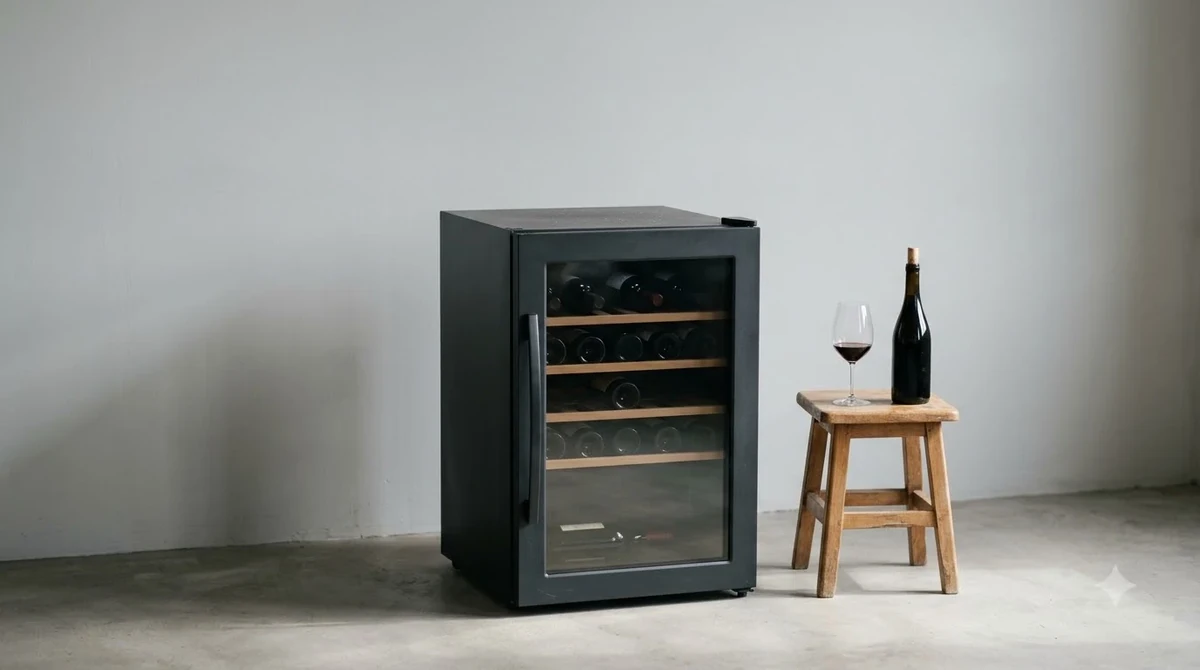
Wayfair’s customer-review summary identifies appearance and quiet operation as recurring positive themes. Owners also mention satisfactory temperature consistency. These comments suggest that the BWR-1002SD’s strongest appeal is its combination of presentation and practical storage rather than advanced wine-management technology.
The glass door allows bottles to remain visible without opening the cabinet. This is convenient in a home bar, dining room, or kitchen where the collection is part of the room’s appearance. The soft-white LED lighting also makes it easier to identify bottles without relying on strong interior illumination.
The wooden shelves provide a more traditional wine-cellar appearance than bare wire shelving. They are removable, which gives owners some flexibility when arranging their collections. For someone storing mostly conventional Bordeaux-style bottles, the shelf arrangement offers a useful balance between visibility and storage density.
Another positive feature is the reversible door. Kitchen layouts are rarely identical, and a refrigerator that can open from either side is easier to integrate into an existing room. The lock is also helpful when the refrigerator is installed in a shared entertainment area or a household where access to particular bottles needs to be controlled.
The below-39-dBA noise specification is another attractive point. Although compressor refrigerators still produce operating sounds, the published rating indicates that Whynter has designed the unit for relatively restrained noise output. Owners who place it in a kitchen or dining area may appreciate this more than someone installing it in a separate utility room.
The display shelf is particularly useful for bottles intended to be presented rather than stored in a tightly packed arrangement. It can also accommodate bottles that have been opened, keeping them separate from the main horizontal storage arrangement.
Temperature control is another area where the model has practical value. Its 40°F to 65°F range covers common serving and storage preferences for several wine styles. A collector can choose a moderate shared temperature rather than operate separate compartments for different categories.
For example, a setting near 55°F provides a useful general storage environment for a mixed collection. White wines can be chilled further before serving, while lighter reds can be brought slightly cooler than fuller-bodied reds. This approach is appropriate for people who value organized storage more than having every bottle immediately ready to serve.
The distinction matters because a wine refrigerator is not necessarily a substitute for a dedicated cellar with separate temperature environments. The BWR-1002SD focuses on maintaining one consistent cabinet temperature, and its appeal depends on whether that arrangement matches the owner’s storage habits.
Common Complaints: Bottle Capacity, Shelf Access, and Model Confusion
The most important practical concern is that the advertised 100-bottle capacity assumes standard bottle dimensions and a particular shelf arrangement. Wider Burgundy bottles, Champagne bottles, and unusual specialty formats can reduce the number of bottles that fit comfortably.
Wine bottles do not all share the same diameter or shoulder shape. A collection dominated by standard Bordeaux bottles is easier to arrange efficiently than one containing substantial numbers of Pinot Noir, sparkling wine, or large-format bottles. Even when a bottle technically fits, neighboring bottles may need to be moved to retrieve it.
Wayfair’s owner-feedback summary specifically identifies mixed opinions about usable storage capacity. Some owners find the space sufficient for a large collection, while others report that oversized bottles reduce the practical total. This is a common issue with capacity claims across wine refrigerators, but it is particularly relevant when purchasing a cabinet advertised for 100 bottles.
The display shelf creates another trade-off. Whynter lists up to 100 bottles in the standard configuration and 90 bottles when the display arrangement is used. Buyers who want to display a few special bottles should account for that reduction rather than assume the full advertised capacity remains available.
Shelf access is also worth considering. Removable shelves provide flexibility, but the practical convenience of a wine refrigerator depends on how easily bottles can be reached without disturbing the rest of the collection. A tightly packed cabinet may require some rearrangement when retrieving a bottle from the back.
There is also a meaningful difference between the model’s official specification and its promotional description. The manufacturer’s product page identifies one temperature zone in the specifications even though another paragraph mentions dual-zone functionality. This inconsistency could mislead shoppers who are comparing wine refrigerators primarily by their number of independently controlled compartments.
The distinction should not be overlooked. A true dual-zone refrigerator allows different sections to operate at separate temperatures. A single-zone appliance does not provide that independent control, regardless of how its marketing description is worded.
Delivery and installation are further considerations. The refrigerator weighs 159 pounds before bottles are added, and its packaged dimensions are larger than its installed footprint. Moving it through narrow doorways, stairwells, or tight kitchen passages requires advance planning.
Home Depot’s review page also illustrates why retailer feedback needs to be read carefully. Its review collection contains comments associated with other Whynter refrigerator models, including larger dual-zone units. Those comments should not automatically be treated as direct evidence about the BWR-1002SD.
For the same reason, complaints about a retailer’s delivery process should be separated from complaints about the refrigerator’s cooling performance. A damaged shipment, a difficult return, and an appliance that cannot maintain temperature are different problems requiring different purchasing considerations.
Tip: Before ordering, measure your largest bottle diameters and compare them with the available shelf spacing. If your collection contains many Champagne, Burgundy, or oversized bottles, plan for fewer than 100 bottles rather than relying on the advertised maximum.
Who Should Buy and Who Should Skip the Whynter BWR-1002SD
The BWR-1002SD is best suited to collectors who want a substantial single-temperature storage cabinet in a relatively narrow 24-inch format. It is less suitable for people who need separate temperature settings for red and white wines or regularly store unusually shaped bottles.
Who should consider buying it?
Collectors with predominantly standard 750 ml bottles are the clearest audience. The 100-bottle advertised capacity provides considerably more room than a small countertop wine cooler, while the removable shelving offers some flexibility for organizing different producers, regions, and vintages.
Homeowners planning a kitchen renovation may also appreciate the built-in installation option. The front-vented design is intended to accommodate installation alongside cabinetry, and the 23.5-inch width can be useful in spaces planned around a 24-inch appliance opening.
However, built-in suitability does not eliminate the need to follow the installation instructions. Cabinet depth, door clearance, leveling, and ventilation should all be considered before the unit is installed. The refrigerator should not be treated as a conventional cabinet insert that can be enclosed without attention to airflow.
People who primarily collect Cabernet Sauvignon, Merlot, Chardonnay, and other conventional bottle formats may also find the shelf arrangement practical. A shared storage temperature can work well for a collection where the main objective is keeping bottles organized and appropriately chilled.
The refrigerator may also suit homeowners who want an attractive display cabinet. Its stainless steel trim, glass door, interior LEDs, and display shelf make the collection more visible than it would be inside a solid-door storage appliance.
Who should skip it?
Collectors who want separate red and white wine compartments should look elsewhere. The BWR-1002SD has one temperature zone, so it cannot independently maintain different settings in different sections of the cabinet.
People with a large Champagne or Burgundy collection should also be cautious. Wider bottles can reduce the effective storage total, and a cabinet that appears spacious on paper may be less convenient once the actual collection is arranged.
Buyers who prioritize long-term warranty coverage may prefer a refrigerator with more comprehensive protection. Whynter’s stated one-year limited warranty is relatively short for an appliance intended to store a valuable wine collection.
Finally, shoppers with difficult delivery routes should consider the 159-pound net weight. A narrow staircase, limited doorway clearance, or an installation location that requires several turns can make delivery substantially more complicated.
For a broader comparison of wine refrigerator designs and capacities, the wine refrigerator model reviews section can help identify which configuration better suits a particular collection.
How It Compares to Alternatives: Single-Zone Versus Dual-Zone Storage
The BWR-1002SD makes the most sense when its large capacity and single-zone arrangement are more important than separate temperature settings. Its closest alternatives should be evaluated by cabinet dimensions, usable bottle capacity, installation design, and temperature flexibility rather than advertised capacity alone.
One useful comparison is Whynter’s own BWR-1642DZ, which the manufacturer’s product page identifies as a 24-inch, 164-bottle dual-zone wine refrigerator. The larger advertised capacity and two independent zones make it a different proposition for collectors with more extensive or varied storage needs.
The BWR-1642DZ is worth investigating if the primary reason for considering a refrigerator is to maintain separate storage temperatures. However, a larger advertised bottle count does not automatically mean that it will fit better in a particular kitchen. Cabinet height, depth, ventilation, and available space still need to be checked.
The BWR-1002SD remains the simpler option for someone who wants a single shared temperature. Its 55-inch height and 24-inch installed depth with the handle make it a relatively straightforward size to evaluate against an existing undercounter or freestanding space.
Another consideration is the difference between a wine refrigerator and a traditional kitchen refrigerator. A conventional refrigerator is generally designed for everyday food storage and colder operating temperatures. A wine refrigerator provides a more appropriate adjustable temperature range for wine, along with horizontal bottle storage and reduced exposure to strong interior lighting.
The BWR-1002SD’s 40°F to 65°F range is broad enough for many wine-storage and serving preferences. For example, sparkling wines are generally served around 40°F to 50°F, light whites around 45°F to 50°F, and fuller-bodied whites around 50°F to 55°F. Lighter reds are commonly served around 55°F to 60°F, while fuller-bodied reds are served around 60°F to 65°F.
These serving temperatures demonstrate why one-zone storage involves compromise. A single setting can maintain the collection, but it cannot make every bottle immediately ready to serve at its ideal temperature.
For owners who entertain frequently, this may not be a major drawback. A bottle can be moved to a regular refrigerator or allowed to warm slightly before serving. The same arrangement works for people who primarily store wine for future occasions rather than expect every bottle to be ready for immediate pouring.
It is also important to consider the overall storage environment. A refrigerator with two temperature zones is not automatically better for long-term storage if its usable capacity, cabinet dimensions, or installation requirements do not fit the room.
Buyers should compare the complete specifications of any alternative, including the number of shelves, bottle arrangement, reversible-door configuration, warranty terms, and whether the appliance is designed for built-in installation. A model with fewer advertised bottles may be more practical if its shelving better accommodates the bottles actually being collected.
For entertaining, the refrigerator can support a mixed selection of wines and ingredients for drinks. A chilled bottle of sparkling wine, for example, can be used in an Aperol Spritz recipe, while a dinner featuring a rich sauce can be paired with a bottle chosen from the cabinet alongside a chicken Marsala recipe.
The final decision comes down to the collection itself. The BWR-1002SD is a sensible candidate for standard-format bottles and shared-temperature storage, while a dual-zone alternative is more appropriate for buyers who want independently controlled compartments.
Frequently Asked Questions
Does the Whynter BWR-1002SD have a built-in carbon filter?
Yes. Whynter lists an activated carbon filter among the refrigerator’s features. The filter is intended to help manage odors inside the storage cabinet, which is useful when different wine varieties are stored together over extended periods.
Can the Whynter 100-bottle wine refrigerator operate in a garage?
The instruction manual specifies an operating environment above 60°F and below 90°F. An unconditioned garage can experience temperatures outside that range, particularly during seasonal extremes, so a garage installation should be evaluated against the manufacturer’s environmental requirements.
Does the BWR-1002SD have a Sabbath mode?
The manufacturer’s listed features and operating instructions do not identify a dedicated Sabbath mode. Buyers who require this function should confirm the availability of an appropriate model-specific feature directly with Whynter before purchasing.
Can the refrigerator be moved while it contains wine bottles?
Whynter’s instruction manual says the appliance should be emptied and its door secured before it is moved. The manual also warns against positioning or moving the refrigerator upside down or at an angle greater than 45 degrees. Following these precautions helps protect the appliance during relocation.
Does Whynter cover commercial use under the standard warranty?
No. The instruction manual’s limited warranty excludes commercial and industrial applications. Its stated coverage applies to qualifying residential purchases by the original owner from an authorized dealer within the 48 continental United States, subject to the listed warranty conditions.
The Whynter BWR-1002SD is a capable option for collectors who want an attractive, relatively quiet, single-zone refrigerator with room for a substantial collection of standard wine bottles. Its removable shelves, reversible door, and built-in installation design add practical flexibility, but the single-zone configuration and bottle-size limitations deserve careful consideration. If those compromises suit your storage habits, it is a worthwhile model to compare against other 24-inch wine refrigerators before choosing your next cellar appliance.
More in Model Reviews
 Magic Chef 44 Bottle Wine Cooler Review for Flexible StorageUpdated Nov 21, 2026
 Whynter 164 Bottle Wine Cooler Review: Capacity, Features, and FitUpdated Nov 21, 2026
 Insignia NS WC16BK6 Review: Compact 16-Bottle Wine StorageUpdated Nov 21, 2026
 Wine Enthusiast Electric Blue Omega Review: Opening, Pouring, and Preserving Made EasierUpdated Nov 21, 2026
 Koolatron 20 Bottle Wine Cooler Review: Features, Fit, and PerformanceUpdated Nov 21, 2026
 NewAir AWC 330E Review for Home Wine StorageUpdated Nov 21, 2026