

We may earn a commission when you buy through links on this page, at no extra cost to you. Learn more.
White wine history spans more than 6,000 years, evolving from amber, skin-fermented ancient beverages in the South Caucasus and Egypt into the crisp, pale styles defined by modern refrigeration and stainless steel. Early winemakers crushed light-skinned grapes and fermented juice alongside skins and seeds in clay vessels, creating oxidized, tea-colored wines. Only with the rise of medieval monastic vineyards, glass bottles, and twentieth-century temperature control did winemakers separate juice from skins immediately to preserve delicate floral and citrus aromatics.
Understanding how pale, chilled wines became a global staple requires looking at both viticulture and cellar engineering. Unlike red wines that rely on skin maceration for color and tannin, the story of white wine is largely a story of oxygen management, gentle pressing, and cooler fermentation temperatures. Across centuries, shifts in agriculture, trade routes, and vessel materials completely transformed what drinkers saw and tasted in the glass.
Ancient Origins in the Caucasus and Egypt
The earliest chapters of white wine history began around 6,000 BC in the Southern Caucasus, where Neolithic communities fermented wild and early cultivated grapes in buried clay jars. While archaeologists cannot always separate red from white residues in the oldest Neolithic pottery, written records and labeled vessels from ancient Egypt confirm that distinct pale wines were already prized by royal courts over 3,000 years ago.
According to biomolecular research cited by Wine Folly, organic chemical traces found inside Georgian pottery dated to 6,000 to 5,800 BC mark the oldest confirmed grape wine production on earth. These early vintners used large clay vessels called qvevri, burying them underground to keep fermentations naturally cool. Because mechanical presses and filtration did not exist, light-skinned grapes fermented directly on their skins and stems, yielding structured, amber-hued liquids rather than the translucent straw-colored wines familiar today.
By the time of Egypt’s New Kingdom, winemaking had grown far more specialized and documented. Excavations of King Tutankhamun’s tomb uncovered 26 wine jars bearing detailed hieroglyphic labels noting the harvest year, vineyard estate, and chief vintner. Several of those jars explicitly identified their contents as white wine, proving that ancient producers deliberately sorted light-skinned grapes from dark ones to create lighter styles for ceremonial and royal consumption.
Across the Mediterranean, Phoenician and Greek merchants carried grapevine cuttings and winemaking techniques westward along coastal trade routes. As Vitis vinifera vines adapted to new soils and microclimates in Greece, southern Italy, and Iberia, natural mutations produced hundreds of distinct white cultivars. Greek writers documented sweet, sun-dried white wines alongside resin-sealed styles designed to survive long sea voyages without spoiling into vinegar.
Roman Expansion and Medieval Monastic Vineyards
Roman engineers standardized vineyard planting and wooden barrel transport across Western Europe, while medieval Christian monks later refined white wine quality by mapping individual vineyard sites. Following the collapse of the Western Roman Empire, monasteries became the primary guardians of viticultural knowledge because wine was essential for both daily rations and religious liturgy.
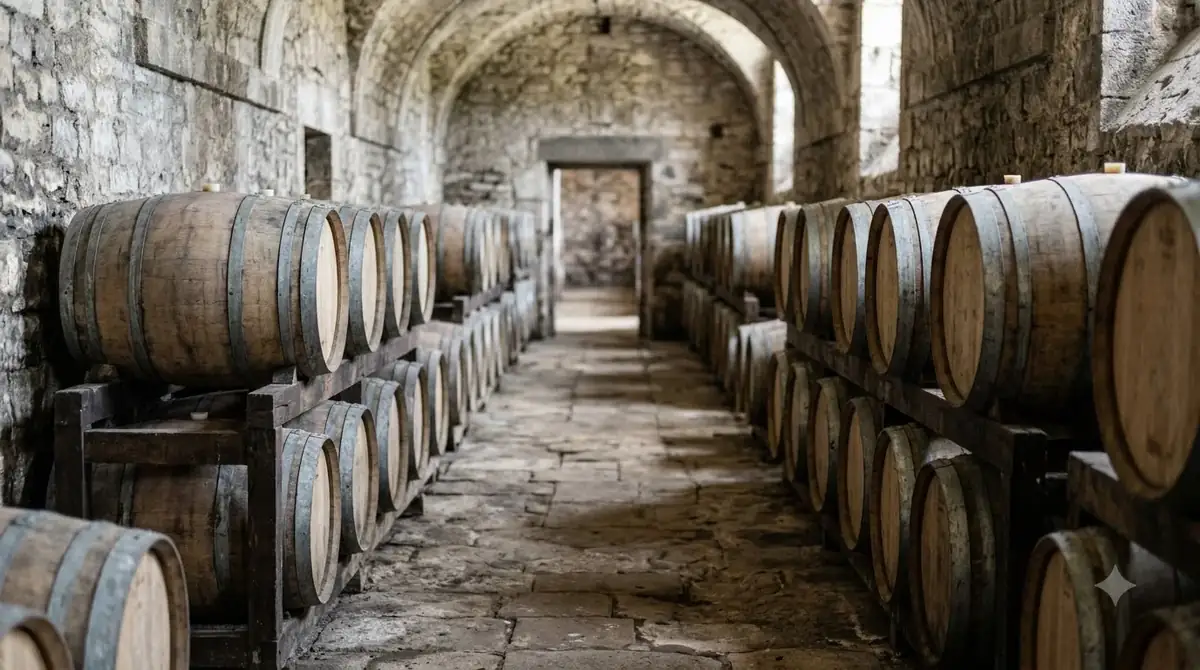
Roman agriculturalists classified white grape varieties by climate suitability and expanded cultivation into Gaul and the Rhine Valley. In regions like Alto Adige in northern Italy, viticulture dates back over 2,500 years to the Rhaetian tribes before Roman annexation accelerated vineyard organization. Roman cellars relied heavily on clay amphorae and dolia, though northern provinces increasingly adopted wooden casks from Celtic coopers, introducing subtle wood aging and easier overland transport.
During the Middle Ages, Benedictine and Cistercian monks advanced site-specific winemaking across Burgundy, the Loire Valley, and Germany’s Rhine and Mosel rivers. Cistercian orders kept thorough agricultural records, observing how specific limestone or slate slopes produced white wines with sharper acidity and cleaner aromatics. In northern Italy, monasteries such as Abbazia di Novacella, founded in 1140, helped establish enduring Alpine white wine traditions.
Despite monastic breakthroughs, most medieval white wine bore little resemblance to modern bottles. Without airtight closures or sulfite stabilization, barrels oxidized quickly once tapped, turning pale wine dark gold or brown within months. Tavern keepers frequently masked oxidation and volatile acidity by sweetening white wine with honey or infusing it with cinnamon, ginger, cloves, and pepper—a spiced tradition that evolved into medieval hippocras.
Key Milestones in White Wine Evolution
Technological breakthroughs in glassware, fermentation vessels, and microbiology reshaped white wine faster between 1650 and 1980 than during the previous five millennia. Each innovation solved a specific preservation or flavor problem that had previously limited how pale, fresh, and aromatic white wine could be.
| Era | Key Innovation | Impact on White Wine |
|---|---|---|
| 6,000–3,000 BC | Buried clay qvevri and Egyptian grape sorting | Separated white grapes from red, producing amber skin-contact wines |
| 11th–14th Centuries | Cistercian vineyard mapping in Burgundy and the Rhine | Matched cool-climate slopes to white grapes for higher natural acidity |
| 17th–18th Centuries | Stronger coal-fired glass bottles and cork stoppers | Enabled bottle aging and gave rise to sparkling white wine in Champagne |
| 19th Century | Louis Pasteur’s yeast and fermentation research | Reduced spoilage and gave vintners control over stuck or wild fermentations |
| Mid-20th Century | Stainless steel tanks and temperature-controlled cooling | Preserved volatile citrus and floral esters, creating crisp modern styles |
The arrival of sturdy coal-fired glass bottles and natural corks in the seventeenth century changed white wine storage permanently. For the first time, producers could seal white wine away from ambient oxygen after fermentation. In northeastern France, trapping secondary fermentation inside thick glass bottles transformed still, pale wines into sparkling Champagne, creating one of the most celebrated styles within Wine by Type.
In the 1860s, Louis Pasteur’s identification of yeast’s role in alcoholic fermentation and bacterial spoilage gave winemakers scientific tools to prevent vinegar taint. Shortly afterward, the phylloxera louse devastated European vineyards, forcing growers to graft European white cultivars onto resistant American rootstocks and reorganize chaotic field blends into single-variety plantings.
The Twentieth-Century Stainless Steel Revolution
The invention of jacketed stainless steel fermentation tanks and mechanical refrigeration in the mid-twentieth century created the clean, aromatic white wine profile that dominates modern wine shops. Before cooling jackets existed, active fermentations routinely overheated, burning off delicate fruit aromas and encouraging premature browning.
Cool fermentation temperatures allow yeast to convert grape sugar into alcohol slowly while retaining fragile aromatic compounds such as esters and thiols. Regions like Friuli in northeastern Italy championed stainless steel vinification in the 1960s and 1970s, demonstrating that varieties like Pinot Grigio and Sauvignon Blanc could taste vibrant, floral, and crisp rather than heavy or oxidized.
At the same time, winemakers in Burgundy, California, and Australia refined contrasting oak-aged techniques for white grapes. By pairing barrel fermentation with lees stirring and malolactic conversion—a bacterial process that softens sharp malic acid into creamier lactic acid—producers crafted richer white wines showing hazelnut, vanilla, and brioche complexity. Just as pinot noir history illustrates how Burgundy’s cool slopes reward gentle extraction, Chardonnay’s rise showed how cellar choices could steer a single white grape from lean and chalky to lush and full-bodied.
Tip: When exploring older or traditional white styles, look for bottle terms like “sur lie” (aged on dead yeast cells for texture) or “skin-contact” (fermented with grape skins for amber color and subtle grip).
Classic White Grapes That Shaped Global Trade
Three historic European varieties—Chardonnay, Riesling, and Sauvignon Blanc—carried white wine from regional staples to international benchmarks during the nineteenth and twentieth centuries. Each grape established a distinct blueprint for how climate and cellar craft shape white wine character.
Originating in eastern France, Chardonnay became the world’s most adaptable white cultivar because its neutral fruit base reflects both vineyard soil and winemaker intervention. In cool, limestone-rich Chablis, unoaked fermentations yield high-acid wines with green apple and flint notes, while warmer regions like Napa Valley and South Australia popularized barrel-fermented versions with tropical fruit and toasted spice.
Along Germany’s Rhine and Mosel rivers, Riesling built a parallel reputation for longevity without relying on oak barrels. As detailed in VinePair’s Riesling guide, the grape’s naturally high tartaric acid balances residual sugar in off-dry and late-harvest styles while allowing dry and sweet bottles alike to evolve for decades in glass. Historic German classifications—ranging from crisp Kabinett to botrytis-affected Trockenbeerenauslese—codified ripeness levels long before modern appellation systems existed.
Meanwhile, fortified trade routes also relied heavily on white grapes, a dynamic explored further in port history, where white varieties such as Malvasia Fina and Gouveio were fortified with grape spirit to survive warm Atlantic crossings. Across Bordeaux and the Loire Valley, Sauvignon Blanc and Sémillon similarly anchored maritime export markets, balancing crisp herbaceous freshness with age-worthy honeyed richness.
The Modern Revival of Ancient Skin-Contact Styles
Beginning in the late 1990s, a wave of winemakers revived ancient skin-contact techniques, bringing amber and orange white wines back into mainstream restaurants and wine shops. Rather than viewing oxygen and grape skins as flaws to eliminate with stainless steel, these producers looked directly to 6,000-year-old Georgian clay traditions for inspiration.
Winemakers in northeastern Italy and Slovenia, notably Joško Gravner in Friuli’s Oslavia district, imported large beeswax-lined clay amphorae from Georgia and buried them in their cellars. By fermenting thick-skinned native grapes like Ribolla Gialla and Rkatsiteli on their skins for months without temperature control or additives, they produced deeply textured, copper-gold wines with noticeable tannin and dried apricot aromas.
Today, wine drinkers can experience the entire timeline of white wine history in a single tasting flight. From ultra-crisp, cold-fermented stainless steel bottles to barrel-aged classics and clay-fermented amber wines, modern cellars actively preserve every era of white winemaking innovation.
Frequently Asked Questions
What is the oldest evidence of white wine?
While the oldest general wine residues date to around 6,000 BC in the Southern Caucasus, the earliest explicitly labeled white wine comes from ancient Egypt. Excavations of King Tutankhamun’s tomb uncovered clay amphorae dating to the fourteenth century BC marked with hieroglyphs specifically identifying white wine alongside its harvest year and vineyard estate.
Why did ancient white wine look amber or orange instead of pale yellow?
Ancient winemakers lacked mechanical bladder presses, inert gas blanketing, and temperature-controlled tanks. Light-skinned grapes were crushed and fermented directly with their skins, seeds, and stems in porous clay jars, extracting golden-amber pigments and tannins while gentle oxygen exposure deepened the color further.
When did crisp, pale white wine become common?
Pale, fruit-forward white wines became widespread in the mid-twentieth century following the adoption of stainless steel fermentation tanks and mechanical refrigeration. Keeping fermentations cool prevented heat-driven oxidation and preserved delicate citrus and floral aromatics that previously boiled off in warm wooden vats.
How did medieval monks influence white wine history?
During the Middle Ages, Benedictine and Cistercian monks preserved viticultural records and systematically mapped vineyard slopes across Burgundy, the Loire Valley, and Germany. Their observations identified which limestone and slate hillsides produced white grapes with the best balance of acidity, ripeness, and aging potential.
From buried Neolithic clay jars to precision-cooled stainless steel tanks, white wine history reflects humanity’s evolving relationship with agriculture and preservation. Every bottle on a modern shelf carries traces of those breakthroughs, whether expressed through racy mineral purity, creamy oak richness, or skin-fermented amber structure.
More in Wine Types & Grapes
 Zinfandel Sugar Content: Dry Red vs. White Zinfandel GramsUpdated Nov 21, 2026
 Best Zinfandel Substitute Options for Sipping and CookingUpdated Nov 21, 2026
 Zweigelt Food Pairing: Best Dishes, Cheeses, and Serving TipsUpdated Nov 21, 2026
 Zinfandel Tannins Explained: How Structure Shapes Every BottleUpdated Nov 21, 2026
 Zinfandel Sweetness Level: Dry Red vs. Sweet White Zin ExplainedUpdated Nov 21, 2026
 Xinomavro Food Pairing: Best Dishes, Styles, and Serving TipsUpdated Nov 21, 2026