

We may earn a commission when you buy through links on this page, at no extra cost to you. Learn more.
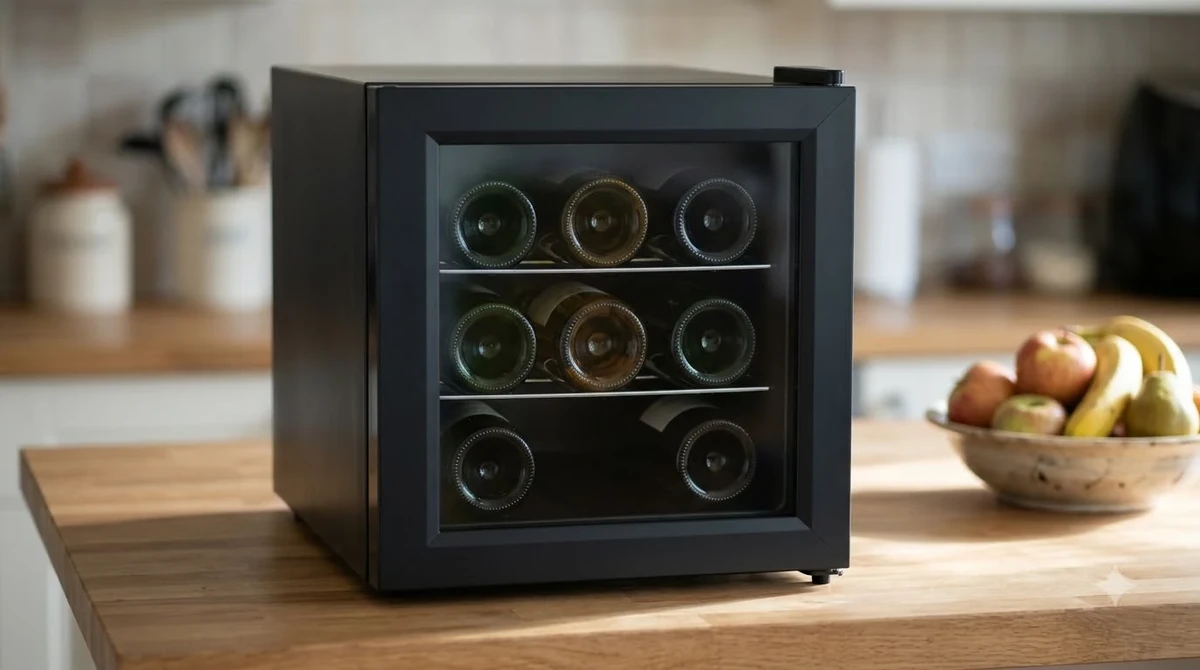
What is a thermoelectric wine cooler? It is a wine refrigerator that uses the Peltier effect to move heat out of its interior without relying on a conventional refrigeration compressor. This technology makes the appliance quieter and produces very little vibration compared with many compressor-based wine coolers. However, its cooling capacity depends heavily on room temperature, so it works best in a climate-controlled indoor space with a relatively small wine collection.
If you are shopping for a wine refrigerator, understanding its cooling technology can help you avoid buying an appliance that cannot maintain the conditions your bottles need. Thermoelectric models offer a distinctive combination of quiet operation, compact construction, and straightforward cooling, but they also have limitations involving temperature control, bottle capacity, and placement. Here is how the technology works, what it can realistically do, and how to decide whether it suits your home.
How Thermoelectric Wine Cooling Works
A thermoelectric wine cooler uses an electrical component called a Peltier module to transfer heat from the inside of the cabinet to the surrounding room. Unlike a conventional refrigerator, it does not depend on a compressor circulating refrigerant through a cooling circuit.
The Peltier effect occurs when direct electrical current passes through a junction made from different semiconductor materials. This process creates a temperature difference between two sides of the module. One side becomes cold, while the other becomes hot. The cold side faces the wine compartment, and the hot side releases the collected heat outside the appliance.
The cooler also needs a way to distribute cold air and remove unwanted heat. Internal and external fans perform these jobs. An interior fan helps circulate air around the bottles, while another fan and a heat sink help dissipate heat from the hot side of the Peltier device. Without adequate heat removal, the system cannot maintain its intended cooling performance.
Temperature sensors and electronic controls monitor the cabinet and regulate the cooling system. When the interior temperature rises above the selected setting, the controller adjusts the operation of the thermoelectric module. This helps maintain a reasonably consistent environment when the surrounding conditions remain suitable.
According to Vintec’s explanation of Peltier cooling, direct current creates heat movement between two different materials, producing a cold side and a hot side. Its description also explains why fans are generally used to circulate cooled air inside the cabinet.
For a closer look at the manufacturer’s explanation, read Vintec’s comparison of compressor and thermoelectric cooling systems.
The absence of a conventional compressor is the defining difference. A thermoelectric cooler still consumes electricity, generates waste heat, and may produce fan noise. It is not a passive cooling cabinet or an appliance that operates without moving air. Its main distinction is the method used to transfer heat.
Advantages of Thermoelectric Wine Coolers
The biggest advantages of thermoelectric wine coolers are quiet operation, minimal mechanical vibration, and relatively simple construction. These characteristics make them appealing for smaller collections kept in living spaces, home offices, and other indoor rooms.
Quiet operation: Conventional compressor refrigerators create noise when their cooling systems cycle on and off. A thermoelectric unit avoids that particular source of sound. Its fans still operate, but many models produce less noticeable operating noise than comparable compressor appliances. This can be useful if the cooler will sit near a dining area, bedroom, or workspace.
Minimal vibration: Wine storage benefits from limiting unnecessary movement, especially when bottles remain undisturbed for extended periods. Thermoelectric cooling avoids the mechanical vibration associated with a conventional compressor. Haier identifies minimal vibration and noise as important characteristics of its thermoelectric wine cellars.
That does not mean every thermoelectric cooler is completely vibration-free. Fans and other appliance components can still produce some movement or sound. The overall design, shelf construction, and placement also influence the operating experience.
Compact construction: Many thermoelectric coolers are designed for relatively small collections. Their cooling components can be lighter and less mechanically complicated than those in compressor models. This can make them convenient for apartments, small kitchens, and homes without dedicated wine-storage rooms.
No conventional refrigerant circuit: The Peltier system transfers heat electronically rather than relying on the refrigerant cycle used by conventional compressor refrigeration. Haier explains that its thermoelectric technology avoids CFC, HCFC, and HFC-type refrigerants in the cooling process. This is a useful distinction for buyers comparing the construction of different appliances.
Thermoelectric systems can also be relatively straightforward to operate. Most models provide a digital temperature display, adjustable controls, interior lighting, and removable or sliding shelves. You generally select a temperature and allow the appliance to regulate its cooling automatically.
For someone storing a modest number of everyday bottles in an air-conditioned room, these benefits may outweigh the limitations. The quieter operating character can be particularly attractive when the refrigerator is visible and accessible rather than hidden in a utility room.
Cooling Limitations and Room Temperature
The main weakness of thermoelectric wine cooling is its limited ability to reduce cabinet temperature below the surrounding room temperature. A cooler that performs well in an air-conditioned room may struggle in a hot kitchen, garage, or sun-exposed space.

Vinotemp explains that many thermoelectric wine coolers typically maintain an interior temperature approximately 10–12°F below ambient conditions. This is a general operating guideline, not a guaranteed specification for every model. Actual performance varies with the Peltier module, ventilation, cabinet insulation, bottle loading, and surrounding temperature.
Consider a room maintained at 68°F. A model capable of cooling approximately 10–12°F below its surroundings could maintain an interior near 56–58°F under suitable conditions. That is a practical range for general wine storage. However, if the same appliance sits in an 82°F room, its cooling ability may be insufficient to maintain a desirable wine-storage temperature.
The problem becomes more noticeable during hot weather. A thermoelectric cooler does not necessarily become more powerful simply because you select a lower number on its digital display. The display represents the desired setting, not an unconditional promise that the appliance can reach that temperature.
Cooling recovery is another consideration. Every time you open the door, warm air enters the cabinet. Adding several room-temperature bottles also introduces additional heat. Because thermoelectric systems have limited cooling capacity, restoring the previous temperature can take longer than it would with an appropriately sized compressor unit.
Vintec identifies limited temperature pull-down capacity as a major disadvantage of Peltier cooling. It also explains that the technology performs poorly outside its suitable ambient operating conditions. These limitations matter particularly for people who frequently open their wine cabinets or regularly add new bottles.
Energy efficiency should also be considered carefully. Although thermoelectric models have relatively simple cooling components, simplicity does not automatically mean lower electricity consumption. Vintec notes that thermoelectric systems are less efficient than conventional vapor-compression systems in refrigeration performance. Actual electricity use depends on the particular appliance, operating environment, and cooling demand.
These limitations do not make thermoelectric technology unsuitable for every home. They mean the room where you place the cooler is part of the cooling system’s practical operating environment.
Temperature Settings, Placement, and Installation
A thermoelectric wine cooler works best when its surrounding environment remains moderate and stable. Correct placement, suitable temperature settings, and unobstructed ventilation are essential for maintaining consistent wine-storage conditions.
For general wine storage, approximately 55°F is a useful target. It provides a practical compromise for keeping different wine styles together without requiring separate serving temperatures. Vinotemp identifies 55°F as a desirable storage temperature and gives a broader recommended storage range of 45–65°F.
Serving temperatures are different from storage temperatures. White wines, rosé, sparkling wines, and lighter reds may benefit from being served cooler than the temperature at which they are stored. You can move a bottle to a regular refrigerator briefly before serving rather than repeatedly changing the entire wine cooler’s settings.
Consider the following practical temperature references when deciding whether a thermoelectric model offers sufficient cooling capability.
| Wine or operating condition | Temperature | Practical consideration |
|---|---|---|
| General wine storage | 55°F | Useful shared storage setting |
| Light red wine serving | 55–60°F | Suitable for lighter-bodied reds |
| Full-bodied red serving | 60–65°F | Avoid serving excessively warm |
| Light white and rosé serving | 45–50°F | Cooler service temperature |
| Full-bodied white serving | 50–55°F | Allows more aromatic expression |
| Sparkling wine serving | 40–50°F | Requires stronger cooling for very cold service |
| Example thermoelectric temperature difference | 10–12°F | Vinotemp’s typical ambient-temperature comparison |
Placement is just as important as the temperature setting. Keep the appliance away from direct sunlight, ovens, radiators, dishwashers, and other heat-producing equipment. A cooler positioned beside a frequently used oven may experience higher surrounding temperatures than one located in an air-conditioned dining room.
Ventilation is particularly important because the hot side of the Peltier module must release heat into the room. Follow the manufacturer’s specified clearance around the back, sides, and other ventilation openings. Do not assume that a freestanding model can be pushed into a tight cabinet opening without affecting its operation.
Tip: Place a thermoelectric wine cooler in a consistently air-conditioned room, away from windows and heat-producing appliances. Allow adequate ventilation, let the empty cabinet stabilize before loading it, and monitor the actual interior temperature rather than relying exclusively on the selected display setting.
Installation classification also deserves attention. Freestanding and built-in are not interchangeable descriptions. A built-in wine refrigerator is specifically designed to release heat through an appropriate ventilation arrangement, commonly at the front. A freestanding thermoelectric cooler may release heat through its rear or sides and should not be enclosed unless the manufacturer explicitly approves that installation.
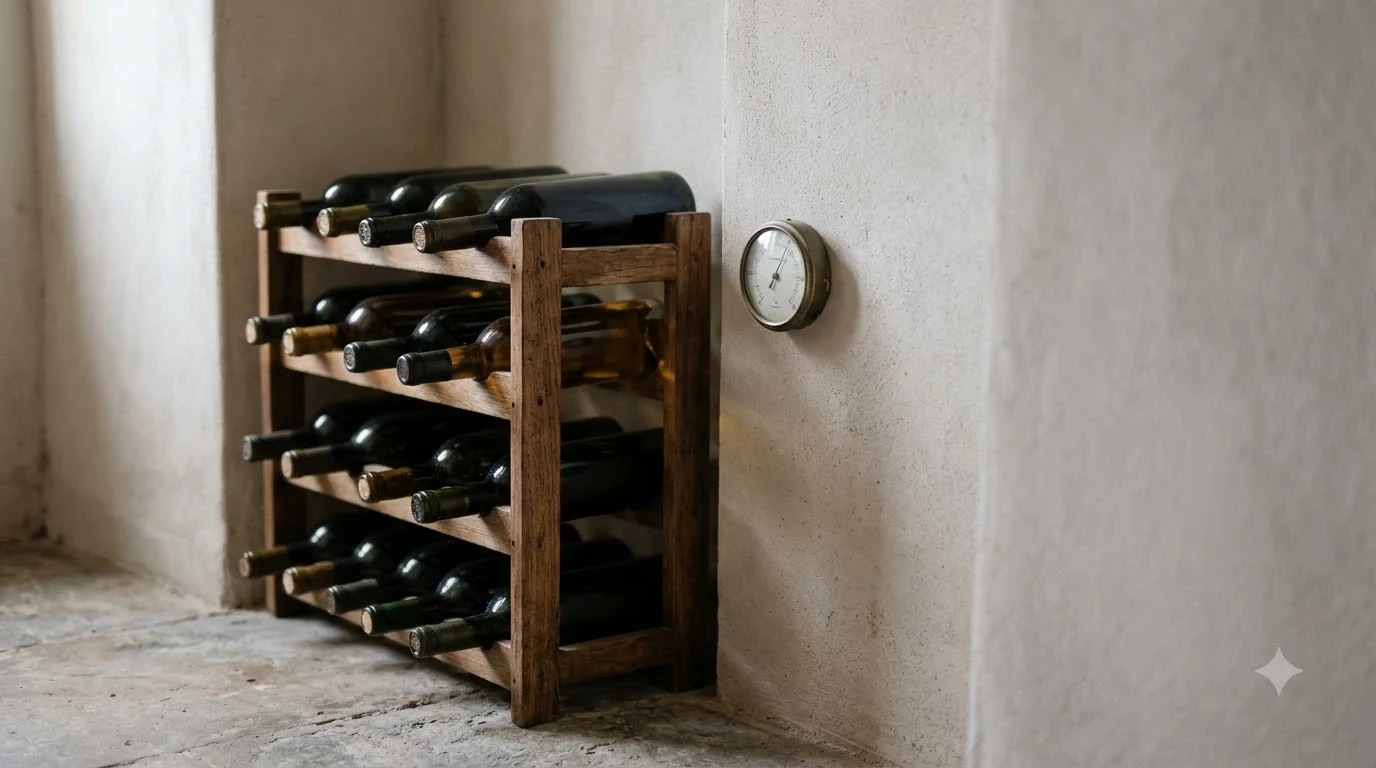
For long-term storage, keep bottles on their sides when they have natural cork closures, protect them from strong light, and avoid unnecessary movement. Temperature stability matters more than frequently adjusting the cabinet to match the serving requirements of individual bottles.
Bottle Capacity, Shelves, and Storage Features
Thermoelectric wine coolers are generally most suitable for small collections, with many models offering compact capacities rather than the large storage space available in full-size compressor cabinets. The advertised bottle count is only a starting point because bottle shape and shelf configuration affect the number of bottles that fit.
A standard 750 ml Bordeaux-style bottle is the usual reference for wine-cooler capacity. A manufacturer might advertise a capacity of 12 or 20 bottles, but that figure assumes bottles with relatively uniform dimensions. Burgundy bottles, Champagne bottles, and some specialty wine bottles have wider bodies or different shapes that occupy more shelf space.
For example, a cabinet advertised for 20 standard bottles may not accommodate 20 wide sparkling-wine bottles in the same arrangement. You may need to remove a shelf, rearrange the bottles, or use fewer storage positions. This is especially relevant if your collection includes several bottles of Champagne, traditional-method sparkling wine, or larger-format bottles.
Before purchasing, consider the number of bottles you own now and how quickly your collection is likely to grow. A 12-bottle appliance may be sufficient for someone who buys a few bottles for immediate enjoyment. A collector who regularly purchases mixed cases may find a larger compressor cooler more practical.
Interior shelf design is another important detail. Sliding shelves make individual bottles easier to access, while fixed shelves can maximize the available space. Wooden shelves may create a traditional cellar appearance, while metal shelves are often lighter and easier to clean.
Look at the following features when comparing models:
- Adjustable shelving: Useful for accommodating wider bottles and changing the storage arrangement.
- Digital temperature display: Makes it easier to monitor the selected cabinet temperature.
- Interior lighting: Helps identify bottles, although keeping the light switched off when unnecessary reduces continuous light exposure.
- Door construction: A well-sealed door helps limit unwanted warm-air exchange.
- UV protection: Tinted or UV-protective glass can help protect wine from damaging light exposure.
- Temperature memory: Some models retain their settings after a power interruption, while others may require adjustment.
Think about accessibility as well. A countertop model may be convenient for a small apartment, but a taller freestanding cooler can offer more storage without using valuable counter space. Check the external dimensions, door clearance, electrical connection, and ventilation requirements before deciding where it will go.
Finally, consider the type of wine you intend to store. If you regularly purchase dry sparkling wines, such as dry Cava, confirm that the appliance can maintain a sufficiently low temperature for your intended serving routine. If your collection mainly consists of reds, a single-zone cabinet maintained around 55°F may be perfectly practical.
Thermoelectric vs. Compressor Wine Coolers: Which Should You Choose?
Thermoelectric and compressor wine coolers serve the same general purpose, but they suit different storage environments and collection sizes. Thermoelectric models prioritize quiet operation and minimal compressor-related vibration, while compressor models generally provide stronger cooling and more dependable temperature control in changing room conditions.
A compressor wine refrigerator uses a conventional vapor-compression refrigeration cycle. It circulates refrigerant through components such as the compressor, condenser, and evaporator to remove heat from the cabinet. The system can deliver substantial cooling capacity and is generally better equipped to maintain its target temperature when the surrounding room becomes warmer.
Thermoelectric cooling uses a Peltier module instead. It transfers heat electronically between two sides of a semiconductor device. This arrangement reduces mechanical complexity, but it also limits how much the appliance can cool below ambient temperature.
The following comparison highlights the practical differences.
| Feature | Thermoelectric | Compressor |
|---|---|---|
| Cooling technology | Peltier effect | Vapor compression |
| Compressor | No | Yes |
| Operating noise | Generally quieter | Generally more noticeable |
| Mechanical vibration | Minimal | Present but can be reduced |
| Cooling strength | Limited | Generally stronger |
| Ambient temperature sensitivity | High | Generally lower |
| Cooling recovery | Usually slower | Usually faster |
| Typical collection size | Small | Small to large |
| Best environment | Moderate indoor room | Broader range of indoor conditions |
Neither technology is automatically the best choice for every buyer. If you live in an apartment with reliable air conditioning and want to store 12–20 standard bottles, a thermoelectric cooler may offer an attractive balance of convenience and quiet operation. If your room regularly reaches 80°F or higher, a compressor model is generally a safer option.
Compressor technology is also worth considering if you have a growing collection, frequently open the cabinet, or want to store different wine styles at carefully controlled temperatures. Larger cabinets and dual-zone appliances are more commonly available with compressor cooling.
Dual-zone models have separate compartments that can maintain different temperatures. For instance, you might use one zone around 55°F for storage and another around 48°F for white wines awaiting service. A single-zone cooler maintains one temperature throughout its main compartment, which is suitable for collections that do not require separate storage conditions.
Remember that compressor wine coolers are not necessarily noisy or unsuitable for delicate wines. Quality models can use vibration-dampening mounts and other design features to reduce mechanical movement. The decision should be based on the complete appliance rather than one feature in isolation.
For a more detailed comparison of the two technologies, see compressor vs thermoelectric wine cooler. Your collection size, room temperature, and installation space should guide the final decision.
Who Should Buy a Thermoelectric Wine Cooler?
A thermoelectric wine cooler makes the most sense for someone with a small collection, a moderate indoor environment, and a preference for quiet operation. It is less appropriate for people who need strong cooling in a warm room or want to maintain a large collection for many years.
Consider a home where the indoor temperature remains between 65°F and 72°F throughout most of the year. A suitable thermoelectric model may be able to maintain a storage environment near 55°F, depending on its cooling specifications. Someone keeping a dozen bottles of Pinot Noir, Chardonnay, and Cabernet Sauvignon may find that arrangement sufficient.
It can also be useful for people who want a dedicated wine-storage appliance without installing a large refrigerator. A compact model can fit into a home office, a small dining area, or a kitchen corner with adequate airflow. Its relatively quiet operation may be especially appealing in rooms used for relaxation or conversation.
However, buyers in warmer climates should be more cautious. If a kitchen frequently reaches 80°F or above, a thermoelectric cooler may not have enough cooling capacity to reach the desired temperature. This is also a concern in garages, enclosed utility rooms, and spaces exposed to afternoon sunlight.
Long-term wine collectors should focus on temperature stability rather than the cooling technology’s advertised convenience. Vinotemp describes 55°F as a desirable general storage temperature, while its wine-storage guidance emphasizes avoiding substantial temperature fluctuations. A thermoelectric appliance that cannot consistently achieve its selected temperature is not a good storage solution, regardless of how quiet it operates.
Think about your wine-buying habits, too. Someone purchasing occasional bottles of everyday wine has different requirements from someone assembling a collection of age-worthy Bordeaux, Barolo, or Napa Valley Cabernet Sauvignon. Buyers interested in particular styles can explore low sugar Cabernet Sauvignon options while considering how much dedicated storage space their collection needs.
Before purchasing, work through these practical questions:
- Does the room stay cool and relatively stable throughout the year?
- Can the appliance reach approximately 55°F under your actual room conditions?
- Will its bottle capacity accommodate your current collection and future purchases?
- Can you provide the ventilation clearance required by the manufacturer?
- Will the cooler be used mainly for short-term storage or for bottles you plan to age?
- Would the stronger cooling performance of a compressor model be more valuable than quieter operation?
It also helps to understand your overall buying requirements before selecting an appliance. The wine-buying basics section can help you consider the different factors involved in choosing wine and organizing a home collection.
In general, a thermoelectric cooler is a sensible choice when the room is suitable and the collection is modest. For a warm environment, frequent cabinet access, or a larger collection, a compressor wine refrigerator usually provides greater flexibility.
Frequently Asked Questions
Can a thermoelectric wine cooler operate continuously?
Yes. Thermoelectric cooling systems are designed to regulate cabinet temperature automatically during normal operation. Their fans may operate for extended periods as part of the heat-transfer process, rather than cycling exactly like a conventional compressor refrigerator. Follow the manufacturer’s instructions for ventilation and routine cleaning to support normal operation.
Does a thermoelectric wine cooler need special electrical wiring?
Most household thermoelectric wine coolers use a standard electrical outlet, but the required voltage and frequency depend on the specific model and country. Some appliances designed for the US market use a 120-volt, 60-hertz electrical supply. Always compare the appliance’s electrical rating with the supply available at its installation location.
Can a thermoelectric wine cooler be transported on its side?
It is generally preferable to transport a wine cooler upright to protect its cabinet, shelves, and internal components. Some manufacturers provide different instructions depending on the appliance’s construction. After transportation, allow the unit to stand upright and stabilize before connecting it to power, following the specific owner’s manual.
Does humidity inside a thermoelectric wine cooler matter?
Humidity matters particularly for bottles sealed with natural corks during extended storage. A commonly cited long-term cellar target is approximately 70% relative humidity, although the appropriate conditions depend on storage duration and cabinet design. Thermoelectric coolers do not necessarily provide active humidity control, so buyers planning extended cork-sealed bottle storage should investigate this feature separately.
Can a thermoelectric wine cooler keep beer and soft drinks?
Some models can accommodate sealed beverages if their bottle dimensions and temperature requirements are compatible with the appliance. However, Haier specifically warns that its thermoelectric wine cellars are not designed or recommended for food storage. Wine coolers should not be treated as substitutes for food refrigerators, and their operating temperatures may be unsuitable for products requiring colder storage.
A thermoelectric wine cooler can be an excellent option for a small wine collection in a consistently cool indoor space, particularly if quiet operation and minimal vibration are priorities. Its biggest limitation is its dependence on surrounding room temperature, so compare the appliance’s actual cooling capability with your home’s conditions before purchasing. If you need stronger cooling, greater capacity, or more dependable performance in warm surroundings, a compressor wine cooler is generally the more practical investment.
More in Wine Buying Guides
 Cheap Red Blend: How to Find a Flavorful Bottle for LessUpdated Nov 20, 2026
 Pinot Grigio Gift: How to Choose a Bottle They’ll EnjoyUpdated Nov 20, 2026
 Best White Wine at Total Wine for Every MealUpdated Nov 20, 2026
 Wine Fridge Replacement Shelves: Find the Right FitUpdated Nov 20, 2026
 Best Sparkling Wine Under 20: Find Bubbles Worth BuyingUpdated Nov 20, 2026
 Best Wine For Birthday Celebrations With Perfect Party PairingsUpdated Nov 20, 2026