

We may earn a commission when you buy through links on this page, at no extra cost to you. Learn more.
Vinotemp vs Wine Enthusiast comes down to whether you prioritize specialized wine-storage equipment, larger collection capacity, and installation flexibility or a broader selection of wine refrigerators and accessories. Vinotemp is particularly appealing for buyers considering built-in cabinets, large-capacity cellars, and dedicated wine-storage equipment. Wine Enthusiast is a strong alternative for households looking for compact dual-zone refrigerators, wine accessories, and a wider assortment of storage products. The right choice depends on your collection size, available space, cooling requirements, and the warranty attached to the specific model.
Choosing a wine refrigerator involves more than comparing bottle counts or exterior finishes. Two cabinets with similar advertised capacities can differ considerably in temperature control, ventilation, shelving, installation requirements, and long-term ownership costs. This comparison examines both brands through those practical considerations rather than assuming that one manufacturer is automatically better across every category.
| Comparison | Vinotemp | Wine Enthusiast |
|---|---|---|
| Business model | Specialized wine-storage equipment brand | Wine products retailer and house-brand seller |
| Product selection | Wine cabinets, beverage coolers, cellar systems | Wine refrigerators, storage furniture, accessories, other brands |
| Small collections | Compact refrigerator options | Compact and household-oriented options |
| Large collections | Models extending beyond 100 bottles | Multiple storage categories and premium alternatives |
| Temperature zones | Single-zone and dual-zone models | Single-zone and dual-zone models |
| Installation | Freestanding and designated built-in models | Depends on the individual refrigerator |
| Cooling technology | Compressor and thermoelectric options | Compressor and other model-dependent technologies |
| Best starting point | Specialized wine-storage requirements | Comparing household wine-storage products |
Brand Positioning and Product Selection
Vinotemp focuses on dedicated wine-storage equipment, while Wine Enthusiast provides a broader shopping destination for wine refrigerators, accessories, and related products. The distinction matters because buyers are not necessarily choosing between two manufacturers offering identical appliances.
Vinotemp was founded in 1985 and has developed a product assortment covering residential wine cabinets, beverage coolers, wine racks, and cellar cooling equipment. Its selection includes compact refrigerators for smaller collections and substantially larger cabinets for collectors. This specialization makes the company particularly relevant when the project involves more than simply finding a small refrigerator for a kitchen or dining room.
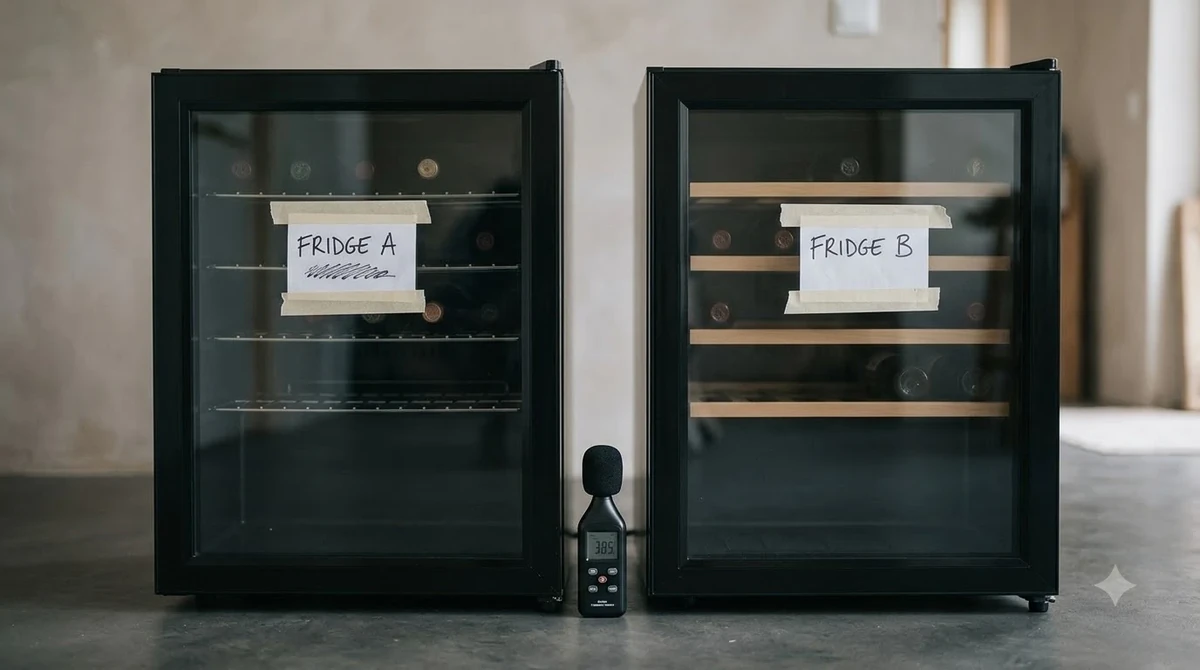
Wine Enthusiast approaches the category from a broader wine-lifestyle perspective. Its assortment includes wine refrigerators, storage furniture, accessories, and products from other manufacturers. According to KaTom’s comparison, Wine Enthusiast is also the exclusive US distributor for EuroCave wine cabinets. That provides another purchasing route for customers interested in premium wine-storage equipment without limiting their research to one manufacturer’s catalog.
Neither business model guarantees better cooling performance. A specialized manufacturer can offer more focused product choices, but a retailer carrying several brands can make it easier to compare different designs and configurations. The important question is whether the particular refrigerator satisfies your installation and storage requirements.
For example, someone replacing an existing wine cabinet may prefer to investigate Vinotemp’s dedicated equipment range. Someone furnishing a new apartment may find Wine Enthusiast’s selection of smaller refrigerators and accompanying accessories more convenient. Both approaches can make sense, depending on the size and purpose of the collection.
Capacity, Bottle Layout, and Storage Flexibility
Vinotemp has an advantage for shoppers specifically investigating larger wine-storage cabinets, while Wine Enthusiast offers practical household-oriented capacities and access to additional brands. Advertised bottle capacity should be treated as a starting point rather than a guarantee of how many bottles will fit in everyday use.
One useful comparison is the Wine Enthusiast 32-bottle Dual Zone MAX Compressor Wine Cooler. Liquor.com lists a capacity of 32 standard bottles and dimensions of 17 x 19.5 x 33.5 inches. The appliance includes removable chrome racks, a larger bottom rack for bigger bottles, interior LED lighting, and a tinted viewing window. These details make it relevant for households that want a relatively compact refrigerator with separate storage areas. See the Liquor.com wine refrigerator comparison for its model specifications and additional appliance comparisons.
Vinotemp also offers considerably larger storage configurations. Liquor.com identifies a 141-bottle Vinotemp single-zone cellar, illustrating the difference between a compact household appliance and a larger collection-oriented cabinet. Buyers with several cases of wine should investigate these larger formats instead of comparing only countertop or apartment-sized refrigerators.
Actual capacity depends on bottle dimensions and rack configuration. Standard Bordeaux bottles are relatively straightforward to arrange, but Burgundy bottles, Champagne bottles, and other wider formats can occupy more room. A cabinet advertised for 32 bottles may hold fewer if a significant proportion of the collection uses larger bottles.
| Storage consideration | 32-bottle Wine Enthusiast | 141-bottle Vinotemp |
|---|---|---|
| Advertised capacity | 32 bottles | 141 bottles |
| Temperature zones | 2 | 1 |
| Temperature range | 41°F–64°F | 41°F–64°F |
| Primary purpose | Household wine storage | Larger wine collection |
| Installation category | Freestanding | Check the specific model |
These specifications come from Liquor.com’s descriptions of the respective appliances, not from a claim that every refrigerator from either brand shares the same configuration. The two models also illustrate why capacity alone is an incomplete measure of value: the smaller unit has two zones, while the larger Vinotemp example uses one storage temperature.
Think about how many bottles you expect to own after two or three years. If you currently keep 20 bottles but regularly purchase wine by the case, a refrigerator with a capacity close to your present collection could become inconvenient quickly. Wine-storage expert Marshal Tilden, quoted by Liquor.com, recommends considering a refrigerator with approximately twice the capacity of the current collection.
Temperature Zones and Wine Preservation
Both brands offer refrigerators with different temperature configurations, but the number of zones and the consistency of cooling matter more than the logo on the door. A single-zone refrigerator suits a collection stored at one cellar temperature, whereas a dual-zone refrigerator provides separate settings for wines that need different serving conditions.
For long-term storage, approximately 55°F is a useful target. Vinotemp itself recommends 55°F (13°C) for preserving wine over an extended period. This temperature works as a practical general setting for a mixed collection of red, white, and sparkling wines that are being stored rather than prepared for immediate service.
A dual-zone refrigerator can be more convenient for households that frequently serve different styles. For example, a household might keep its red wine in a warmer compartment and its Sauvignon Blanc or Chardonnay in a cooler compartment. The Wine Enthusiast 32-bottle model described by Liquor.com offers two independently adjustable zones covering 41°F to 64°F.
However, a dual-zone configuration does not automatically make a refrigerator better for aging wine. If the entire collection is intended for long-term storage, maintaining a consistent temperature throughout the cabinet can be more important than having separate serving temperatures. A single-zone cabinet may therefore be a sensible choice for collectors with a substantial inventory of bottles intended for aging.
Understanding temperature differences inside a cabinet
Vinotemp provides useful information about the differences between direct cooling and fan-assisted air cooling. Its FAQ identifies an approximately 8°F difference between upper and lower sections in certain direct-cooling freestanding models. In its described fan-assisted built-in designs, that difference is approximately 3°F.
This distinction matters because the temperature displayed on a control panel may not represent identical conditions throughout the cabinet. A refrigerator with more consistent internal circulation can be useful when bottles are stored across several shelves and the owner wants predictable conditions.
It is also important to distinguish storage temperature from serving temperature. A wine stored around 55°F may need additional chilling before serving. For example, sparkling wine generally benefits from serving temperatures around 40°F to 50°F, while full-bodied red wines are often better served around 60°F to 65°F. A dedicated storage refrigerator does not necessarily need to maintain every bottle at its ideal drinking temperature.
Installation, Ventilation, and Available Space
Vinotemp provides specific distinctions between freestanding and built-in wine coolers, while Wine Enthusiast’s installation requirements depend on the particular appliance. Buyers planning an under-counter installation should pay especially close attention to ventilation, cabinet dimensions, and manufacturer instructions.
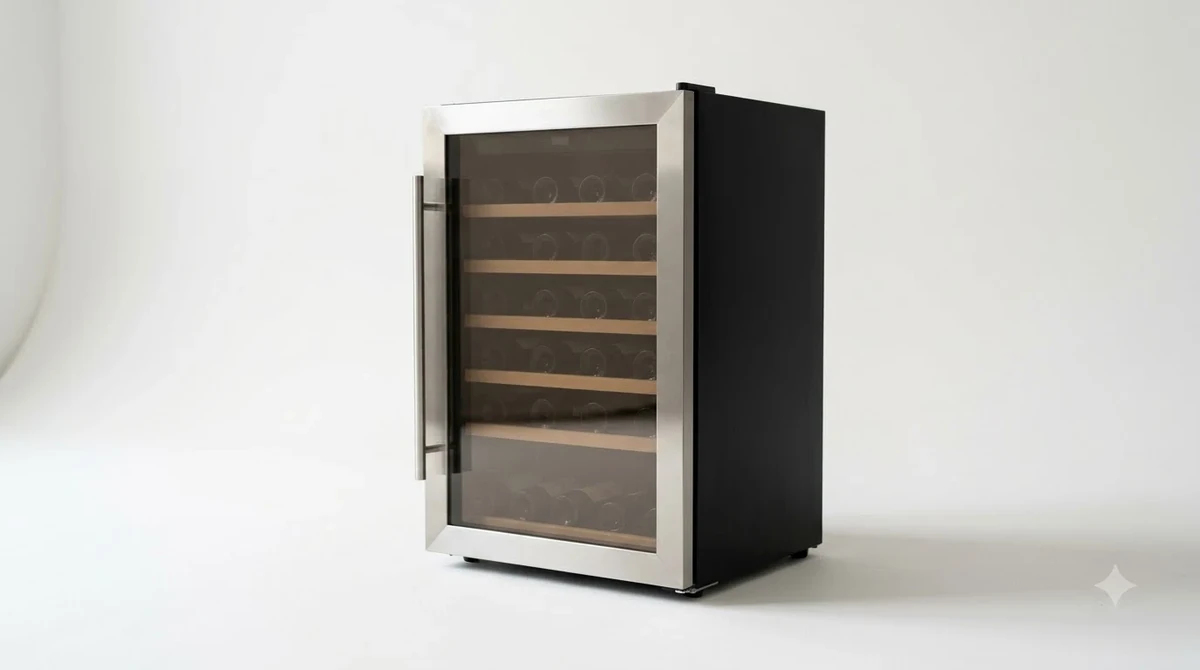
A built-in wine refrigerator generally uses front ventilation so that warm air can escape without requiring open space behind the appliance. A freestanding refrigerator with rear exhaust needs room for air circulation. Vinotemp explicitly recommends at least 6 inches of rear clearance for its freestanding coolers, warning that inadequate ventilation can cause heat accumulation and overheating. The manufacturer’s wine cooler FAQ and installation guidance explains these ventilation and cooling distinctions.
This is one of the most important distinctions to check before ordering. A freestanding appliance may fit physically beneath a kitchen counter but still be unsuitable for enclosed installation. Dimensions alone do not establish whether a refrigerator is designed for built-in use.
The Wine Enthusiast 32-bottle Dual Zone MAX Compressor model provides a useful example. Liquor.com lists it as a freestanding refrigerator measuring 17 inches wide, 19.5 inches deep, and 33.5 inches high. The publication specifically identifies its inability to be installed as a built-in appliance as a limitation.
For a kitchen renovation, measure the opening carefully before deciding between the two brands. Allow for the manufacturer’s specified ventilation clearance, door swing, electrical access, and space needed to remove racks. A refrigerator that fits the opening but cannot ventilate correctly is not an appropriate installation choice.
Check the installation environment
Vinotemp advises against placing wine refrigerators in direct sunlight or moist areas. These recommendations are relevant to both indoor cabinets and appliances installed near frequently used kitchen equipment. A location exposed to strong sunlight or substantial temperature fluctuations can make it harder for a cooling system to maintain stable conditions.
Also consider the surrounding ambient temperature. A refrigerator installed in an enclosed utility room, an unusually warm kitchen, or an unconditioned garage may face operating conditions different from those in a normal living area. Do not assume that every model is suitable for every environment simply because it has compressor cooling.
Garage-rated equipment is a separate category that requires an explicitly documented operating-temperature range. If a garage installation is important, compare the environmental specifications of the exact Vinotemp and Wine Enthusiast models rather than relying on general brand descriptions.
Cooling Technology, Noise, and Everyday Operation
Compressor and thermoelectric cooling systems offer different advantages, and neither brand should be judged solely by the technology used in one refrigerator. Compressor systems are generally more suitable for larger collections and changing ambient conditions, while thermoelectric units can be attractive when quieter operation is a priority.
Vinotemp’s published FAQ explains these differences directly. It describes compressor refrigerators as capable of reaching colder temperatures and adapting to changes in surrounding temperatures. The trade-off is operational noise: Vinotemp compares the sound of a compressor cycling to that of a standard household food refrigerator.
Thermoelectric refrigerators have fewer moving parts and can operate more quietly. However, Vinotemp states that their coldest achievable temperature is approximately 20°F below the ambient temperature. That limitation becomes important in warm rooms because the refrigerator cannot necessarily compensate for a high surrounding temperature.
For example, a room at 75°F creates a different cooling challenge from a room at 65°F. A thermoelectric unit may struggle to achieve a sufficiently low internal temperature in the warmer environment. A compressor refrigerator is generally a more suitable starting point for buyers who need stronger cooling performance or a larger storage capacity.
Consider the sound and location
Noise can become an important practical consideration when the refrigerator sits beside a dining table, in a small apartment, or in an open-plan kitchen. A compressor refrigerator periodically cycles on and off, so its operating sound may be noticeable in an otherwise quiet room.
Thermoelectric models can be quieter, but their environmental limitations should be understood before purchase. Choosing a quieter refrigerator that cannot maintain the required internal temperature in the intended room is a poor trade-off.
Wine Enthusiast’s 32-bottle MAX Compressor model is described by Liquor.com as quiet and energy efficient despite using compressor technology. It also has removable racks and LED lighting, features that make routine access and bottle organization more convenient.
Neither a brand name nor a cooling-system label tells the whole story. Look for model-specific information about operating noise, cooling performance, internal circulation, and energy consumption. If possible, consider the refrigerator’s location and how often its door will be opened throughout the day.
Warranty Coverage, Returns, and Ownership Costs
Warranty conditions deserve as much attention as bottle capacity because wine refrigerators contain electrical and cooling components that can require professional service. Vinotemp publishes detailed warranty and return terms, while Wine Enthusiast warranty coverage must be checked against the documentation for the exact model being considered.
Vinotemp’s published terms list 12 months of parts-and-labor coverage for metal-cabinet compressor appliances. Its terms also list a 90-day warranty for thermoelectric units. These distinctions mean that buyers should not assume every product carrying the Vinotemp name receives identical protection.
There is another important consideration: the model-specific warranty information and the general terms should be reviewed together. The warranty page directs customers to a registration process, while the general terms explain the applicable product coverage. Before paying, request written confirmation of the warranty duration for the exact model, including the cooling system, labor, and any other covered components.
Wine Enthusiast also sells appliances with different manufacturer arrangements. Some of its product documentation provides separate coverage for the sealed refrigeration system. For example, the N’Finity manual information described in the company’s product documentation has been reported as providing one year of general coverage and three years for the sealed system. That should not be treated as a universal warranty for every Wine Enthusiast refrigerator.
Returns and delivery deserve attention
Vinotemp’s terms require technical-service troubleshooting before a defective-product exchange can proceed. Customers also need a return authorization number. Its published conditions state that return freight for defective products is covered during the first 90 days, while customers may become responsible for freight costs after that period within the applicable warranty term.
Its cancellation provisions also specify that an authorized cancellation can involve a 35% restocking fee and freight charges in both directions. This makes it particularly important to measure the installation space and confirm the product configuration before placing an order.
For Wine Enthusiast, buyers should review the retailer’s current return conditions, delivery arrangements, and manufacturer warranty information before checkout. Do not assume that an appliance sold by a wine retailer has the same return process as a product manufactured and sold directly by its brand.
Ownership costs also include electricity, replacement components, potential service calls, and delivery arrangements. A larger compressor refrigerator may require more operating resources than a compact appliance, while a more expensive cabinet may offer a better physical fit or more suitable storage configuration. Comparing these practical costs is more useful than focusing on the initial purchase decision alone.
Tip: Before ordering either brand, save the exact model’s warranty document, installation instructions, and return policy. Confirm the cooling-system coverage, labor period, freight responsibility, and whether the appliance is approved for your intended installation. These details can make a greater difference to ownership satisfaction than a small difference in advertised bottle capacity.
Which Should You Pick: Vinotemp or Wine Enthusiast?
Vinotemp is a logical choice for buyers who want a dedicated wine-storage brand with compact and large-capacity cabinets, cellar equipment, and specific built-in configurations. Wine Enthusiast is a strong choice for shoppers who want to compare wine refrigerators alongside accessories, furniture, and appliances from other manufacturers.
Choose Vinotemp if you are planning a larger storage installation or need to investigate specialized equipment. Its assortment includes single-zone and dual-zone cabinets, compact models, and refrigerators designed for substantially larger collections. Its published installation guidance is also useful when comparing front-vented built-in equipment with rear-vented freestanding designs.
Vinotemp is especially worth investigating if your collection is approaching 100 bottles or more. A larger cabinet can reduce the need to purchase multiple small refrigerators and provides a more centralized place to organize bottles. However, confirm the actual dimensions, internal shelving configuration, ambient operating range, and service arrangements before committing to a large appliance.
Choose Wine Enthusiast if you want to compare different types of wine-storage products in one shopping destination. Its 32-bottle Dual Zone MAX Compressor model illustrates the appeal of a household refrigerator with two temperature zones, removable racks, LED lighting, and a relatively compact footprint. The brand’s broader assortment also gives shoppers access to other wine-related storage options.
Wine Enthusiast is particularly relevant for buyers who want a smaller appliance for a home bar or kitchen and who value the ability to compare several product categories. Its association with EuroCave also gives premium-storage shoppers another direction to investigate.
For a first-time buyer, the best option is not necessarily the brand with the largest catalog or the most impressive bottle count. Start by deciding whether you need 20, 32, 50, or more than 100 bottles of capacity. Then determine whether you need one storage temperature or two, and whether the appliance must fit inside cabinetry.
These are also useful principles when comparing other appliances in our Versus comparisons. The strongest purchasing decision comes from matching specifications to the actual installation rather than assuming that a familiar brand name guarantees a better result.
For households that use a wine refrigerator as part of a home entertaining setup, consider how the surrounding drinks and food will be stored as well. A dedicated wine cabinet and a separate beverage refrigerator can provide more flexibility for serving chilled drinks, including ingredients used in an Aperol Spritz recipe.
Frequently Asked Questions
Is Vinotemp a manufacturer or a retailer?
Vinotemp is a wine-storage equipment brand that designs and distributes wine cabinets, beverage coolers, and cellar cooling products. Its product range also includes associated storage equipment and accessories. Buyers can investigate its dedicated product catalog and contact its support team for product-specific assistance.
Does Wine Enthusiast sell EuroCave wine refrigerators?
Yes. KaTom identifies Wine Enthusiast as the exclusive US distributor for EuroCave wine cabinets. EuroCave is a separate wine-storage brand, so buyers should distinguish between a Wine Enthusiast-branded refrigerator and a EuroCave product sold through Wine Enthusiast.
How long should a wine refrigerator run before storing bottles?
Allow a newly installed refrigerator to stabilize before loading the collection. The exact stabilization period depends on the manufacturer’s instructions and the starting room temperature. Vinotemp separately instructs customers to leave a newly delivered unit upright for 24 hours before plugging it in so the coolant can settle.
Can Champagne bottles fit in a standard wine refrigerator?
Many standard wine refrigerators can accommodate some Champagne bottles, but wider bottle shapes may reduce the usable capacity. The bottom shelf or a removable rack may provide additional flexibility. Measure representative bottles and compare their dimensions with the available shelf spacing before purchasing.
Should wine refrigerators be kept full to operate efficiently?
A refrigerator does not need to be completely full to function. However, the number of bottles stored can influence the amount of temperature change when the door is opened and the appliance’s cooling workload. Avoid blocking internal ventilation openings with bottles or accessories, and follow the manufacturer’s loading instructions.
Overall, Vinotemp is the more natural starting point for specialized cabinets and larger wine-storage projects, while Wine Enthusiast is attractive for shoppers comparing household refrigerators, accessories, and premium alternatives. Compare individual model specifications, ventilation requirements, and warranty documents before making your final decision. The best refrigerator is the one that maintains appropriate storage conditions while fitting your collection and your available space.
More in Versus
 Edgestar Vs Kalamera: Choose the Right Wine CoolerUpdated Nov 21, 2026
 Frigidaire Vs Magic Chef: Compare Wine Cooler Features and FitUpdated Nov 21, 2026
 EdgeStar Vs Whynter Wine Coolers for Smarter StorageUpdated Nov 21, 2026
 Newair Vs Whynter: Choose the Right 46-Bottle Wine CoolerUpdated Nov 21, 2026
 Kalamera Vs Newair: Choose the Right Wine Cooler for Your HomeUpdated Nov 21, 2026
 Danby Vs Vinotemp: Choose the Right Wine Cooler for Your SpaceUpdated Nov 21, 2026