

We may earn a commission when you buy through links on this page, at no extra cost to you. Learn more.
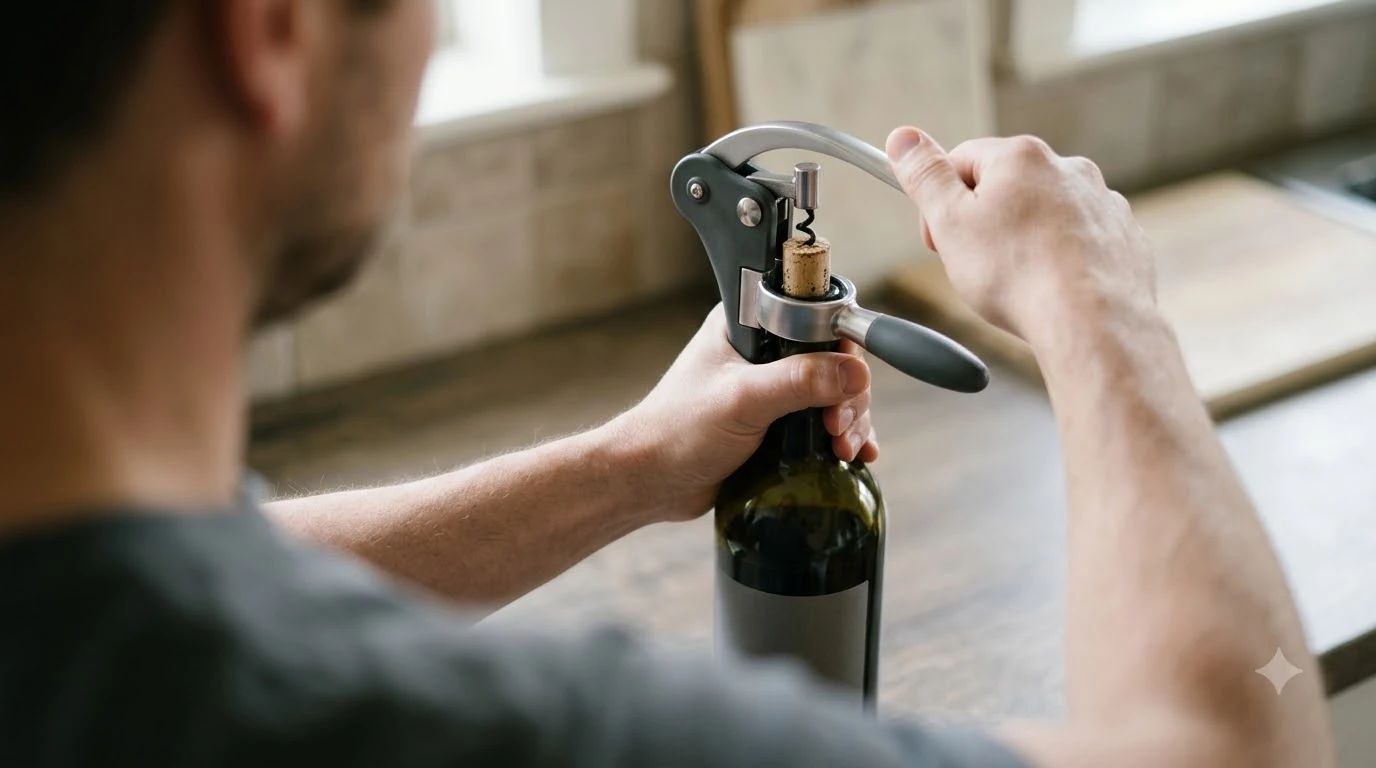
The Vacu Vin corkscrew is a practical choice for wine drinkers who want easier cork removal through a lever-and-gear mechanism rather than relying entirely on hand strength. The Vacu Vin Lever Corkscrew is designed for natural and synthetic corks, with a rubberized grip intended to improve stability during opening. Its larger mechanism makes it less compact than a traditional waiter’s corkscrew, so the right choice depends on whether you prioritize leverage, portability, or straightforward storage.
Opening a bottle should be a simple part of enjoying wine, but the wrong opener can make an ordinary bottle surprisingly difficult to handle. A tight synthetic cork, an unusually firm natural cork, or an awkward bottle position can turn a basic task into an exercise in patience. Vacu Vin offers several opening mechanisms, including lever, winged, and double-hinged designs. This review focuses on the Vacu Vin Lever Corkscrew, examining its construction, operating method, practical advantages, limitations, and alternatives before deciding who should consider it.
Specs and Key Features
The Vacu Vin Lever Corkscrew is built around a mechanical lever and gear system that helps insert the spiral and extract the cork. Its main advantage is that the opening process uses a controlled lever movement instead of requiring the user to twist and pull the cork entirely by hand.

The manufacturer’s product information identifies the tool as suitable for both natural and synthetic wine corks. That versatility matters because synthetic closures can sometimes feel particularly firm, while natural corks vary in density, age, and condition. A mechanism that provides leverage can make these differences easier to manage during ordinary bottle opening.
| Specification | Vacu Vin Lever Corkscrew |
|---|---|
| Product category | Lever-operated wine corkscrew |
| Operating mechanism | Lever and gear system |
| Cork compatibility | Natural and synthetic corks |
| Grip | Rubberized grip |
| Net weight | 0.614 kg (614 g) |
| Article number | 66514606-USA |
| UPC | 084256 665145 |
| Advertised warranty | Minimum five years |
One important distinction is that this is a lever-style opener, not the compact Vacu Vin Double Hinged Corkscrew or the familiar Winged Corkscrew. Those products use different mechanical arrangements and have different handling requirements. Buyers should compare the actual mechanism rather than assuming every Vacu Vin opener has the same dimensions, materials, or opening procedure.
The 614-gram listed weight is particularly relevant when considering placement in a home bar. It indicates a substantially heavier accessory than a small waiter-style opener. That additional mass is not automatically a disadvantage: a countertop tool can benefit from a substantial feel. However, someone who regularly travels with wine accessories or carries an opener in an apron may prefer a smaller model.
Another useful feature is the rubberized grip. Vacu Vin describes this as providing stability and control while the lever is operated. Maintaining a secure hold matters because the opener needs to remain properly positioned over the bottle neck throughout the extraction process. A slipping opener can interrupt the movement and make a simple opening task more awkward.
The manufacturer’s US listing also advertises a minimum five-year warranty. That is a useful consideration when comparing a mechanical accessory with simpler manual openers, although warranty coverage, exclusions, and claim requirements should be reviewed through the manufacturer’s current warranty information before purchase.
For the official product description and operating instructions, see the Vacu Vin Lever Corkscrew manufacturer’s product page.
What Owners Like
The main appeal of a Vacu Vin lever opener is its mechanical assistance. Instead of relying on a long twisting motion followed by a direct pull, the user operates a lever to control cork insertion and extraction. This makes the design particularly attractive to people who open bottles frequently or prefer a more guided process.

Ease of operation is one of the most important considerations for a home wine accessory. A traditional corkscrew requires the user to coordinate downward pressure, rotation, and upward pulling. A lever mechanism separates these movements into a more structured sequence. Once the opener is correctly positioned, the mechanism handles much of the physical work.
A more controlled opening movement
The Vacu Vin Lever Corkscrew is designed to keep the spiral aligned with the cork while the lever moves. This is helpful because a crooked insertion can make extraction more difficult and may damage the cork. A reasonably straight opening path also reduces the chance of the spiral emerging through the side of the closure.
The manufacturer describes the extraction process as a smooth movement after the initial lever operation. For someone who regularly opens bottles with firm synthetic closures, that mechanical assistance may be more comfortable than using a small manual opener. The same principle applies to natural corks that resist the first pull.
Compatibility with different cork materials
Wine bottles use different closure materials, and not all of them respond identically to a corkscrew. Natural cork is compressible and can vary in density, while synthetic closures may offer more resistance during insertion and removal. Vacu Vin specifically identifies both types as compatible with the Lever Corkscrew.
This makes the opener suitable for households that buy a mixture of everyday wines rather than sticking to one producer or closure type. A bottle of California Cabernet Sauvignon with a synthetic closure and a Burgundy Pinot Noir with natural cork can both be opened using the same tool, provided the closure is intact and the bottle neck is compatible.
A substantial home-bar accessory
Some buyers prefer a larger opener that stays in a designated kitchen drawer or home-bar area. The Vacu Vin model’s listed 614-gram weight gives it a different character from a pocket-size waiter opener. It is intended more for stationary use than for carrying around between restaurant tables or outdoor gatherings.
The rubberized grip also gives the design a practical feature beyond its mechanical action. A secure grip helps users keep the opener steady during the downward and upward movements. This can be particularly useful when opening bottles on a countertop rather than holding them in the air.
There is also a convenience benefit to choosing one dedicated opening tool rather than several small accessories. A household that regularly serves wine may appreciate having a lever opener ready in the same location as its decanter, stopper, and glasses. Other wine accessories can be explored in our guide to wine accessory brands, which helps place a corkscrew within a broader home-bar setup.
However, these advantages should be understood as design benefits rather than a guarantee that every user will find the opener equally comfortable. Bottle dimensions, cork condition, grip strength, and familiarity with lever mechanisms all affect the experience.
Common Complaints
The biggest potential drawback of the Vacu Vin Lever Corkscrew is its size and mechanical complexity compared with a basic waiter’s opener. A lever mechanism offers assistance, but it also introduces more moving parts, requires suitable bottle positioning, and takes up more storage space.
Its listed weight of 614 grams is a concrete consideration. Someone who wants a small tool for a picnic basket, travel bag, or service apron may find a compact double-hinged opener more practical. A larger lever tool is generally better suited to a permanent location in a kitchen or home bar.
Positioning still matters
A lever mechanism does not remove the need for correct alignment. The opener must sit securely over the bottle neck so that the spiral enters the cork centrally. If the tool is tilted, the cork may resist extraction or the spiral may travel at an undesirable angle.
Users who are accustomed to small manual corkscrews may need a little practice with the lever movement. The first attempts should be performed slowly, with the bottle standing on a stable surface and the opener properly centered. Rushing the operation can create unnecessary resistance.
More parts mean more maintenance
A basic corkscrew has relatively few components. A mechanical lever opener has additional joints and moving sections that may collect dust, wine residue, or other kitchen debris. It therefore deserves a little more attention during cleaning and storage.
Users should also avoid assuming that every component is made from metal simply because the product has a substantial feel. Vacu Vin’s US product description identifies a rubberized grip and high-quality materials but does not provide a complete material breakdown for every component on the Lever Corkscrew listing. Buyers who prioritize an all-metal construction should obtain that information before choosing the model.
Mixed expectations across the Vacu Vin range
It is important not to confuse complaints about one Vacu Vin opener with evidence about every model. For example, a published Yuppiechef owner review of the Winged Corkscrew criticized its predominantly plastic body and reported difficulty fitting the tool over a bottle neck. The retailer responded by clarifying that the reviewed product was designed for a standard bottle with an inner neck diameter of 18.5 mm.
That feedback is relevant when comparing the brand’s different mechanisms, but it is not direct evidence that the Lever Corkscrew has the same construction or fit problem. The products are mechanically different, and the complaint should be treated as model-specific rather than a universal judgment about the brand.
Another possible disadvantage is that a dedicated lever opener may be unnecessary for occasional wine drinkers. If only a few bottles are opened each month, a compact manual opener can accomplish the same basic task without requiring a larger storage space.
Finally, the mechanism is designed for conventional cork closures. It is not a substitute for a champagne opener, and it should not be used to remove a pressurized sparkling-wine cork. Sparkling bottles require a controlled opening method designed for their pressure and closure system.
Who Should Buy and Who Should Skip
The Vacu Vin Lever Corkscrew is most appropriate for people who want mechanical assistance and have a convenient place to keep a larger wine opener. It is less attractive to buyers who prioritize portability, minimal storage requirements, or a simple tool with very few moving parts.
Who should consider buying it
Regular home wine drinkers: Households that open several bottles throughout the week may appreciate the consistent lever-operated process. A dedicated opener on a kitchen counter or in a home bar can make repeated bottle opening more convenient.
People who prefer mechanical assistance: The lever-and-gear mechanism is the defining reason to consider this model. It reduces dependence on the user’s ability to twist and pull a cork manually. People who find traditional openers uncomfortable may appreciate the more structured movement, although no opener should be assumed to eliminate every physical limitation.
Hosts who serve different wine styles: The manufacturer’s stated compatibility with natural and synthetic corks gives the tool flexibility for mixed collections. A host serving Oregon Pinot Noir, Napa Valley Cabernet Sauvignon, and Italian Chianti does not need a different opener for each bottle simply because the wines come from different regions.
Buyers who want a dedicated home-bar tool: The 614-gram weight is more reasonable for a stationary accessory than for something carried around in a pocket. If storage space is available and a larger opener is preferred, its design may fit the intended use.
Who should skip it
Travelers and restaurant professionals: A compact waiter-style opener is generally easier to carry and store. It also provides an integrated foil-cutting blade and bottle-cap opening function on the Vacu Vin double-hinged design.
People who prefer minimal equipment: If a small, inexpensive manual opener already meets household needs, the larger lever mechanism may not provide enough additional value to justify changing tools.
Collectors opening very old bottles: A conventional spiral opener is not always the best approach for a fragile cork that has deteriorated over many years. A two-prong cork puller can be a more suitable option because it is designed to work between the cork and the inside of the bottle neck instead of drilling through the cork.
Buyers with limited storage space: The heavier lever design is less convenient than a slim opener stored in a utensil drawer. A compact model can be easier to keep alongside wine glasses and other small accessories.
Tip: Before opening a bottle, stand it upright on a stable counter, remove the foil from the neck, and center the corkscrew carefully. Keeping the opener aligned is more important than applying extra force to the lever.
The best purchase decision depends on how often the tool will be used. A household that opens wine regularly may benefit from a dedicated mechanical opener, while an occasional drinker may be better served by a compact double-hinged corkscrew. The choice should reflect actual use rather than the number of features advertised.
How It Compares to Alternatives
Vacu Vin’s other corkscrew designs provide useful alternatives for buyers who like the brand but do not necessarily need a large lever mechanism. The main options include its Winged Corkscrew, Double Hinged Corkscrew, and compact Waiter’s Corkscrew. Each uses a different approach to extracting the cork.
Vacu Vin Lever Corkscrew vs. Winged Corkscrew
The Lever Corkscrew uses a lever-and-gear system to control the insertion and extraction movements. The Winged Corkscrew instead uses a central spiral and two rising arms. The user turns the handle until the arms extend and then pushes both arms downward to remove the cork.
The winged mechanism is familiar to many casual wine drinkers because its operating sequence is easy to understand. It can be a sensible choice for a household that wants a conventional countertop opener without the operating style of a dedicated lever model.
The Lever Corkscrew is the more relevant choice for buyers specifically interested in its guided mechanical extraction. The Winged Corkscrew may appeal more to people who prefer the traditional two-arm design and do not mind turning the handle themselves.
Vacu Vin Lever Corkscrew vs. Double Hinged Corkscrew
The Double Hinged Corkscrew is a much smaller, lighter alternative. Vacu Vin lists its dimensions as 50 x 155 x 25 mm and its weight as 100 grams. It also incorporates a foil cutter and crown-cap opener, making it a practical multipurpose accessory.
Its two-stage hinge provides leverage as the user removes the cork. Rather than using a large lever mechanism, the operator anchors the hinged support against the bottle lip and raises the handle in stages. This is the traditional waiter-style approach found in many restaurant settings.
For a portable option, the Double Hinged Corkscrew is generally easier to store and carry. For someone who wants a larger mechanical opener and a dedicated place to keep it, the Lever Corkscrew has a different appeal.
Vacu Vin Lever Corkscrew vs. Waiter’s Corkscrew
A waiter-style corkscrew is a sensible alternative for people who value compactness and control. The Vacu Vin Waiter’s Corkscrew combines a spiral, a hinged support, and a small foil-cutting blade in one folding tool. Its operating sequence requires the user to turn the spiral into the cork and use the hinge for extraction.
The double-hinged version is particularly useful because it divides extraction into two movements. This allows the user to lift a long cork without needing one continuous, extended pulling motion. It also takes up little drawer space.
For a more detailed look at competing lever-operated designs, the best Rabbit corkscrew options provide another useful comparison point. A buyer comparing lever openers should consider grip, alignment, operating movement, and storage requirements rather than choosing based on appearance alone.
Which mechanism makes the most sense?
The following comparison summarizes the practical differences without treating the mechanisms as interchangeable.
| Opener type | Opening method | Main advantage | Main limitation |
|---|---|---|---|
| Vacu Vin Lever | Lever and gear mechanism | Mechanical assistance | Heavier and larger |
| Vacu Vin Winged | Two rising lever arms | Familiar operation | Requires manual twisting |
| Vacu Vin Double Hinged | Two-stage manual leverage | Compact and portable | Requires more technique |
| Vacu Vin Waiter’s | Manual spiral and hinge | Small multipurpose design | Manual insertion and extraction |
For a stationary home bar, the Lever Corkscrew is worth considering if its mechanical action is the priority. For a restaurant apron or picnic bag, the Double Hinged Corkscrew is more practical. The Winged Corkscrew occupies a familiar middle ground, while a standard waiter’s opener is particularly useful for people who value portability and a traditional operating method.
Wine enthusiasts who also want to improve their understanding of aromas and tasting terminology can explore Le Nez du Vin. Although aroma training does not affect which opener is mechanically suitable, it can complement a more considered home wine setup.
Frequently Asked Questions
These answers address practical questions about using and choosing a Vacu Vin opener, including details that are separate from its main mechanical features.
Can a Vacu Vin corkscrew open bottles with unusually long corks?
The corkscrew’s insertion depth and extraction travel should be sufficient for the closure being used, but the manufacturer does not publish a maximum cork-length measurement for the Lever Corkscrew. Avoid forcing the mechanism if a long cork resists movement. A cork that is unusually long, damaged, or poorly positioned may require a different extraction approach.
Can the Vacu Vin Lever Corkscrew be used on screw-cap wine bottles?
No spiral extraction mechanism is needed for a screw-cap bottle. Remove the cap by turning it counterclockwise while holding the bottle securely. Using a corkscrew on an intact screw cap can damage the closure and is unnecessary.
Is the Vacu Vin Lever Corkscrew suitable for left-handed users?
The manufacturer’s product description does not identify a dedicated left-handed version or publish a specific handedness restriction. The most important practical consideration is whether the user can comfortably position the opener and operate its lever. Checking the handle orientation and trying the movement safely before regular use can help establish comfort.
Should a wine bottle be chilled before using the corkscrew?
Wine temperature does not determine whether the mechanical opener can remove a cork. Chilling is a serving decision rather than a requirement for the corkscrew. For example, sparkling wines are generally served around 40 to 50 degrees Fahrenheit, while light-bodied red wines are commonly served around 55 to 60 degrees Fahrenheit.
What should you do if a cork breaks during extraction?
Stop applying force and remove the opener carefully. If enough cork remains accessible, a suitable corkscrew can sometimes remove the remaining section with a carefully centered insertion. For a very fragile older cork, a two-prong cork puller may offer a more appropriate alternative than repeatedly drilling into the damaged material.
The Vacu Vin Lever Corkscrew is best understood as a dedicated home-bar tool for people who appreciate mechanical assistance and do not mind a larger opener. Its lever-and-gear system, stated compatibility with natural and synthetic corks, rubberized grip, and advertised five-year minimum warranty make it a worthwhile option to compare. If portability and compact storage matter more, the Vacu Vin Double Hinged Corkscrew or a traditional waiter’s opener may be the more practical purchase.
More in Wine Accessories
 Coravin Vs Vacu Vin: Choose the Right Wine Saver for Your BottlesUpdated Nov 21, 2026
 Zwilling Wine Stopper Review: Preserve Open Bottles LongerUpdated Nov 21, 2026
 Wine Enthusiast Wine Preserver Review: Features, Benefits and LimitationsUpdated Nov 21, 2026
 Wine Enthusiast Wine Stopper: An Easier Way to Reseal Open BottlesUpdated Nov 21, 2026
 Vintorio Wine Opener: Two-Step Cork RemovalUpdated Nov 21, 2026
 Zwilling Wine Aerator Review: Aerate, Pour, and Seal With One ToolUpdated Nov 21, 2026