

We may earn a commission when you buy through links on this page, at no extra cost to you. Learn more.
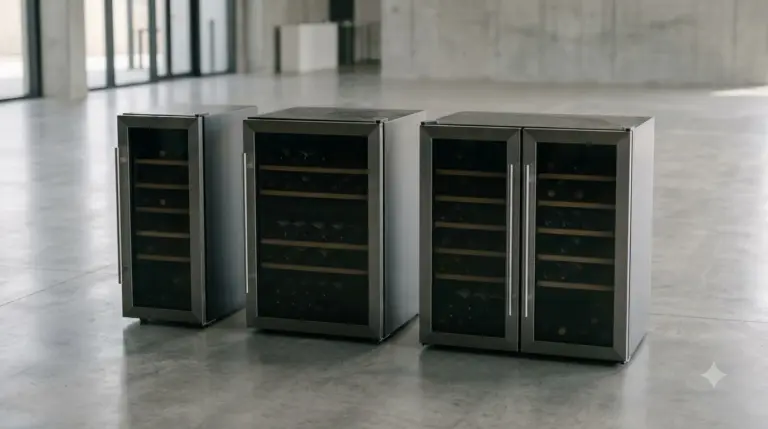
The best under counter wine cooler for most kitchens is a front-venting, dual-zone compressor model sized to a standard 24-inch base cabinet cutout. Dual-zone cabinets keep reds and whites at separate serving temperatures, while single-zone units offer better capacity and steadier conditions for long-term aging. Narrow 15-inch coolers fit tight galley layouts, wine-and-beverage centers handle mixed entertaining needs, and panel-ready builds disappear into custom cabinetry.
Sliding a wine refrigerator beneath a kitchen island or wet bar frees up countertop space while protecting bottles from the dry, overly cold air of a standard kitchen fridge. Because under-counter installations restrict airflow on the sides and back, choosing the right cooling architecture, cabinet width, and zone layout determines how quietly and reliably the appliance performs over a decade of daily use.
Quick Comparison
Different under-counter cabinet configurations balance bottle capacity, temperature precision, and kitchen footprint in distinct ways.
| Cooler Type | Typical Width | Bottle Capacity | Temperature Zones | Best Use Case |
|---|---|---|---|---|
| 24-Inch Dual-Zone Compressor | 23.5–24 in | 40–54 bottles | 2 independent zones | Mixed red and white collections ready to pour |
| Single-Zone Cellar Cooler | 23.5–24 in | 46–60 bottles | 1 uniform zone | Long-term aging and single-style collections |
| 15-Inch Slim Undercounter | 14.8–15 in | 24–34 bottles | 1 or 2 zones | Tight kitchen cutouts, wet bars, and apartments |
| Dual-Zone Wine & Beverage Center | 23.5–24 in | 20–30 bottles + 60–100 cans | 2 zones (down to 34–38°F) | Entertaining households storing beer, soda, and wine |
| Panel-Ready Built-In Cooler | 22.5–24 in | 40–50 bottles | 1 or 2 zones | Custom kitchen remodels with integrated millwork |
Best for Mixed Red and White Collections: 24-Inch Dual-Zone Compressor Cooler
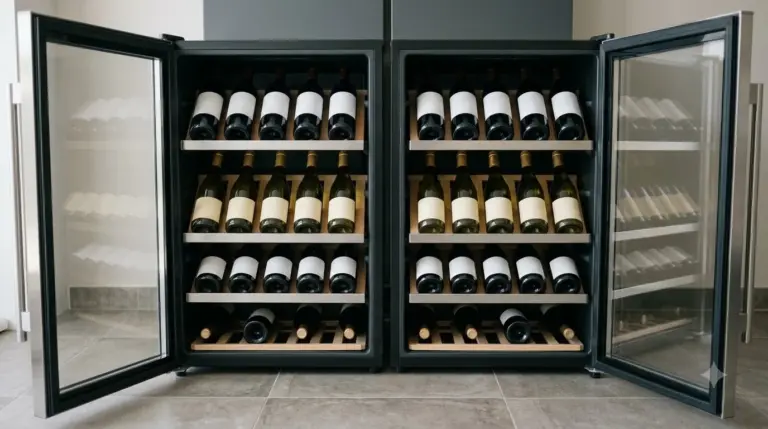
A standard 24-inch dual-zone compressor unit is the most versatile configuration for households that regularly open both crisp whites and full-bodied reds. By dividing the interior into two independently regulated compartments, it eliminates the compromise of storing every bottle at one middle-ground temperature.
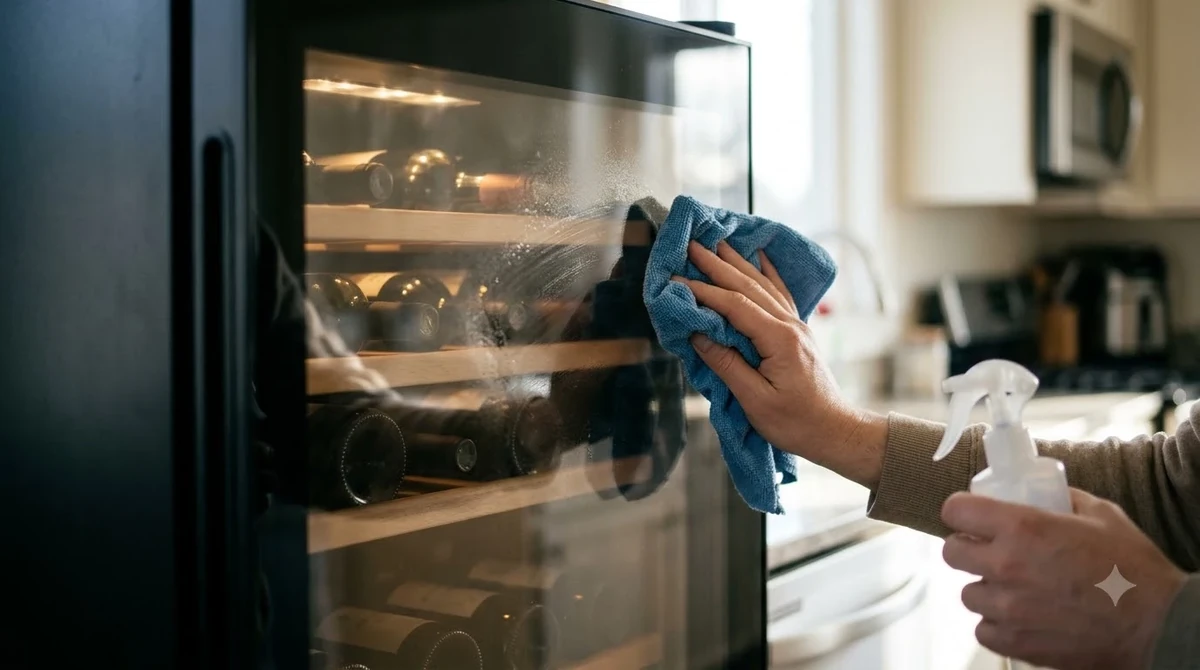
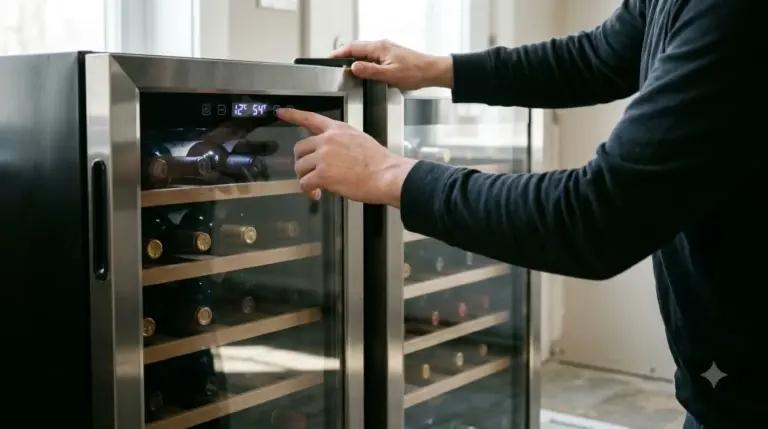
Why it stands out: Two separate thermostats let you hold an upper compartment at 41°F to 54°F for Sauvignon Blanc, Chardonnay, and sparkling wine while keeping the lower compartment at 55°F to 65°F for Cabernet Sauvignon or Pinot Noir. Compressor cooling also maintains stable internal temperatures even when a warm kitchen heats up during dinner prep, outperforming thermoelectric units in ambient rooms above 70°F. Quality builds include front-kickplate ventilation for flush installation, double-pane UV-tinted glass, and smooth-gliding wooden or wire racks that prevent label scuffing.
Keep in mind: The insulated divider wall separating the two temperature zones takes up interior vertical space, trimming total capacity by four to eight bottles compared with a single-zone cabinet of identical exterior dimensions. Compressor motors also produce a faint hum—look for models rated under 40 decibels if the unit sits near an open-concept living area. Best for: Everyday wine drinkers who want reds and whites ready at proper serving temperatures without pulling bottles out early to chill or warm up.

- Capacity
- 52 bottles (5.7 cu.ft)
- Zones
- Dual zone, 40–64°F
- Cooling
- Compressor, fan-assisted
- Install
- Built-in, under counter, freestanding
Collectors who keep reds and whites side by side will appreciate the two temperature zones in this 24-inch cooler. A compressor with fan-assisted airflow holds 40–64°F, and the adjustable sapele wood shelves are sized for Bordeaux, Pinot Noir, or Champagne bottles. Front ventilation and leveling feet let it sit under a counter, in a built-in run, or freestanding.
Pros & ConsView
- Holds 52 standard 750ml bottles
- Two zones for reds and whites
- Front ventilation allows built-in installation
- Needs a full 24-inch-wide, 34-inch-tall opening
- Compressor needs front clearance for airflow
Best for Long-Term Aging and Maximum Capacity: Single-Zone Undercounter Cooler
When your goal is cellaring bottles for several years rather than grabbing weeknight pours at distinct serving temperatures, a single-zone under-counter cooler delivers cleaner temperature uniformity and extra rack space. Without an internal partition, every inch of the 24-inch cabinet goes toward bottle storage and unrestricted airflow.
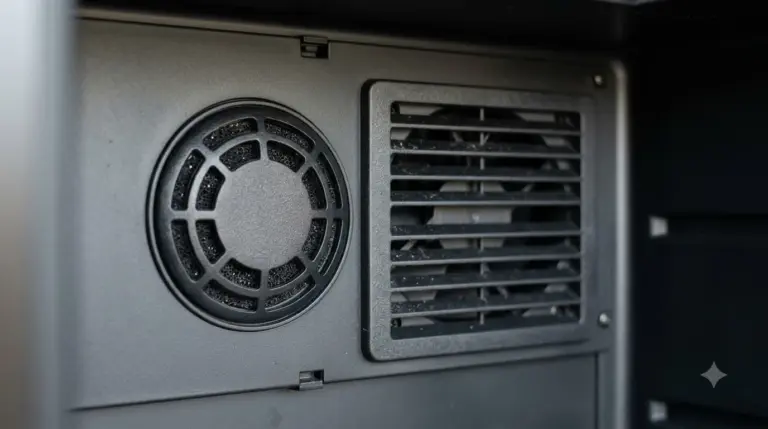
Why it stands out: According to Wine Folly’s wine cellar storage guidelines, steady temperature, darkness, and balanced humidity matter far more for multi-year aging than chilling reds and whites separately. Setting a single-zone cabinet to a consistent 55°F keeps corks supple and slows chemical aging evenly across top and bottom shelves. Inverter-driven compressors paired with activated charcoal filters circulate fresh, odor-free air while limiting vibration that could disturb sediment in older vintages.
Keep in mind: Whites and sparkling wines stored at 55°F will need 20 to 30 minutes in an ice bucket or kitchen refrigerator before serving. Additionally, advertised bottle counts assume narrow 750 mL Bordeaux bottles; wider Burgundy, Pinot Noir, and Champagne shapes typically reduce real-world capacity by 15 to 25 percent unless the shelves are adjustable or removable. Best for: Collectors building a vertical of age-worthy reds or storing a uniform cellar collection under a kitchen island.

- Capacity
- 26 bottles, 2.8 cu ft
- Width
- 15 inches
- Zones
- Dual, 41-64°F
- Cooling
- Compressor, 360° airflow
Meant for tight kitchens where only a slim gap remains beside the cabinets. At 15 inches wide with front venting, it fits below a standard counter, yet still offers two zones set anywhere from 41 to 64°F. Touch controls, removable beech wood shelves and a double-layer tempered glass door keep the interior organized and shielded from light.
Pros & ConsView
- Only 15 inches wide with front venting
- Two zones with touch control
- Removable beech wood shelves
- Capacity tops out at 26 bottles
- Listed installation type is freestanding
Best for Compact Kitchens and Wet Bars: 15-Inch Slim Undercounter Cooler
If your cabinetry layout cannot spare a full two-foot bay, a 15-inch slim under-counter cooler slides neatly into the footprint of a standard trash compactor or narrow base cabinet. Despite its trimmed width, it still uses true front-venting compressor cooling to protect two to three cases of wine.
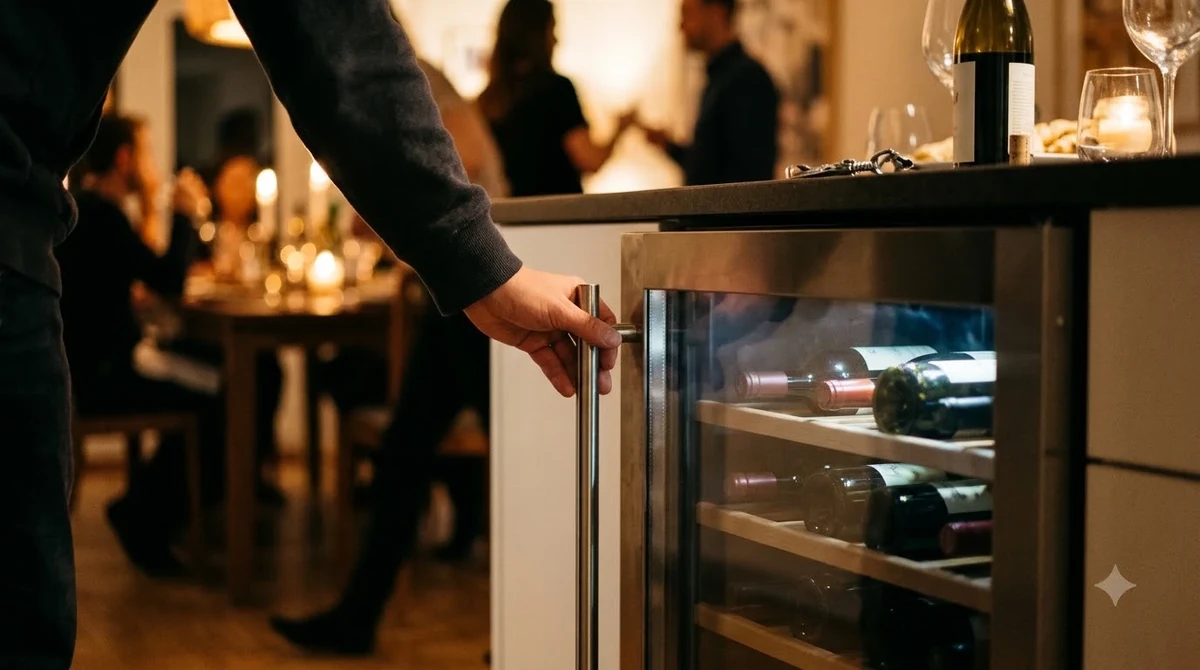
Why it stands out: At roughly 14.8 to 15 inches wide and 34 inches high, these narrow units fit galley kitchens, butler’s pantries, and basement wet bars where wider appliances block walkway clearance. Many slim builds still pack dual-zone dividers, reversible door hinges, and digital touch controls behind UV-resistant glass. If you want an even smaller footprint that sits on a countertop or inside a pantry rather than beneath cabinetry, exploring a dedicated mini wine fridge or compact freestanding small wine fridge gives you flexible placement without carpentry work.
Keep in mind: Narrow shelves hold three to four bottles across rather than five or six, which makes wider magnum or Alsace flutes harder to arrange without removing a rack. Stacking bottles two-deep on non-sliding shelves can also force you to unload front bottles to reach labels in the back, so full-extension rollers are especially helpful in a 15-inch frame. Best for: Condo owners, apartment dwellers, and home bar setups needing true built-in ventilation in tight quarters.

- Capacity
- 33 bottles (3 cu.ft)
- Temp Range
- 40–65°F, 1°F control
- Cooling
- Compressor, 360° air circulation
- Size
- 14.8 in. W x 22.4 in. D x 34 in. H
Wet bars and compact kitchens often leave little more than 15 inches for a cooler, and this one is built to that width. Six wood shelves hold up to 33 Bordeaux bottles, while a power-failure memory restores the set temperature after an outage. The double-layer glass door blocks over 90% of UV rays, and the front grille keeps children away from vents.
Pros & ConsView
- Six wood shelves reduce vibration and friction
- Power-failure memory restores the set temperature
- Insulating glass layer blocks over 90% of UV
- Capacity tops out at 33 bottles
- Door orientation is listed as right-hinged only
Best for Entertaining and Mixed Drinks: Dual-Zone Wine and Beverage Center
A dual-zone wine and beverage center pairs scalloped wine racks on one side or top section with flat glass or wire shelving designed to chill cans, craft beer, and sparkling water down to near-freezing temperatures. It solves the common kitchen bottleneck of beverage cans crowding out fresh produce in your main refrigerator.
Why it stands out: Standard wine coolers rarely drop below 41°F, which leaves sodas, beers, and mixers warmer than most guests prefer. Beverage combo centers—available either as side-by-side French-door 24-inch units or top-and-bottom split cabinets—let the beverage zone dip to 34°F–38°F while the wine side stays safely at 45°F–60°F. Separate doors on French-door layouts also prevent cold air from spilling out of the wine compartment every time someone grabs a sparkling water.
Keep in mind: Flat beverage shelves lack the contoured cradles needed to keep wine bottles from rolling, so wine capacity is usually capped at 20 to 30 bottles. The lower beverage zone also runs a colder evaporator cycle that can reduce ambient humidity slightly compared with a dedicated wine cellar cabinet. Best for: Busy households and frequent hosts who want one under-counter appliance for both weeknight bottles and party drinks.
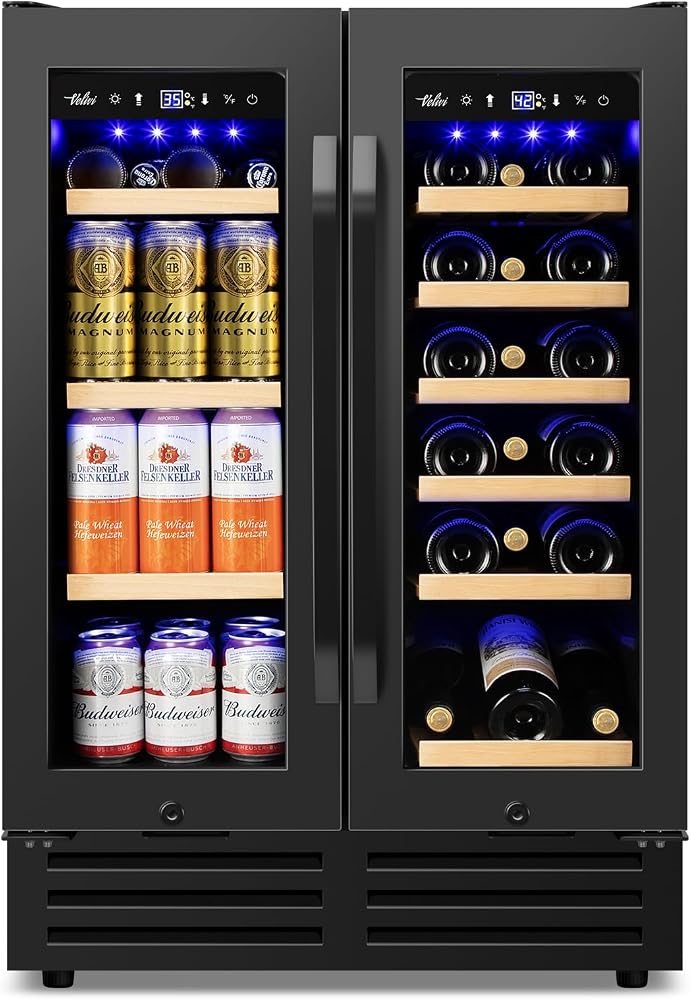
- Capacity
- 18 bottles, 68 cans
- Zones
- Dual, independent controls
- Cooling
- Compressor
- Install
- Built-in or freestanding
Renters can use this 24-inch unit as a freestanding cooler now and tuck it into cabinetry later, since it is designed for both placements at 23.4 by 23.6 by 34.2 inches. Two independently controlled zones separate wine from soft drinks, and the left beverage zone covers 35°F to 50°F. Seven shelves of metal and wood sit behind a black stainless steel door.
Pros & ConsView
- Two independent cooling zones
- Fits built-in or freestanding placement
- Holds 18 bottles and 68 cans
- Door hinges on the left only
- About 34 inches tall, so needs clear space
Best for Custom Kitchen Remodels: Panel-Ready Built-In Wine Cooler
Panel-ready under-counter wine coolers accept a custom wood overlay frame on the door so the appliance blends directly into surrounding shaker, slab, or inset cabinetry. Instead of breaking up a run of millwork with stainless steel, only the UV-protected glass viewing window and integrated handle remain visible.
Why it stands out: Custom-cabinet builds use zero-clearance articulated hinges that allow the door to swing open 90 to 115 degrees without striking adjacent cabinet faces or countertops. Flush toe-kick grilles align cleanly with standard 4-inch cabinet base moldings while exhausting warm air forward into the room. Many architectural models also feature dual-color interior LED lighting—switching between crisp white for label reading and warm amber for evening ambiance—along with Wi-Fi temperature alerts.
Keep in mind: You will need your cabinetmaker to mill and mount the custom door frame according to the manufacturer’s exact weight and thickness tolerances, adding installation coordination compared with a finished stainless-steel door. Choosing the wrong hinge side during ordering can also delay a remodel if the door is not field-reversible. Best for: Full kitchen renovations and designer wet bars where visual continuity across cabinetry is a top priority.
How to Choose
Selecting the right under-counter wine cooler starts with matching installation mechanics and bottle geometry to your kitchen layout. Browse additional wine fridges by type if you are still deciding between built-in, freestanding, and countertop formats, and check these core specifications before measuring your cutout:
- Front-venting exhaust: True under-counter coolers pull air in and push heat out through a slotted grille beneath the door. Never slide a rear-venting freestanding cooler into an enclosed cabinet bay, as trapped heat causes premature compressor failure.
- Cutout dimensions and door swing: Standard 24-inch built-in coolers measure roughly 23.5 to 23.8 inches wide and 33.8 to 34.5 inches tall with leveling legs adjusted. Leave enough clearance on the hinge side so shelves pull out smoothly without hitting a wall or cabinet pull.
- Compressor vs. thermoelectric cooling: As Wine Enthusiast’s placement guide explains, thermoelectric units rely on ambient room temperature and struggle in warm kitchens, whereas compressor models hold steady targets regardless of summer heat or nearby cooking appliances.
- UV-protected double-pane glass: Kitchen windows and overhead task lights emit ultraviolet rays that degrade wine aromatics. Look for tinted, argon-filled double-pane glass and low-heat LED interior bulbs rather than incandescent lighting.
- Noise rating and vibration control: In open kitchens, aim for a sound rating of 39 to 42 decibels or lower, paired with rubber-mounted compressor cradles and beechwood-trimmed shelves that absorb micro-vibrations.
- Shelf spacing for varied bottle shapes: Verify whether at least one or two racks adjust vertically or feature wider spacing so wide-shouldered Pinot Noir, Rhône, and Champagne bottles fit without scraping labels.
Tip: Keep your under-counter cooler at least one cabinet bay away from heat-generating appliances like dishwashers, wall ovens, and ranges, and allow an newly delivered compressor unit to stand upright for 24 hours before plugging it in so refrigerant oils settle properly.
Frequently Asked Questions
What is the difference between a built-in and a freestanding wine cooler?
A built-in or under-counter wine cooler vents heat through a grille at the front base, allowing it to sit flush inside cabinetry with minimal side or rear clearance. Freestanding wine coolers exhaust heat through the back or sides and require two to four inches of open air space around the cabinet to avoid overheating.
What temperature should I set my under-counter wine cooler to?
For long-term storage in a single-zone unit, set the thermostat to 55°F, which suits reds, whites, and sparkling wines equally well. In a dual-zone cooler configured for immediate serving, set the white and sparkling compartment between 45°F and 50°F and the red wine compartment between 58°F and 65°F.
Can I store open bottles of wine inside an under-counter wine fridge?
Yes, standing an opened, recorked bottle upright inside a cooler slows oxidation compared with leaving it on a warm kitchen counter. Check our guide on how long does wine last after opening for exact timelines by style, and note that tall upright bottles usually require removing a middle shelf.
How much extra capacity should I buy when choosing a wine cooler?
Plan for 20 to 30 percent more bottle capacity than you currently keep on hand. Manufacturers calculate maximum bottle counts using uniform 750 mL Bordeaux bottles, so mixing in wider Burgundy, sparkling, or magnum bottles quickly reduces usable rack space.
Before finalizing your order, measure your under-counter opening at the top, middle, and bottom to account for uneven flooring or countertop overhangs. Matching a front-venting compressor design to your preferred bottle mix ensures reliable temperature control and easy access every time you reach for a pour.
More in Wine Fridges by Type
 Best White Wine Fridge for Reliable Chilling and StorageUpdated Nov 20, 2026
 Best Smart Wine Fridge for Steady Temperatures and Remote ChecksUpdated Nov 18, 2026
 Best Black Under Counter Wine Fridge Options for Kitchens and IslandsUpdated Nov 18, 2026
 Best Black Slim Wine Fridge for Narrow Gaps and Dark KitchensUpdated Nov 18, 2026
 Best Built In Dual Zone Wine Fridge Options by Kitchen LayoutUpdated Nov 18, 2026
 Best Slim Built in Wine Cooler: 5 Space-Saving Styles for Tight KitchensUpdated Nov 18, 2026