

We may earn a commission when you buy through links on this page, at no extra cost to you. Learn more.
The screwpull wine stopper is a wine-preservation accessory associated with Le Creuset’s Screwpull wine-tool range, and its sparkling wine stopper design is particularly useful for keeping Champagne and Prosecco fizzy between pours. The Le Creuset Champagne Crown Sealer uses a secure closure mechanism rather than an ordinary push-in rubber plug. Its main advantages are convenient operation, an attractive metal appearance, and a dependable seal for sparkling bottles. However, buyers should distinguish a sparkling wine stopper from a vacuum wine preserver because the two products perform different jobs.
Wine accessories can make a noticeable difference during dinner parties, celebrations, and ordinary evenings when a full bottle is more than one person wants to finish. A suitable stopper helps keep leftover wine protected while making the next pour easier. The Screwpull name is particularly relevant because Le Creuset continues to associate its wine-tool collection with Screwpull design and innovation. Understanding which stopper you are buying is important, though: the Champagne Crown Sealer is designed around retaining carbonation, while other wine stoppers and pumps address the preservation of still wine. This review examines the design, practical advantages, limitations, and alternatives to help determine whether this style of accessory belongs in a home wine collection.
Specs and Key Features
The defining feature of the Le Creuset sparkling wine stopper is its locking closure, which is designed to retain carbonation after a bottle has been opened. Its metal construction and switch-style valve make it different from the inexpensive silicone plugs commonly used for still wine.
There is an important naming distinction to understand before purchasing. Screwpull is associated with Le Creuset’s wine-tool collection, but a reference to a Screwpull wine stopper does not necessarily identify one specific model. Le Creuset lists multiple wine accessories, including the Champagne Crown Sealer, and the Champagne Stopper sold through Williams Sonoma is another clearly identified product in this category. Buyers should compare the actual product design and description rather than assume that every Screwpull-branded accessory has identical features.
The Champagne Stopper described by Williams Sonoma uses an airtight seal and a switch-style valve. Its curved base is intended to slide onto the bottle neck, while the switch locks or releases the closure in a single motion. The product is described as metal with a black nickel finish. These details give a useful picture of its construction and operating approach without assuming that every older or differently named Screwpull stopper shares the same specifications.
| Feature | Available specification or finding | Practical significance |
|---|---|---|
| Product category | Sparkling wine stopper | Designed to retain carbonation |
| Closure | Airtight sealing mechanism | Helps limit gas escaping from the bottle |
| Operating control | Switch-style valve | Allows straightforward locking and release |
| Construction | Metal | More substantial than a basic rubber plug |
| Finish | Black nickel | Provides a polished appearance |
| Base design | Curved bottle-neck fitting | Designed to slide onto the bottle neck |
| Operating action | Single-motion switch | Reduces complicated handling |
| Reported carbonation retention | Up to 4 days | TechGearLab’s tested result for the Champagne Crown Sealer |
The most useful independent performance information comes from TechGearLab’s comparison of nine wine stoppers. Its review selected the Le Creuset Champagne Crown Sealer as its best sparkling wine stopper, highlighting its materials, secure lever mechanism, and ability to retain carbonation. The publication reported that its tested bottles remained suitably bubbly for up to four days. That is a more meaningful buying reference than relying entirely on a manufacturer’s general description, although individual results depend on the wine, bottle condition, and how carefully the stopper is fitted. The TechGearLab wine stopper comparison provides further details about its testing criteria and competing designs.
Another important distinction is that this product is not a vacuum pump. A conventional vacuum wine saver removes some air from a bottle of still wine. A sparkling wine stopper instead needs to retain the pressure and dissolved carbon dioxide that create bubbles. These mechanisms have different purposes, and substituting one for the other can produce disappointing results.
For a buyer comparing accessories, the main specification to prioritize is therefore the closure type. If the bottle contains Champagne, Cava, or Prosecco, choose a stopper specifically designed for sparkling wine. If the bottle contains Cabernet Sauvignon, Chardonnay, or Pinot Noir, a conventional stopper or vacuum preservation system may be more appropriate.
What Owners Like
The strongest reasons to consider a Screwpull-style sparkling wine stopper are its secure closure, straightforward operation, and appearance. It is particularly appealing to households that regularly open sparkling wine but rarely finish a bottle in one sitting.
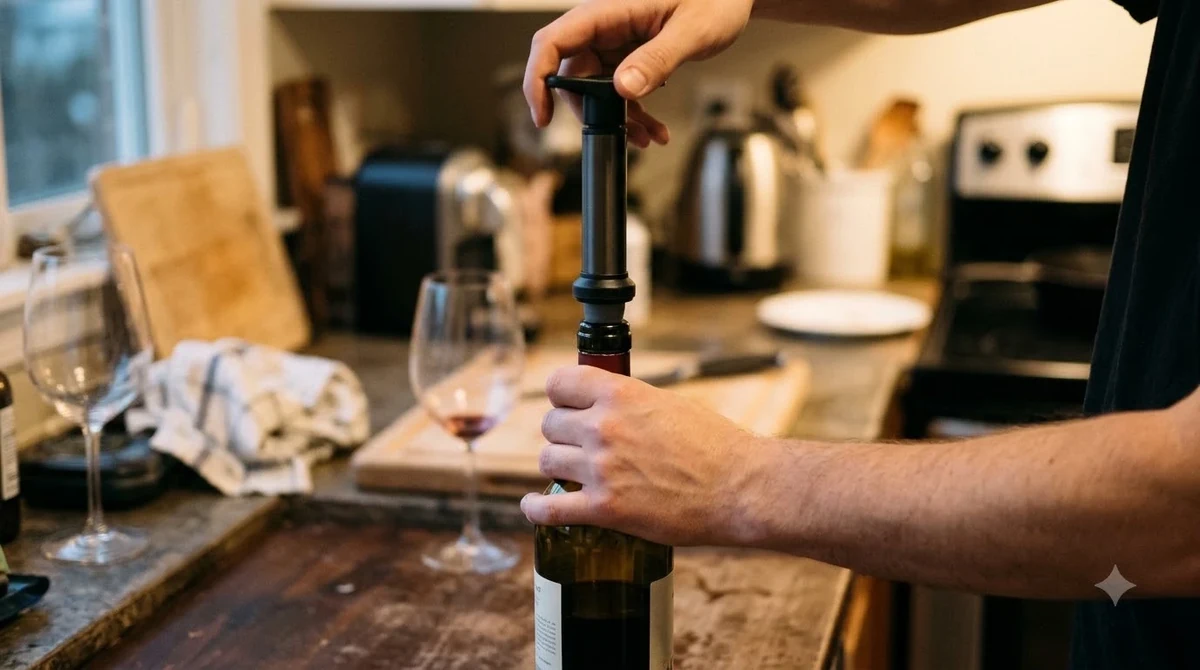
The first advantage is the locking mechanism. An ordinary rubber stopper depends largely on friction to remain in position. A purpose-built sparkling wine stopper uses a more secure attachment to help keep the closure in place against the pressure inside the bottle. The switch-style valve described by Williams Sonoma adds a simple control that makes opening and closing more convenient. Instead of repeatedly pushing and pulling a loose plug, the user can operate the closure through a defined locking action.
This matters during entertaining. Imagine opening a bottle of Champagne before dinner, serving a few glasses, and saving the remainder for a later course. A properly fitted sparkling wine stopper makes it easier to close the bottle between pours without attempting to force the original cork back into the neck. Champagne corks expand after removal, making them difficult to reinsert securely. A dedicated stopper avoids that inconvenience.
Appearance is another advantage. The black nickel finish and metal construction give the accessory a more refined appearance than many inexpensive plastic closures. It can sit comfortably alongside polished wine glasses, a stainless-steel wine cooler, or other bar accessories. Buyers who care about how their serving equipment looks on the table may appreciate this difference.
Independent testing also provides a useful reason to consider this style. TechGearLab reported that its tested Le Creuset Champagne Crown Sealer kept sparkling wine suitably bubbly for up to four days. Its evaluation considered carbonation retention, seal quality, and storage conditions rather than focusing only on appearance. The publication also reported that the stopper handled side storage with little leakage during its testing.
That finding is particularly relevant for people who store an opened bottle in a refrigerator. A stopper that remains securely attached reduces the risk of accidental leakage if a bottle is moved. Nevertheless, upright storage is a sensible everyday choice because it makes spills easier to avoid and keeps the bottle stable among other refrigerator items.
Another positive is the simplicity of the product category. There is no pump to operate, battery to charge, or gas cartridge to replace. The user only needs to fit the stopper correctly and operate its locking control. For someone who opens sparkling wine occasionally, fewer components can make an accessory easier to keep available and use consistently.
The stopper can also make entertaining more flexible. A host does not have to plan every pour around finishing a bottle immediately. One bottle can accompany appetizers, dinner, and a later dessert course without requiring the remaining sparkling wine to sit uncovered between servings. This is particularly useful for smaller households, where a full bottle may represent several servings.
Finally, a dedicated stopper makes a practical gift. People who already own a corkscrew, foil cutter, and wine glasses may not need another basic opener. A dedicated sparkling wine accessory fills a different role and can complement a well-organized home bar. It is especially appropriate for someone who enjoys Champagne cocktails, weekend brunch, or occasional celebrations.
Common Complaints
The main disadvantages are the narrower purpose, the need for correct bottle compatibility, and the limitations of sparkling wine preservation. Even a well-designed stopper cannot keep an opened bottle tasting exactly like a freshly opened one indefinitely.

The first potential complaint is that the accessory is not a universal solution for every bottle in a wine collection. A sparkling wine stopper is designed around the neck and pressure characteristics of sparkling wine bottles. It is not automatically the right tool for every conventional still wine bottle. Someone who primarily drinks Merlot, Sauvignon Blanc, or Chardonnay may get more everyday use from a standard wine stopper instead.
There is also a distinction between the Champagne Crown Sealer and the broader range of Screwpull accessories. Buyers searching for the phrase Screwpull wine stopper may encounter older accessories, pourer-stopper combinations, and different Le Creuset products. Their mechanisms and purposes are not necessarily interchangeable. A listing that simply uses the Screwpull name without showing the closure design deserves closer inspection before purchase.
Another limitation is that carbonation retention has a finite window. TechGearLab reported that the tested Le Creuset sparkling stopper kept wine suitably bubbly for up to four days. In the same evaluation, sparkling wine had clearly lost carbonation by day five and was considered flat by day six. Those findings demonstrate that even a secure closure does not provide indefinite preservation.
Some buyers may also find the construction more substantial than necessary. A metal closure with a dedicated locking mechanism is attractive, but it has more parts and a more specialized design than a simple silicone plug. Someone who only opens sparkling wine once or twice a year might prefer a basic stopper rather than purchasing a more elaborate accessory.
Price positioning is another consideration, although the cost alone does not determine value. TechGearLab noted that the Le Creuset Champagne Crown Sealer costs more than many competing options. A buyer should decide whether the materials, finish, and locking mechanism justify choosing it over a simpler closure. Paying for a recognizable design makes less sense if the accessory will remain unused in a kitchen drawer.
Cleaning can also require a little more attention than a plain molded plug. The sealing surfaces and moving parts need to remain free of wine residue. Dried sparkling wine can leave sticky deposits around the closure, potentially making a switch mechanism less pleasant to operate. Gentle cleaning and thorough drying are sensible habits for maintaining any reusable wine accessory.
Finally, the stopper does not solve every wine-preservation problem. It helps retain carbonation, but it cannot reverse oxidation that has already begun or restore a bottle that has been left warm and exposed to air. Wine quality depends on both the closure and the conditions under which the bottle is stored. Buyers expecting a stopper to preserve sparkling wine for weeks should reconsider their expectations.
Tip: Refrigerate an opened sparkling wine bottle promptly and fit its dedicated stopper securely. Cold storage slows quality deterioration, while the stopper helps retain carbonation. Do not substitute a vacuum pump intended for still wine.
Who Should Buy and Who Should Skip
A Screwpull-style sparkling wine stopper is most useful for people who frequently open Champagne, Prosecco, or Cava and want a convenient way to close unfinished bottles. It is less compelling for households that mainly drink still wine or rarely have leftover sparkling wine.
Who should buy it
Regular sparkling wine drinkers: If a bottle of Prosecco accompanies weekend brunch or Champagne is a regular feature of dinner parties, a dedicated stopper has a clear purpose. Being able to close a bottle securely between pours is more convenient than attempting to reinsert an expanded cork. The locking mechanism is particularly useful when the bottle will be opened several times over a short period.
Small households: A household with one or two wine drinkers may not finish a bottle of sparkling wine in one sitting. A suitable closure provides more flexibility, allowing the remaining wine to be stored for another occasion. This can make larger bottles more practical for people who prefer moderate pours.
Hosts and entertainers: People who serve sparkling wine alongside appetizers, seafood, brunch dishes, or desserts can benefit from a stopper that is easy to operate. A metal design also looks appropriate on a serving table or home bar. It offers a useful combination of appearance and practical function.
Wine accessory collectors: Buyers who already own a reliable corkscrew, wine glasses, decanter, and drip-control accessories may appreciate having a dedicated sparkling wine closure. It fills a distinct role in a complete wine-serving setup.
Who should skip it
Mostly still-wine drinkers: If the usual bottle is Cabernet Sauvignon, Merlot, Pinot Noir, or Chardonnay, a sparkling wine closure is not the most versatile purchase. A regular stopper or a vacuum system designed for still wine is likely to be more useful.
Infrequent sparkling wine drinkers: Someone who opens a bottle only for an annual celebration may not need a specialized accessory. A simpler sparkling wine stopper can provide the basic function without requiring a more elaborate design.
Buyers expecting long-term preservation: No ordinary bottle stopper can maintain sparkling wine indefinitely. The four-day result reported by TechGearLab should be understood as an observed performance finding, not a universal guarantee. Wine that has been open for several days will still undergo changes in aroma, flavor, and carbonation.
People seeking one stopper for every bottle: A dedicated sparkling closure and a still-wine preservation stopper solve different problems. If a single accessory must cover a broad range of bottles, a general-purpose stopper may be a better starting point.
How It Compares to Alternatives
The best alternative depends on whether the bottle contains sparkling or still wine. Le Creuset’s Champagne Crown Sealer is designed for carbonation retention, while products such as the OXO Good Grips stopper, Rabbit Bottle Stoppers, and Vacu Vin Wine Saver Pump address different sealing and preservation needs.
TechGearLab’s comparison provides a useful distinction between these products. It selected the Le Creuset Champagne Crown Sealer for sparkling wine, the OXO Good Grips 2-Piece Spillproof as its best overall stopper, and Rabbit Bottle Stoppers as a value-oriented option. These selections reflect different use cases rather than a single product being suitable for every bottle.
| Alternative | Best application | Main difference | Important consideration |
|---|---|---|---|
| Le Creuset Champagne Crown Sealer | Champagne and other sparkling wine | Locking sparkling wine closure | Specialized rather than universal |
| OXO Good Grips 2-Piece Spillproof | Still wine | Expanding sealing mechanism | Not a substitute for a sparkling wine closure |
| Rabbit Bottle Stoppers | Everyday still wine storage | Simple push-in stopper design | Requires a proper fit |
| Vacu Vin Wine Saver Pump | Opened still wine | Uses a pump to reduce air exposure | Not appropriate for preserving carbonation |
Le Creuset versus OXO
The Le Creuset sparkling wine stopper is the more specialized choice. Its purpose is to keep carbonation inside sparkling wine bottles, while the OXO Good Grips stopper uses a mechanical expanding design for sealing still wine. TechGearLab favored OXO as its overall wine stopper because of its convenience, appearance, and sealing performance. However, that does not make OXO the automatic choice for Champagne or Prosecco.
The right selection depends on the bottle rather than the brand. Someone who regularly serves sparkling wine should prioritize the locking mechanism of a dedicated Champagne closure. Someone who opens mostly still wine will probably benefit more from OXO’s general-purpose approach.
Le Creuset versus Rabbit
Rabbit Bottle Stoppers are another alternative identified in TechGearLab’s comparison. They are positioned as a value-oriented option and offer a straightforward way to close opened still wine bottles. Their simpler design can appeal to households that need several reusable stoppers for everyday use.
The Le Creuset sparkling closure has a different objective. Its specialized locking mechanism is intended to handle the pressure inside a sparkling wine bottle. The two products should therefore be evaluated by their intended bottle types rather than by appearance alone.
Le Creuset versus Vacu Vin
The Vacu Vin Wine Saver Pump is a more appropriate comparison for someone who wants to preserve unfinished still wine. A vacuum system uses a stopper and pump to reduce the amount of air remaining in an opened bottle. The objective is to slow oxidation rather than retain carbonation.
That distinction is important because removing air from a sparkling wine bottle can also remove the carbon dioxide responsible for its bubbles. A sparkling wine stopper should retain pressure rather than attempt to create a vacuum. The two accessories are complementary additions to a wine collection, not interchangeable products.
For readers building a more complete wine-serving setup, a suitable wine drip stopper can help prevent wine from running down the outside of the bottle during pouring. It addresses a different inconvenience, but it pairs naturally with a reusable bottle closure.
For a home entertaining area, the stopper can also be stored with glasses, openers, and other equipment on a dedicated bar cart. This keeps the accessory accessible when a bottle is opened rather than leaving it buried among miscellaneous kitchen tools.
Frequently Asked Questions
Is a Screwpull wine stopper the same as a Le Creuset wine stopper?
Screwpull is associated with Le Creuset’s wine-tool collection, but the name can refer to different accessories and product generations. A Champagne Crown Sealer, a Champagne Stopper, and an older Screwpull pourer-stopper should not automatically be treated as identical products. Compare the actual model name and closure design before purchasing.
Can a Screwpull sparkling wine stopper fit every Champagne bottle?
Bottle-neck dimensions and closure designs can differ between sparkling wine producers. A stopper intended for standard sparkling wine bottles should not be assumed to fit every unusual bottle format, miniature, or specialty closure. Check the manufacturer’s compatibility information if the bottle has an unusually shaped neck.
Can a sparkling wine stopper be used on a bottle with a screw cap?
A conventional screw-cap bottle has a threaded neck rather than the same closure arrangement used by traditional Champagne bottles. A stopper designed to lock onto a sparkling wine bottle may not attach securely to that opening. A compatible screw-cap closure is the more appropriate option for that format.
Does a sparkling wine stopper need to be fitted immediately?
Yes, fitting the closure promptly after pouring is a sensible way to minimize unnecessary gas loss. Leaving a bottle open while serving food or preparing another drink gives carbon dioxide more time to escape. Keep the bottle cold and avoid repeatedly leaving it uncovered between servings.
Can the original Champagne cork be reused instead of buying a stopper?
Champagne corks expand considerably after extraction and are difficult to push back into the bottle securely. Even if a cork can be partially reinserted, it may not provide a dependable closure. A properly fitted reusable sparkling wine stopper is generally more convenient for this task.
The Screwpull wine stopper category is worth considering if sparkling wine is a regular part of home entertaining. The Le Creuset Champagne Crown Sealer stands out for its dedicated locking design, metal construction, and independently reported carbonation-retention performance. Choose it for the bottle type it was designed to serve, store opened wine appropriately, and remember that a good stopper extends useful enjoyment rather than preserving an opened bottle indefinitely. For additional wine accessories and equipment from established makers, explore the Accessory Brands collection or browse a wine advent calendar for another way to enjoy wine throughout the holiday season.
More in Wine Accessories
 Coravin Vs Vacu Vin: Choose the Right Wine Saver for Your BottlesUpdated Nov 21, 2026
 Zwilling Wine Stopper Review: Preserve Open Bottles LongerUpdated Nov 21, 2026
 Wine Enthusiast Wine Preserver Review: Features, Benefits and LimitationsUpdated Nov 21, 2026
 Wine Enthusiast Wine Stopper: An Easier Way to Reseal Open BottlesUpdated Nov 21, 2026
 Vintorio Wine Opener: Two-Step Cork RemovalUpdated Nov 21, 2026
 Zwilling Wine Aerator Review: Aerate, Pour, and Seal With One ToolUpdated Nov 21, 2026