

We may earn a commission when you buy through links on this page, at no extra cost to you. Learn more.
This oster wine opener review finds that the Oster Silver Electric Wine Opener is convenient and simple to operate, but its long-term battery reliability and occasional cork-jamming problems make it a cautious purchase. Its cordless design, push-button operation, included foil cutter, and advertised capacity of up to 30 bottles per charge make it appealing for everyday wine drinkers. However, owner feedback raises concerns about charging failures and mechanisms that become stuck. It is best suited to occasional home use rather than buyers who prioritize long-term durability.
An electric wine opener can make opening a bottle considerably easier, particularly during dinner parties or when several bottles need to be opened in succession. Oster offers a familiar, straightforward design with a rechargeable base and a few practical accessories. The important question is whether its convenience outweighs the possibility of battery and mechanical problems. This review examines the Silver Electric Wine Opener, its specifications, owner experiences, and the situations in which a different style of opener might make more sense.
Specs and Key Features
The Oster Silver Electric Wine Opener is a cordless household appliance designed to remove traditional wine corks with a powered mechanism. Its main appeal is simplicity: position the opener over the bottle, operate the switch, and let the motor handle the extraction.
Oster identifies the Silver model by model number FPSTBW8207-S-AMZ. The manufacturer advertises up to 30 bottle openings per charge and includes a charging base and foil cutter. The handle has a soft-grip finish, while the rechargeable design eliminates the need to operate the corkscrew manually. The manufacturer’s Oster Silver Electric Wine Opener product page provides the model’s specifications and included accessories.
Here are the manufacturer’s published specifications for this particular model. These figures should not be confused with those of Oster’s separate wine opener kits or older electric opener products.
| Specification | Oster Silver Electric Wine Opener |
|---|---|
| Model number | FPSTBW8207-S-AMZ |
| Operating style | Cordless electric |
| Advertised capacity | Up to 30 bottles per charge |
| Charging time | Approximately 6–8 hours |
| Dimensions | 5.51 x 14.96 x 5.32 inches |
| Listed wattage | 14.4 watts |
| Battery powered | Yes |
| Included accessories | Charging base and foil cutter |
| Warranty | 1-year limited warranty |
One detail deserves attention: the advertised 30-bottle capacity is a manufacturer estimate, not a guarantee that every unit will open that many bottles throughout its useful life. Battery condition, charging contact, cork resistance, and usage patterns can affect actual performance. Buyers should also distinguish between the charging time and the number of bottles available afterward.
The dimensions make the opener relatively substantial compared with a small manual corkscrew. It is designed to stand in its charging base, which gives it a convenient home on a kitchen counter or bar cart. However, households with limited counter space may prefer a compact manual tool.
Oster also sells a separate 4-in-1 Wine Kit, model FPSTBWGS19. That package includes a rechargeable opener, wine pourer, vacuum wine stoppers, and foil cutter. Its listed warranty is three years, rather than the one-year limited warranty specified for the Silver model reviewed here. These are different products, so the additional accessories and warranty should not be assumed to apply to every Oster opener.
The overall feature list is straightforward. There is no elaborate digital display, adjustable extraction setting, or complicated control system. For someone who wants a basic electric corkscrew rather than a multifunction wine accessory, that simplicity is part of the appeal.
What Owners Like
Owners who are satisfied with the Oster opener generally appreciate its straightforward operation, reduced physical effort, and ability to remove corks without the twisting motion required by a traditional corkscrew. These advantages are especially useful when opening wine for a group.
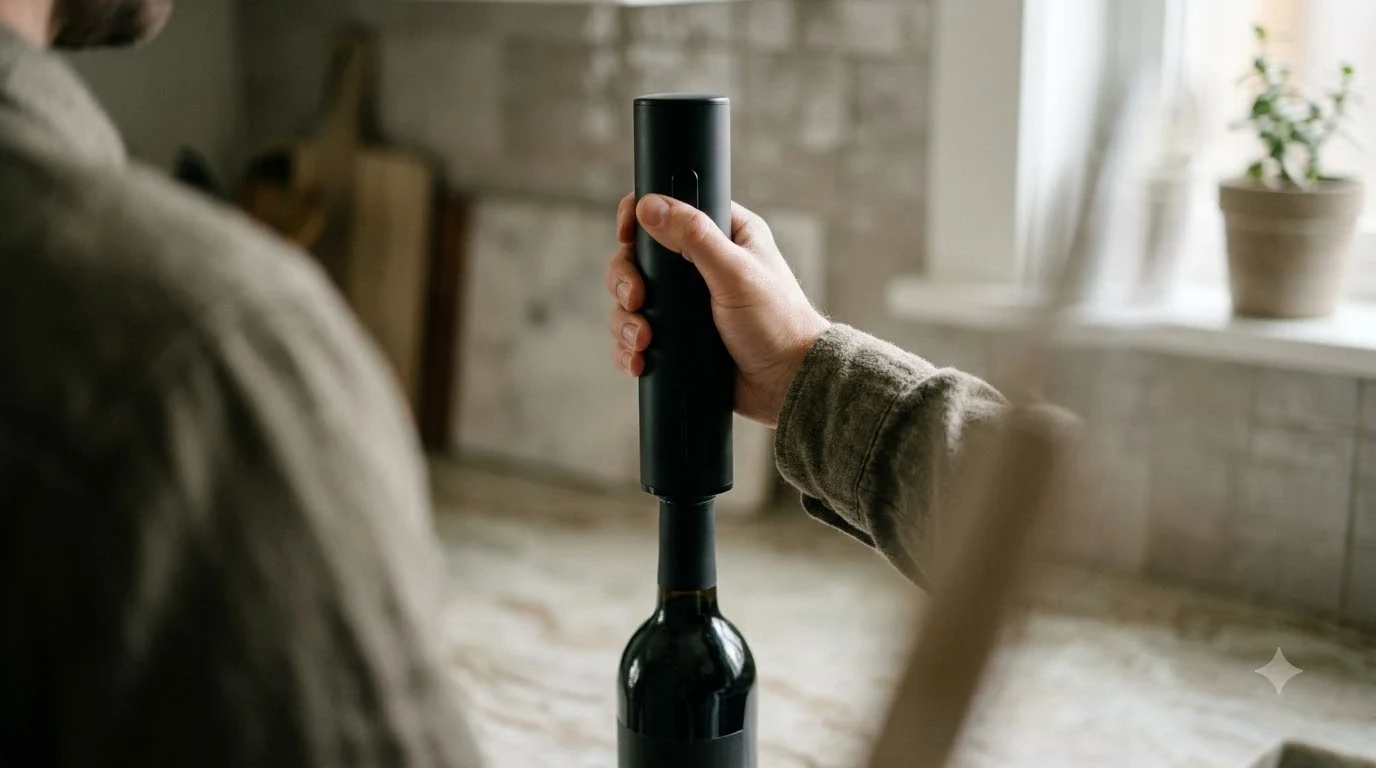
The push-button approach is the product’s biggest selling point. A conventional waiter’s corkscrew requires the user to position a spiral, apply leverage, and extract the cork with controlled pressure. The Oster replaces much of that work with a powered mechanism. This can make opening a bottle less demanding for people who find manual corkscrews uncomfortable or awkward.
The cordless format is another practical advantage. Once charged, the opener can be carried from the kitchen to a dining table or entertaining area without dragging a power cord along. The charging base also gives the appliance a consistent storage location, making it easier to find than a small corkscrew that might disappear into a crowded kitchen drawer.
Convenience during dinner parties
Opening several bottles is where electric operation can be particularly attractive. A host serving Cabernet Sauvignon, Pinot Noir, and Chardonnay during the same evening can move between bottles without repeatedly performing the twisting and pulling motions associated with a manual opener.
Oster advertises capacity for up to 30 bottles on one charge. That figure is more than sufficient on paper for many ordinary home gatherings. It also means users do not necessarily need to recharge after every dinner. Still, a battery-powered appliance should be charged ahead of an important occasion rather than relying on its remaining power at the last minute.
Useful basic accessories
The included foil cutter is a practical addition. Before using an electric corkscrew, the foil covering the bottle neck must be removed. Having the cutter stored alongside the charging base means users do not have to find another tool each time they open a bottle.
The soft-grip handle is another feature owners may appreciate. It gives the user a more comfortable surface to hold while positioning the opener over the bottle. This matters because the device needs to remain upright and reasonably stable during the extraction process.
Some positive owner feedback also describes years of successful operation. One Oster customer specifically mentions that correct seating on the charging base is important to keeping the unit ready for use. This is a useful reminder that charging performance depends not only on the battery but also on the connection between the opener and its base.
For a household that opens wine occasionally, the combination of cordless operation, simple controls, and a dedicated charging stand can make the routine more convenient. The experience is less appealing, however, if the battery begins losing capacity or the corkscrew mechanism stops working reliably.
Common Complaints
The main concern with the Oster Silver Electric Wine Opener is durability rather than its basic operating concept. Owner feedback repeatedly mentions batteries that stop holding a charge, corks that become trapped in the mechanism, and openers that lose their ability to extract corks.

Battery performance is particularly important for a rechargeable appliance. A manual corkscrew can continue working as long as its mechanism remains intact, but an electric opener depends on a functioning battery and motor. If the battery no longer provides enough power, the opener may become unusable even when its exterior looks perfectly fine.
Charging problems and declining battery performance
Several owners describe units that work normally for a period before becoming difficult to charge. Some report that the charging base appears to receive power while the opener itself fails to indicate that it is charging. Others describe a unit that remains on the charging stand but no longer has enough power to remove a cork.
One customer report describes useful operation lasting approximately 12 to 18 months before battery performance became inadequate. Other feedback describes units failing after about a year, while another owner reports substantially longer use. These accounts do not establish a guaranteed lifespan, but they indicate that long-term battery performance is an important purchasing consideration.
The absence of an advertised user-replaceable battery is another drawback. If the rechargeable battery deteriorates, owners may have limited practical repair options. That is frustrating for buyers who would otherwise prefer to replace one worn component rather than discard the entire appliance.
Corks getting stuck
A second recurring complaint involves corks becoming trapped inside the opener. This can happen when the corkscrew does not complete its extraction or release cycle correctly. Once the mechanism becomes stuck, a powerless or malfunctioning unit may be difficult to use again.
The issue is more than an inconvenience during dinner. A cork trapped inside the device can prevent it from returning to its normal position, making it impossible to use the opener on another bottle. Owners have also described situations in which the internal mechanism binds during operation.
Oster’s instructions for related electric wine opener models emphasize using the appliance at its intended speed and avoiding force. They also warn users not to touch the moving corkscrew. This is sensible guidance for preventing accidental damage, but it does not eliminate the possibility of a mechanical jam.
Storage and counter space
The opener is also larger than a simple manual corkscrew. Its charging base requires a permanent or semi-permanent location, and the assembled unit can take up valuable space on a kitchen counter. That may be a minor concern in a dedicated entertaining area but a meaningful inconvenience in a small apartment.
Lowe’s owner feedback also identifies the relatively large footprint as a drawback. Some customers are willing to accept this in exchange for electric operation, while others would rather store a compact manual opener in a drawer.
These complaints do not mean every Oster opener will fail. Some owners report satisfactory long-term operation. However, the repeated combination of charging issues and stuck corks makes reliability a more significant concern than the product’s simple feature list initially suggests.
For further comparisons of wine accessories, the site’s Accessory Brands section provides a useful starting point when considering other equipment for a home wine setup.
Who Should Buy and Who Should Skip
The Oster Silver Electric Wine Opener makes the most sense for someone who values push-button convenience and does not want to operate a manual corkscrew. It is less attractive for buyers who expect a rechargeable kitchen appliance to provide dependable service over many years.
Who should consider buying it
Occasional wine drinkers: People who open a bottle once or twice a week may appreciate the simplicity of an electric opener without putting the mechanism through constant use. Its advertised capacity of up to 30 bottles per charge is generous for ordinary household occasions.
Hosts who serve several wines: Someone entertaining friends with multiple bottles can benefit from the powered extraction process. The included foil cutter also keeps the essential opening tools together. A charged opener is convenient when moving between a dinner table and kitchen counter.
People who dislike manual corkscrews: The powered operation reduces the twisting and pulling involved in opening a traditional cork closure. The soft-grip handle and straightforward switch may be appealing to anyone who prefers a simpler opening process.
Buyers who already own a backup opener: Keeping a manual corkscrew available makes an electric opener less of a single point of failure. If the battery is empty or the mechanism jams, another tool can still open the bottle.
Who should skip it
Frequent wine drinkers: Households opening multiple bottles every day may place more demands on the battery and motor. The reported charging and mechanical issues make it difficult to recommend this model as the only opener in a busy wine-serving environment.
Buyers who prioritize repairability: Anyone who wants replaceable batteries and easily serviced internal components should investigate those features before purchasing an electric opener. The Oster Silver model’s published specifications do not advertise a user-replaceable battery.
Minimalist kitchens: The charging base and relatively large assembled footprint make this less convenient than a small manual corkscrew. A compact opener can be easier to store and transport.
People who need dependable backup-free operation: If opening wine is part of a restaurant, tasting event, or frequent entertaining routine, a product with uncertain long-term charging reliability may not be the right primary tool.
Tip: If you choose the Oster, charge it fully before an event and test it with an ordinary bottle beforehand. Keep a manual corkscrew nearby so a low battery or stuck cork does not interrupt dinner.
There is also a useful distinction between buying an electric opener for convenience and buying one because manual opening is genuinely difficult. In the second situation, the device’s ability to work consistently becomes much more important. A model with replaceable batteries, accessible support, or a different operating mechanism may deserve closer consideration.
How It Compares to Alternatives
The Oster Silver Electric Wine Opener competes with manual corkscrews and other electric wine openers. Its principal advantage is reduced effort, while its main disadvantages are the charging requirement and the possibility of battery-related failure.
A traditional waiter’s corkscrew is the simplest alternative. It uses a hinged lever and spiral to extract the cork manually. A well-made model takes up little space, does not need electricity, and is easy to carry in a drawer or picnic bag. It does require more coordination and physical effort than the Oster.
A rabbit-style lever corkscrew provides another approach. It uses a mechanical lever arrangement to insert the spiral and pull the cork. This can make extraction easier than using a basic waiter’s corkscrew, although the tool is generally larger and still requires the user to operate its mechanism.
Other rechargeable electric openers offer similar push-button convenience. When comparing them with the Oster, the most useful differences are battery design, charging method, warranty coverage, included accessories, and availability of replacement parts. A longer advertised battery capacity is not automatically proof of better durability.
| Opener type | Power source | Physical effort | Main advantage | Main limitation |
|---|---|---|---|---|
| Oster Silver Electric | Rechargeable battery | Low | Push-button operation | Battery and charging dependence |
| Waiter’s corkscrew | Manual | Moderate | Compact and portable | Requires leverage and technique |
| Rabbit-style lever opener | Manual | Low to moderate | Mechanical leverage | Bulkier construction |
| Other electric opener | Usually rechargeable | Low | Convenient powered extraction | Depends on model and battery quality |
For someone who wants a compact manual backup, a wine bottle opener keychain is another option. It is not a direct replacement for the Oster’s push-button convenience, but it can be useful for travel, picnics, or unexpected situations when an electric opener is unavailable.
Buyers who want an opener and preservation accessories in one purchase can also look at a wine opener and preserver set. These packages may be more useful for households that regularly open a bottle but do not finish it in one sitting.
The important comparison is not simply electric versus manual. It is convenience versus long-term independence. An electric opener saves effort each time it works, but a manual corkscrew does not need a charged battery or functioning electrical contacts. For a household that values reliability above convenience, that difference may settle the decision.
Frequently Asked Questions
Can the Oster electric wine opener remove synthetic corks?
Oster describes the Silver opener as suitable for traditional wine bottles, but its product specifications do not provide a separate compatibility guarantee for every synthetic closure. Synthetic corks vary in density and friction, so extraction performance may differ from natural cork. For an unfamiliar closure, operate the device carefully and stop if the mechanism struggles.
Can the Oster electric wine opener be used for sparkling wine bottles?
No electric corkscrew is needed for the usual sparkling-wine closure, which is held in place by a wire cage and bottle pressure. Sparkling wine should be opened by controlling the cork with one hand and slowly turning the bottle with the other. Keep the bottle pointed away from people and fragile objects while releasing the cork.
Does the Oster opener need a special power adapter?
Oster specifies a recharging base and power connection for its rechargeable models. The manual for the 4207 and 4208 models instructs users to use the supplied charging unit and power cord rather than an unrelated charger. Buyers should retain the original charging accessories because replacement compatibility should not be assumed.
Can the Oster wine opener damage an older cork?
Yes, a fragile cork can crumble or break during extraction, particularly if it has deteriorated with age. Older bottles with delicate closures are often better opened slowly with a two-prong wine opener or a specialized cork extractor. These tools can reduce the risk of pushing a worn cork into the bottle.
Is an electric wine opener suitable for collecting vintage wines?
It is not necessarily the ideal first choice for valuable older bottles. Vintage corks can become brittle, making controlled extraction more important than speed. A specialized vintage cork extractor gives the user more control and may be a better option when preserving an intact cork matters.
The Oster Silver Electric Wine Opener offers genuine everyday convenience, particularly for people who prefer push-button operation and a cordless design. Its simple controls and included foil cutter are appealing, but recurring owner complaints about battery performance and stuck corks prevent it from being an easy recommendation for everyone. Consider it if convenience is your priority, but keep a manual opener available and compare warranty and repair options before making a purchase.
More in Wine Accessories
 Coravin Vs Vacu Vin: Choose the Right Wine Saver for Your BottlesUpdated Nov 21, 2026
 Zwilling Wine Stopper Review: Preserve Open Bottles LongerUpdated Nov 21, 2026
 Wine Enthusiast Wine Preserver Review: Features, Benefits and LimitationsUpdated Nov 21, 2026
 Wine Enthusiast Wine Stopper: An Easier Way to Reseal Open BottlesUpdated Nov 21, 2026
 Vintorio Wine Opener: Two-Step Cork RemovalUpdated Nov 21, 2026
 Zwilling Wine Aerator Review: Aerate, Pour, and Seal With One ToolUpdated Nov 21, 2026