

We may earn a commission when you buy through links on this page, at no extra cost to you. Learn more.
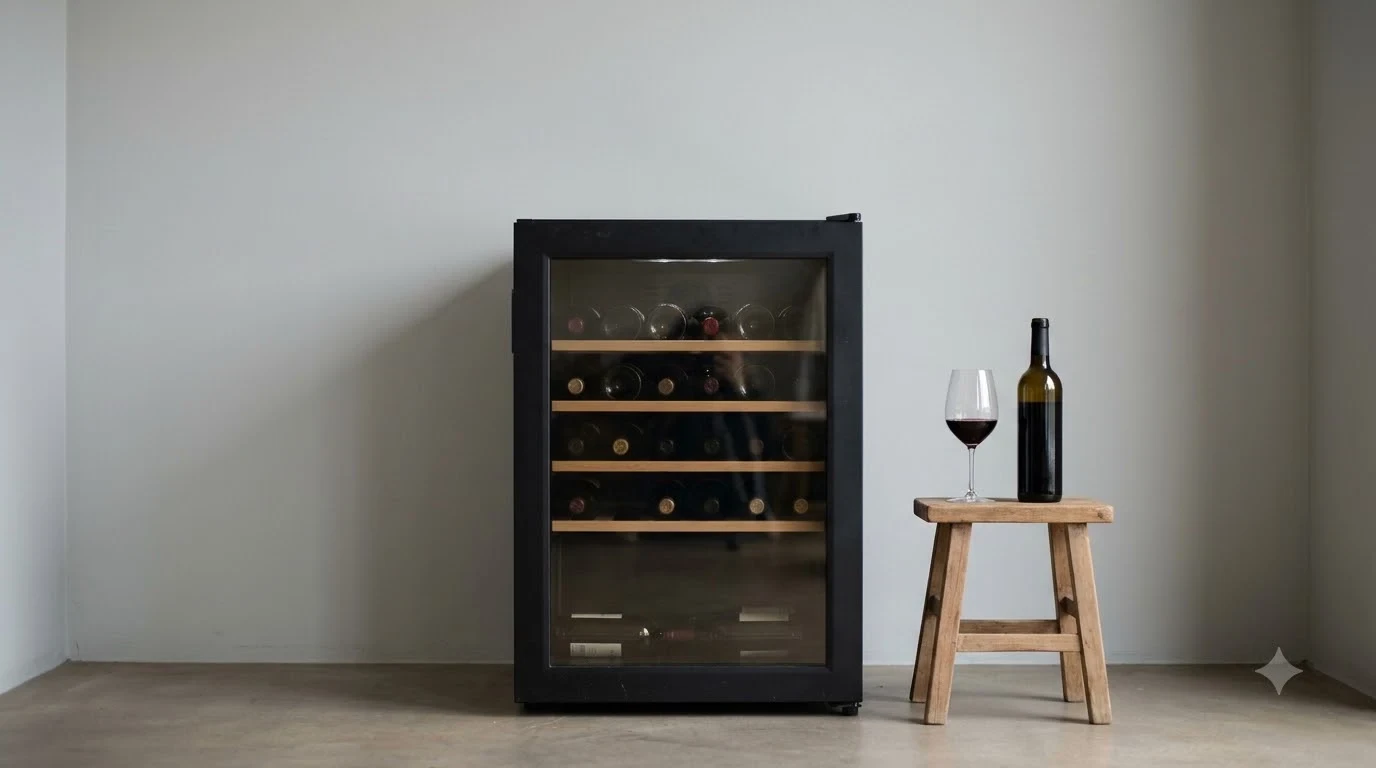
The nutrichef 12 bottle wine fridge is a compact, compressor-cooled wine refrigerator designed for storing up to 12 standard bottles, with adjustable temperatures from 41°F to 64°F. The NutriChef PKCWC12 combines a digital control panel, glass door, interior LED lighting, and chrome storage racks in a relatively narrow freestanding cabinet. Its main attractions are its adjustable cooling range and straightforward storage layout, although its actual capacity depends on bottle shape, and its ventilation requirements make placement more demanding than its slim width initially suggests.
A small wine refrigerator can make sense for an apartment, home bar, dining area, or kitchen where a full-size cellar would take up too much room. The NutriChef PKCWC12 targets that middle ground: more organized than a regular refrigerator shelf, but considerably smaller than a dedicated wine cabinet holding several dozen bottles.
However, a 12-bottle rating does not automatically mean every collection will fit comfortably. Bottle diameter, sparkling wine formats, clearance around the cabinet, and the temperature requirements of different wines all deserve attention before buying. This review examines the specifications, practical advantages, potential frustrations, and alternatives worth considering.
Specs and Key Features of the NutriChef PKCWC12
The PKCWC12 offers a 12-bottle nominal capacity, compressor cooling, and a temperature adjustment range suitable for several common wine styles. Its combination of digital controls and a glass-front cabinet makes it a straightforward option for everyday household wine storage.

NutriChef lists an internal capacity of 32.93 liters and exterior measurements of 9.9 inches wide, 17.7 inches deep, and 31.2 inches high. That unusually narrow profile is an important part of the product’s appeal. It can fit into spaces where a wider refrigerator might be inconvenient, although the required ventilation clearance increases the actual installation footprint.
The cooling system is compressor-based rather than a thermoelectric arrangement. That distinction matters because compressor cooling is generally the more practical choice when a refrigerator needs to maintain a controlled temperature under changing household conditions. It does not mean the appliance is silent or immune to fluctuations, however. The manufacturer includes a circulation fan and ventilation grill, so buyers should expect some operating sound.
The digital control panel provides adjustable temperature settings in either Fahrenheit or Celsius. The manufacturer also specifies a reinforced glass door, an airtight door seal, and interior LED lighting. These features make the unit convenient for checking the collection without repeatedly opening the door.
| Specification | NutriChef PKCWC12 |
|---|---|
| Rated capacity | 12 bottles |
| Internal volume | 32.93 liters |
| Temperature range | 41°F–64°F (5°C–18°C) |
| Cooling technology | Compressor |
| Exterior width | 9.9 inches |
| Exterior depth | 17.7 inches |
| Exterior height | 31.2 inches |
| Standard bottle dimensions supported | 3 inches diameter × 11.9 inches height |
| Storage components | 5 chrome racks and 1 bottom standing rack |
| Power supply | 120 volts |
| Power cable | 6.6 feet |
| Temperature display | Fahrenheit and Celsius |
| Lighting | Interior LED |
| Installation style | Freestanding |
These specifications come from NutriChef’s official PKCWC12 product listing. The dimensions are especially important because the appliance is tall and narrow rather than short and wide. Buyers should measure the intended location carefully, including room for the electrical connection and air circulation.
One particularly useful detail is the standing storage section at the bottom. It offers an alternative to placing every bottle horizontally, although the available space should not be treated as a guarantee that unusually tall or wide bottles will fit.
The product’s advertised capacity is based on standard bottle dimensions. Traditional 750 ml Bordeaux-style bottles are the most sensible reference point when planning storage. Wider Burgundy bottles, sparkling wine bottles, and some specialty packaging may reduce the number that can be accommodated.
What Owners May Appreciate About the Design
The PKCWC12’s strongest selling points are its narrow cabinet, adjustable temperature controls, and organized bottle arrangement. These features address common household storage problems without requiring the space or complexity of a large wine refrigerator.
The slim 9.9-inch width is an obvious advantage for homes with limited floor space. A compact wine cooler can fit beside a kitchen cabinet, near a home bar, or in a suitable dining-area location where a conventional refrigerator would look out of place. Its 31.2-inch height also makes the top surface accessible for routine cleaning and surrounding furniture arrangements.
The digital display makes temperature adjustments easier than relying on a basic mechanical dial. Because the control operates in 1-degree increments, users can select a more appropriate setting for their regular collection instead of choosing between only a handful of preset levels. Switching between Fahrenheit and Celsius also makes the interface convenient for households accustomed to either scale.
The glass door and interior LED light provide another practical benefit. A quick visual inspection can show whether a preferred bottle is available without opening the refrigerator. The light can be switched off when unnecessary, and the manual explains that it automatically shuts off after approximately 10 minutes.
The five chrome racks provide recognizable horizontal bottle storage. This arrangement is useful for keeping bottles organized and limiting unnecessary movement. The separate bottom standing rack adds flexibility for a bottle that is easier to store upright.
A practical choice for a small collection
A 12-bottle refrigerator is particularly appealing to someone who purchases wine in small quantities rather than buying cases. A modest selection might include a few bottles of Cabernet Sauvignon, Pinot Noir, Chardonnay, and Sauvignon Blanc, with some room for a special occasion bottle.
For someone who regularly prepares dinner at home, having wine stored separately from everyday groceries can make meal planning easier. A bottle of Chardonnay can be kept ready for roast chicken, while a softer Pinot Noir can be reserved for mushroom dishes or lighter meat preparations.
The cooler’s 41°F to 64°F adjustment range also provides considerable flexibility for serving different styles. Light whites and rosé generally benefit from colder serving temperatures than full-bodied reds. However, the appliance has only one temperature compartment, so it cannot maintain separate permanent settings for red and white wine simultaneously.
That limitation is important for mixed collections. Someone who wants sparkling wine, crisp white wine, and full-bodied red wine ready at their ideal serving temperatures may prefer a dual-zone refrigerator. The PKCWC12 is better understood as a compact single-temperature storage appliance.
Common Complaints and Practical Limitations
The main potential drawbacks are restricted bottle compatibility, ventilation requirements, and the limitations of a single-temperature compartment. The manufacturer’s troubleshooting instructions also identify several conditions that can affect cooling performance and operating noise.
The first issue is the 12-bottle capacity. It is a useful reference for standard bottles, but it should not be interpreted as a universal capacity for every wine format. Champagne bottles, some sparkling wines, and larger Burgundy-style bottles have different dimensions from conventional Bordeaux bottles.
For example, a collection containing several wide bottles may require rearranging the racks or leaving some positions empty. That can make the refrigerator less convenient for someone who regularly buys different wine styles. Before buying, consider the actual bottle dimensions in the collection rather than relying exclusively on the capacity number.
The second concern is installation space. NutriChef recommends approximately 6 inches of clearance behind the refrigerator and 10 inches on both sides. Although the cabinet is only 9.9 inches wide, these requirements mean it is not a straightforward appliance to squeeze between two tightly fitted cabinets.
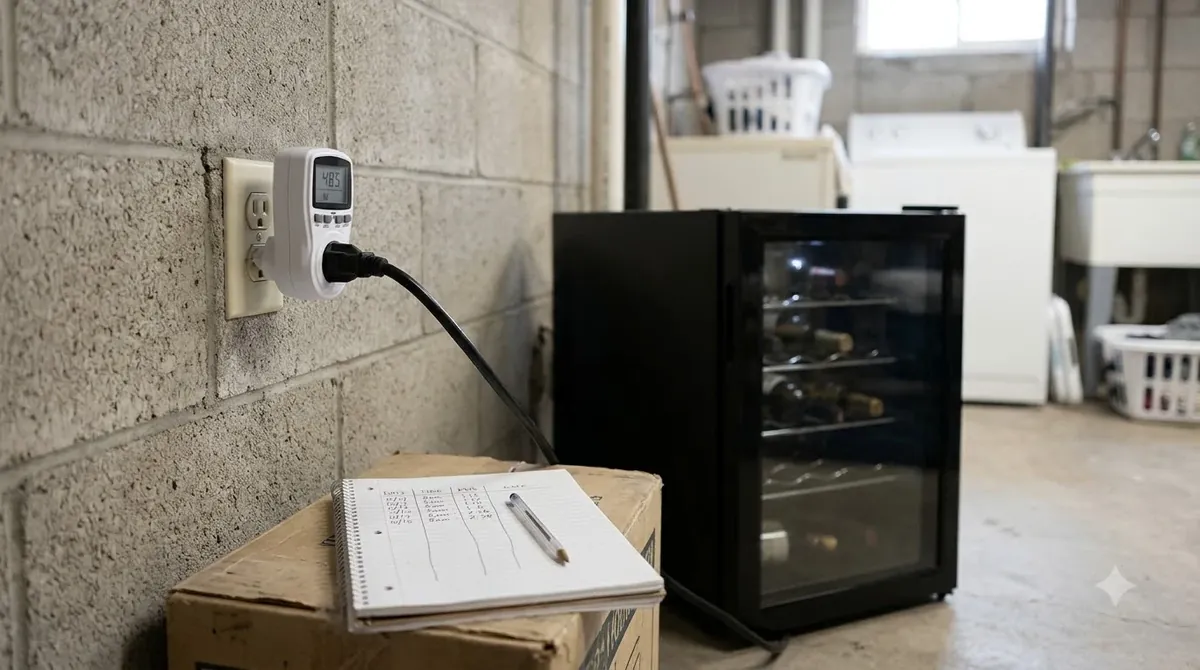
The manual also warns against installing the refrigerator inside a closed cabinet without suitable ventilation. Heat needs to escape from the cooling system, and restricting airflow can affect performance. A location beside an oven, dishwasher, radiator, or another heat-producing appliance is also undesirable.
Noise is another consideration. The manufacturer’s marketing describes quiet operation, but the appliance contains a compressor and circulation fan. Its manual identifies poor leveling and dust accumulation around the fan as possible causes of increased noise. Buyers who expect a completely silent appliance may find this distinction important, especially when placing it in a bedroom-adjacent living area.
Another limitation is the absence of separate temperature zones. Setting the entire cabinet for a crisp white wine may leave a full-bodied red colder than its preferred serving temperature. Conversely, a red-wine-oriented setting may be too warm for a bottle of sparkling wine.
For buyers with a diverse collection, this can become a regular inconvenience. A dual-zone model offers more flexibility, while a single-zone model works best when most stored bottles share similar temperature requirements.
Tip: Do not judge cooling performance immediately after loading several bottles. NutriChef’s troubleshooting guidance recommends allowing up to 24 hours for an overloaded cooler to cool down and stabilize before reassessing its performance. Avoid repeatedly opening the door during this period.
Temperature performance depends on placement
The operating environment can influence how consistently the refrigerator maintains its selected temperature. The manual recommends an installation environment between 60°F and 80°F for normal performance and warns that temperatures outside the recommended range can cause fluctuations.
Direct sunlight is another avoidable problem. A sunny window can increase the heat load on the appliance, making it harder to maintain a stable interior temperature. A shaded, dry, well-ventilated position is a more sensible choice.
The manual also lists frequent door opening, an incompletely closed door, a poor door seal, and excessive loading as possible reasons for insufficient cooling. These are not necessarily evidence of a defective appliance. They are factors worth checking before assuming the refrigerator cannot reach its selected setting.
Who Should Buy the NutriChef PKCWC12 and Who Should Skip It
The PKCWC12 makes the most sense for households with a modest wine collection, available ventilation space, and a preference for straightforward temperature controls. It is less suitable for collectors who regularly store oversized bottles or want different temperatures for different wine categories.
Consider this model if your collection generally contains standard 750 ml bottles and rarely exceeds a dozen at a time. Its compact capacity can help prevent wine from occupying valuable kitchen refrigerator space. The separate wine compartment also makes it easier to maintain an organized collection for casual dinners and entertaining.
It can also appeal to someone setting up a small home bar. The glass front gives the appliance a recognizable wine-storage appearance, while the digital panel allows straightforward adjustments. Its relatively narrow cabinet can be helpful where floor space is limited, provided the surrounding area meets the manufacturer’s clearance requirements.
Buyers who primarily drink one or two wine styles may find the single-temperature design entirely adequate. Someone who usually drinks Chardonnay or Sauvignon Blanc, for example, can select an appropriate setting for that collection without needing multiple zones.
However, serious collectors should consider the capacity carefully. Twelve bottles offer limited room for building a substantial vintage collection. If purchases regularly involve six-bottle or twelve-bottle cases, the available storage can become restrictive quickly.
The same applies to households that frequently entertain. A few bottles of sparkling wine, several whites, and multiple reds can fill the cabinet before the next shopping trip. A larger wine refrigerator provides more flexibility and reduces the need to move bottles elsewhere.
Consider your wine-serving habits
Serving temperature is not identical to long-term storage temperature. The PKCWC12 offers settings that cover a useful range, but a single setting cannot be perfect for every wine.
For example, sparkling wine is generally served at 40°F to 50°F, light whites and rosé at 45°F to 50°F, full-bodied whites at 50°F to 55°F, lighter reds at 55°F to 60°F, and full-bodied reds at 60°F to 65°F.
The cooler’s maximum setting of 64°F makes it suitable for many red-wine serving preferences, while its lower range accommodates chilled white and sparkling wine. Nevertheless, switching settings whenever the collection changes can be inconvenient.
Think about what you actually drink rather than choosing an appliance based solely on its advertised capacity. A smaller refrigerator with an appropriate temperature range may be more useful than a larger model with features you will rarely use.
Food pairing can also influence the wines you keep available. Chardonnay is a familiar choice for chicken dishes, while Pinot Noir can complement mushroom-based recipes. A bottle selected for a dinner featuring chicken Marsala is another reason to maintain a small, accessible selection at home.
How the PKCWC12 Compares to Other NutriChef Models
NutriChef offers other wine refrigerator capacities, including the PKCWC15, PKCWC18, and larger dual-zone products. The PKCWC12 is the smaller-capacity choice, while the alternatives are worth examining if bottle count or separate temperature control matters more than a narrow footprint.
The manufacturer’s product documentation identifies the PKCWC15 as a 15-bottle model and the PKCWC18 as an 18-bottle model. These alternatives offer more nominal storage capacity, which can be useful for households that purchase wine regularly or want room to expand a collection.
The additional capacity does not automatically make a larger model better. A larger refrigerator needs an appropriate installation location and may have different exterior dimensions. Compare the measurements of the exact model before choosing one based on bottle count alone.
NutriChef also lists dual-zone products, including the PKCWCDS188 and PKCWCDS185. The manufacturer’s manual identifies separate upper and lower temperature zones for these models. That arrangement is more appropriate for a collection that includes wines with different storage and serving preferences.
For example, a household that regularly drinks both Cabernet Sauvignon and Sauvignon Blanc may prefer separate zones. One area can be configured for the white wine, while the other can accommodate red wine. This avoids repeatedly changing a single cabinet’s temperature whenever someone wants a different bottle.
The PKCWC12 remains attractive if simplicity and capacity are the main priorities. Its single-zone configuration is easier to understand, and a collection of standard bottles can be organized without managing two different temperature settings.
Another consideration is the difference between nominal capacity and usable capacity. A larger refrigerator can provide additional positions, but unusual bottle shapes may still reduce the number that fit. The same issue applies to the 12-bottle model, so checking the actual rack arrangement is more useful than comparing headline numbers alone.
For a broader look at choosing wine refrigerators by storage capacity and design, the wine refrigerator model reviews category can help put the PKCWC12 into context alongside other appliance options.
Choosing between single-zone and dual-zone storage
Single-zone refrigerators are generally more straightforward for collections that contain mostly similar wines. A dual-zone refrigerator offers greater flexibility, but it introduces another control setting and requires buyers to think about how bottles will be distributed between compartments.
There is no reason to pay for separate zones if almost every bottle in the collection will be kept at the same temperature. On the other hand, a mixed collection containing sparkling wines, crisp whites, and full-bodied reds may benefit considerably from independent temperature control.
For a home bar where cocktails are as important as wine, the storage requirements may be different again. Bottles used for an Aperol Spritz recipe do not necessarily need the same dedicated storage arrangement as a collection of collectible reds. The best appliance depends on what the household actually keeps refrigerated.
Frequently Asked Questions
These answers address additional purchasing and operating details that can help clarify whether the NutriChef PKCWC12 is appropriate for a particular home.
Does the NutriChef PKCWC12 need to stand upright before its first use?
Yes. The manufacturer’s manual recommends leaving the refrigerator upright for approximately 2 hours before connecting it to electricity after transportation. This precaution allows the cooling system to settle after handling and reduces the possibility of startup problems associated with transportation.
Can the NutriChef PKCWC12 be installed inside a kitchen cabinet?
It should not be placed inside an enclosed cabinet without adequate ventilation. The manual specifically warns against restricting airflow and recommends keeping the appliance away from blocked ventilation areas. A properly ventilated installation space is essential even when the refrigerator fits physically between surrounding cabinets.
Does the NutriChef wine cooler require a grounded electrical outlet?
Yes. The manufacturer’s manual specifies a grounded three-pin electrical connection and a standard 110V–60Hz outlet. It also advises against using extension cords and warns users not to remove the grounding connection from the supplied power cord.
Can the PKCWC12 be used in an unheated garage?
Garage installation can be problematic if the surrounding temperature falls outside the manufacturer’s recommended operating conditions. The manual identifies 41°F to 90°F as the broader ambient operating range for compressor cooling and recommends 60°F to 80°F for normal performance. An unheated garage with substantial seasonal temperature changes is therefore not an ideal location.
How should the NutriChef PKCWC12 be cleaned after extended use?
The manual recommends unplugging the appliance and removing its contents and shelves before cleaning. For the interior, it specifies a solution of approximately 2 tablespoons of baking soda mixed with 1 quart of water. The shelves can be washed with mild detergent, while electrical controls should be cleaned carefully without excessive moisture.
The NutriChef PKCWC12 is a practical candidate for households that want compact, compressor-cooled wine storage with digital temperature adjustment and room for a modest collection. Its main compromises are the single-temperature compartment, standard-bottle capacity limitations, and substantial ventilation requirements. If those conditions match your available space and drinking habits, it deserves consideration; buyers with larger or more varied collections should compare NutriChef’s larger and dual-zone alternatives before deciding.
More in Model Reviews
 Magic Chef 44 Bottle Wine Cooler Review for Flexible StorageUpdated Nov 21, 2026
 Whynter 164 Bottle Wine Cooler Review: Capacity, Features, and FitUpdated Nov 21, 2026
 Insignia NS WC16BK6 Review: Compact 16-Bottle Wine StorageUpdated Nov 21, 2026
 Wine Enthusiast Electric Blue Omega Review: Opening, Pouring, and Preserving Made EasierUpdated Nov 21, 2026
 Koolatron 20 Bottle Wine Cooler Review: Features, Fit, and PerformanceUpdated Nov 21, 2026
 NewAir AWC 330E Review for Home Wine StorageUpdated Nov 21, 2026