


We may earn a commission when you buy through links on this page, at no extra cost to you. Learn more.
A Newair wine cooler is a worthwhile option for buyers who want compressor-based wine storage, flexible bottle capacities, and a choice of single-zone or dual-zone designs. The brand offers compact 29-bottle cabinets, larger collection-focused refrigerators, and built-in wine and beverage centers. Its strongest selling points are model variety, practical temperature controls, and installation flexibility, although owner feedback raises questions about long-term reliability and repair experiences. Comparing individual models and warranty terms is more useful than judging the entire brand by one refrigerator.
Newair makes wine refrigerators for different household setups, from small kitchens and apartments to dedicated home bars. Its catalog includes freestanding units, under-counter cabinets, compressor wine fridges, and combination beverage coolers. This brand overview examines the product families, features, owner feedback, and support options to help you decide whether a Newair wine fridge belongs in your home.
Brand Overview: Newair’s Wine Storage Approach
Newair focuses on household cooling appliances, including wine refrigerators designed for different collection sizes and installation requirements. Its wine cooler range includes compact cabinets, larger bottle-storage units, and combination refrigerators that accommodate wine alongside cans and other beverages.
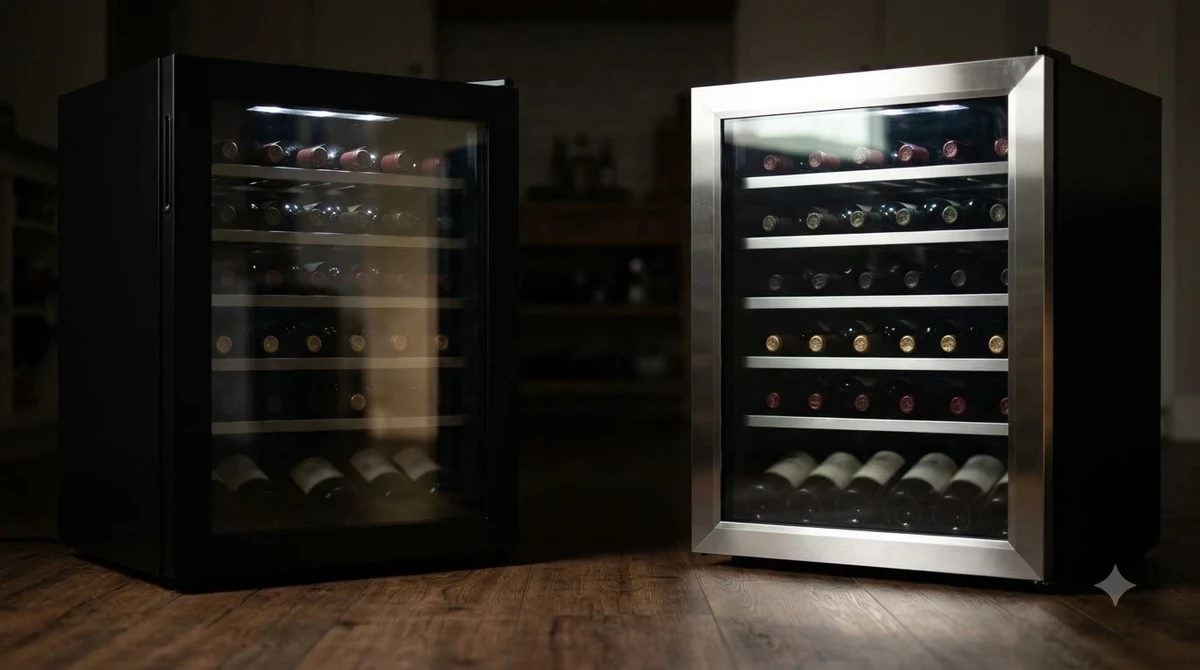
One of the brand’s main advantages is the variety of configurations. A buyer with a small collection can consider a compact 29-bottle cabinet, while someone with more storage requirements can investigate models rated for 76, 98, 116, or 160 bottles. These capacity differences make it important to compare the actual model number rather than assuming every Newair refrigerator has the same construction or features.
Newair also separates its products into built-in, freestanding, and dual-zone categories. Built-in models generally use front ventilation to accommodate under-counter installation, while freestanding refrigerators offer more flexibility in placement. Dual-zone units provide separate temperature controls, making them useful for households that regularly keep different wine styles ready to serve.
The distinction between storage and serving temperature matters. For example, a collection containing Cabernet Sauvignon, Pinot Noir, Chardonnay, and Sauvignon Blanc may benefit from separate compartments because these wines are commonly served at different temperatures. A dedicated wine refrigerator also keeps bottles away from the frequent door openings and food odors associated with a busy kitchen refrigerator.
Newair’s product documentation is another useful part of its brand offering. Its official manual library includes individual documents for numerous wine refrigerator models, including the NWC098SS00, AWR-1160DB, NWC043SS00, and SPWC160SSD0. Buyers can use these documents to identify installation requirements and operating instructions before committing to a particular cabinet.
For shoppers comparing several appliance manufacturers, it also helps to examine alternatives such as Black and Decker, Rovsun, and Galanz. Their product ranges and installation options may differ, so comparisons should focus on equivalent capacity and refrigeration features.
Product Lines Explained: Capacities, Zones, and Configurations
Newair’s wine refrigerator range covers small and large collections, with both single-zone and dual-zone configurations. The most useful starting points are bottle capacity, installation type, and whether the refrigerator stores wine exclusively or combines wine storage with beverage cooling.
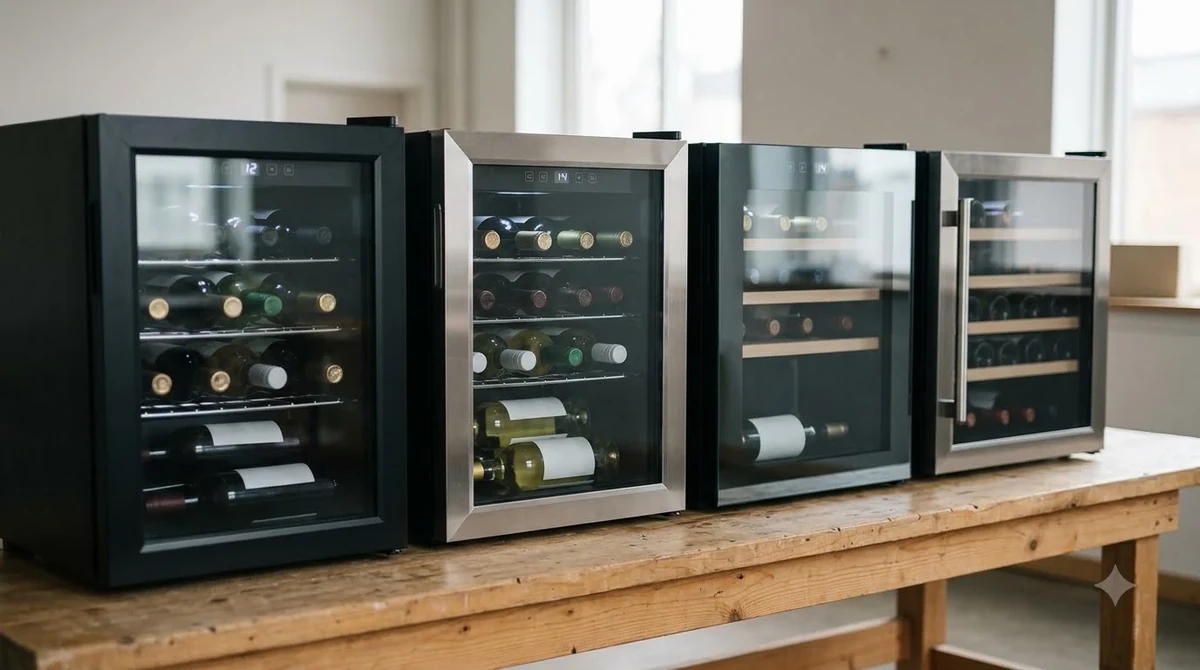
The following table summarizes representative models listed in Newair’s product documentation. These examples illustrate the range rather than suggesting that every model has identical controls, dimensions, or installation requirements.
| Model | Storage or configuration | Notable characteristics |
|---|---|---|
| NWC029BS00 | 29 bottles | Dual-zone compressor wine refrigerator; removable beechwood shelves |
| NWC043SS00 | 43 bottles | Dual-zone wine cooler |
| NWC050SS00 | 50 bottles | Wine refrigerator |
| AWR-520SB | 52 bottles | Single-zone compressor wine cooler |
| NWC076SS00 | 76 bottles | Compressor wine refrigerator |
| NWC098SS00 | 98 bottles | Compressor wine refrigerator |
| AWR-1160DB | 116 bottles | Built-in compressor wine cooler |
| SPWC160SSD0 | 160 bottles | Premium dual-zone wine cooler |
| AWB-365DB | 20 wine bottles and 78 cans | Dual-zone wine and beverage refrigerator |
Compact wine refrigerators
Smaller cabinets are suitable for apartments, compact kitchens, and households that keep a modest selection of bottles. The NWC029BS00 is a useful example. Newair specifies a capacity of 29 standard bottles, a 3.2-cubic-foot internal volume, and a compressor refrigeration system.
The NWC029BS00 measures approximately 14.8 inches wide, 33.75 inches high, and 22.6 inches deep before accounting for its handle. Its listed weight is 74 pounds, so buyers should consider delivery access and the available installation space before ordering. Removable beechwood shelves provide some flexibility for different bottle arrangements.
Large-capacity wine refrigerators
For larger collections, Newair lists refrigerators with capacities extending to 160 bottles. Models such as the NWC098SS00 and AWR-1160DB offer considerably more storage than compact cabinets, while the SPWC160SSD0 adds a dual-zone configuration to the large-capacity category.
These refrigerators make sense for collectors who regularly purchase cases of wine or want to organize bottles by grape variety, region, or drinking window. However, a larger capacity also means a larger physical footprint. Measure the intended location, door clearance, and ventilation space rather than relying only on the advertised bottle count.
Wine and beverage combination units
Combination refrigerators are aimed at households that want wine storage and chilled beverages in one appliance. The AWB-365DB, for example, has separate compartments rated for 20 Bordeaux bottles and 78 standard cans.
Newair specifies seven removable sapele wood shelves for wine and four tempered-glass shelves for beverages. The design also features French doors, a VinoRest bottle holder, and three LED lighting options. This arrangement is particularly useful for home bars where wine bottles, sparkling wine, cans, and other refreshments share the same storage area.
Product capacities are based on standard bottle and can arrangements. Larger Champagne bottles, Burgundy bottles, and unusually shaped bottles may reduce the practical number of bottles that fit. Consider the shapes in your collection before treating the advertised maximum as your everyday capacity.
Buyers exploring other manufacturers can browse our wine and appliance brand hubs for additional comparisons.
What the Brand Does Well: Cooling, Design, and Flexibility
Newair’s strongest features are its range of storage formats, separate temperature zones on selected models, and installation flexibility. These features address practical household needs rather than relying solely on decorative details.
Dual-zone cooling is especially useful for households that keep red and white wines available simultaneously. A single-zone refrigerator maintains one general temperature throughout its interior, whereas a dual-zone cabinet has separately controlled compartments. This allows owners to organize wines according to their preferred storage or serving temperatures.
For example, a wine enthusiast might keep Sauvignon Blanc and Riesling in a cooler compartment while reserving a warmer setting for Cabernet Sauvignon or Syrah. A practical serving reference is 45–50°F for light white wines and 60–65°F for fuller-bodied reds. These are serving ranges rather than universal long-term storage targets, but they illustrate why separate compartments can be convenient.
Flexible installation
Newair offers both built-in and freestanding refrigerators. Some models feature front-venting compressors and flush-hinge designs that accommodate installation beneath a counter. This is important because a refrigerator designed for freestanding use should not automatically be placed inside enclosed cabinetry.
Before buying a built-in model, measure the opening in three directions: width, height, and depth. Include space for the electrical connection, door movement, and any clearance specified in the installation instructions. Front ventilation is a significant advantage, but the manufacturer’s specified installation dimensions still matter.
Practical shelving and interior lighting
Wooden shelves are a familiar feature in wine cabinets because they support horizontal bottle storage and give the interior a traditional appearance. Newair uses beechwood shelving on the NWC029BS00 and sapele wood shelving on the AWB-365DB. Some models also have removable or adjustable shelves for larger bottles.
The AWB-365DB adds three lighting choices: midnight blue, warm amber, and soft white. Its double-paned glass doors provide a view of the interior while contributing to the cabinet’s insulated construction.
Owner feedback for the AWR-520SB also identifies several positive characteristics. Lowe’s review summary highlights quiet operation, temperature stability, storage space, and installation flexibility as recurring advantages. Those comments suggest that Newair can offer a satisfying everyday experience, although they should not be treated as proof that every model performs equally well.
Compressor refrigeration
Many Newair wine refrigerators use compressor cooling. According to the manufacturer’s support information, compressor models can reach colder temperatures and perform better in warmer rooms than thermoelectric alternatives.
This makes compressor refrigeration a sensible option for households where the wine refrigerator will operate in a kitchen, dining area, or other room with changing ambient temperatures. However, compressors can produce operating sounds and vibration, so placement and leveling remain important considerations.
Tip: If you plan to install a Newair wine refrigerator under a counter, choose a model explicitly designed for built-in installation. Confirm front-venting requirements and cabinet dimensions before purchasing. A freestanding refrigerator should not be enclosed simply because its exterior measurements fit the opening.
Common Complaints: What Newair Wine Cooler Reviews Reveal
Newair wine cooler reviews show a mixed ownership picture. Some customers appreciate the appearance, storage capacity, and temperature controls, while others report cooling failures, component problems, or difficulties obtaining satisfactory service.
One recurring concern in retailer feedback is long-term cooling reliability. Home Depot reviews for the NWC028SS01 include reports of refrigerators that stopped cooling after approximately one to two years. Some owners describe temperature-sensor problems, while others report units that stopped operating shortly after the warranty period.
These reports deserve attention, particularly because a wine refrigerator is expected to operate continuously. However, individual complaints do not establish the failure rate across the entire brand. They should be considered alongside the positive feedback and the specific model’s warranty coverage.
Cooling and temperature-control concerns
A wine refrigerator that stops maintaining its selected temperature can create problems for an entire collection. Some owner reports describe cooling failures, unresponsive controls, or refrigerators that no longer restart after being unplugged.
Before purchasing, look for feedback about the exact model rather than relying on reviews for another Newair refrigerator. A 29-bottle dual-zone model and a 98-bottle compressor refrigerator have different internal layouts and potentially different components.
It is also useful to distinguish between a temperature-control issue and an installation problem. Insufficient ventilation, a poorly leveled cabinet, or an unsuitable room environment can affect cooling performance. A buyer should establish that the installation conditions match the manufacturer’s requirements before assuming the appliance itself is defective.
Noise and construction feedback
Some Newair owners praise quiet operation, particularly in reviews of the AWR-520SB. Other customers have mentioned shelf construction, adjustable feet, or delivery damage. This variation makes it sensible to inspect the refrigerator immediately after delivery.
Check that the door closes properly, shelves slide into their supports, and the cabinet stands level. Listen for unusual buzzing or rattling after the compressor begins operating. A refrigerator may make normal cooling sounds, but persistent mechanical noise deserves attention.
Customer service experiences
Feedback about Newair’s customer support is also mixed. Trustpilot includes positive accounts from customers who received assistance locating replacement parts for older wine refrigerators. Other reviewers describe delayed communication or problems resolving delivery and service issues.
Retailer reviews also show that Newair representatives sometimes respond to complaints by offering further assistance. That is useful, but a public response does not guarantee that every repair will be completed or that every replacement request will be approved.
The most sensible approach is to investigate the return policy, warranty, and service process before buying. A refrigerator that looks attractive and offers the right capacity may still be a poor purchase if local service or replacement options are difficult to arrange.
How to Choose a Newair Wine Cooler Model
The best Newair wine fridge depends on the size of your collection, your installation space, and how you organize your wines. Buyers should compare capacity, refrigeration type, temperature zones, shelf configuration, and electrical requirements before selecting a model.
1. Estimate your actual bottle requirements
Start with the number of bottles you currently own and how quickly your collection grows. A 29-bottle refrigerator may suit someone who buys wine occasionally, while a 76- or 98-bottle cabinet provides more room for regular purchases.
Do not automatically select the largest available refrigerator. A cabinet that remains mostly empty takes up unnecessary space, while an undersized refrigerator can force you to store bottles elsewhere. Leave some spare capacity for new purchases and different bottle shapes.
2. Decide between single-zone and dual-zone cooling
Single-zone refrigerators are suitable for buyers who want one consistent temperature across their collection. They are straightforward and can be a good fit when most bottles are similar in style or are intended for longer-term storage.
Dual-zone refrigerators offer separate settings for different categories of wine. They are especially useful if you regularly serve both red and white wines. The NWC029BS00 and NWC043SS00 are examples of Newair dual-zone wine refrigerator models.
3. Match the refrigerator to the installation location
Measure the available space before ordering. For a kitchen island or under-counter location, prioritize a model with front ventilation and manufacturer-approved built-in installation. For a dining room, pantry, or home bar, a freestanding model may offer more placement flexibility.
Pay attention to the door swing and handle depth. A cabinet that fits the opening but cannot open fully is inconvenient, especially when shelves need to slide out for cleaning or bottle access.
4. Examine bottle compatibility
Standard Bordeaux bottles are the usual basis for advertised capacity figures. Burgundy bottles and Champagne bottles can have wider bodies, and sparkling wine bottles may not fit every shelf arrangement.
Newair’s support guidance specifically mentions that Champagne bottles may require shelves to be adjusted or removed. If your collection includes many sparkling wines or larger-format bottles, inspect the shelf spacing before purchasing.
5. Compare operating requirements
Check the electrical specifications, ventilation instructions, and ambient-temperature requirements for the exact model. The NWC029BS00, for example, is listed with a 120-volt supply, 90-watt rating, and 60-Hz frequency.
Also consider the room in which the refrigerator will operate. Compressor models are generally better suited to warmer environments than thermoelectric models, according to Newair’s own support guidance. Neither type should be installed in conditions outside its specified operating range.
6. Read reviews for the exact model
Search for the full model number rather than simply entering Newair wine fridge reviews. This helps separate feedback about different refrigerator designs and production configurations.
Look for repeated comments about cooling consistency, noise, shelf durability, delivery condition, and customer support. A single positive or negative review provides limited information; recurring themes across multiple owners are more useful.
Finally, compare warranty coverage and return conditions. The convenience of a dual-zone refrigerator is less valuable if a cooling failure becomes difficult or expensive to resolve.
Warranty and Support: Finding Manuals and Getting Help
Newair provides an online support center, product registration information, and a searchable manual library. These resources are particularly useful when setting up a new wine refrigerator, troubleshooting temperature issues, or preparing a warranty request.
Finding a Newair wine cooler manual
The easiest way to locate a Newair wine cooler manual is to search the manufacturer’s product-manual page using the model number. The library includes documents for products such as the NWC098SS00, NWC076SS00, NWC043SS00, NWC029BS00, and AWR-1160DB.
Using the exact model number matters because similar-looking refrigerators can have different control panels, shelf arrangements, temperature ranges, and installation instructions. A manual for another model should not be treated as a substitute.
The manual normally provides useful information about initial setup, temperature adjustment, electrical requirements, cleaning, and troubleshooting. Keep a copy of the document somewhere accessible after installation.
Start with the manufacturer’s Newair product manuals and model lookup when you need operating instructions or technical information.
Warranty coverage
Newair’s current website advertises a two-year warranty, and its support center instructs customers seeking warranty service within that coverage period to contact the support team for diagnostics and return merchandise authorization.
Buyers should confirm the warranty terms applicable to the specific refrigerator and purchase channel. Coverage conditions, proof-of-purchase requirements, exclusions, and return arrangements can affect how a claim is handled.
Do not assume that every repair will be covered indefinitely. Owner reports include examples of refrigerators developing problems after the original warranty period, which makes the exact coverage particularly important for a continuously operating appliance.
Contacting customer support
Newair lists the following support channels:
- Telephone: 1-855-963-9247
- Email: [email protected]
- Online support: Live chat through the manufacturer’s website.
The support page states that email responses are generally expected within 24 hours during normal business hours, Monday through Friday, from 8 a.m. to 4 p.m. Pacific Time. Response times can vary, so this should be treated as the manufacturer’s stated service expectation rather than a guarantee of immediate resolution.
When contacting support, prepare the model number, serial number, purchase documentation, and a description of the problem. Photographs or a short video showing an error message, damaged component, or unusual operating noise may also help explain the issue.
For official contact details and warranty-service instructions, use the Newair customer support center.
Owners should avoid attempting electrical or compressor repairs without appropriate qualifications. If the refrigerator stops cooling, follow the model-specific troubleshooting instructions and contact the manufacturer or an appropriate appliance technician.
Frequently Asked Questions
Is Newair considered a premium wine refrigerator brand?
Newair occupies the household appliance and wine-storage market rather than specializing exclusively in professional cellar equipment. Its range includes decorative glass-door cabinets, built-in refrigerators, and large-capacity storage units. Buyers seeking commercial cellar systems should compare specialist refrigeration equipment as well.
Can Newair wine coolers maintain humidity for cork storage?
Newair’s general wine refrigerator descriptions emphasize temperature control rather than a separately adjustable humidity system. Buyers concerned about humidity should ask support for the exact model’s humidity specifications before purchase. A temperature-controlled cabinet should not automatically be assumed to provide precise humidity regulation.
Can a Newair wine refrigerator be transported while lying down?
Transport instructions depend on the individual refrigerator and its compressor design. Keep the unit upright whenever possible and consult the model’s manual if horizontal transportation cannot be avoided. The manual should also explain the required waiting period before reconnecting power after transportation.
Do Newair wine refrigerators have replacement shelves available?
Replacement-part availability can vary by model and component. Contact Newair support with the complete model number and a description of the shelf you need. Ask whether the replacement is sold individually or as part of a larger shelf assembly before ordering.
Are Newair wine refrigerators suitable for aging collectible wine?
Some Newair compressor models provide the temperature-controlled storage needed for a household collection, but serious long-term aging also depends on stable conditions, vibration, light exposure, and humidity. Check the exact model’s operating specifications and environmental requirements. A dedicated wine cellar may be more appropriate for particularly valuable collections or extensive aging programs.
Newair offers a broad selection of wine refrigerators, from compact dual-zone cabinets to large-capacity built-in models and combination beverage centers. Its flexible designs and available product documentation make the brand worth considering, but mixed owner feedback means reliability, service, and warranty terms deserve careful attention. Choose according to your actual collection size and installation requirements, and compare reviews for the exact model before making a purchase.
More in Brand Hubs
 Icyglee Wine Fridge: Compare Capacities, Features and ModelsUpdated Nov 20, 2026
 Fomup Wine Fridge: Explore Models, Features, and Buying TipsUpdated Nov 20, 2026
 Aaobosi Wine Fridge: Compare Models and Choose the Right CoolerUpdated Nov 20, 2026
 Orymuse Wine Fridge Reviews: Compare Capacities, Features and WarrantyUpdated Nov 20, 2026
 Tylza Wine Fridge: Find the Right Cooler for Your CollectionUpdated Nov 20, 2026
 Vintec Wine Fridge: Features, Warranty, and Buying AdviceUpdated Nov 20, 2026