

We may earn a commission when you buy through links on this page, at no extra cost to you. Learn more.
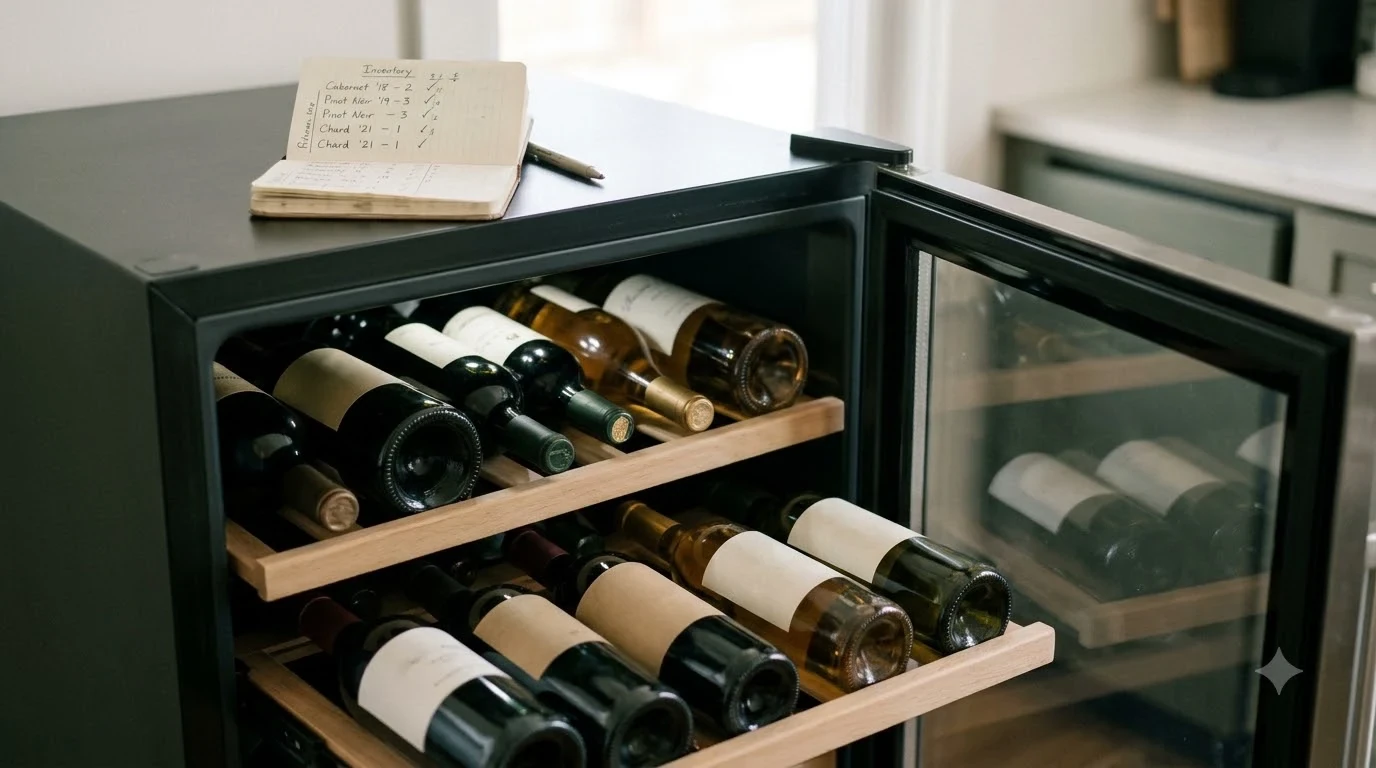
newair wine fridge repair usually starts with the model number, a power check, and a review of airflow, temperature settings, and the door seal—not an immediate compressor replacement. Newair makes both thermoelectric and compressor wine coolers, and their operating limits and service needs are not identical. A few safe checks can resolve common setup and airflow problems, while electrical controls, fans, and sealed refrigeration components call for qualified service.
A wine cooler that runs without reaching its set temperature can put a collection at risk, but the symptom alone does not identify the failed part. Work through the checks below in order, record what the cabinet is doing, and use the manual for the exact model before removing panels or ordering replacement parts.
Newair Wine Fridge Repair Starts With the Exact Model
The model number determines which manual, temperature range, and installation instructions apply. Newair’s thermoelectric NWC06TBK00, NWC08TBK00, and NWC12TBK00 models are compact freestanding units, while the NWC098SS00 is a 98-bottle compressor model with two temperature zones.
Find the rating label and record the full model and serial numbers. Similar-looking Newair coolers can use different cooling systems, controls, vent locations, and replacement components, so photograph the label and keep the receipt before moving the appliance.
Use the model number to open the matching document in Newair’s product-manual library. Read the installation, operation, cleaning, troubleshooting, and warranty sections rather than relying on instructions for a different Newair cooler. The manuals for the compact thermoelectric models, for example, specify a 46–65°F control range and freestanding installation; the NWC098SS00 manual describes a separate dual-zone arrangement.
This distinction matters because a thermoelectric cabinet does not have the compressor and sealed refrigerant circuit found in a compressor-based model. Check the model first, then compare symptoms with the correct troubleshooting chart.
Check Power, Controls, and Temperature Recovery
Start with the simplest causes: power supply, control settings, and enough time for the cabinet to cool. Newair’s manuals list an unplugged cord, a switched-off control, a tripped breaker, a blown fuse, and an incorrect temperature setting among the first causes to rule out.
Confirm that the plug is firmly seated and the outlet works. Check the home’s breaker panel for a tripped circuit, but do not open the electrical compartment or remove the control panel. Stop using the unit if the cord or outlet is hot, damaged, sparking, or smells burned.
Next, verify that the cooler is switched on and that the desired setpoint is appropriate for the specific model. The compact NWC06TBK00, NWC08TBK00, and NWC12TBK00 models allow settings from 46°F to 65°F. The NWC098SS00 manual gives each zone a 40°F to 65°F range, so its controls should be checked independently rather than treating the display as one shared thermostat.
Allow for recovery after a restart, a large bottle load, or a prolonged door opening. A cabinet cannot chill warm bottles instantly, and repeated door checks release cold air. On the NWC098SS00, wait 3 to 5 minutes after unplugging or losing power before restarting; other models may have different instructions. Record the setpoint and actual temperature with a separate refrigerator thermometer, then recheck after several hours without repeatedly opening the door. Keep the thermometer in the same central location, away from the door and cooling surfaces, so readings are comparable. A momentary screen change after adjusting a target does not prove that the bottles have reached that temperature. A normal display with rising cabinet temperature is a different clue from a blank screen or unresponsive buttons.
Tip: Move valuable bottles to a stable storage location if the cabinet temperature keeps rising. Keep the door closed while you arrange diagnosis, and note the cabinet temperature and the time of each reading for the technician.
Restore Airflow and Check the Door Seal
Restricted ventilation and a door that leaks room air are common reasons a wine fridge struggles to hold its setpoint. Before assuming a component has failed, check the installation space, front or rear grille, internal vents, bottle placement, and gasket for the exact model.
The thermoelectric NWC06TBK00, NWC08TBK00, and NWC12TBK00 manual specifies a dry room between 60°F and 75°F, 5 inches of rear and side clearance, and 2 inches of ground clearance. These models are freestanding-only; do not push one into a cabinet or cover its vents. Look for dust, furniture, or stored items blocking a grille, keep bottles away from internal air passages, and note whether only one zone is warmer on a dual-zone cabinet. Compressor models may have different clearance rules.
Inspect the gasket around the full door perimeter for twists, tears, hardened areas, or gaps. Clean it with a soft cloth and mild soap, then dry it. Make sure shelves are seated and bottles do not block the door. Replace a damaged seal with the correct model part rather than using a makeshift strip.
Use the following table to separate owner-level checks from symptoms that deserve service. The temperature and clearance figures are model-specific, not universal settings for every Newair cooler. Newair’s manuals list frequent door opening, a damaged seal, a hot room, and poor clearance as causes of weak cooling; the wine storage and care resources explain how stable conditions support a collection after the appliance is working again.
| Model or symptom | Published specification or clue | First check |
|---|---|---|
| NWC06TBK00 | 46–65°F; 6-bottle thermoelectric unit | Confirm setpoint and freestanding ventilation |
| NWC08TBK00 | 46–65°F; 8-bottle thermoelectric unit | Check rear and side clearance and room temperature |
| NWC12TBK00 | 46–65°F; 12-bottle thermoelectric unit | Check fan operation and door closure |
| NWC098SS00 | 40–65°F per zone; 98-bottle compressor model | Check both zone settings and clear the vents |
| Temperature continues rising | Possible airflow, gasket, fan, sensor, control, or sealed-system fault | Move wine to stable storage and arrange diagnosis |
Know Whether the Cooler Is Thermoelectric or Compressor-Based
The cooling technology changes what noises are normal and which failures are plausible. Newair describes thermoelectric models as quieter, lower-vibration units suited to cooler environments, while compressor models can reach colder temperatures and handle warmer rooms more effectively.
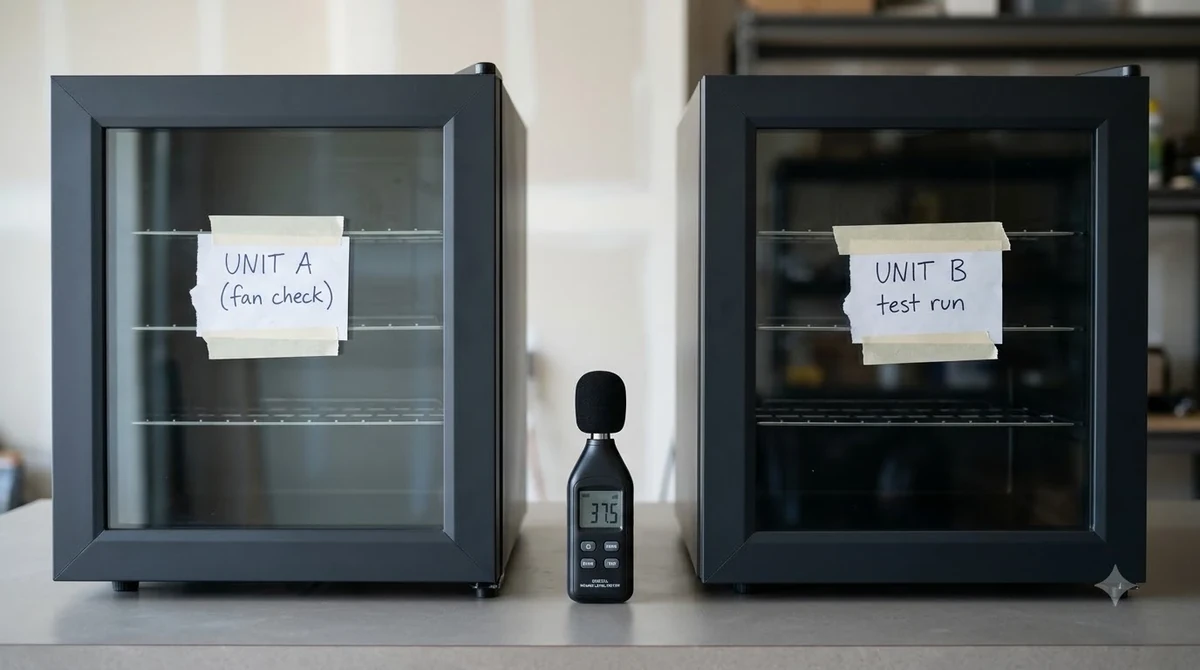
Compact thermoelectric coolers move heat through a solid-state module and rely on fans and surrounding airflow. The NWC06TBK00, NWC08TBK00, and NWC12TBK00 manuals identify room heat, clearance, and fan operation as key checks. A compressor diagnosis does not apply to this design.
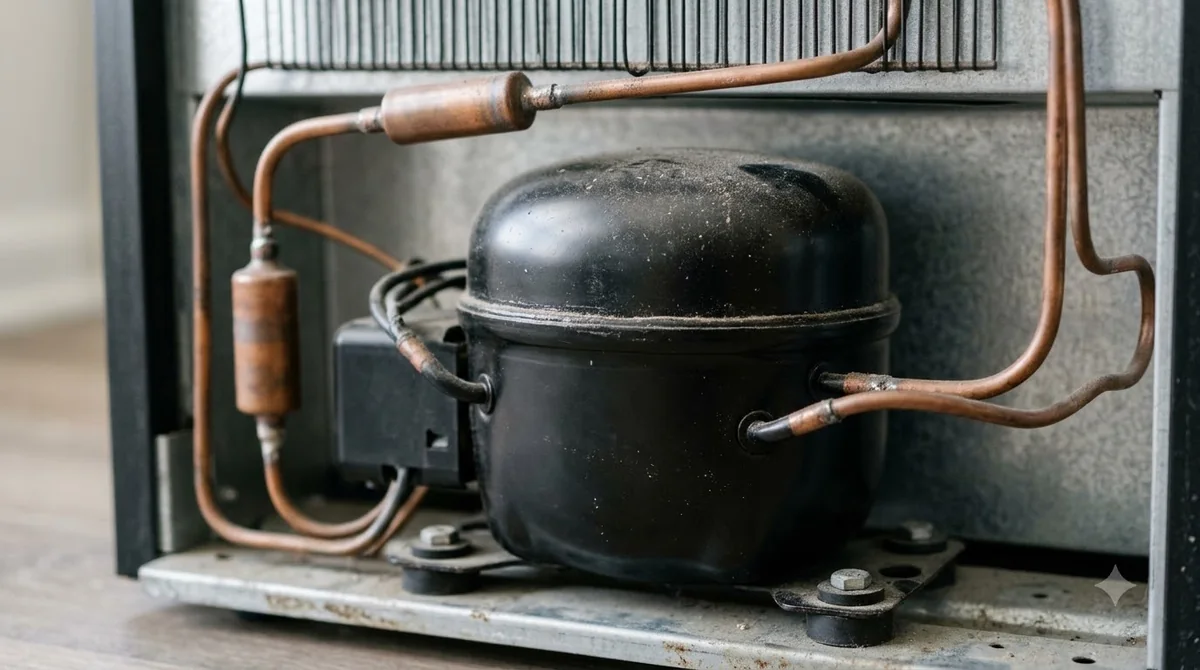
A compressor wine fridge has a refrigeration circuit and may make a low hum, start-and-stop sound, or brief fluid noise during normal operation. The NWC098SS00 is identified by Newair as a compressor model. If it clicks repeatedly, runs continuously without cooling, becomes unusually hot, or loses temperature in one or both zones, record those symptoms and arrange professional diagnosis rather than opening the sealed system.
After clearing a vent or closing a door, give the cabinet time to recover. No improvement, erratic readings, or a failed fan points toward a component that needs testing. The NWC098SS00 manual says the lower zone setting must be the same as or higher than the upper zone, with at least a 4°F difference for optimal performance. Record both displayed temperatures and readings inside each zone if the cabinet will not hold its settings. Do not replace a compressor, cooling module, sensor, or circuit board based only on sound.
Interpret Noise, Frost, Leaks, and Display Problems
Some operating sounds are normal, but a new or persistent noise combined with poor cooling deserves attention. Newair’s NWC098SS00 manual describes faint humming, gurgling as refrigerant circulates, and occasional popping or crackling from the cabinet walls as sounds that can occur during normal operation.
Make sure the cooler is on a firm, level surface; an uneven cabinet can vibrate or prevent the gasket from sealing. Secure the feet and check for rattling shelves or bottles. Note when a new scraping, repeated clicking, severe rattle, or loud fan noise occurs: a failing fan can reduce cooling, while a compressor that clicks without settling into normal operation needs service. Never reach through a grille toward a moving fan, and disconnect power before manual-approved cleaning.
Frost inside a compact thermoelectric unit may indicate high humidity, frequent door opening, or a defrost issue. Its manual says to unplug the unit, let ice melt fully, dry the interior, and restart it; do not chip ice with a tool or apply a heat gun. For water under or inside the cabinet, check for a spill, condensation, or an ajar door, then dry the floor. If moisture returns, appears near electrical components, or accompanies cooling failure, arrange service.
A blank display, error message, or unresponsive button can point to a sensor, wiring, control panel, or circuit-board problem. Confirm outlet power and check the exact model manual; codes are not universal across Newair products. If basic checks do not restore the display, contact Newair or a qualified technician.
Protect the Warranty and Prepare for Professional Service
Before arranging a paid repair, establish whether the cooler is covered. Newair’s support page directs customers seeking service within its advertised 2-year coverage to support for diagnostics and an RMA, while the manuals for the NWC06-series and NWC098SS00 describe a 1-year limited warranty. Terms can vary by model and purchase documentation, so check the receipt, model manual, and written warranty. Ask whether opening the cabinet or using a third-party part could affect coverage before authorizing work; a damaged power cord must be replaced by the manufacturer, a service agent, or a similarly qualified person.
Newair lists support at 1-855-963-9247 and [email protected]. Its contact page gives normal hours as Monday through Friday, 8 a.m. to 4 p.m. Pacific Time, and says email responses are expected within 24 hours during business hours. Use Newair’s support center for model-specific guidance. Have the model and serial numbers, purchase date, receipt, setpoint, cabinet and room temperatures, affected zones, run time, and any fan or compressor sounds ready; photos of the display and rating plate can also help.
Ask whether the work involves a fan, sensor, control board, compressor, or sealed refrigeration system. Sealed-system repairs require specialist tools and refrigerant handling; never cut tubing, add refrigerant, bypass a safety device, or test exposed wiring yourself. For comparison, see the Allavino repair guide, Zephyr repair guide, and Marvel repair guide. After repair, keep vents clear, wipe spills promptly, inspect the gasket, and avoid leaving the door open. Newair’s NWC098SS00 manual recommends cleaning the unit, including its front grille and back, at least once a year. Record cleaning dates and temperature checks to spot gradual changes early.
Frequently Asked Questions
How long should a new thermoelectric Newair cooler stand before it is plugged in?
The NWC06TBK00, NWC08TBK00, and NWC12TBK00 manual says to leave the unit upright for 2 hours before plugging it in. This setup instruction is specific to that manual’s models, so owners of other Newair coolers should follow the preparation instructions supplied with their own unit.
What electrical rating does the compact NWC06-series manual list?
The manual lists 110–120 volts AC, 60 hertz, 0.95 amps, and 60 watts for the NWC06TBK00, NWC08TBK00, and NWC12TBK00. Use a properly grounded outlet that matches the rating plate, and direct questions about household wiring to a qualified electrician.
How much weight can a shelf in the NWC098SS00 hold?
Newair’s NWC098SS00 manual gives a maximum shelf load of 55 pounds. It also advises pulling out only one shelf at a time, which reduces the chance of tipping or putting excessive strain on the extended shelf assembly.
Will a short power outage always damage the wine inside?
The NWC098SS00 manual says an outage corrected within a few hours should not affect the cabinet temperature when the door is opened as little as possible. If power will remain off longer, move the bottles to another stable storage location rather than repeatedly opening the cooler to check them.
What should I do before moving a Newair wine fridge for service?
For the NWC098SS00, the manual says to remove the bottles, secure loose shelves, raise the adjustable leg to the base, tape the door shut, and keep the unit upright during transport. Protect the exterior with a blanket or similar covering, and confirm the moving instructions for the exact model before transporting it.
A Newair wine fridge that will not cool may need no more than a corrected setting, clear ventilation, or a properly closing door, but persistent warming, control faults, and abnormal mechanical symptoms deserve qualified diagnosis. Match every check to the model, protect the bottles while the cabinet is unstable, and keep the manual and service record with the appliance.
More in Storage & Fridge Care
 How Long Can You Store Wine in a Wine Fridge? Protect Bottle QualityUpdated Nov 20, 2026
 Can You Store Beer in a Wine Fridge? Keep Both Drinks FreshUpdated Nov 20, 2026
 Is It Worth Repairing a Wine Fridge? Spot the Cheap Fixes Before You ReplaceUpdated Nov 20, 2026
 Wine Fridge Condensation: Identify Causes and Fix Moisture ProblemsUpdated Nov 20, 2026
 Wine Fridge Too Cold: Protect Your Wine and Fix the TemperatureUpdated Nov 20, 2026
 How to Reset Wine Fridge: Restore Cooling and SettingsUpdated Nov 20, 2026