

We may earn a commission when you buy through links on this page, at no extra cost to you. Learn more.
The Newair dual zone wine fridge is a practical option for wine drinkers who want separate temperature settings for red and white wines in a compact, under-counter-friendly refrigerator. The 29-bottle Newair AWR-290DB is particularly appealing for smaller kitchens, home bars, and collections that need more flexibility than a standard beverage refrigerator provides. Its two temperature zones, adjustable beechwood shelves, digital controls, and locking door are attractive features, although advertised bottle capacity, installation clearance, and long-term reliability deserve careful consideration before purchasing.
A dedicated wine refrigerator can make everyday wine storage considerably easier, especially if your collection includes everything from crisp Sauvignon Blanc to fuller-bodied Cabernet Sauvignon. Newair offers several dual-zone configurations, but the 29-bottle AWR-290DB provides a useful example of what the company’s compact wine-storage approach looks like. This review examines its specifications, owner feedback, practical advantages, and limitations to help determine whether it deserves a place in your kitchen or entertaining space.
Specs and Key Features
The Newair AWR-290DB combines a narrow cabinet, compressor cooling, and two independently adjustable temperature zones. Its most attractive feature is the ability to keep different wine styles in separate compartments without dedicating an entire room or large appliance to wine storage. The manufacturer’s AWR-290DB product specifications provide the model-specific details buyers should use when comparing refrigerators.
The manufacturer specifies a 29-bottle capacity and a 3.2-cubic-foot interior. Its stainless steel exterior, digital display, removable racks, and interior LED lighting give it the appearance of a dedicated wine appliance rather than a converted beverage refrigerator. The relatively narrow cabinet is particularly useful in kitchens where a full-width wine cooler would consume too much valuable storage space.
| Specification | Newair AWR-290DB |
|---|---|
| Product type | Dual-zone compressor wine refrigerator |
| Advertised capacity | 29 standard wine bottles |
| Interior volume | 3.2 cubic feet |
| Upper temperature range | 40°F–50°F |
| Lower temperature range | 50°F–66°F |
| Width | 14.8 inches |
| Depth | 22.6 inches |
| Height | 33.75 inches |
| Power consumption | 90 watts |
| Electrical supply | 120 volts |
| Cooling technology | Compressor |
| Wine racks | 5 removable racks |
| Temperature controls | Digital push-button controls |
| Interior lighting | LED |
| Door | Locking glass door |
| Listed weight | Approximately 70 pounds |
These specifications make the AWR-290DB a relatively compact choice for a dedicated wine refrigerator. The 14.8-inch width is especially important because it opens up installation possibilities that are unavailable with many larger 24-inch appliances. However, the listed dimensions are only a starting point. Door movement, handle projection, electrical access, and the manufacturer’s required ventilation clearances also affect whether the appliance will fit comfortably in a particular space.
The temperature arrangement is straightforward. The upper compartment operates between 40°F and 50°F, while the lower compartment operates between 50°F and 66°F. This division supports the common household arrangement of keeping white wines cooler than red wines, although the best setting depends on the style and intended serving temperature of each bottle.
Another important distinction is that this review focuses on the AWR-290DB. Newair also sells other dual-zone appliances, including larger wine refrigerators and combination wine-and-beverage coolers. Their capacities, temperature ranges, and dimensions are not interchangeable. Buyers should identify the precise model before comparing specifications or ordering replacement components.
What Owners Like
Owner feedback highlights the compact cabinet, separate temperature controls, and attractive appearance as important advantages. The AWR-290DB is designed for households that want dedicated wine storage without giving up an entire kitchen cabinet or creating a separate cellar.
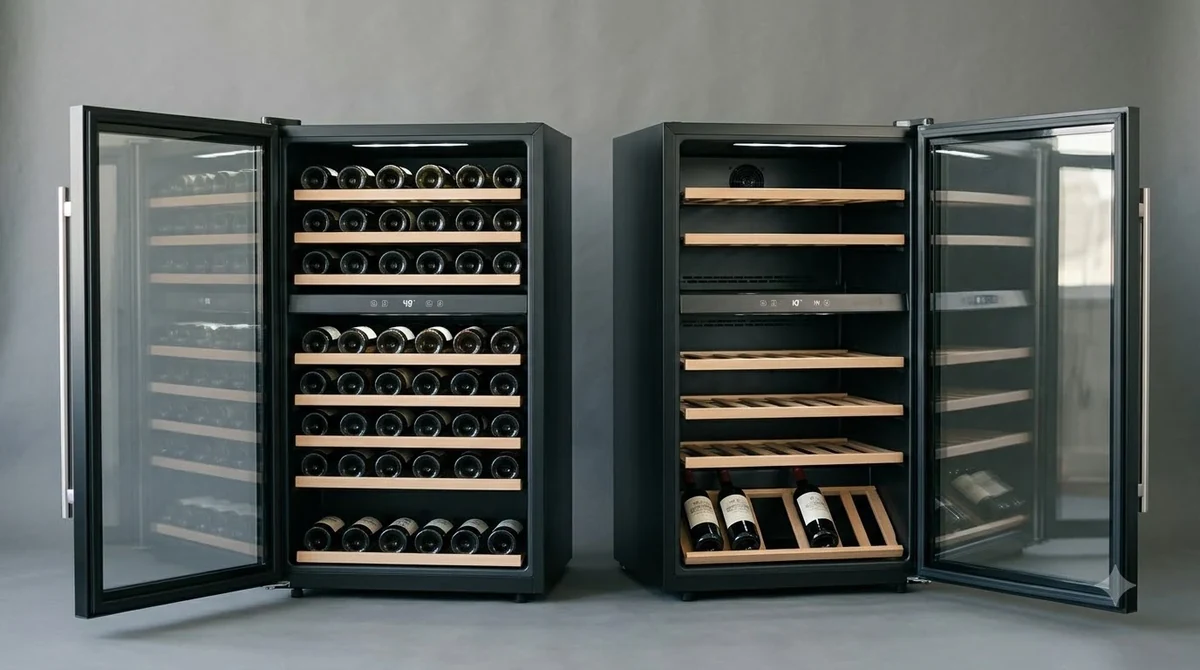
The narrow footprint is one of its most useful characteristics. A refrigerator measuring approximately 14.8 inches wide can fit into spaces that would not accommodate a conventional 24-inch appliance. This makes it worth considering for a kitchen renovation, a compact entertaining area, or a home bar with limited cabinetry.
Temperature flexibility is another frequently appreciated feature. Instead of placing every bottle at the same temperature, owners can organize the collection according to drinking preferences. A bottle of Pinot Grigio can occupy the cooler upper zone while Merlot or Cabernet Sauvignon sits in the warmer lower compartment.
The digital controls also make everyday adjustments relatively straightforward. Push-button controls and a digital display are easier to interpret than a simple mechanical dial, particularly when two compartments have different temperature requirements. The interior lighting provides another convenience because it makes bottle labels easier to identify without relying on external room lighting.
Newair’s adjustable beechwood shelving contributes to the appliance’s wine-focused design. Wooden racks provide a traditional appearance and help separate bottles in an orderly arrangement. Removable shelving can also make it easier to accommodate different storage needs, although removing shelves naturally reduces the number of bottles that fit inside.
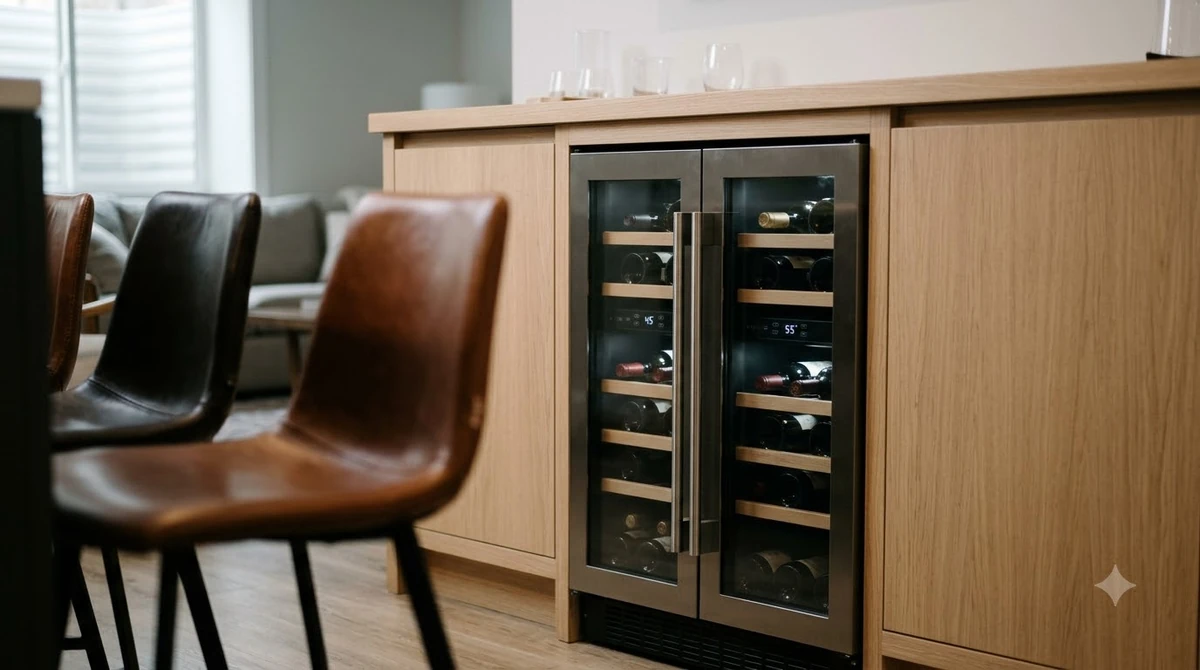
Some owners also appreciate the flexibility of built-in or freestanding placement. The front-venting design is intended to support under-counter installation, while the appliance can also operate as a standalone wine refrigerator when placed appropriately. This gives homeowners more options during a kitchen redesign or home-bar installation.
Customer reviews should still be interpreted carefully. Positive feedback about temperature controls and appearance does not establish that every individual refrigerator will perform identically. Installation conditions, ambient room temperature, how frequently the door is opened, and the shape of the bottles inside can all affect everyday satisfaction.
Common Complaints
The main concerns surrounding the Newair AWR-290DB involve practical bottle capacity, installation details, and reports of cooling or durability problems. These issues do not mean every unit will experience difficulties, but they are important considerations for a relatively specialized kitchen appliance.
The advertised 29-bottle capacity is based on standard bottle dimensions and an organized loading arrangement. Real wine collections are rarely that uniform. Champagne bottles, Burgundy bottles, sparkling wine bottles, and some premium California wines can have wider bodies or longer shapes than conventional Bordeaux bottles.
Consequently, the usable capacity may be lower when a collection includes a variety of bottle formats. Removing a shelf can help accommodate larger bottles, but that reduces the total storage space available. Buyers who regularly purchase sparkling wine or wider Burgundy-style bottles should leave some additional capacity rather than planning around every advertised position.
Installation deserves similar attention. Although the product is designed for built-in placement, the door hinge arrangement may affect access when the refrigerator sits directly beside another cabinet or appliance. A Home Depot customer review specifically mentions difficulty opening the door next to neighboring cabinetry. This is an important reminder that fitting the cabinet into an opening does not automatically guarantee comfortable door movement.
Long-term reliability is another area to investigate. Some customer reports describe refrigerators that stopped cooling properly, while others discuss difficulties with replacement parts and troubleshooting. These reports represent individual experiences rather than a verified failure rate, but they are sufficient reason to review warranty terms and available service options before committing to the purchase.
Temperature performance also requires realistic expectations. A digital setting is not necessarily identical to the actual temperature of every bottle in the compartment. The temperature of the surrounding room, bottle placement, door openings, and cooling cycles can influence conditions inside the refrigerator. For valuable wine collections, an independent refrigerator thermometer can provide additional information about actual storage conditions.
Finally, the AWR-290DB is a dedicated wine refrigerator, not a full-size food refrigerator or freezer. Its purpose is to maintain wine-friendly temperatures rather than provide the extremely cold conditions expected from an ordinary household refrigerator. Buyers looking for a general-purpose beverage cooler may prefer a different Newair configuration.
Who Should Buy and Who Should Skip
The Newair AWR-290DB makes the most sense for households with modest wine collections, limited installation space, and a genuine need for two temperature zones. It is less compelling for collectors who require extensive capacity, extensive bottle-format flexibility, or specialized long-term cellar conditions.
Consider buying it if:
- You own a collection of approximately 15 to 25 standard bottles and want room for occasional additions.
- You regularly drink both red and white wines and prefer keeping them at different serving temperatures.
- Your kitchen has an available opening close to 15 inches wide.
- You want a dedicated wine refrigerator with removable wooden racks and digital controls.
- You prefer a locking door and an interior light for a home bar or entertaining area.
- You are renovating a kitchen and can plan the refrigerator’s ventilation and door clearance before installation.
A smaller collection may actually be a better match than a buyer who intends to fill all 29 advertised positions immediately. Leaving some room between bottles makes it easier to organize different wine styles and retrieve bottles without repeatedly rearranging the shelves.
Skip it if:
- You regularly purchase large quantities of wine and need storage for substantially more than 29 standard bottles.
- Your collection contains many Champagne, Burgundy, or unusually shaped bottles.
- You have an installation opening where the door cannot swing freely.
- You want one appliance to store wine, beer, soft drinks, and other beverages in large quantities.
- You expect cellar-style humidity management or specialist long-term aging controls.
- You are uncomfortable with the possibility of troubleshooting an appliance that has reported service and cooling complaints.
For serious collectors, a larger dual-zone cabinet may be a better investment in practical storage space. A 46-bottle configuration, for example, offers more room for future purchases, although its wider dimensions require a different installation plan. Buyers with very limited floor space may also want to compare compact freestanding refrigerators instead of assuming built-in placement is always the best solution.
The choice should also reflect how wine is consumed. Someone who regularly opens a bottle of white wine for dinner and serves red wine at weekend gatherings can benefit from separate temperature settings. Someone who mostly buys one wine style may have little reason to pay for a dual-zone configuration.
How It Compares to Alternatives
The Newair AWR-290DB competes with larger dual-zone wine refrigerators and combination wine-and-beverage appliances. Its defining advantage is its narrow cabinet, while its principal compromise is limited storage capacity compared with wider models.
Newair’s 46-bottle AWR-460DB is a useful comparison for households with larger collections. That model offers 46 standard bottle positions, a 40°F to 50°F upper-zone range, and a 50°F to 66°F lower-zone range. Its wider cabinet requires considerably more horizontal space than the 14.8-inch-wide AWR-290DB, so it is more appropriate for buyers with a larger installation opening.
For buyers who want wine and cold drinks in one appliance, Newair’s AWB-365DB is another option. It combines separate wine and beverage compartments and is designed to hold up to 20 wine bottles and 78 standard cans. Its wine compartment and beverage compartment offer different temperature requirements, making it more versatile for mixed household use than a wine-only refrigerator.
| Comparison | AWR-290DB | AWR-460DB | AWB-365DB |
|---|---|---|---|
| Primary purpose | Wine storage | Wine storage | Wine and beverages |
| Wine capacity | 29 bottles | 46 bottles | 20 bottles |
| Additional beverage capacity | None specified | None specified | 78 cans |
| Upper or wine-zone range | 40°F–50°F | 40°F–50°F | 40°F–66°F |
| Lower or beverage-zone range | 50°F–66°F | 50°F–66°F | 37°F–66°F |
| Width | 14.8 inches | 23.4 inches | 23 inches |
| Installation style | Built-in or freestanding | Built-in or freestanding | Built-in or freestanding |
The table illustrates why capacity and intended use matter more than simply choosing the largest number. The AWR-290DB is the more space-conscious option for a wine-focused collection. The AWR-460DB offers greater dedicated wine capacity, while the AWB-365DB is more appropriate for households that want chilled cans alongside wine.
There is also a difference between wine storage and beverage chilling. Wine generally benefits from relatively stable temperatures, whereas soft drinks and other beverages may be preferred considerably colder. A combination refrigerator can provide convenience, but its temperature ranges and shelving arrangements should be evaluated according to the drinks being stored.
Buyers comparing different appliances should also investigate installation dimensions, door hinges, rack construction, lighting, and warranty coverage. A larger refrigerator is not automatically better if it cannot fit through the doorway or leaves insufficient clearance for neighboring cabinets.
For additional appliance comparisons, the wine refrigerator model reviews section can help readers assess different storage configurations and features before choosing a unit.
Installation, Temperature Settings, and Everyday Use
Proper installation is essential for getting useful performance from a dual-zone wine refrigerator. The AWR-290DB should be positioned away from direct sunlight and heat-producing appliances, with ventilation openings kept clear according to the manufacturer’s instructions. The Newair AWR-290DB owner’s manual includes the installation, operating, maintenance, and troubleshooting instructions that should guide setup.
Before installation, measure the cabinet opening at several points rather than relying on a single width measurement. Check the available height, depth, electrical outlet position, handle projection, and door-swing clearance. If the appliance will sit beside a dishwasher, oven, or neighboring cabinet, confirm that the door can open sufficiently for normal bottle access.
The manufacturer specifies a 120-volt electrical supply and 90-watt power consumption. The owner’s manual also provides electrical and installation safety instructions. A properly grounded outlet and accessible electrical connection are important considerations, particularly for an under-counter installation.
Choosing useful temperature settings
The upper compartment’s 40°F to 50°F range works well for many whites and sparkling wines. A setting around 45°F to 48°F is a useful starting point for crisp white wines intended for relatively cool service. The lower compartment’s 50°F to 66°F range provides flexibility for reds that are generally served warmer than whites.
Different wines benefit from different serving temperatures. Light-bodied Pinot Noir is often more enjoyable around 55°F to 60°F, while fuller-bodied Cabernet Sauvignon is commonly served around 60°F to 65°F. Chardonnay generally works well around 50°F to 55°F, depending on its style and body.
Remember that storage temperature and serving temperature are related but not identical concepts. A refrigerator can keep wine ready for drinking, but the ideal serving temperature still depends on the bottle. Some fuller reds may need a short period outside the refrigerator before pouring, while delicate whites may benefit from a few minutes of warming in the glass.
Tip: Start with the upper zone around 46°F for everyday white wine and the lower zone around 58°F for lighter reds. Adjust the settings according to the wine styles you drink most frequently, and use a separate thermometer if you want to check actual compartment temperatures.
Organizing the collection
Use the upper compartment for bottles that benefit from cooler serving temperatures, such as Sauvignon Blanc, Pinot Grigio, and sparkling wine. Reserve the lower compartment for lighter reds and fuller-bodied bottles that are more enjoyable slightly warmer. The exact arrangement can change depending on your drinking habits.
For example, a household that frequently serves Chardonnay and Pinot Noir might use the upper section for Chardonnay and the lower section for Pinot Noir. Someone who prefers Riesling and Cabernet Sauvignon could organize the refrigerator differently, keeping the Riesling cooler and the Cabernet warmer.
Do not assume that every wine must remain at its eventual drinking temperature throughout long-term storage. Consistent, moderate conditions are generally more important for wine intended to age. The AWR-290DB is primarily a convenient household wine refrigerator, so collectors with expensive bottles intended for extended aging should consider whether a dedicated cellar appliance is more appropriate.
Its organization can also support entertaining. Keep frequently served bottles in accessible positions and avoid packing the shelves so tightly that removing one bottle disturbs several others. If you regularly serve wine with dinner, having a chilled white and a ready-to-serve red can make hosting easier.
For food pairings, the refrigerator can be useful when preparing a meal such as chicken Marsala. A lighter red or medium-bodied white can complement the savory flavors, depending on the recipe and sauce. Keeping the wine organized by style makes it easier to choose a bottle when dinner is ready.
Cleaning and maintenance
Routine maintenance should follow the manufacturer’s manual. Keep the exterior and interior clean, avoid blocking the ventilation openings, and inspect the door seal periodically. A damaged or dirty seal can interfere with proper closure and contribute to temperature instability.
When cleaning the interior, remove bottles carefully and use an appropriate soft cloth and mild cleaning solution. Avoid abrasive materials that could damage the interior surfaces or finish. Allow the refrigerator to return to its operating conditions before reorganizing the collection.
Pay attention to unusual noises, persistent condensation, or changes in cooling behavior. Compressor refrigerators naturally produce some operating sounds as the cooling system cycles, but a sudden change in sound or a noticeable loss of cooling deserves investigation.
The manual also recommends allowing the appliance to stand upright for approximately two hours before connecting it to a power source after transportation. It specifies a 24-hour stabilization period before use. Following these instructions gives the cooling system time to settle and the interior temperature time to stabilize.
If the refrigerator needs to be moved, consult the owner’s manual for the correct handling procedure. Avoid damaging the electrical cord, door, or cooling system, and allow the appliance to settle appropriately before restarting it after transportation.
Regular maintenance cannot eliminate every potential mechanical problem, but it can help prevent avoidable installation and operating issues. Keeping the manual and purchase documentation accessible will also make warranty or service conversations easier if a problem develops.
Frequently Asked Questions
Does the Newair AWR-290DB have a reversible door?
The manufacturer’s product specifications identify a locking door but do not establish that the door can be reversed. Do not assume the hinge direction can be changed without confirmation from Newair. Check the exact model’s installation documentation before designing cabinetry around an alternative opening direction.
Can the Newair wine fridge store Champagne bottles?
Champagne bottles are generally wider and heavier than standard Bordeaux bottles, so they may not fit in every standard rack position. The advertised capacity is based on standard bottle dimensions rather than every possible wine format. Test the available shelf arrangement before planning to store a large sparkling-wine collection.
Does the Newair AWR-290DB have a humidity-control system?
The published specifications do not identify an independently adjustable humidity-control system. This matters to collectors who prioritize specialized cellar conditions for extended bottle aging. Buyers who require precise humidity management should compare dedicated wine-cellar appliances rather than assuming this compact refrigerator offers that function.
Can the refrigerator be used in an unheated garage?
The AWR-290DB is designed for indoor household use, and its published specifications do not establish suitability for every unheated garage environment. Large ambient temperature changes can affect refrigeration performance. Review the manufacturer’s permitted operating conditions before installing the unit in a garage or other temperature-variable space.
How long should the refrigerator run before it is filled?
The owner’s manual specifies a 24-hour stabilization period before use. Allowing the refrigerator to reach its selected operating temperatures before loading the entire collection is a sensible setup practice. This also provides an opportunity to confirm that both compartments are cooling as expected before valuable bottles are placed inside.
The Newair dual zone wine fridge is an appealing choice for households that need compact, separate storage for red and white wines, particularly when kitchen space is limited. The AWR-290DB offers useful features, but buyers should carefully assess actual bottle requirements, installation clearance, and reliability feedback before purchasing. If its narrow footprint and 29-bottle capacity match your needs, it deserves consideration; if your collection is larger or includes many unusual bottle shapes, a more spacious alternative may be the better long-term choice.
More in Model Reviews
 Magic Chef 44 Bottle Wine Cooler Review for Flexible StorageUpdated Nov 21, 2026
 Whynter 164 Bottle Wine Cooler Review: Capacity, Features, and FitUpdated Nov 21, 2026
 Insignia NS WC16BK6 Review: Compact 16-Bottle Wine StorageUpdated Nov 21, 2026
 Wine Enthusiast Electric Blue Omega Review: Opening, Pouring, and Preserving Made EasierUpdated Nov 21, 2026
 Koolatron 20 Bottle Wine Cooler Review: Features, Fit, and PerformanceUpdated Nov 21, 2026
 NewAir AWC 330E Review for Home Wine StorageUpdated Nov 21, 2026